The Amazing World of M.C. Escher (Modern Two, Edinburgh, 27 June-27 September 2015, Dulwich Picture Gallery, London, 14 October 2015-17 January 2016)
I have three memories.
Viewing an Escher exhibition in Manchester in the mid-1980s.
A family holiday in the Lake District, after the best part of a year spent in Hull, clinging onto the side of a hill with vertigo.
A colleague showing us paintings at the National Gallery and pointing out the Dutch interest in squares.
The first memory is almost certainly false – I suspect the only previous Escher show in the UK I could have seen was at Croydon in the 1990s and I’m pretty sure I didn’t see that, nor when it moved north.
Maurits Cornelis Escher was born in Leeuwarden, Friesland, in 1898, son of a civil engineer, and went to school in Arnhem, which was a dreadful experience. He was a good drawer, but he was initially expected to train as an architect. However, it was speedily agreed that his talents lay in the visual arts. He travelled around Western Europe and, whilst in Italy, met and fell in love with Jetta Umiker. Their parents agreed an allowance for the couple, whilst Escher began a career as an artist specialising in woodcuts.
 In 1922 he designed a grouping of eight heads, “Eight Heads”, which cut be fitted together indefinitely and seems to have been the earlier example of an interest in tessellations. When he was to come to the Alhambra in Granada later that year and admire the Moorish tiles there, it was already part of his set of interests. Over the next five decades he was to play with birds, fish, lizards and all kinds of animals in a series of tessellations.
 But before he developed that theme, he was to work on landscapes, especially those seen on his travels. The Tower of Babel (1928) is a nod to Brueghel, but generates a vertiginous sense in us by depicting it from above. Castrovalva (1930) – a name familiar to me from Doctor Who — depicts a series of buildings, a monastery perhaps, high on a hill, with a village deep below. I suspect that there is a play with vanishing points here, as there is so often, so that the distance is increased in several directions. I cannot help but feel that Escher, as someone from a flat country, would have felt the hills and cliffs of Europe to be steeper than they really are. Indeed, the landscapes that have a real-world counterpart are apparently exaggerated.
 He was to move from the possible to impossible – the fantastical Dream (Mantis Religiosa) (1935) has an ambiguity over whether it is a bishop dreaming he is a praying mantis or a praying mantis dreaming she is a bishop, with an Alhambra palace architecture behind. In a street scene he balances rows of books against buildings, as it transforms into a bedside table. In a mirror, the street outside the room is reflected, but not the room. All of this is rendered in wood cut, occasionally wood print or lithograph, rarely mezzotint.
His work came to the attention of two mathematicians, Coxeter and Penrose. H. S. M. Coxeter, a British-born Canadian, was an expert in geometry and tessellations and was impressed with Escher’s apparently instinctive approach. In correspondence with Escher, he came up with a better way to represent infinitely tessellating fish in a circle – the way you do. Meanwhile Roger Penrose and his father Lionel Penrose were inspired to devise an impossible triangle – which Escher was to use in his endless Waterfall (1961) – and endless stairs – which Escher used in Ascending and Descending (1960). (Penrose’s uncle was Roland Penrose who was husband to photographer Lee Miller and whose library is in Modern Two.)
His work continued to play with perspective, some of it incorporating the staircases and halls from his hated school. A final piece of work was a tangle of snakes and chain, based around the circle motif. By then he was already being subsumed into popular culture – although he said no to Jagger and Kubrick who wanted his services.
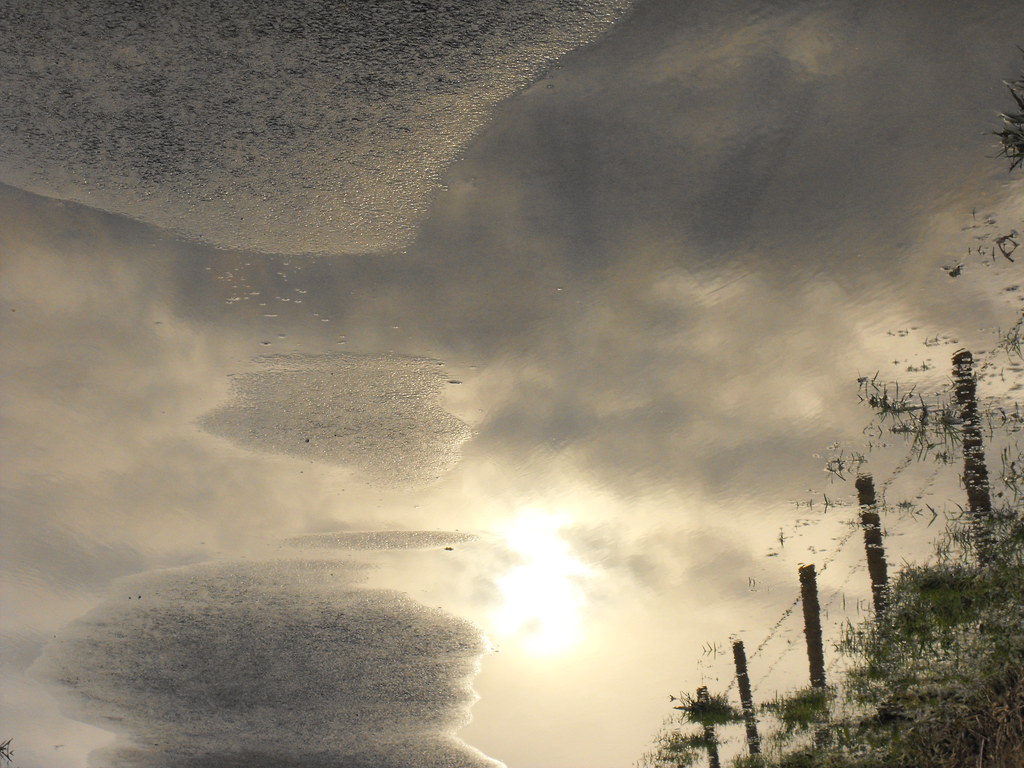
I was suddenly reminded on seeing relatively straightforward work such as Three Worlds (1955), with fish in the water reflecting the sky and trees, how far his play with the play has influenced my own photographic aesthetic. I am a sucker for reflected surfaces.
Apparently there is only one Escher work in a British collection, Night and Day (1938) in the Hunterian, Glasgow, and that only because it interested a geographer. He would seem to be just too popular – and also, one suspects, there is a bias toward oils and watercolours over prints.
So go see Escher in Edinburgh if you can – it may be more convenient for the metropolitans in Dulwich, but I’m not sure they can fit in all the work and Modern Two has a rather more generous scale. I fear it will be heaving.
 I confess I had never heard of Jean-Étienne Liotard. He was born in Geneva in 1702 and began his training there before going to Paris for further training. He then travelled to Naples and Rome in the 1730s, as well as travelling several times to Constantinople. Much of what he did were portraits, both of the famous people he met and of the people who were effectively on a grand tour. Many of them — including himself — dressed up as if they were Turks, in a clear example of orientalism.


 Subject to Change