Unknown's avatar

Posts by flares

I am a critic and researcher of sf, with interests in queer theory, postmodernism, psychoanalysis and other long words. I have various blogs.

Anguished Martian

Agnes Martin (Tate Modern, 3 June–11 October 2015)

In the ongoing round of suppressing women’s writing, so to speak, it is striking how rare a solo-female artist show is in a major institution show. In the moloch of the Tate, things are getting better — there’s the Hepworth show at Britain and the Sonia Delaunay at Modern overlapped with this. I confess to not having heard of Agnes Martin — who I guess historically fits into Abstract Expressionism pigeon hole and was associated with Sol LeWitt and Donald Judd.

Born in Canada in 1912, she moved to Washington to study in 1931 and was influenced by Zen Buddhism scholar D.T. Suzuki. The early work includes various biomorphic forms, dominos, game boards and claws, with Earth colours of brown, yellow, grey and white being prominent. But clearly she was striving toward the square and the grid, with an evident dislike of the curve.

Three years ago, Tate Modern had a Yayoi Kusama, with thousands of spots, apparently symptomatic of her struggle with mental breakdowns and her willingly living in a psychiatric institution. Here we get the square grid as expression of Martin’s schizophrenia.

The obsession, the repetition, the very straight lines.

H’mm. I don’t know. I’m not sure the diagnosis is helpful.

But you can see that she works a very narrow range of variants on the grid and the stripe, the faded deck chair. By the time you get to The Island, a series of white squares with grey lines, the impact is very subtle and yet loud. It invokes eastern formlessness, apparently, but that again is a tad essentialist.

Holiday

The later paintings of black rhomboids on grey fields are positively excessive by comparison.

I’m not sure that at the end of the day I was hugely impressed by her. Certainly I’m glad to have made her acquaintance, so to speak, and it’s always useful to get a wider sense of a period of art. But it didn’t feel, alas, like coming across a long lost friend.

I ATEN’T DED

The Ecstasy of Wilko Johnson (Julien Temple, 2015)

It’s a long time since Earthgirls are Easy (Julien Temple, 1988), a valley girl sf satire with roles for Geena Davis, Jeff Goldblum and (a heavily-furred) Jim Carrey that is great fun in memory and yet sank at the time. This was Temple’s penance for sinking the British film industry with Absolute Beginners (1986). And he is is, doing television documentaries that get a cinema release.

Of course, that’s misleading. His heart’s clearly always been in documentary — The Great Rock ‘n’ Roll Swindle (1988) as one take on the Sex Pistols and The Filth and the Fury (2000) as another. His films Ray Davies: Imaginary Man (2010) and Rio 50 Degrees: Carry on CaRIOca! (2014) were part of Botney’s Imag!ne strand on the BBC, and The Ecstasy has a producer credit for Alan Yentob. (And, music aside, Requiem for Detroit? (2008) was a great piece of work.)

So, Wilko Johnson is a … rhythm and blues guitarist, in 1971 a founder member of Dr. Feelgood and associated with a range of musicians from or near Canvey Island, Essex. I will have heard his stuff, although not knowingly and I frankly cannot name a single track by the band. I’m either too old or too young and prog-rock of the Yes/Floyd ilk is what I listen to from that period.

I have no musical taste. But it’s my no musical taste. Get over it.

So any way, he was still going and still playing and in January 2013 he was diagnosed with inoperable, late stage pancreatic cancer and opted not to go through chemotherapy. The diagnosis was the making of him — there’s that classic interview between Dennis Potter and Lord Bragg of South Bank where the former discusses the blossom outside his window and the world and senses come alive. Wilko is saturated in Romantic poetry (and Shakespeare and Icelandic sagas and … studied a degree in English Literature and taught for a year) and has clearly had a Blakean epiphany. At one point he mentions LSD trips — but this clearly felt more vivid.

Temple had already interviewed him for Oil City Confidential (2009), a documentary on Dr Feelgood, so it seemed natural to go back. There was a great interview between Wilko and John Wilson — for Kaleidoscope Front Row? — and so he had proven he could talk feelingly about his own life, and not be maudlin or angry or depressing. Pretty well the only other voice here is Roger Daltrey, whom Wilko made an album with when he thought he was too ill to tour — oh, and a clip or two from Wilson and BBC news presenters.

It would make a great radio interview.

But this is a film — and I guess there aren’t enough bits of footage or archive photographs to eek out the talking head. The conceit of him playing chess against Death is appropriate — and Temple intercuts bits of Det Sjunde Inseglet (The Seventh Seal (Ingmar Bergman, 1957)) to help us. His taste for Shakespeare mean he can quote Hamlet (and Temple can intercut footage of a film of the play — I *think* Richard Burton’s), although it’s less clear if he knows that famous soliloquy is about suicide not just death. Then there’s A Matter of Life and Death (Michael Powell and Emeric Pressburger, 1946), a classic film about an airman’s near-death experience, which obvious offers a chance for A Canterbury Tale (Michael Powell and Emeric Pressburger, 1944) for a rather more Kentish (and Canterbury Sound) take on neo-romantic landscape. Oh, and Nosferatu and La Belle et la Bête (Beauty and the Beast (Jean Cocteau, 1946)) and … Stalker (Andrei Tarkovsky, 1979). And something Italian with books and chickens.

Temple’s own footage, when he’s not content to film Wilko in a landscape is ploddinly literal — growing/decaying plants, sands in a timer, stars rotating around sky, time-lapsed.

EVERY THING ENDS.

Although, of course, spoilers.

A photographer and oncologist Charlie Chan saw Wilko and though, that doesn’t look like that kind of tumour. You need a second opinion.

So now we have a Wilko very much in recovery — but frankly more depressed than when he thought he was going to die.

Don’t go to this expecting to get a sense of what Dr Feelgood was — I guess you need the other film for that — but try and edit out the frankly sub-Jarman visuals in favour of one of those great English musical characters who is still very much alive.

Death of a Maître d

Mistress America (Noah Baumbach, 2015)

The central sequence of this film feels like a stage play: Brooke (Greta Gerwig) wants to open her dream restaurant in New York but is several thousand short, so has travelled to Greenwich, Connecticut (screwball comedy central) to borrow the money from her nemesis Mamie-Claire (Heather Lind) who had previous stolen her best idea for a tshirt, her kittens and her fiancé Dylan (Michael Chernus). She has been driven there by Harold (Matthew Shear), friend of her soon to be step-sister Tracy Fishko (Lola Kirke) and Harold’s girlfriend Nicolette (Jasmine Cephas Jones).

Brooke is a dreamer, probably self deluded, the kind of role that a Ricky Gervais or a Ben Stiller or a Jim Carey would play at any opportunity — a motor mouth, turning on a sixpence, full of how great they are and how dreadful others are. It’s rare that it’s a female character, although it clearly offers a version of the unruly woman. It’s a twenty or thirty year younger version of Edina and Patsy. Her dream of a restaurant, Mom’s, where you could get a hair cut and would be a shop in the day and where her children when she has them would do their homework, needs money, but we go through various shades of farce as she attempts to get it — foiled by a pregnant lawyer at Maire-Claire’s bookclub, a snide neighbour and Nicolette’s jealousy of Tracy.

Tracy is meant to be the viewpoint character — in her first term at a swanky New York university, wanting to be a writer and to join the university’s fraternity (of writers) and the Nick to Brooke’s Gatsby or the I to her Withnail. Tracy has stolen Brooke’s character for her latest fiction, something that will lead to friction. She is dull of course, but we should luxuriate in a rare example of a movie built around female friendships. There is a minor drama around how far she will become like Brooke, but there’s more of a sense that she can see through her whilst wanted to give support.

Your liking of the film will depend on your liking for cringe comedy — think of the embarrassments of Basil Fawlty, David Brent and (restaurant investor) Larry David. At times it’s nails on a blackboard, fingers on a balloon, laughing bat rather than with. But it also has that awkwardness of Willy Loman in Death of a Salesman, the tragic hero of the American Dream, who believes the tales he spins because to sell objects requires commodifying the seller. You can see straight through him and yet don’t want him to fail.

It is surely no accident that the film is Mistress America: Brooke becomes the personification of the American Dream that anyone can make it. She’s brash, self-deluded, yes, but also determined and ambitious. We don’t have to like her — but I think we can respect her.

Meanwhile, how does the film fit into the history of the bizarre post-apocalyptic depictions of New York in which all People of Colour have been wiped out? Well, Brooke has an African American neighbour, there’s the pregnant lawyer in Connecticut and, of course, Nicolette, whose jealousy reminds me of Angela (Jaz Sinclair) in Paper Towns. Is the indie-flavoured young female of colour there to be insecure or clingy? I hope not, but it’s just a sample of two.

All in all, an interesting film, although I can’t say I laughed out loud more than once or twice. But Baumbach and Gerwig, cowriters here, have plainly hit a groove that will be interesting to follow (and I should look up Frances Ha (Noah Baumbach, 2012), which is clearly on a similar theme).

Be Careful Out There

Precinct Seven Five (Tiller Russell, 2014)

We’re used from television programmes such as NYPD Blue and The Wire to the complex interrelations between cops, criminals, politicians and victims and the shades of moral greyness that are faced in policing the streets. Our news of the last couple of years has been filled with dubious shootings of African Americans — not that this is a new phenomena. And despite the fact that particular police forces are clearly — in Stokely Carmichael and Charles V. Hamilton’s term — institutionally racist, we keep ending up with the one bad apple alibi.

This account of New York police corruption in the late 1980s and early 1990s is a documentary, although you can imagine Al Pacino and Joe Pesci and Robert De Niro playing the roles and the DEA guy is a double for J.K. Simmons. Thus it is mostly talking heads — with only one of the speakers shown in silhouette, one of the New York dealers — along with police evidence video, grainy reconstruction, archive photos and the inevitable skycam view of the streets.

But it begins with former policeman Michael Dowd giving evidence to some kind of enquiry and is taken up in talking heads. There had already been corruption in a nearby Brooklyn precinct, and several cops had resigned lest they be exposed too. Dowd, having reflected on the cynicism with which their ethical training was treated, began his shadow career by asking for a bribe rather than arresting a criminal and then started lifting cash from crime scenes. Soon he recruited his partner, Kenny Eurell, by giving him a hundred dollar bill from a crack dealer. Dowd appears the most dynamic of the speakers, the camera moves with him rather than staying locked off and it is clear there is next to no remorse.

We’re talked through his career — the bribes and thefts proceed to a working relationship with a local king pin to arresting the competition to a potential kidnapping of a debtor’s wife. The amounts of money involved are clearly vast — hundreds of thousands a week, devastating hundreds if not thousands of lives. The Dominican kingpin clearly admired Dowd, but still thought of Eurell as a cop and not up to it. (Meanwhile: cast Jared Leto?)

And inevitably it comes crashing down — we see his testimony — and we might reassure ourselves that criminals will not prosper. Dowd served his sentence. Only one female voice is heard — Eurell’s wife — and none of the consumers of crack. What is striking is that the real emotions come when you see Dowd and Eurell’s discussion of their feelings for each other — textbook homosociality. Clearly a cop’s partner is a blood brother, indeed when they discuss becoming partners you expect there to be a swapping of blood. You have to have each others’ back. You have to trust the other person won’t betray you.

And you get the sense that Dowd doesn’t regret a single moment of his career — only the betrayal.

The Man from Unclever

The Man from Unclever (Guy Ritchie, 2015)

There was a moment part way through The Man from U.N.C.L.E. when Morricone music swells on the soundtrack and I thought Quentin Tarantino does repeat himself. It’s Inglourious Basterds (2009) all over again.

Then I realised it was a Guy Ritchie film.

Still, Tarantino had been down to direct (and you can see why), but he did Jackie Brown (1997) instead, I suspect his best film. Soderbergh, too, but he did enough already with the Oceans sequence (and I like Soderbergh).

I remember liking Ritchie’s work very briefly because Lock, Stick and Two Smoking Barrels (1998) because it wasn’t Merchant fucking Ivory – but then we got a spew of London gangster movies which were clearly mockney heritage, mocknerage if you will. I saw Sherlock (2009) much against my better judgement and knowledge of London geography, and it at least scores over other versions by not being created by Moffatt.

So thirteen versions of the script in, we get American art thief and reluctant agent Napoleon Solo (Henry Cavill) sent to help Gabby Teller (Alicia Vikander) escape from Cold War Berlin – only Soviet agent Illya Kuryakin (Armie Hammer) is there to prevent him. Solo succeeds, or we wouldn’t have a film, only to find his new mission is to help her find her father because of, yanno, uranium bomb and has been given Kuryakin as a partner to help. So, it becomes a parable of détente – or it would do if it put a tenth as much of its channelling the 1960s-as-GQ fashion photo shoot.

Cavill’s Solo is no whatisname from The Thomas Crown Affair, he’s not even Lovejoy, although he’s looking like Connery-era Bond undercover with Don Draper. His delivery is so mannered that it’s a wonder he can maintain the accent – utterly baffling. Hammer has his moments, but he also has an unreconstructed pre-feminism masculinity to him that is uncomfortable to like. He also has to do Incredible Hulk impressions (although he never tells us not to make him angry). Kuryakin’s playing of chess reminds me that the film is partly dependent on the kind of plotting that I’ve most recently seen in Spooks: The Greater Good (Bharat Nalluri, 2015), where the protagonist can predict what his opponent will do twenty minutes ahead of him.

And then, at the end, you realise that the whole film is an origin myth, the killing of the Waynes, the biting of the spider, because God forbid we begin in media res. I do remember watching the original television series – and have a faint sense of a crush on one of the leading characters although I forget who – but to be honest I have no memory of the series itself. The point of the film is to get Solo and Kuryakin into U.N.C.L.E. – explaining the broken-backed narrative that is typical of the first film in most superhero franchises: acquire power, acquire vocation. The sequel will no doubt include two villains and the threequel will have them fighting their doubles.

All of this is to damn the film – which is just so by the numbers dull. You can see the Bond and the Harry Palmer bits and the Steve McQueen of The Great Escape and whatisname from Thomas Crown and moments of early Paul Newman and even The Italian Job without the minis or Benny Hill or Noel Coward. And those are all much better films.

The oddest thing is that the film is largely stolen by Hugh Grant and the thought that a spin-off with him might be more fun.

(It could have been worse. It could have been Tom Cruise as Henry Cavill.)

Paper Chase

Paper Towns (Jake Schreier, 2015)

I’m pretty sure there are a couple of moments in Philip K. Dick novels – Time Out of Joint? Voices from the Street? – when a character looks at their world and thinks it’s all paper. Or at the very least a stage set. That idea is here in a speech given to Margo Roth Spiegelman (Cara Delevingne) in this YA film, looking over Orlando from the top of a skyscraper. She also appears to be a bit of a Dickian anima sprite, there to bring some excitement to the middle-aged protagonist.

Except that the protagonist is here a teen, Quentin or Q (Nat Wolff), best friends forever with fellow geeks or nerds Ben (Austin Abrams) and Radar (Justice Smith), all of whom are prematurely middle-aged. Well, apart from Ben, who is turned on by any woman he knows, including Q’s mother.

Maybe that is also middle aged.

Q and Margo are neighbours, once inseparable, but grown apart through high school, until one night she calls upon him to help her commit nine acts of revenge. I didn’t quite count nine, so perhaps there’s stuff we didn’t see, but it brings Q alive at last. But then Margo vanishes – leaving Q clues to find her with. He has a choice – go to the prom, graduate, go to university, graduate, becomes a doctor, get married, have kids and be happy or find Margo. You can imagine the choice he makes.

I’ve got a copy of The Fault in Our Stars (2012), which has also been filmed and is also written by John Green, but I’ve yet to read it. I should remedy this. This is one of those films that is cleverly structured to undermine your objections to it. Isn’t she a little too idolised? Check. Isn’t it a little too convenient? Check. If he gets the girl, then it’s a rather trivial film with the female as impossible yet winnable love object, with the emphasis on object. If she rejects him, is that any better? And I guess since Galaxy Quest, nerds winning has been a thing – and you could imagine Justin Long of that film and several dozen TV classics in two of the central roles. Actually, its pedigree probably includes The Sure Thing.

Radar’s character occasionally risks stealing the movie with his parents’ collection of Black Santas (an attempt to get into The Guinness Book of World Records) and the moment when he is given a heritage-not-hate t-shirt (a detail that presumably became ultra-satirical since the movie was made).

What makes me resist the film a little, however, is the first person narration. Yes, there are a couple of scenes that Q isn’t in so I quibble a bit at that, but mainly I’ve a sense of being told not shown. In a film such as Stand By Me (Rob Reiner, 1986), there is a distinct age difference between the narrating self and the narrated self – which can bring pathos or irony or nostalgia according to taste – but here I felt I was being instructed. The director or script writer didn’t trust us and that’s a shame.

Sickert to ’em (Down, Down, Diepper and Down)

Sickert in Dieppe (Pallant House, Chichester, 4 July—4 October 2015)

So, in my head, I get him mixed up with James Whistler. Or possibly John Singer Sargent. He’s the one that Stephen Knight and Patricia Cornwell reckon to be Jack the Ripper. Whatever. So, he’s born in Munich in 1860, son and grandson of an artist, who initially wanted to be an actor in London, but became a pupil of Whistler (ha!). In 1883 he went to Paris and met Edgar Degas – whose paintings and sculptures include dancers – and learned from him about impressionism. Oddly, he seems to have learned to avoid all the en pleine air nonsense and was advised to make drawings and work in a studio. Splendid. Back in London, he started making pictures of music halls. Splendid. Later he was to become part of the Camden Town group.

He was described as flamboyant and bohemian — and the portraits and photos endorse this. He’d later hang out with Audrey Beardsley and give him a painting lesson. And so it is somewhat of a surprise to me that he first came to Dieppe on his honeymoon with Ellen Cobden (daughter of the anti-Corn Law guy) in 1885. Dieppe was a fashionable seaside resort, increasingly popular with the Bohemian fraternity, and initially Sickert produced seascapes, on small oak panels, before focusing more on architecture. Whilst apparently he had been more interested in portraiture in Britain, now he moved to landscapes. Having spent a number of “seasons” in Dieppe (alongside a trip to Venice), he settled there as his marriage disintegrated and before his divorce was finalised. He found a mistress, Augustine Villain, and lived in the harbour area for a period. In 1912 he bought a house in the Dieppe countryside, with his second wife Christine Angus, but was forced back into town by the outbreak of war. Having returned to England, it was not until 1919 that he got back to Dieppe, but within a couple of years Christine died of tuberculosis. Degas worked once more on the seafront also sketched then painted people at the casino. There were also a series of dark pictures of figures in bedrooms – probably alluding to the Camden Town murder.

The paintings are mostly street scenes – the Hôtel Royal, the Rue Notre Dame, the church of St. Jacques and the statue of Admiral Duquesne – and the tone is overall rather brown and muddy. Wendy Baron writes: “His main harmony was generally based on hardly more than two colours corresponding to the dark and midtones, with the addition of creamy buff for the lights [… h]e often used blue-black with brown or mauve.” (69). Four commissioned landscapes intended for a restaurant – but rejected by the owner – seem to distill this and you face one of these as you enter the exhibition. There is clearly the essence of Impressionism here, with wet paint applied on wet paint in layers, but you get the sense that it is planned to appear improvised. There are various squared drawings and canvases that show the careful recording of buildings, which then can be painted back in any of his several studios.

I’m pleased I saw this exhibition – on a day I’d anticipated that I’d actually be in Brighton and after a journey from hell – but I can’t say I warmed to him. He was described as “the Canaletto of Dieppe” – and of course his time there included him working on canvases imagined in Venice. There is a sense of the mysterious to some of the pictures, and the moral commentary that may be in the late casino paintings. There’s a room of painters influenced by Sickert that’s also worth a look – and elsewhere a fascinating if largely black and white collection “St. Ives and British Modernism”, the George and Ann Dannatt Collection.

I can’t help but share a (paraphrased) comment from George Dannatt: “The objection to this art is often that ‘My child can do it’. So give it to a child. The answer is often silence.”

Bibliography

  • Wendy Baron, Sickert (London: Phaidon Press, 1973).

The Enlightenment Condition

Jean-Étienne Liotard National Gallery of Scotland, 4 July-13 September 2015, Royal Academy of Arts, 24 October 2015-31 January 2016)

I confess I had never heard of Jean-Étienne Liotard. He was born in Geneva in 1702 and began his training there before going to Paris for further training. He then travelled to Naples and Rome in the 1730s, as well as travelling several times to Constantinople. Much of what he did were portraits, both of the famous people he met and of the people who were effectively on a grand tour. Many of them — including himself — dressed up as if they were Turks, in a clear example of orientalism.

Back in Western Europe, he was much in demand oas a portraitist of the royals families in Vienna, Paris and London, sometimes in oil, sometimes in pastels. Supposedly they are more relaxed and intimate than the typical royal portraits — he had an incredulity to court formality. His depiction of hands is striking — so to speak — or of fingers, almost as if he was showing off. He was very open to making money from his work through mezzotints and engravings. He also painted many self portraits and pictures of his family (it would have been helpful to have these by the side of some of the royal portraits on show at The Queen’s Gallery, Holyrood).

I was slightly confused by the chronology of the exhibition — are the royal and society portraits (actors, actresses) not later than the pictures of Constantinople? Still, the incredible trompe l’oieil of the paintings in the third room are worth seeing last.

I was, naturally, struck by the picture of Count Jean Diodati at his villa c.1762-70; just over forty years later this was to be the birthplace of Frankenstein.

Not the Town in Surrey

The Amazing World of M.C. Escher (Modern Two, Edinburgh, 27 June-27 September 2015, Dulwich Picture Gallery, London, 14 October 2015-17 January 2016)

I have three memories.

Viewing an Escher exhibition in Manchester in the mid-1980s.

A family holiday in the Lake District, after the best part of a year spent in Hull, clinging onto the side of a hill with vertigo.

A colleague showing us paintings at the National Gallery and pointing out the Dutch interest in squares.

The first memory is almost certainly false – I suspect the only previous Escher show in the UK I could have seen was at Croydon in the 1990s and I’m pretty sure I didn’t see that, nor when it moved north.

Maurits Cornelis Escher was born in Leeuwarden, Friesland, in 1898, son of a civil engineer, and went to school in Arnhem, which was a dreadful experience. He was a good drawer, but he was initially expected to train as an architect. However, it was speedily agreed that his talents lay in the visual arts. He travelled around Western Europe and, whilst in Italy, met and fell in love with Jetta Umiker. Their parents agreed an allowance for the couple, whilst Escher began a career as an artist specialising in woodcuts.

In 1922 he designed a grouping of eight heads, “Eight Heads”, which cut be fitted together indefinitely and seems to have been the earlier example of an interest in tessellations. When he was to come to the Alhambra in Granada later that year and admire the Moorish tiles there, it was already part of his set of interests. Over the next five decades he was to play with birds, fish, lizards and all kinds of animals in a series of tessellations.

But before he developed that theme, he was to work on landscapes, especially those seen on his travels. The Tower of Babel (1928) is a nod to Brueghel, but generates a vertiginous sense in us by depicting it from above. Castrovalva (1930) – a name familiar to me from Doctor Who — depicts a series of buildings, a monastery perhaps, high on a hill, with a village deep below. I suspect that there is a play with vanishing points here, as there is so often, so that the distance is increased in several directions. I cannot help but feel that Escher, as someone from a flat country, would have felt the hills and cliffs of Europe to be steeper than they really are. Indeed, the landscapes that have a real-world counterpart are apparently exaggerated.

He was to move from the possible to impossible – the fantastical Dream (Mantis Religiosa) (1935) has an ambiguity over whether it is a bishop dreaming he is a praying mantis or a praying mantis dreaming she is a bishop, with an Alhambra palace architecture behind. In a street scene he balances rows of books against buildings, as it transforms into a bedside table. In a mirror, the street outside the room is reflected, but not the room. All of this is rendered in wood cut, occasionally wood print or lithograph, rarely mezzotint.

His work came to the attention of two mathematicians, Coxeter and Penrose. H. S. M. Coxeter, a British-born Canadian, was an expert in geometry and tessellations and was impressed with Escher’s apparently instinctive approach. In correspondence with Escher, he came up with a better way to represent infinitely tessellating fish in a circle – the way you do. Meanwhile Roger Penrose and his father Lionel Penrose were inspired to devise an impossible triangle – which Escher was to use in his endless Waterfall (1961) – and endless stairs – which Escher used in Ascending and Descending (1960). (Penrose’s uncle was Roland Penrose who was husband to photographer Lee Miller and whose library is in Modern Two.)

His work continued to play with perspective, some of it incorporating the staircases and halls from his hated school. A final piece of work was a tangle of snakes and chain, based around the circle motif. By then he was already being subsumed into popular culture – although he said no to Jagger and Kubrick who wanted his services.

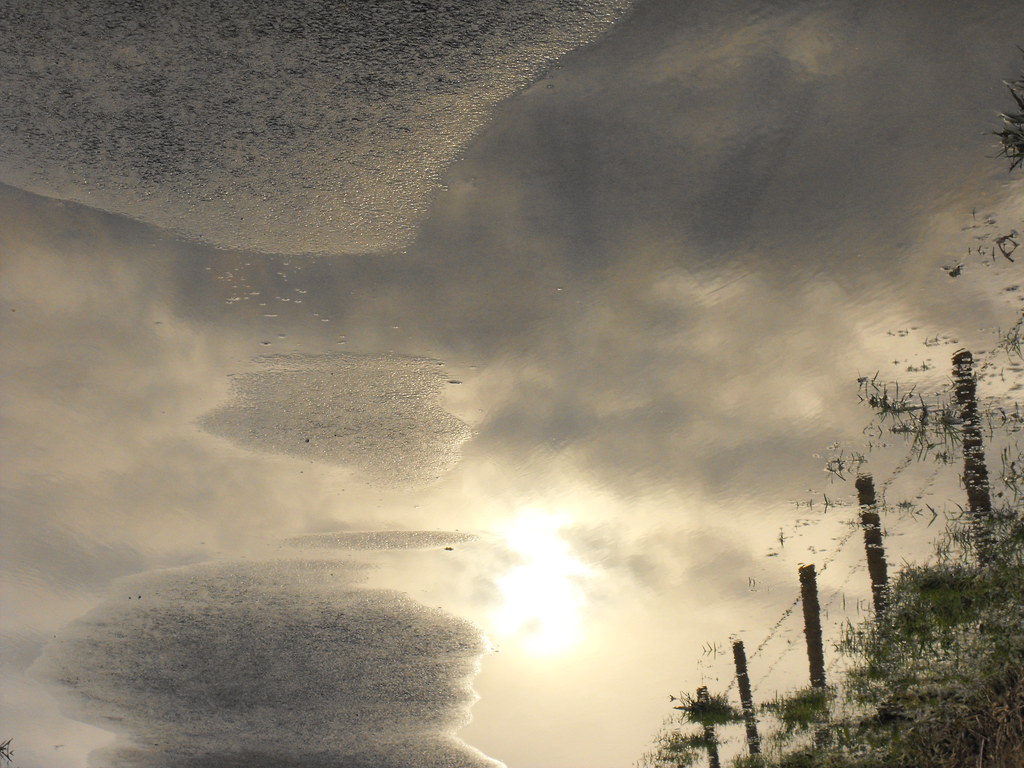
I was suddenly reminded on seeing relatively straightforward work such as Three Worlds (1955), with fish in the water reflecting the sky and trees, how far his play with the play has influenced my own photographic aesthetic. I am a sucker for reflected surfaces.
Elements
Apparently there is only one Escher work in a British collection, Night and Day (1938) in the Hunterian, Glasgow, and that only because it interested a geographer. He would seem to be just too popular – and also, one suspects, there is a bias toward oils and watercolours over prints.

So go see Escher in Edinburgh if you can – it may be more convenient for the metropolitans in Dulwich, but I’m not sure they can fit in all the work and Modern Two has a rather more generous scale. I fear it will be heaving.

My Darling Caro

Caro in Yorkshire (Yorkshire Sculpture Park, 18 July-1 November 2015)
Caro in Yorkshire (The Hepworth Wakefield, 18 July-1 November 2015)


As far as I can see, twentieth-century British sculpture was dominated by Barbara Hepworth and Henry Moore and, whilst you would be unlikely to mistake the two, there is a sense of continuity. Both are very organic in form and were committed to sculpture in public spaces. Whilst both did work in bronze and other metals, there is a background in manual carving in wood, marble and so on. The aura of the handcrafted. Bronze, on the other hand, usually requires a foundry and experts in metal.

Since the late 1960s there has been the more conceptual — walk as sculpture, glass of water on shelf as sculpture (of a tree).

Before this, however, there was Anthony Caro (1924-2013), a generation younger than Moore — and one of his studio assistants. Caro’s early works would involve a hands on roach — lumpy bronzes, a twisted human form and drawings or painting that seem to me reminiscent of Henri Gaudier-Brzeska. But a trip to the USA in 1959 sent him down a more industrial route — large pieces of metal welded together. Whilst he was to play with bronzed surfaces — rusted, waxed and so forth — the break through works were painted in a limited range of colours.

Caro’s work in sculpture brings together painting and architecture, pushing the boundaries. Being metal, being forged, they are clearly solid and heavy, but at the same time they are often suspended or balanced, seemingly lightweight. “They’ve got an inside but they’ve got no centre,” he said of them. His Table Pieces are often suspended on the edge of tables or shelves, and presumably have a very carefully placed centre of gravity.

What he is also credited with is the disappearance of the plinth. I have a few thoughts about this to follow up, but once a huge lump of metal is placed upon the ground, the frame between world and art is wafer thin. From this comes the possibility of the texture in the grass or a pile of aggregates. Some of the work looks like a climbing frame or an adventure playground — if the Hepworth and Moore sculptures demand to be felt, than these demand to be climbed. In some cases, the sculptures offer a kind of Wendy house, but mostly there are attendants to stop you.

Across one hillside at the Yorkshire Sculpture Park there are a range of different bronzes — curves and planes, verticals and horizontals, holes and towers. Across the other side of the site are the early works, preparatory drawings (and you can see he draws figures like Moore), as well as works from across nearly fifty years. Alongside steel and bronze there is also the use of Perspex — apparently glass turned out to be unwieldy. He also sculpted in paper and plaster imitations of paper. Meanwhile the works at the Hepworth cover the period from the 1960s to his death.


I didn’t take a note of the architect, but for a period he tried to codesign a tower; unable to find the funding or whatever, he appropriated the shape as sculpture but turned it upside down. At this point I was reminded of the work of Eduardo Paolozzi, and the mosaic of machinery he explored.

I liked these works more than I expected to — there is an aesthetic to them that is pleasing as they balance the solid and the ethereal. There is space and nonspace. And whilst this may end up disappearing the artist, there’s an infection of the real world as art — the scaffolding becomes installation (indeed, Cedric Christie and others have made sculpture from scaffold poles).

All photos here