Unknown's avatar

Posts by flares

I am a critic and researcher of sf, with interests in queer theory, postmodernism, psychoanalysis and other long words. I have various blogs.

Cogito Ego Operor

So… a couple of days ago I was going through the draft sent emails having realised I’d sent an important email to myself and wondering what else was stuck in the outbox. I found a message about a call for papers that I’d tried to send to myself but had somehow failed.

Doh!

I reread it, thinking, interesting, but who has the time? I forwarded it to a grad student, thinking it might be his mug of Earl Grey.

I looked again — abstract by then, chapters by then, neatly bracketing the autumn term. That’s going to be my heavy term.

Who has the time?

And there I left it, and there was no more, until I was thinking about a book I really have to read Real Soon Now to apply to the Sekrit TTTTTTTT Projekt (or at least the proposal).

A project which overlaps with the Call for Papers.

Uh huh.

I don’t have the time this autumn, but perhaps I should make a start this summer and that’ll have materials that can fit the Sekrit TTTTTTTT Projekt. And again I’m struck how often I chistel away at the block of marble to find the statue rather than build a statue from chickenwire and papier-mâché.

Manifest Pollocks

Blind Spots: Jackson Pollock (Tate Liverpool, 1 July 2015-17 October 2015)

Jackson Pollock was born in 1912 in Cody, Wyoming, but grew up in Arizona and California. Having gone to art school (and been expelled), he became an artist for the Federal Work Program. His big stylistic breakthrough was the all-over drip painting, although pouring might be a better word. The whole canvas is covered by oil or thinned enamel paint dripped from brushes or syringes; in most cases the paint over lies and is overlain with other paint, in some cases the canvas is visible.

Pollock was slotted into the abstract expressionism category — abstract because it wasn’t figurative, expressionist because he was expressing his feelings and emotions on the canvas. This wasn’t necessarily a term he liked and I will come back to it. Pollock was an alcoholic and went through Jungian psychoanalysis to attempt to cure this — the assumption is that his art can be understood in Jungian terms, presumably expressing a nonindividuated ego and archetypes. Early paintings had Greek mythic titles and he is also assumed to be drawing in an interest in Native American art.

I hope to return to this but I’m troubled — action painting gives access to the unconscious and more primitive stares of mind, such as that of the Native American.

Koffs.

Really?

In 1951, after a less successful exhibition of the kind of paintings we know Pollock for, he took a change in direction: the black paintings. These were largely blank canvases with thinned black enamel dribbled on them — sometimes calligraphy, sometimes faces, sometimes scribbles — and it is this set of paintings that becomes central to Blind Spots, the current exhibition. Whilst they’ve never been entirely ignored, they have been downplayed.

Pollock wasn’t the first to paint in black — Malevich’s black squares have been seen at at least two British shows in the last year, at Tate Modern and the Whitechapel. Willem de Kooning had a black and white painting, coincidentally also in the Tate at the moment. But Pollock painted just in black.

I was worried — I prefer twentieth to pre-twentieth-century art, but I don’t like all abstract art. I was worried that I’d be wasting my time seeing this, even though I prepared by reading three or four books on Pollock. Pollock is the epitome of the “My six year old can paint like that” school of art criticism; it’s said of Picasso, too. And bollocks. But I wasn’t sure I’d get it.

I don’t pretend this to be profound, but it struck me that there is an opposition between figurative and abstract, figure and ground, paint and canvas and so on. Paint is applied in layers — in three dimensions, however trivially, as new paint obscures old.

If abstract expressionism gives us access to the unconscious, how do we know it’s the artist’s unconscious rather than our own? Does that matter?

Of course, schooled in deconstruction, you’d expect me to pick away at the oppositions.

There are specks rather than spots in this exhibition — but blind spots are the part of your eye where the nerve and exits and lacks rods and cones, there the bit that wing mirrors can’t pick out (Pollock died in a car crash) and blind spots are the things critucs overlook. But there was for me a misprison — I thought of Paul de Man’s Blindness and Insight, the blind spot of a text or of the critic’s reading of it.

Hmmm.

At the start of the exhibition is a found collotype of a mother and child, mostly obscured in black ink.

Obscure vs. reveal. Mask vs. unmask.

The mother and child is a key trope — archetype of — of the history of art. The Madonna and Child. This is clearly a pop art version, but we need to keep an eye out for this in the exhibition. Pollock’s mother and Pollock? Maybe. Is the black ink covering them up or revealing them? It certainly draws attention — you look harder.

The idea of looking is set up for us in the first picture of the show. It is the keynote.

(To be continued…)

When We Were Very Young

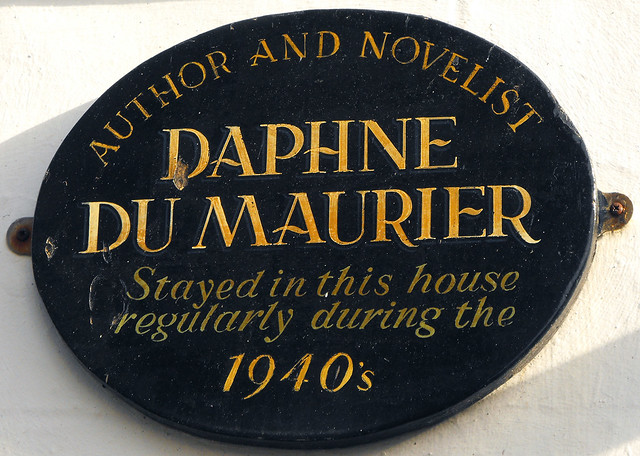
For reasons that escape me, a number of years ago I bought a boxset of Daphne Du Maurier novels. I must have thought this was good plan, because I then bought a second, and a couple of novels not included in either. I also bought the collection which contains the story that was the basis for ‘Don’t Look Now’. The most Hitchcockian of novelists – with perhaps the thought that Du Maurier was a Cornish Patricia Highsmith. The grand plan, being anal, was to read the novels in chronological order of publication, but that never happened and the boxes sat by my bed, gathering dust. So I picked another one at random. Du Maurier Plaque

Daphne du Maurier, I’ll Never Be Young Again (1932)

I’ll Never Be Young Again is very much a book of two halves. In the first, Call-Me-Dick is about to throw himself into the Thames, having been estranged from his Famous Author Father for writing pornographic poetry. For the sake of the first person narration, he is rescued by Jake, a young man recently released from jail having served a sentence for manslaughter. The two decide to go to Scandinavia — partly working their passage, partly tourists. Call-Me-Dick is plainly a dick, he being miserable and contrariwise half the time and it’s a wonder that Jake doesn’t drop him in the nearest fjord at the fjirst opportunity.

In the second half, he settles in Paris, initially adrift, sacked from job after job, pretending to be a writer, and set up at first by selling his rights to the pornographic poems. Think Henry Miller without the explicit sex scenes. Somewhere along the line he picks up an American music student, Helva, who becomes his partner and muse and is generally messed around by Call-Me-Dick.

It’s a brave thing, to have a protagonist and first person at that who is such a whiny. It’s pretty episodic, of course, with a vague theme of growing up and becoming accepted by one’s father. Jake isn’t sure he wants Call-Me-Dick to grow up — perhaps he’s a bit of a manchild too.

What would have made the characters grow up? There’s no shadow of war on the scene — assuming CMD is twenty in 1932 (when the novel was published), he would have been two to six when it took place. Too young to fight, obviously, but still a shadowy memory? If it’s set even earlier, then even more of a memory. I began assuming that there was a Victorian setting — the manslaughter, the fog on the Thames — but there’s a gramophone and then there’s cars and the characters go to the cinema. Early twentieth century then? Are there mentions of phones at the end? It’s all a little … closed in.

Inevitably, there’s some amateur psychoanalysis to undertake – du Maurier, the bisexual, putting herself into the viewpoint of a man who moves from effete to pugilist (Jake was a boxer, who defended a young woman’s honour, incidentally.) there’s a sense of CMD being picked up by Jake and an odd love-hate attitude to the sailors, a sense of CMD throwing himself at the ladies that I don’t think Jake echoes.

The novel, in that alibi-ing, disavowing dance, even has a character ask CMD:

“Are you a sodomite?” […]
“No, I haven’t sufficient rhythm.”

Oscar Wilde was accused of “Posing as a sodomite” (or, rather, a somdomite, the Marquis of Queensbury being presumably better at rules than spelling). Late in the novel, we learn that CDM’s dialogue in his novel (or is it his play?) is meant to be Wildean. Hmm.

This is a mixed bag — some exciting scenes of action, some dull scenes of domestic life, a very weird ending where the joke seems to be on Dick. But, after all, this was her second novel.

Gucci Gucci Goo

Blood Cells (Joseph Bull and Luke Seomore, 2014)

So there’s a moment when a character in this film explains to someone that the light from those stars was shining years ago and has only just arrived — then and now. For that matter, the light from the cinema screen left microseconds ago — then and now. And the film was made a year or so ago — then and now. Cos that is just like memories innit — then and now.

So Adam (Barry Ward), the first man, the elder son, is haunted by the death of his father some years ago due to fall out from the BSE crisis and frankly he’s gone off the rails. There is no farm any more, he’s got a string of women across the UK and still does bits and pieces of casual farmwork. But now, Aiden, the younger son, is having a baby, or his partner is, and Adam’s got to go home and get his shit together.

So obviously he looks up old friends and ex-lovers, because that’s the best way to get one’s shot together. There’s hitchhiking past pylons, there’s bus journeys past pylons, there’s car journeys past pylons and there’s taxi rides past pylons and there’s walking past pylons.

If you like pylons, then we have a movie for you.

The rest of us not so much.

Shit gathering seems to involve much drinking and gate crashing birthday parties of 18 years olds and hanging out with jailbait girls. Adam seems to prefer young women — although the woman in Rhyl is not quite that young. I guess he hasn’t quite grown up — and we see Adam and Aiden in flashback as children too. Then and now.

We get a lot of shots of characters from behind — which is as well because Ward kept reminding me of Greg from the 1970s version of Survivors. The back of the neck keep us focused. Of course, if he were a Sontaran he’d have a probic vent that we could use to knock him out. Ward has one of the finest back of necks I’ve seen all week.

So it turns out this was a debut film — and whilst the debut Slow West was a long 84 minutes because it was packed with details, this is a looooooooooooooooong 86 minutes because it’s packed with the back if necks and bloody pylons and windfarms for variety.

So it also turns out that Gucci funded this micro budget film as part of the Venice Biennale and it’s the first British film to be so funded. I hoping it’s the last as Gucci should stick to fragrances rather than film making because this is a stinker.

Imagine if filmmakers made fragrances. HAL9000 by Kubrick. Competition with The Duke of Burgundy, which listed its perfumes as I recall. And was Citizen Kane in comparison.

More Majestic Shalt Thou Rise

For reasons that escape me, a number of years ago I bought a boxset of Daphne Du Maurier novels. I must have thought this was good plan, because I then bought a second, and a couple of novels not included in either. I also bought the collection which contains the story that was the basis for ‘Don’t Look Now’. The most Hitchcockian of novelists – with perhaps the thought that Du Maurier was a Cornish Patricia Highsmith. The grand plan, being anal, was to read the novels in chronological order of publication, but that never happened and the boxes sat by my bed, gathering dust. So I picked one at random. Du Maurier Plaque

Daphne Du Maurier, Rule Britannia (1972)

Rule Britannia was Du Maurier’s last novel, even though she died two decades later, and a weird mainstream sf effort which the 1970s was to see a few of — John Sutherland calls them As If Nigel’s and that may well do. Imagine a time forty five years ago and the Conservative Party stood in a General Election committing us the join the European Union that hadn’t wanted us as a member a few years earlier. Then imagine an economic crisis in which we are then kicked out, and the U.S. occupy us as protecting force.

That’s the premise of Rule Britannia, told from the perspective of a small town in Cornwall. The town people largely hate the Americans, presumably can’t abide the Europeans and aren’t that enamoured of Londoners.

How things have changed.

I get the sense that an awful lot of British sf up to about 1980 is refighting the Second World War — the plucky islanders, the sense of an ideal fighting for, the blitz spirit and all that. Survivors, Dad’s Army, Secret Army and “Genesis of the the Daleks” are cousins. Du Maurier in Cornwall during the Second World War would have seen the American soldiers stationed around and the local attitudes to them. I suspect the campaign to win hearts and minds — and a quick how’s your father — would have been similar to that in the novel.

The protagonist is Emma, who presumably isn’t interesting enough to narrate but is in every scene even if that takes some jiggery pokery. Her father is a merchant banker of some kind — absent for much of the novel, a vital link to the powers that were — and her grandmother is Mad, a seventy nine year old former actress, inspired by Gertrude Lawrence, Gladys Cooper and, I suspect, du Maurier herself. And then there are various adopted children, under the age of 18, who can be relied on to keep the plot spinning.

Du Maurier had been recruited to the cause of Cornish nationalism and was aware that — as tin mines and fishing declined — the capital’s big economic plan for the West Country was heritage and tourism, until package holidays destroyed even that possibility. This is the occupying U.S.’s vision of Cornwall, with Welsh and Scottish heritage in the mix. A land of surf and Doombar.

There is resistance — although I think the satirical mood here makes the novel step back from the horrors hinted at in the Resistance in The Scapegoat and attempts to pull the wool over the eyes of the authorities. There’s a pompous local MP, a suspicious American colonel (and tougher colleagues), a pliable GP and a mysterious hermit. If this wasn’t a six part BBC drama it should have been — you could easily cast it.

This was a real page turner, not quite the gothic material I’d expect from my limited sense of du Maurier, but certainly worth a read.

Go West, Young Man

Slow West (John Maclean, 2015)

This is the first Kiwi western.

It may be the first explicitly Darwinist western.

Although I suppose the first label doesn’t quite work on the model of spaghetti westerns. But the landscape, having been out of a job since the fifteenth episode of The Hobbit, gets to play Colorado and so forth. It does it well — and if I get the sense that the same mountains keep appearing, that is only appropriate since there is a dream feel to much of this.

I’ve not been a huge fan of the Western — I guess anxieties about the depiction of First Nations people hovered over them as I was becoming more aware of film and I don’t know enough history to unpick it. I probably need to know more about the American Civil War since so many westerns are set then or thenabouts. I’ve seen a pile of John Ford westerns (The Searchers will be key), Leone’s work, various Eastwoods (not, yet, I think, Unforgiven?) and some made since the turn of the century. The gaps are something I occasionally do something to fill. I don’t recall seeing The Missouri Breaks nor The Hired Hand. But the western is clearly part of the U.S. selfmythologising. There’s much written on it from a structuralist point of view — Sixguns and all that, antinomies, the outsider who expels himself from the society he saves…

So here we have Jay (Kodi Smit-McKee, from The Road), a young son of aristocracy, in search of his not really girlfriend, Rose (Carol Pistorius), on the run from Scotland for crimes that are not her fault. He’s a naïf. He barely needs to shave. And yet somehow — money, lots of it — he has gotten across the Atlantic and out into the West. When he runs into a Unionist officer and two men chasing a Native American, he also runs into Silas (Michael Fassbender) who agrees to help him find Rose.

For a fee.

And that suits Silas, because he wants to find Rose and her father. As indeed do a posse of bounty hunters.

We are offered a string of vignettes of the journey, which curiously lengthens its duration beyond its otherwise economical 84 minutes without out staying its welcome. The editing studiously maintains a right to left movement for our protagonists. We find a trading post, an anthropologist wanting to make his name from studying the native tribes, a group of Black musicians who speak French, a priest with a suspicious case and an old friend with a bottle of absinthe. We also see the skeleton of a pioneered killed by the tree he was chopping down.

Trust no one.

And there are flashbacks to Scotland and stories told around the campfire and meanwhile in Rose-land.

The hut whe she lives looks suspiciously clean even if new, and imported from Inglourious Basterds. Again, there’s something no quite real, as if Jay has conjured this up out of his romantic imagination. We are breaking the rules of narrated cinema — especially when we see a memory related by someone around a campfire that Silas isn’t at. The rules are broken as it veers between comic and tragic, an odd mix of Jarmusch, Coens and Anderson without being arch.

And we build to the generic imperative of High Noon.

There’s a shot at the end of The Searchers where we see out of the door of the house that the girl has been returned to, with Ethan (John Wayne) on the outside, leaving. There’s also a shot here, before a final montage, which rejects that kind of exclusion. The curious paradox of an ending which embraces a family unit being somehow radical — at least in generic terms. Evolution gives us survival of the fittest and Dawkins versions of this add selfish genes. Is there a place in that scheme for selflessness and charity and love? That would be the romantic ending. I think the truth here is murkier — put a foot wrong and you won’t survive. Survival is not a moral act.

This, a debut film from a Scottish musician, is definitely worth your time.

And in the summer that gave us Mad Max and not so feminist dinosaurs, I’d quite like to see Rose’s film.

The Trail of the Spinning Plates

So, let’s look at the to-do list based on 26 January 2015, updated 15 March 2015, 3 April 2015 and 20 May 2015:

  • a submitted chapter that needs editorial queries answeringanswered
  • a keynote to write for the SF postgrad conferencedelivered
  • chapter to write for another companion — first draft
  • an article that’s been bounced from a special issue but has been taken up and needs another thousand words addingapparently doesn’t need those words; edited version submitted
  • two a conference papers to convert to an articles
  • a book to read for review
  • a book proposal to finish — I’ve had some ideas
  • a book manuscript to rescue — I printed out chapter one… somewhere
  • several reference book entries that are missing in actionchased and waiting
  • * new * article on The Arthur C. Clarke Award

Shall we note and celebrate the fact that I’ve completed the first draft of something a goodly way ahead of the deadline? I fear that this is something that happens rarely these days (leaving aside the “Can you write this by tomorrow?” commissions).

I have, admittedly, spotted a problemette in it that I ought to think through and solve, although I can see I need to cut 200 words to fit anything in to deal with that.

And He Painted Matchstalk Men and Matchstalk Cats and Sharks

Lowry by the Sea (Jerwood Gallery, Hastings, 11 June 2015-1 November 2015)

Whilst my birthday is all too often a series of examples of bad timing, I was lucky enough to have one which coincided with a members’ private view of the L.S. Lowry exhibition at Tate Britain. For a few glorious moments, I had the exhibition to myself. Lowry is one of those artists we’re not meant to like because people like him and because there was a one-hit wonder in the 1970s about him.

What that exhibition made clear was that Lowry was a greater artist than given usually credit for – although I suspect his faux naivitée could be objected to. Whilst Alfred Wallis was self-taught, Lowry attended the Manchester School of Art and was trained by French Impressionist Pierre Adolphe Valette. Lowry made sense in terms of Impressionism, even if you don’t accept his own constructions of working class realities as art in their own right.

I stumbled across the fact that there was a Lowry show at the Jedward Jerwood Gallery, a newish and controversial space at Hastings. It’s a fifteen minute train ride back from Bexhill (where Riley is) or a two-hour walk. The Jerwood is home to the Jerwood Collection, the philanthropic gathering of art by a pearl company which also gives prizes for painting, drawing and sculpture. The collection is mainly early twentieth century British, but I have to say it can come across as a bit muddy and grey in its pallette. I think I’ve been disappointed by the two big exhibition rooms on the right as you enter – I can’t recall a show blowing me away there. At the moment it’s a selection from the Fraser Collection, along with Scottish artists from the Jerwood, and I confess to being underwhelmed. There was some interesting sculptural pieces in the space where there was the Marlow Moss show.

But the hit or miss part of the Jerwood is the two upstairs rooms that tend to have temporary shows. At the moment, it’s Lowry, representing the seaside. Should we be surprised that his choice of holiday destination was Berwick on Tweed, South Shields and Sunderland? The Jerwood does like its sea exhibitions, but this is a good one.
There’s only really one Lowry that is immediately recognisable as a Lowry, July, the Seaside (1943), a series of tiny incidents on the beach – games being played, a punch and judy kiosk, sitting, lying, walking, prams, swings. It is the urban crowd transplanted from factory gates and football matches to the sea – possibly in north Wales. What is striking is that the people are dressed much the same – there is no concession to sea and sun. Still, there’s a war on.

Berwick Jetty
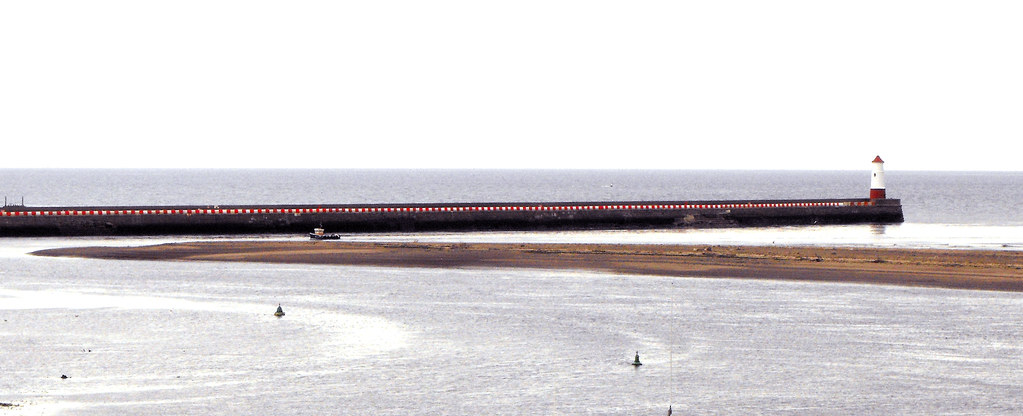
The figures are more impressionist in his Spittal Sands (1960) – perhaps it’s a mistier day, but I reognise the spot which is just south of Berwick. And is that the same harbour arm in Untitled (Beach Scene with Central Monument and Chimney), sketched in felt tipped pen? There’s a chimney or two that makes me think of the (fish?) smoking chimney in Spittal.

There’s also South Shields – Waiting for the Tide (1960) – showing Lowry’s love of solitude and quiteness and isolation. Am I misrecognising A Ship (1965) as Tynemouth?

Is that a version of the aerials next to Tynemouth Priory? But there’s a harbour arm he will have lost (and yet I recall two paintings of the same scene, I think Sunderland, where towers were moved. He’s an artist who will recompose landscapes.)
Then, there’s the Self-Portrait as a Pillar in the Sea (1966), awfully phallic. It’s not a surprise to me – do I recall drawn versions of this at Sunderland? There is another painting like this, also 1966, in Sunderland.

Lowry writes, somewhere, “Look at my seascapes, they don’t really exist you know, they’re just an expression of my own loneliness.” In some paintings the sea and sky merge – the elemental boundaries merge. And then, somewhere again, he writes, apparently about the world of art, “I spent my whole life wondering what it all means, I can’t understand it, don’t understand it at all, can’t see any point in it myself. Still, there it is, you keep on working, and you keep on wondering what it all means, and it goes on and on and on and, there you are.” It reminds me of childhood reading, it reminds me of Eeyore.

And I had to laugh.

There’s a Lowry cartoon called The Shark (1970) where the shark is the art world and the person in the shark’s mouth is Lowry. Better than Damien Hirst’s shark. There are other people in the sea. Waving. Or drowning.

I had a sudden flash, at this point, of someone else that had a reputation for being gloomy, but was also blackly comic. I wondered if they ever could have met – the other one was an insurance clerk, but Lowry was a rent collector. I thought, for a moment, he worked for the Pru. Ah well.

But this is a show to see.

You Know My Methods

“But you have retired, Holmes. We heard of you as living the life of a hermit among your bees and your books in a small farm upon the South Downs.”

*

My villa is situated upon the southern slope of the downs, commanding a great view of the Channel. At this point the coast-line is entirely of chalk cliffs, which can only be descended by a single, long, tortuous path, which is steep and slippery. At the bottom of the path lie a hundred yards of pebbles and shingle, even when the tide is at full. Here and there, however, there are curves and hollows which make splendid swimming-pools filled afresh with each flow. This admirable beach extends for some miles in each direction, save only at one point where the little cove and village of Fulworth break the line.

Mr. Holmes (Bill Condon, 2015)

So the conceit is that Sherlock Holmes is real and retired thirty-five years ago (from 1947) to Sussex, after a final, unsatisfactory case, a case that has been published by Watson and even filmed, but which Holmes cannot quite remember.

Holmes has one of those canons that is easily filled – how did he learn his skills? what are those cases we are told he solved but we’re not ready for? what did he do in the gap between “The Final Problem” and “The Empty House”? what happened to him after Watson put down his quill? And then there are the inevitable continuity errors that add further layers – was Watson shot in the leg or shoulder? why is Watson called James in “The Man With the Twisted Lip”? was Watson married twice? And despite an occasionally proprietorial estate – with little connection to Doyle, I believe – we have endeavoured to provide solutions.
So Holmes has been living on the South Downs (or edging into Romney Marsh at times, I suspect), forgetting. Forgetting and remembering is a theme – he remembers the case, he remembers dealing with Mycroft and a visit from Watson, he remembers his trip to Japan. He has forgotten coming out of retirement on the eve of World War One and “The Adventure of the Lion’s Mane”. Meanwhile, Roger (Milo Parker), the child of Mrs Munro (Laura Linney) his housekeeper, cannot remember his father, killed in the Second World War.
Holmes strives to retain and win back his powers of deduction, so he can resolve that last case, and to train up Roger to take over the bees, as the son he never had.

The word we’re looking for is redemption.

Curiously, redemption through stories and through lying to others.

So, Holmes is either lying or has forgotten that he has written two stories already: “The Adventure of the Blanched Soldier” and “The Adventure of the Lion’s Mane”. The stories themselves tell us he disputed some of Watson’s story-telling.

We’re meant to forget this.

We have McKellen, reunited with director Bill Condon who did the James Whale biopic Gods and Monsters (1998) with him – McKellen, one of those actors who’s always seemed old to me. I remember his coming out on Radio 3 – in 1987? I recall seeing his one man show, Acting Shakespeare. I was lucky enough to catch his Waiting for Godot with Patrick Stewart. I gather he’s done other movies and a sitcom (but Michael Hordern is Gandalf). Laura Linney is divine in a somewhat thankless role. John Sessions and Philip Davies have brief cameos, Roger Allam a bit more screen time. Colin Starkey needs a better agent (or there are bonus scenes). Virtually everyone plays it straight – aside from good old Frances de la Tour who seems to have wandered in from a sitcom (although not, I guess, Vicious) when they couldn’t afford Miriam Margolyes. If the film doesn’t work, it’s at the level of plot, not acting.

And what worried me, pondering at a hidden unhappy ending of the deaths we will not see, was the prickly ash that Holmes has brought home all the way from … Hiroshima. And then ingested. As, indeed, has Roger.
Maybe they end up with super powers?

The Secret Scapegoat

Every one of us has his, or her, dark side. Which is to overcome the other?

For reasons that escape me, a number of years ago I bought a boxset of Daphne Du Maurier novels. I must have thought this was good plan, because I then bought a second, and a couple of novels not included in either. I also bought the collection which contains the story that was the basis for ‘Don’t Look Now’. Note “The Birds”, Jamaica Inn and Rebecca. The most Hitchcockian of novelists – with perhaps the thought that Du Maurier was a Cornish Patricia Highsmith. The grand plan, being anal, was to read the novels in chronological order of publication, but that never happened and the boxes sat by my bed, gathering dust. So I picked one at random. Du Maurier Plaque Daphne Du Maurier, The Scapegoat (1957) John, a university lecturer, is on holiday in France, fantasising about the past and Joan of Arc, and imagining a secret life. He runs into his exact double, Jean de Gué, and the two go for a drink, in fact a series of drinks, before retiring to de Gué’s hotel room where John passes out. He wakes, in Jean de Gué’s clothes and is mistaken for the other – a Comte who has failed to negotiate favourable terms for the family glass foundry business, who has a morphine addicted mother, who hates (and is hated by) his brother and who is shagging half the female population of the locality. Rather than saying, Oh my good man, you have mistaken me for someone else, to the chaffeur, John decides to take over de Gué’s life and set about saving the family and the business. We are in melodrama territory – the morphine mum, the swooning pregnant wife, the visionary daughter who is on the one hand disappointed by her lying daddy and on the other hand prepared to lie for him. (There is an incident quite late on, a suspicious death that the daughter alibis as accidental.) It feels curiously nineteenth century – but we are in France and we are in the decade after the Second World War and neither detail is irrelevant. The mechanisms of plot are perhaps a little too visible – and one expects the first Mmme de Gué to burn down the chateau at some point… Note that John is given no surname (remember the central character of Rebecca is nameless), and that we can but wonder if he is a doppelganger or the same person, a psychotic twin (or unpsychotic), the result of some trauma. Is John Dr Jekyll or Mr Hyde? I was careful to avoid spoilers whilst reading the novel and avoided the introduction. What I did discover was that it has been filmed twice, once in 2012 with Matthew Rhys directed by Charles Sturridge and previously with Alec Guinness directed by Robert Hamer. Now that is a film I do want to track down – Guinness is perfects casting (and it’s a bit Graham Greene territory as a novel) and Hamer is better known for Kind Hearts and Coronets, with several Alec Guinnesses. Betty Davies plays the matriarch, which also seems like genius casting. And so I’m tempted to have another lucky dip, another Du Maurier.