Unknown's avatar

Posts by flares

I am a critic and researcher of sf, with interests in queer theory, postmodernism, psychoanalysis and other long words. I have various blogs.

Editing the Editing

This afternoon’s email brought an edited manuscript of a journal article rejected for a special issue (no biggie — it plainly didn’t fit) but accepted for the journal (yay!). I assumed that at some point this summer I’d spend a week going back to the reading list — and the articles on the matters discussed I’d not fitted in — and a chapter I borrowed some ideas from to add, say, a thousand words. But it’s already at a preferred word count and I guess that’s time I can spend on other projects…

So there’s a new title which I need to decide if I like (or maybe I can propose an alternative if I don’t) and most of the endnotes have been incorporated into the text. It’s also been trimmed, with a couple of things added.

For about thirty seconds, I considered digging out my original file, and starting to compare… but that way lies madness and needless defensiveness. Trust the editor.

Unless you find you are saying something stupid and you have to work out if that’s them or you. They are there to save you from yourself. The piece I finished off this morning appeared incredibly lightly edited, given that it contains about twelve thousand words’ worth of information in six thousand. I suspect if I went back to the submitted manuscript, I’d start getting defensive. It’s not worth it.

(Although, a recent chapter had marginal comments from someone who either didn’t get the joke or didn’t get the joke until too late and left their comments. Ah well.)

So, to edit the edits then…

Fast and Furiosa, Or: Foiling this Fiend’s Foul Plots

Mad Max: Fury Road (George Miller, 2015)

Just to be clear, the Mad Max of the title should not be confused with that other Max.

But basically we have a feature-length episode of Wacky Races directed by whoever did those Lynx adverts. Only feminist. Honest.

Because that woman who did The Vagina Monologues helped out.

In Road Runner country — although actually it’s a whitewashed Namibia.

It’s post apocalypse time and Mad Max (Tom Hardy) is kidnapped and dragged back to a citadel that produces water and mother’s milk to be used as a blood bank to Tony from Skins (OK, Nux (Nicholas Hoult)).  Meanwhile, Imperator Furiosa (Charlize Theron) has been employed to drive a tanker to a refinery, only this is an escape bid for her and the wives of citadel leader Immortan Joe (Hugh Keays-Byrne). The citadel sends out its best warriors and drivers to catch them.

Presumably one of the genetic abnormalities caused by the apocalypse is pale skin, because almost everyone at the citadel looks pasty. The women are of various ethnicities, and presumably mutant free, and I’m guessing they had been kidnapped.

The chasers include Dux, with Max doing a Bane impersonation on the front of his vehicle and a guy with a flame-throwing, double-necked Fender guitar because, hey, in this scarcity world we can afford to waste gas like that. And someone’s been looking at too many heavy metal album covers. Seeing a means of escape, Max jumps ship from the notably rubbish chasers and joins Furiosa, along with Nux.

There’s a bizarre encounter in a canyon — somehow Furiosa has communicated long distance that she can have free passage in return for gasoline, and nobody noticed that she set off to the refinery with a lot of gasoline — and then a pretty sandstorm and then a mudflat (gloriously macabre) and then a meeting with more women, I assume the surviving lifetime subscribers to Spare Rib. And then everyone heads home, somehow avoiding the mudflat.

The action hardly gives you a chance to breathe, although it is mostly followable even if it takes a big dollops of suspension of disbelief. Max is reluctant to give his name, but then I caught barely any of the women’s names.

And somewhere, as you try to work out if the Bechdel Test might be passed in a multi-million dollar franchise, you wonder whether it might not be a much better movie without young Max. He’s clearly heroic and knows both ends of a Glasgow kiss, grunts appealingly and can’t make eye contact in a Heather Ledger/Brad-Pitt-in-Twelve Monkeys kind of way,  but is he necessary for anything other than getting the project green lit, twenty years after first mooted. There’s Ethan Edwards and Shane in the mix of course, as well as the man with no name.

However, whilst the plot is about women being more than baby factories, there is a tendency to slide back to being the hope for the future and the seeds of life to come and female as nature. There is a degree of objectification — but less so than say Princess elia by the time of being chained up in Return of the Jedi. They do seem to be able to hold their own in a fight and there is a minimum of love interest as characterisation. If there’s little character development for them then that’s true of all but Furiosa.

Curious this: a film in which at least three characters find redemption, one way or another, but no character is especially changed.

28 Dogs Later

“Dogs are not an alibi for other themes [… C]ontrary to lots of dangerous and unethical projection in the Western world that make domestic canines into furry children, dogs are not about oneself. Indeed, that is the beauty of dogs.”

pumpkin
Fehér isten (White God (Kornél Mundruczó, 2014))

I was thrown at first by the nature of the dogastrophe. If we are indeed post-adogalypse, would the headlights on the abandoned car still be on? Would the traffic lights still work?

But still, a pleasingly deserted town, a girl (Zsófia Psotta) cycling in a blue hoodie on the motorway and then a pack of mixed breed dogs chasing her through the streets towards and beyond Aldi.

Flashback.

Dániel (Sándor Zsótér), a former professor (of what?) is inspecting an abattoir (gruesome) and then takes on his daughter (the girl, Lili) and her dog Hagen (Luke and Body, effortlessly doubling) as his ex-wife and her mother heads to Sydney for a conference. Dogs aren’t welcome in the apartment and the dogcatcher (Robert Helpmann Gergely Bánki) soon turns up. The conductor of the orchestra Lili plays in is even less sympathetic. Before you know it, Hagen is abandoned by the roadside. Whilst Lili does search for Hagen, she mainly descends into sex (ish) and drugs and rock’n’roll (or house stuff). Hagen has to avoid the dogcatcher and certain death, but falls instead into the murky world of dog fights and training for them (stop humming the Rocky theme at the back) and is renamed Max. And just when you think he’s hit rock bottom, there is dogalution.

Mad Max: Furry Road.

Oh, please yourselves.

I think I could have lived without the human sections — not that Psotta, Zsótér and others don’t put in fine performances, but it was largely handheld in a shakycam. It veered between the dystopian and the soapian. Ah, but the dog narrative — more Steadicam — did hold my interest, and I presume that soon there will be an American remake with Russell Crowe as Hagen:

My name is Maximus Dogious Magyarus, commander of the Hounds of the North, General of the Canine Packs and loyal servant to the TRUE owner, Lili. Son to a neutered Alsatian, husband to a murdered pooch. And I will have my vengeance, in this life or the next.

Hagen, it turns out, is a legendary Burgundian hero, who shows up in Wagner’s Gotterdammerung, and his Tannhäuser becomes a plot point late on. Redemption through love.

Or games of fetch.

Inevitably there is the whiff of allegory and mettaffa — Mundruczó has spoken about the backlash against immigrants, there’s an anti-gypsy/Romany thread running through and the dog shelter with chimneys had a prisoner of war/concentration camp vibe. I had a sense of Conquest of the Planet of the Apes (J. Lee Thompson, 1972), although as with that mythos you worry about the political implications of arguing that gorillas “are” Blacks and so forth.

I suspect, however, there is at the end a sense that Donna Haraway would be a way to unlock this film — a sense of not quite supplication, but mutual supplication. It’s not a comfortable film to watch — although the cast outacted Channing Tatum — and I confess I am ambivalent about dogs. I could have done without being handed a certain flier: nighttime

Spinning Plates Ride Again

So, let’s look at the to-do list based on 26 January  2015, updated 15 March 2015 and last updated 3 April 2015:

  • chapter to write for companion — submitted
  • a  submitted chapter that needs editorial queries answering
  • a keynote to write for the SF postgrad conference
  • chapter to write for another companion — no further than Christmas
  • an article that’s been bounced from a special issue but has been taken up and needs another thousand words adding
  • two a conference papers to convert to an article
  • a book to read for review
  • a book proposal to finish — I’ve had some ideas
  • a book manuscript to rescue — I printed out chapter one…
  • several reference book entries that are missing in actionchased and waiting
  • *new*: an appreciation of Pratchett — published

I note that after a year of researching stuff that has invoked sexism, racism, homophobia and so forth (and some great books and films [and Quest for Love]), I want to go fluffy when I next have an idea.

Speech for Arthur C. Clarke Award, 6 May 2015

There was a moment in the final judging meeting for this year’s Arthur C. Clarke Award when we invoked W.H. Auden’s “Musée des Beaux Arts”:

About suffering they were never wrong,
The Old Masters; how well, they understood
Its human position; how it takes place
While someone else is eating or opening a window or just walking dully along;

It was something about the ordinariness of suffering and disaster, its everydayness. Because we’d realised that each of the books we had chosen, in quite different ways, was about the end of the world.

I’d also been rereading one of Freud’s case studies, in which the patient – not, in fact one of Freud’s patients – imagined that he was living after the end of the world:

At the climax of his illness, […] Schreber became convinced of the imminence of a great catastrophe, of the end of the world. Voices told him that the work of the past 14,000 years had now come to nothing, and that the earth’s allotted span was only 212 years more; and […] he believed that that period had already elapsed. He himself was ‘the only real man left alive’, and the few human shapes that he still saw – the doctor, the attendants, the other patients – he explained as being ‘miracled up, cursorily improvised men’. […] He had various theories of the cause of the catastrophe. At one time he had in mind a process of glaciation owing to the withdrawal of the sun; at another it was to be destruction by an earthquake

Disasters are not new, of course; taking a middle ground definition of science fiction we can see the end of the world in Mary Shelley’s other sf novel, The Last Man, and come close to it in H.G. Wells’s The War of the Worlds. We have the so-called cosy catastrophes of Wyndham and Christopher, Ballard’s ecological psychological disasters. They are perhaps innoculations of fear of the real world ending in disaster – whether it is the ongoing fall out from the economic crash of 2008 with default always just round the corner or the latest salvo in the ongoing culture wars.

Six visions of the end of the world – three women, three men, a range of nationalities, a variety of publishers and a work – sort of – in translation. My thanks to the judges who chose the books and discussed them so passionately at four epic meetings.

Our judges found Claire North’s The First Fifteen Lives of Harry August to be “An unusual take on time travel with communication across generations [and] a metaphor for our lives”. Harry August lives his life over and over again, each time with his memories of the last life intact, trying to get things right. But the end of the world is coming, he is told, and the apocalypse seems to be getting closer all the time. One judge found it “Incredibly immersive” and “didn’t want it to finish”.

Dave Hutchinson’s Europe in Autumn is a “soft apocalypse”, a vision of a near-future Europe, Balkanising. Estonian chef Rudi is drawn into a shadowy organisation, whether he likes it or not, and there seems no way out. One judge called it “A novel about fragmentation – [with Europe] both becoming more localised and globalised.” We noted a minor character shared the name and some of the interests of one of our judges – coincidence we hope – and felt that it avoided “a lot of the probable pitfalls” of the near-future, international thriller.

Michel Faber’s The Book of Strange New Things the judges found “Very Ken MacLeod but not MacLeod”, it was “Understated and unsettling and absolutely absorbing”. Christian pastor Peter Leigh is sent on a secretive mission to an alien planet where the indigenous species want to hear the gospel; he is not the first priest to do so, but no one will tell him what went wrong last time. Meanwhile, back on Earth, things are falling apart. We can’t help but read this with memories of Mary Dorian Russell’s The Sparrow, of course, and before that James Blish’s A Case of Conscience.

Emily St John Mandel’s Station Eleven straddles the apocalypse, both the Georgia flu that begins to wipe out 99% of humanity and the survivors twenty years later. The judges noted that it is “A feel good post apocalypse” and, while many post-apocalypse novels focus on the survival of humanity, this focuses on the survival of culture. According to Auden, “We must love one another or die.” Later he rewrote the line “We must love one another and die.” This novel for the judges, was “An elegy for the hyperglobalised present“.

M.R. Carey’s The Girl with all the Gifts is in the early days of the postapocalypse, some kind of zombie plague where our protagonist or antagonist – the eponymous girl – is among a group of child zombies being experimented on by uninfected survivors. She might hold the answer to humanity’s plight. The judges found it “Very emotional and suspenseful, truly horrifying” and note its move “from humanity to posthumanity” and how it “Worked through its sfnal premise logically”.

And finally, Emmi Itäranta’s Memory of Water takes us to several generations after some kind of disaster, where water has become scarce, and the protagonist’s father is a tea master, gifted with extra water, but under the constant suspicious eyes of an occupying force. Noria Kaitio looks likely to succeed her father, despite being a woman, but secrets, both of her parents and the half-forgotten pre-apocalypse put her at risk. The judges praised the “Beautiful writing” and “The strength of the relationship” at the heart of the novel. It is “intensely focused, narrow-ranging, almost flawless on its own terms.”

My job here, of course, is to draw connections, but we do have six very different apocalypses, sometimes quite mundane apocalypses, lived apocalypses. I’ll quote Auden again. The Old Masters:

never forgot
That even the dreadful martyrdom must run its course
Anyhow in a corner, some untidy spot
Where the dogs go on with their doggy life and the torturer’s horse
Scratches its innocent behind on a tree.

And then, of course, we have something amazing – not thankfully a boy falling out of the sky, but a winner of the Arthur C. Clarke Award.

And On and On and On

Avengers: Age of Ultron (Joss Whedon, 2015)

I am so not the audience for this. I didn’t see Avengers: Assemble and I wasn’t a great fan of the original movie (The Avengers (1998)). It’s been Americanised of course, and whilst Robert Downey, Jr is better in the role than Ralph Fiennes, he’s no Patrick Macnee. The female agent, Scarlett Johansson, is no Honor Blackman or Diana Rigg or Linda Thorson.

So a group of superheroes wisecrack and kickass their way into a secret lair to destroy an irrelevant Big Bad and find an A.I. that allows evil kindly and benevolent arms dealer Tony Stark to restart his programme to create a Colossus style computer which will bring Peace In Our Time. Presumably unfamiliar with how well this worked out for Neville Chamberlain, Stark is confused when the A.I. managed to give itself bodily form and decide that the way to save the village is to destroy it. Only The Avengers can save the world. With help from Royal Holloway. Impact.

So, let’s see, Whedon has a track record in handling ensemble casts — check, we have all kinds of superheroes, various Big Bads, Mr Ultron himself, a couple of Eastern European types who know the name Stark from the wrong end of a missile and most of the time we can keep them all tidy in our minds as to who is where. There’s a confused bit with is the result of the second recurring trait — the Scooby Gang need to fall out with each other — and when the Eastern European Scarlet Witch tries to mess with their heads this appears to be happening. And gets a bit confusing and deleted scene for the DVD territory. They never quite lose it. Oh, yes, and then there’s the feminism thing. We get told — or did Whedon tell us? — he’s a feminist. Which explains why Black Widow seems to spend much of the movie holding someone’s hand. But it’s never her story, whoever the she is. There are a couple more female characters — but then superhero movies don’t like too many women with agency.

You can see there’s some grappling for complexity — Stark is clearly a monster, arms dealers are clearly scum, but it’s never quite delivered. It’s not even in the same league as “Do I have the right?” moral dilemmas.

The audience liked it though — I’m guessing there are in-jokes for the in-crowd. There were appreciative laughs at what felt mundane pieces of dialogue. I’m just wondering where that convenient lake came from in the denouement and what the impact of dropping large rocks into it would be.

Dove Tales

En Duva Satt På En Gren Och Funderade På Tillvaron (A Pigeon Sat on a Branch Reflecting on Existence (Roy Andersson, 2014))

Fourteen years on from Sånger Från Andra Våningen (Songs from the Second Floor (Roy Andersson, 2000)) and Du Levande (You, The Living, (Roy Andersson, 2007)), a great filmic trilogy is completed. I confess I saw the films out of order — I started with Du Levande and saw Sånger on DVD — but I don’t think that’s necessarily a problem. It may be there’s a darkening of tone, for this film is deepest pitch. But let’s begin with a review of Du Levande from my Dreamwidth account. Continue reading →

You Keep Using That Word, I Do Not Think It Means What You Think It Means

Students seem to infect each other.

You suddenly notice a typographical error which you swear you have never seen before and then it’s everywhere. The confusion between defiantly and definitely. The collision of minuet and minute.

“I will defiantly be with you in a minuet.”

I’m gonna dance, dammit.

Language charges, of course, and a lot of our spelling and punctuation is the invention of compositors from the late sixteenth to the early nineteenth century and there is nothing inherently natural about any of this. I heard part of a recent episode of Radio 4’s Word of Mouth which told us to chillax and not worry. Were able to distinguish between “we’re” and “were”, with or without apostrophes.

Don’t sweat the apostrophe’s.

Twitch.

“It is a niece film,” one student wrote a couple of years ago.

So, the latest nonsense that’s memed its way around is “relatable”. It seems to be used to refer to The Hunger Games (Gary Ross, 2012), as in “Katniss Everdeen is very relatable.” I don’t recall coming across this more than a year or so back, but suddenly it’s everywhere.

Ponders. Paraphrases. “Katniss Everdeen can easily be told about.” Nope. Makes no sense.

Ponders. Paraphrases. “Katniss Everdeen can be easily be connected to something or other.” Nope. Makes no sense.

I just have the connotations in my head of her having lots of sisters and brothers.

But within the context of an essay on film — even an essay on the books but that aint my bailiwick — surely what they are trying to say is that it’s easy to identify with the character. “Katniss Everdeen can easily be related to.” You probably want to reach for Laura Mulvey or Linda Williams or someone to theorise it a bit.

And so I turned, with exactly the high-handed sense of smugness that middle aged academics trade in, to look at the OED.

And there it is, sense three:

That can be related to […]; with which one can identify or empathize.

The citation they give is 1965: “The research indicated that boys saw teachers as more directive, while girls saw them as more ‘relatable’.” Note the scare quotes there — but the meaning is clear.

The odd thing is why it’s only just emerged in my marking.

The Stoppard Problem

To ask the hard question is simple:
Asked at a meeting
With the simple glance of acquaintance
To what these go
And how these do;
To ask the hard question is simple,
The simple act of the confused will.

The Hard Problem (2015; writer Tom Stoppard, director Nicholas Hytner, Dorfman Theatre, Royal National Theatre, London, via cinema relay)

For weeks I thought that “the hard problem” was a quotation. But I’m pretty sure I was confusing it in my head with “the hard question”. The hard problem is the problem of consciousness — what is it, where does it comes from, can it be created?

Stoppard has always been a writer of ideas — the talk of chance and probability in Rosencrantz and Guildernstern Are Dead, all kinds of philosophy in Jumpers, the coincidence of Joyce, Lenin and Tzara in Zurich in 1915 in Travesties, quantum mechanics in Hapgood and chaos theory in Arcadia. The recurrent accusation — beyond being too clever for his own good — is that alongside the philosophising and the theatrical gymnastics, Stoppard forgets to have a heart. Well, The Real Thing should have put paid to that.

The Hard Problem is the first Stoppard play I’ve seen since Arcadia; wrong places, wrong times. It’s his first play in years and I don’t think, alas, it’s vintage.

Loughborough University student Hilary (Olivia Vinall) is seeking advice from her lecturer Spike (Damien Molony) as she is applying for a job at the Krohl Institute for Brain Science. He questions her notions of altruism and good and is on the egotism/selfish gene side of human behaviour, especially when she reveals she prays. She gets the job — over a better mathematician, Amal (Parth Thakerar), who goes on to work for the hedge fund run by Krohl (Anthony Calf) which funds the institute — and climbs the greasy pole of research with or without ethics.

In this play, Stoppard is like those fan wank writers who make you feel intelligent. You know, like that episode of Sherlock that invents an underground station so we can be smug about knowing about “The Great Rat of Sumatra” (some people just aren’t ready). The film that preceded the screening had Rufus Sewell telling us how he felt more intelligent when performing in Arcadia. Stoppard begins the play by having Spike explain the prisoner’s dilemma — to be fair, Hilary is bored with how pedestrian that is — and before you know it (well, half a dozen scenes later), Hilary is faced with a situation where she can protest her innocence or claim guilt. Just like a prisoner’s dilemma. Spike tells us that there is no such thing as coincidence — but Hilary runs into an old friend from school, runs into Amal’s girlfriend, runs into Spike in Venice.

Small world.

Still, we never note all those times that someone doesn’t ring us just as we’re thinking of them.

That reunion allows the revelation about Hilary’s past that might lead to a coincidence or not. There was an audible gasp in the audience when that finally panned out. Audiences can be slow.

The problem for me — beyond an age-old wishing for funnier comedies — is that the play was not really about consciousness in any interesting way. There’s a few speeches where we speculate whether human beings are more complicated thermostats…

It’s Daniel Dennett territory:

There is no magic moment in the transition from a simple thermostat to a system that really has an internal representation of the world around it. The thermostat has a minimally demanding representation of the world, fancier thermostats have more demanding representations of the world, fancier robots for helping around the house would have still more demanding representations of the world. Finally you reach us.

And we get a version of the Chinese Box problems, so Searle’s in the mix, too. And that thing about bats is a reference to Nagel.

But this is sleight of hand.

In Hapgood, Stoppard paired idea with theatrical metaphor by asking if a quantum physicist was a spy or a double agent — you could never tell until you looked. I had no sense that the problem of consciousness was being performed here. No moment when Hilary is deluded that she’s conscious, or can’t trust her sense data or is a thermostat.

Instead, the issue is altruism vs egotism — is the good deed still a good deed if it’s for personal gain? Why did that person bring Hilary a cup of coffee? How many times will Spike offer Hilary a lift home in hopes of sex before he gives up? The market that funds the institute is notoriously unpredictable even though the equations of chaos have had a go, and I’m not clear when the play is meant to be set so we don’t have the spectre of 2008 to negotiate. Krohl is ruthless and the game is rigged in his favour — but he also seems a reasonable father. Is his institute altruism or egotism?

But Stoppard has here not worked hard enough to dramatise the speeches, with many scenes as two handers, and doesn’t seem to have the social comedy skills of Ayckbourn anymore to make some of the human interactions painfully, squirmingly funny. The game seems rigged in favour of Hilary — for the female characters in general — and against Spike. Vinall may be the better actor than Molony perhaps, as he is called upon to be eye candy and has a bit of a wandering accent.

And yet — and this is difficult to give full weight to without straying into spoiler territory — a small gesture toward Hilary at the end of the play (which tips the scales to altruism) is genuinely moving. There is a time for altruism and a time for egotism, or they are the same thing, plus time, but I’m not convinced we get any closer to solving the hard problem that way.

In Search of the Indigenous

From the Forest to the Sea: Emily Carr in British Columbia (Dulwich Picture Gallery, London, 1 November 2014-15 March 2015)

I confess that I had never heard of Emily Carr, apparently one of Canada’s best loved female painters. Of course, the list of female painters is depressingly short — although I’m fond of female surrealists such as Frieda Kahlo and Leonora Carrington, not to mention Laura Knight, Paula Rego, Elisabeth Blackadder and Bridget Riley… I presumed that she might have some connection to the Group of Seven, in part because the Dulwich Picture Gallery had a show of their work a few years ago.

If memory serves there were a number of landscapes painted on wood, painted on location in the wilds of Ontario and points north, accompanied by full scale canvases. Slightly before them was Tom Thomson (1877–1917), who I think I saw a show by in Toronto (unless it was in Adelaide…). The landscapes are strangely depopulated, presenting Canada as a Terra Nullis, untouched by human hands. Of course, there were any number of indigenous native groupings, out of sight. It left me a little uncomfortable — but we’ll come back to that.

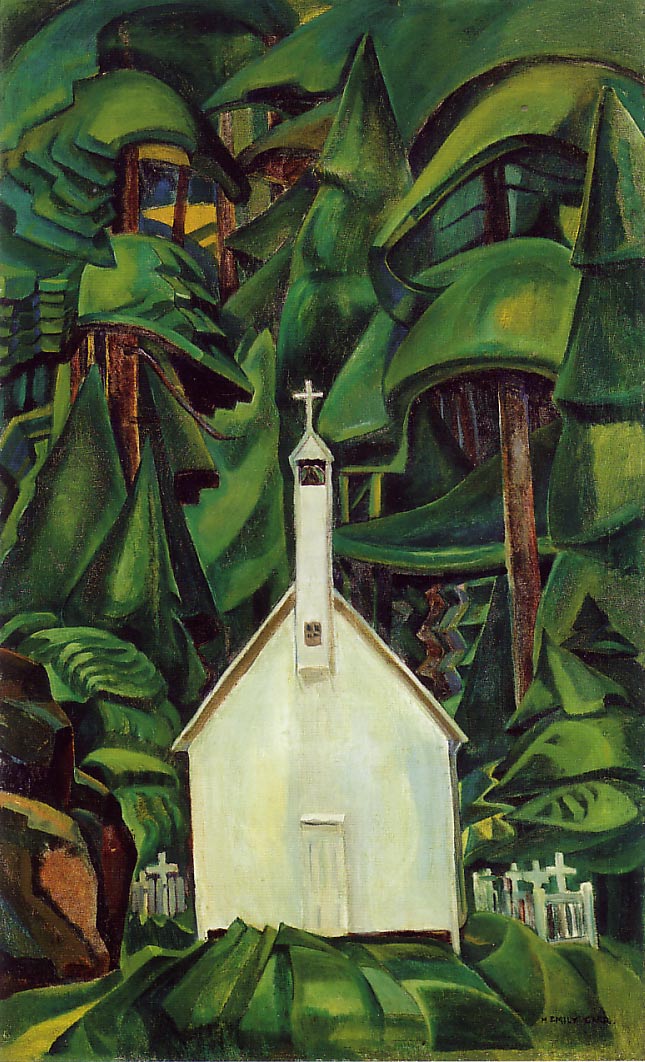
Emily Carr’s exhibition began with paintings of forest from the 1920s – in a sense toward the end of the story. The leaves spiral, there is a real sense of action in the painting – although, of course Carr writes “If there is no movement in the painting, then it is dead paint”. One of the most significant paintings is “Indian Church” (1929).

This is not Terra Nullis, because there is clearly the impact of western society on the forest, a whole way of thinking in the new world. But she was also interested in theosophy and mysticism and argues that “Metamorphosis between species and states is the only predictable feature of the cosmos”. Magic? Maybe.

Daughter of English immigrants to British Columbia, Carr had an interest from an early age in the wilderness outside the settlement. She had art lessons as a child and, despite the death of her parents, went to study at the California School of Design, San Francisco where she learned how to paint outside. On graduating she went to London, to the Westminster School of Art and took courses at places such as St Ives. Back in Canada she taught and painted, before travelling in 1907 to Alaska. She was inspired by Native American culture and art, and started trying to reproduce it in her paintings: “Indian art broadened my seeing, loosened the formal tightness … I was as Canadian-born as the Indian but behind me were the Old World heredity and ancestry”. Her paintings stay largely deserted – although some of the sites she depicted had been abandoned through disease or general depopulation. Here’s Janice Stewart: “Emily Carr found in her unproblematic identification with the Indians of the Canadian west coast a second skin to inhabit, which seems to have allowed her to paint and write beyond the gendered boundaries of contemporary conventional aesthetics. Carr identified the creative part of herself as Indian.” But Stewart is more interested in Carr’s writing than her paintings.

In 1910, Carr took a trip to Paris, where she was exposed to the Impressionism (and I guess early Post-Impressionism). Again, this would feed into her art – and it did strike me that some of her landscapes had the flavour of Vincent Van Gogh to them (whom she referred to as a “crazy poor chap”).

One striking painting is of Kwakwaka’wakw war canoes (1908 and 1912)– and this one does contain figures.

These are exactly the same boats as appeared in Edward S. Curtis Land of the Head Hunters (1914) – an extraordinary and deeply problematic drama where native culture was presented in a deliberately antiquated manner:

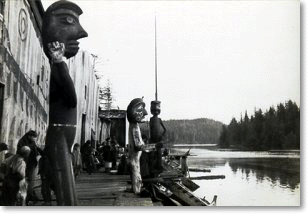
Inevitably she has taken a decision in the representation or not of indigenous peoples. A photograph of Blunden Harbour from 1901 (with people)

became the centre of a painting in 1930:

I’m torn – I don’t have enough data from the exhibition to know whether the elimination of the indigenous (whilst retaining their cultural productions) shows respect for them or is part of the Terra Nullis drive. As a female artist who kept not quite being taken seriously, she found something in the peopels she met to inspire her. But is is a form of romanticisation? Gerta Moray labels it “aestheticized nostalgia”, and suggests that Carr’s attempt to preserve what she perceived as a dying culture contributed to the decline.

Sources

  • Moray, Gerta (1993) Northwest Coast Culture and the Early Indian Paintings of Emily Carr, 1899-1913. Diss. University of Toronto, 1993.
  • Morra, Linda (2004) “‘Like Rain Drops Rolling Down New Paint’: Chinese Immigrants and the Problem of National Identity in the Work of Emily Carr,” American Review of Canadian Studies, 34(3): 415-438.
  • Stewart, Janice (2005) “Cultural Appropriations and Identificatory Practices in Emily Carr’s ‘Indian Stories’”, Frontiers: A Journal of Women Studies 26(2): 59-72.