Spinning Plates Return

It is Sunday, it is 7.30, I am in the library. I have been here since 11.00, delayed getting here by an hour because I thought I’d lost a book I needed (I hadn’t and it turns out I didn’t).

So, let’s look at the to-do list based on 26 January  2015:

  • a paper to write for the Sideways in Time conference — next weekend Sunday
  • a keynote to write for the SF postgrad conference
  • a book to read for review
  • a book proposal to finish — I’ve had some ideas
  • a conference paper to convert to an article
  • a secondary bibliography to annotate not started
  • two chapters to write for companions — lots of ideas for one, no further than Christmas for the other
  • an overdue biographical piece to write — Tuesday afternoon, I hope
  • an overdue survey chapter
  • an article that’s been bounced from a special issue but has been taken up and needs another thousand words adding
  • a book manuscript to rescue — I printed out chapter one…
  • a  submitted chapter that I’ve heard nothing back on
  • several reference book entries that are missing in action
  • a submitted chapter that may well need a proofread
  • *new*: an appreciation of Pratchett

Hmmm. Let’s see what I can do for March 31st. I have written and published an obituary and written something like three lectures a week.

Shameless!

While I’m at it, perhaps I should nod to

  • the review article* I did for LARB of … I forget which Simon Ings novel it was … Painkillers (2000): Finding the Plot: On Simon Ings and the British Boom
  • the review of David Brittain’s Eduardo Paolozzi at New Worlds (2014) for Science Fiction Studies 42(1) 2015.

* I was sent one of his books (although not the one I was asked to review). Fortunately I had most of the back catalogue, but I paid good money to write the review…

Publication: Chapter on District 9, Race and Racism

Ulrike Küchler, Silja Maehl, Graeme Stout (eds) (2015) Alien Imaginations Science Fiction and Tales of Transnationalism (London: Bloomsbury)

There is a moment in a review of District 9 (Neill Blomkamp, 2009) when Joshua Clover anticipates that the film will be ‘a neat allegory of apartheid, with the marooned race of repulsive and sad-sack aliens standing for the dispossessed’ (2009: 8). Similarly, Eric D. Smith suggests that the film ‘at first seem[s] an allegory for the suspension of constitutional law during the officially declared South African State of Emergency in the latter days of apartheid policy (1985-1990)’ (2012: 149). In this essay I want to map District 9’s representation of inter-species hybrids within the complex situation of apartheid-era South African interracial relations and discuss some of the issues surrounding science fiction as allegory. I will consider “race” as being an ideological category and, following Julia Kristeva’s notion of the abject, a psychological construction that nevertheless has a material existence. I will be posing the question of to what extent District 9 is itself racist.

Alien Imaginations Cover

Ulrike Küchler, Silja Maehl and Graeme Stout (eds) (2015) Alien Imaginations Science Fiction and Tales of Transnationalism (London: Bloomsbury)

I got home from Eastbourne on Friday to find a package that I took to be some medium-awaited DVDs but was in fact a copy of Ulrike Küchler, Silja Maehl, Graeme Stout (eds) (2015) Alien Imaginations Science Fiction and Tales of Transnationalism (London: Bloomsbury). I have a chapter in it called “Human Subjects/Alien Objects? Abjection and the Constructions of Race and Racism in District 9“, which began from the sense that there was something racist at the heart of District 9 — the dangers of using aliens as metaphors for racial difference, made more problematic by the representation (with subtitles) of Nigerians. There’s an interesting couple of paragraphs in Adilifu Nama’s Black Space when he argues:

At its best, SF cinema is an allegorical site that invites the audience to safely examine and reflect on long-standing social issues in an unfamiliar setting, providing the possibility of viewing them in a new light.
At its worst, the process of allegorical displacement invites audiences to affirm racist ideas, confirm racial fears, and reinforce dubious generalizations about race […] without employing overt racial language or explicit imagery.

It’s a dangerous ploy. The episode of Star Trek: The Next Generation (“Angel One” (25 January 1988)) that used gender to explore Apartheid is a case in point. Ouchy.

There was a point in writing this chapter where I hit a wall and needed something more — I confess to reading the chapter on race in Adam Roberts’s Science Fiction (2000) and the light dawned. I typed a keyword into the library catalogue and two articles on District 9 were the top results. I swear they had not been visible before. From there, thankfully, it flowed.

Oddly enough, on the train journey to and from Eastbourne I read Nnedi Okorafor’s Lagoon (2014), which is, among other things, a response to District 9 from a Nigerian perspective. I shan’t blog about the novel for now, but I know I will come back to it. Another chapter in the collection, I think Bianca Westermann’s “Meeting the Other: Cyborgs, Aliens & Beyond”, also discusses District 9 and comes to different conclusions, so I will be very interested to read that.

Coinage?

At one of the first sf conventions I went to, Tom Shippey used the word “intergenrification” in conversation with Iain Banks and Iain M. Banks. It seemed to be a useful word, for the ways in which genres collide and intermingle with each other, or the way in which a text belongs to several genres at once. This may well have been one of those moments when we were getting all excited over slipstream — the genre of fiction of postmodern sensibility — that comes along every year or so. A decade or so later, people were getting excited about interstitial texts, texts which belonged to no genres, although its name suggests that these are texts between genres. Despite this being, frankly, arrant nonsense, I was recruited to write on this subject, “Between the ‘Deaths’ of Science Fiction: A Skeptical View of the Possibility for Anti-genres”. For that matter, my contribution to the Festschrift (bless you) for John Clute and Judith Clute considered the fluidity of genre boundaries at the heart of (John ) Clute’s project. I reviewed Gary Wolfe’s Evaporating Genres for Science Fiction Studies, with the sense that for Wolfe the genre had not so much evaporated as never solidified in the first place.

And then, as part of a new module, Popular Genres and Popular Culture, I delivered a lecture on intergenrification I wanted to talk about the way in which the sitcom has overlaps with docusoap and fly on the wall documentaries and game shows and chatshows and I googled the word “intergenrification“.

It gives two results. The second is to a PDF, which apparently includes the quotation, “It may be the case that intergenrification is a staple of postmodernist literature, but there may be other readings of the novel.” Ah, a believer in PoMo, I presume.

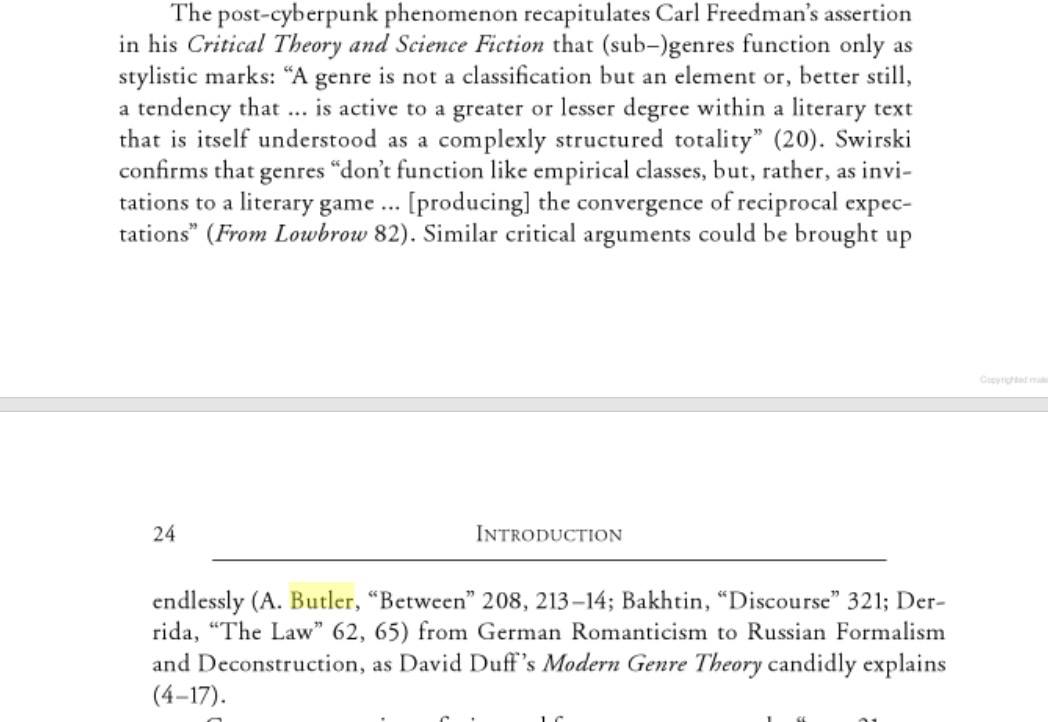
The first is to something I wrote, “Thirteen Ways of Looking at the British Boom, my Pioneer Award-winning article: “As Steve Jeffery wrote in his review: ‘Levy’s debut is assured but tries perhaps too hard … to be too many things at once: sf thriller, fantasy, dystopia and romance’ (Jeffery 28). This intergenrification is typical, however, of the British Boom.” See how I use the word, confidently assuming that people will know what I mean?

I did some hunting around for my JFA piece, but failed to find a file on this computer and or  online, although there is a book that does at least cite it.
quote

Butler, Bakhtin, Derrida. Not bad company.

It looks as though, should the word ever make it into the OED, I’ve got dibs along with the other chap on the citation quotation – and, believe me, I checked for the entry.

It was only today that I’ve clicked on the other link, and discovered it’s a PDF of my PHD and presumably vaguely official. Who knew it was out there?

So, should I ever want to do more work on this, I have the primacy. I don’t have the JFA article to hand, but I have a draft, in which I write

We hold these truths to be self evident: i) no genre is ever pure, ii) no text ever belongs to a single genre, iii) no text is genreless. Our justification for the latter two truths comes in part from the essay by Jacques Derrida called “The Law of Genre” (1979). “As soon as the word genre is sounded,” he writes, “as soon as it is heard, as soon as one attempts to conceive it, a limit is drawn. And when a limit is established, norms and interdictions are not far behind” (224). But that limit is already transgressed. The law of genres is that genres are not to be mixed – but the law of the law of genre is that genres are contaminated, impure or parasitical. Individual texts overflow the boundaries, become larger than their limitations, transcend their classes. Derrida advances the thesis that a text does “not belong to any genre. Every text participates in one or several genres, there is no genreless text, there is always a genre and genres, yet such participation never amounts to belonging” (230). And, lest we forget, Brian Aldiss reached a similar point two decades earlier in a review: ‘[T]here is no sf novel that is purely an sf novel. At some stage all sf novels turn into something else’ (Aldiss, Brian (1964) ‘[Review of] Judgement at Jonbar’, S. F. Horizons 1: 22.). This is not just the case for sf novels.

But, obviously, if Professor Shippey wrote something down, I’d certainly admit priority to seniority.

Bibliography

  • Aldiss, Brian (1964) [Review of] Judgement at Jonbar, S. F. Horizons 1.
  • Butler, Andrew M. (2003) “Thirteen Ways of Looking at the British Boom”, Science Fiction Studies 30(3).
  • Butler, Andrew M. (2004) “Between the ‘Deaths’ of Science Fiction: A Skeptical View of the Possibility for Anti-genres”, Journal of the Fantastic in the Arts 15(3), pp. 208-216.
  • Butler, Andrew M. (2012) Review of Evaporating Genres: Essays on Fantastic Literature, Science Fiction Studies 39(1), pp. 155-158.
  • Derrida, Jacques (1979) “The Law of Genre”, Critical Inquiry 7(1), pp. 55-81.

Spinning Plates

I meant to write this entry six months ago and it would have begun “Yesterday (Friday), I was sent the finalised version of a chapter with a request for proofreading by the end of the weekend. I was annoyed, because I wanted to work on a book proposal.”

I’m always spinning plates. At any one time I could be:

  1. having an idea for a piece
  2. putting in a proposal
  3. drafting a piece
  4. rewriting a piece
  5. proofreading a piece.

Let’s see, at the moment I have various ideas for pieces and …

  • a paper to write for the Sideways in Time conference
  • a keynote to write for the SF postgrad conference
  • a book to read for review
  • a book proposal to finish
  • a conference paper to convert to an article
  • a secondary bibliography to annotate
  • two chapters to write for companions
  • an overdue biographical piece to write
  • an overdue survey chapter
  • an article that’s been bounced from a special issue but has been taken up and needs another thousand words adding
  • a book manuscript to rescue
  • a  submitted chapter that I’ve heard nothing back on
  • several reference book entries that are missing in action
  • a submitted chapter that may well need a proofread.

Meanwhile, there’s an edited collection due out with a chapter in it.

And none of that includes my research on brewing and drinking, that I’ve spent more time talking about in relation to KE and Impact than actually researching. I need to go away and read some Habermas, which incidentally is the thing I need to do for the book proposal although it’s not the same Habermas.

Looking at the list, that’s not much spinning plates as watching them crash. I have three lectures to deliver this week, only one of which has material to hand. My research day is tomorrow, but I fear the morning may have to be writing lectures.

I also have a stealth book I’m planning to assemble, but I’m not sure I’ve written any of the chapters yet. As conferences come up, I should be giving papers that would fit into that or the book proposal mentioned above — but the one for Sideways in Time is 1970s and something I missed from Solar Flares. Having looked at a call for papers for werewolves, I was thinking about something from entirely the wrong period for that proposal — although it wouldn’t fit on the face of it — nor in the stealth book. But it is on film, which I should be writing on.

At this point, I should really be saying no to projects, but then it’s an interesting venue or a cool editor or a sufficient cheque… A collection recently came out that I don’t have a chapter in, and it is clearly “my” thing, but any annoyance is balanced by the realisation that I in no way had time to write for it. I’m still open for business, but don’t be upset if I say no.

ETA: If you think I’m writing something for you and it’s not listed here — I am deliberately coy about the actual projects here for reasons of plausible deniability — email me. I may have entirely forgotten I said yes… Send me a message?