Neither Uncanny Nor Fantastic

Is it too soon for spoilers?

L. Frank Baum, The Marvelous Land of Oz (1904)

I’m unclear how many of the Oz books I’ve read, but I was bought this for Newtonmas something like thirty years ago and I did read this. I suspect it is heresy to say, but I think it is a better book than The Wonderful Wizard of Oz, if only because it isn’t overshadowed by the film. Whether it is true or not that the first book was the first American fantasy (I don’t believe this), or is it first for kids?, it was clearly popular enough that Baum was pressurised into a sequel.

The whole point of the first book was to get Dorothy home — having got her to marvellous Oz — and so returning her is a tough gig. The supporting characters got their brain (Scarecrow), heart (Tinman) and courage (Cowardly Lion), so everyone has what they want. Baum elects to bring back the Scarecrow and the Tinman, mainly in support roles, and gives us a boy hero, Tip.

There’s gratitude to all the Dorothies who wrote letters.

Tip is a mysterious orphan, mistreated by the wicked old witchlet Mombi, who decides to play a trick on her by making a scary dummy with a pumpkin head. Mombi responds by bringing him alive. Tip and Jack — a Scarecrow variant — run away to the Emerald City and en route create a living sawhorse and meet a large intelligent beetle (who I suspect was more amusing when I was twelve).

Then comes revolution — a girl’s army is fed up of slaving away and march on and take over the city. The Scarecrow, Tip, Jack and so forth escape, in the hopes of finding Glinda to rescue them, but mainly so that we can have a series of marvellous episodes to show off the weirdness of Oz. The resolution is more interesting than assuming there’s a satire of suffragism going on. Glinda points out that the Scarecrow is only leader because he took the city over on the Wizard’s departure, and the Wizard, who we had been led to believe built the city, usurped someone else. But there is a daughter, hidden away somewhere in safety and so the Force is safe. We also learn — thanks to the various pills and potions that run through the the story (and I get the sense that Baum trapped as liberated by variations on the three wishes trope) — that the Wizard had rather more magic than he pretended.

Did the Wizard in fact get out of town ahead of the coming revolution?

I note that all the characters are abject and marvellous — the living scarecrow, the animated squash, the giant beetle, the cyborg, the sawhorse, the Gump — and so it should be no surprise that Tip is rather more complex than we’ve led to believe. But the restoration of a matriarchal rule is also a restoration of a blood line — and Baum is perhaps not as generous to the army as his character Glinda is.

Apparently Baum had been involved in theatrical productions of Oz and pantomime — and in a world of dames and principal boys, a certain gender bending is not unexpected.

Until You Find the Key to Your Life

L. Frank Baum, The Wonderful Wizard of Oz (1900)

There was a documentary on BBC Radio 4 over Christmas about Alice — a couple of books to which I sometimes have an allergic reaction — that said something along the lines of the Alice books became popular in the 1960s in America because the US had had no fantasy aside from the Oz books.

Ho hum.

But presumably Alice is a taproot text — a young girl who falls into a fantastical world and undergoes an almost random series of encounters before returning home. Baum gives the story more architecture: there is the journey to the City of Emeralds; the journey to the Wicked Witch of the West and the return to the Emerald City. She is given more defined companions, each with a quest of their own: the Scarecrow; the Tinman and the Cowardly Lion. A recurring trope in the book is their restatement of their needs, a fairy tale recurring rhetorical structure.

The gimmick is surely clear from the perennial Newtonmas screenings of the film version — the titular Wizard is a humbug and you must search for the hero inside yourself. (Incidentally this is a variation on the anti-technology sf movie dependent on technology to narrate its tale — the fantasy narrative distrustful of fantasy and illusions.) The Wizard isn’t who he claims to be and that is a Bad Thing, but the Scarecrow, Tinman and Cowardly Lion must pretend to be who they want to be and that is a Good Thing.

The book doesn’t have the is-it-a-dream-or-not? frame of the film, in which various farmhands are anticipatory doubles of her companions. The farm sequence is pretty brief, barely a chapter, as Baum clearly knows to get her to the fantasy land as soon as he can. On the other hand, there’s little sense of why she wants to go home (although in the film it makes no sense at all). The flying monkeys are less scary than they become in the movie, as indeed is the Wicked Witch. If more incidents are thrown at Dorothy and the gang in the book than the film, they are dealt with chapter by chapter. Can one whisper the film is an improvement on the novel? Or maybe got to me first.

I think a comment needs to be made on gender, and the power vacuums created and filled by the narrative. Oz is divided into four segments, North and South ruled by good witches, West and East are ruled by bad witches. Four domains, four female rulers. The central zone is the Emerald City, built by the humbug wizard (but see The Marvelous Land of Oz) In the course of the novel two of the women are killed and one is replaced by a male character (it is not clear who rules Munchkinland, but presumably Dorothy has squatter’s rights). The male Wizard is replaced by the male Scarecrow, marking a shift from matriarchy to patriarchy. The novel was written in the era of the New Woman and an era of suffragism.

Perhaps this will become significant in the sequel.

What we want is Watney’s

Andy Weir, The Martian (2011)

So there are exceptions — the Watership Downs and The Chronicles of Thomas Covenant the Clenchers — which get rejected by dozens of publishers and then become bestsellers. And there’s the self-published which become bestsellers when they’ve gone mainstream. One has to admire Andy Weir for his success — which seems to have been ordained even before we learned that Ridley Scott was going to get his mitts on the manuscript.

Lots of books get optioned.

Some writers live on this — hoping the bloody film never gets made.

This time it did, but I haven’t seen it yet.

So, we have an astronaut, Matt Watney, on the red barrel planet, who gets separated from the rest of his crew in a sandstorm and is left behind. Or, since he’s telling us the story in the first person, possibly he’d nipped for a slash behind the yurt and got distracted. Anyhow.

Because he’s never read Joanna Russ’s We Who Are About Too…, he decides to Rebuild Civilisation by planting potatoes and keeping going until NASA can send a rescue mission. He sits there and does all the calculation in a sort of rivet-counting engineer in Heart of Darkness way, but we have not sense of jeopardy because it’s in the first person and it would be really naff to suddenly switch viewpoints and add This is the last of the tapes we found and Watney’s body was found buried under the sand. On wonders a little about the balance of amino acids he’s going to get with rations and potatoes, and surely the lunacy induced by just eating potatoes is higher than the lunacy of being on your own for four hundred days or being forced to watch nothing but seventies reruns and listening to disco.

Oh yes, yet another sf novel where the protagonist know no culture produced after the date of the novel being written.

There’s a certain kind of purity that comes from a tight focus on a single character.

…and then the action suddenly switches to Earth and NASA and what they want to do with it. They begin to anticipate what Watney will do and how rescue him, and set a new deadline for him to survive to. There are convenient other spaceships around to borrow and presumably extra rations for the rescue team and at least now we have a sense of jeopardy because we don’t know what Watney’s up to…

… only we do cut back to him and we aren’t really allowed to think he’s dead for more than half a page. At least once we get to the third person — and sometimes we see Watney from the third person and in italics if I recall correctly, so there is hope that he might die after all. At any point it could all go horribly Pete Tong.

It reminded me of two earlier novels — but not the exoticism of Barsoom or the nostalgia of The Silver Locusts or the ontology of Martian Time-Slip or the social richness of Red/Green/Blue Mars. Rather it took me back to Michael Crichton’s The Andromeda Strain, which confuses pedantry with verisimilitude, and Ben Bova’s Voyagers, which has that international glossiness. Every one is competent, there are no real antagonists except the universe itself.

You might argue there are no people.

Hmmm.

It’s a long time since I saw Robinson Crusoe on Mars, but I suspect that was a lot more fun. But this is that reasonable novel that does its job and yes, does keep you reading. But I’ll forget it within the week.

Never Marry Your Cousin

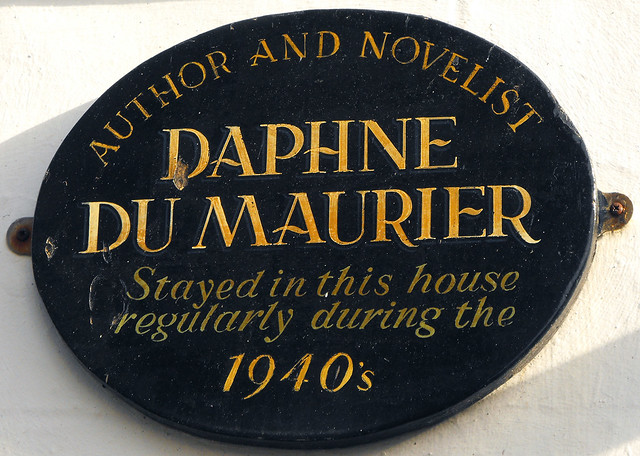
For reasons that escape me, a number of years ago I bought a boxset of Daphne Du Maurier novels. I must have thought this was good plan, because I then bought a second, and a couple of novels not included in either. I also bought the collection which contains the story that was the basis for ‘Don’t Look Now’. The most Hitchcockian of novelists – with perhaps the thought that Du Maurier was a Cornish Patricia Highsmith. The grand plan, being anal, was to read the novels in chronological order of publication, but that never happened and the boxes sat by my bed, gathering dust. So I picked another one at random. Du Maurier Plaque

“This, I suppose, was what men faced when they were married. Slammed doors, and silence.
Dinner alone.”

Daphne Du Maurier, My Cousin Rachel (1951)

Little Orphan Philip lives on a big Cornish estate at some point in time – it’s never entirely clear when, but the lack of trains would put it at some point in the early nineteenth century. His Confirmed Bachelor uncle, Ambrose, fully anticipates that Phil will inherit everything, the lazy brat, but that is before he goes on a holiday to Italy and meets, falls in love with and marries Rachel. Phil’s cousin.

Before you can say, “Cradle snatcher”, it becomes clear that Ambrose is unwell and Philip makes a mad dash across Europe, only to find his uncle dead and his mysterious cousin absent. He returns to Cornwall and begins to run the estate, blind to the sudden charms of the local unmarried women who are awaiting his proposal.

And after a few months he is joined by Rachel – whom at first he is determined to dislike because, yanno, probable homicide, but who he gets a crush on. If there were justice (and she isn’t just an evil schemer), Rachel would get the estate, and Philip seems to do everything he can to give it to her, made complicated by everything being in trust until his twenty-fifth birthday.

What is not clear here, of course, is how reliable the self-serving Philip is. Is it really wise to want to marry a cousin with a dodgy back story? Is it good taste to marry one’s uncle’s widow? Or is Rachel perhaps just poor at handling money and the victim of an infantile young man brought up in a homosocial environment?

More Majestic Shalt Thou Rise

For reasons that escape me, a number of years ago I bought a boxset of Daphne Du Maurier novels. I must have thought this was good plan, because I then bought a second, and a couple of novels not included in either. I also bought the collection which contains the story that was the basis for ‘Don’t Look Now’. The most Hitchcockian of novelists – with perhaps the thought that Du Maurier was a Cornish Patricia Highsmith. The grand plan, being anal, was to read the novels in chronological order of publication, but that never happened and the boxes sat by my bed, gathering dust. So I picked one at random. Du Maurier Plaque

Daphne Du Maurier, Rule Britannia (1972)

Rule Britannia was Du Maurier’s last novel, even though she died two decades later, and a weird mainstream sf effort which the 1970s was to see a few of — John Sutherland calls them As If Nigel’s and that may well do. Imagine a time forty five years ago and the Conservative Party stood in a General Election committing us the join the European Union that hadn’t wanted us as a member a few years earlier. Then imagine an economic crisis in which we are then kicked out, and the U.S. occupy us as protecting force.

That’s the premise of Rule Britannia, told from the perspective of a small town in Cornwall. The town people largely hate the Americans, presumably can’t abide the Europeans and aren’t that enamoured of Londoners.

How things have changed.

I get the sense that an awful lot of British sf up to about 1980 is refighting the Second World War — the plucky islanders, the sense of an ideal fighting for, the blitz spirit and all that. Survivors, Dad’s Army, Secret Army and “Genesis of the the Daleks” are cousins. Du Maurier in Cornwall during the Second World War would have seen the American soldiers stationed around and the local attitudes to them. I suspect the campaign to win hearts and minds — and a quick how’s your father — would have been similar to that in the novel.

The protagonist is Emma, who presumably isn’t interesting enough to narrate but is in every scene even if that takes some jiggery pokery. Her father is a merchant banker of some kind — absent for much of the novel, a vital link to the powers that were — and her grandmother is Mad, a seventy nine year old former actress, inspired by Gertrude Lawrence, Gladys Cooper and, I suspect, du Maurier herself. And then there are various adopted children, under the age of 18, who can be relied on to keep the plot spinning.

Du Maurier had been recruited to the cause of Cornish nationalism and was aware that — as tin mines and fishing declined — the capital’s big economic plan for the West Country was heritage and tourism, until package holidays destroyed even that possibility. This is the occupying U.S.’s vision of Cornwall, with Welsh and Scottish heritage in the mix. A land of surf and Doombar.

There is resistance — although I think the satirical mood here makes the novel step back from the horrors hinted at in the Resistance in The Scapegoat and attempts to pull the wool over the eyes of the authorities. There’s a pompous local MP, a suspicious American colonel (and tougher colleagues), a pliable GP and a mysterious hermit. If this wasn’t a six part BBC drama it should have been — you could easily cast it.

This was a real page turner, not quite the gothic material I’d expect from my limited sense of du Maurier, but certainly worth a read.

The Secret Scapegoat

Every one of us has his, or her, dark side. Which is to overcome the other?

For reasons that escape me, a number of years ago I bought a boxset of Daphne Du Maurier novels. I must have thought this was good plan, because I then bought a second, and a couple of novels not included in either. I also bought the collection which contains the story that was the basis for ‘Don’t Look Now’. Note “The Birds”, Jamaica Inn and Rebecca. The most Hitchcockian of novelists – with perhaps the thought that Du Maurier was a Cornish Patricia Highsmith. The grand plan, being anal, was to read the novels in chronological order of publication, but that never happened and the boxes sat by my bed, gathering dust. So I picked one at random. Du Maurier Plaque Daphne Du Maurier, The Scapegoat (1957) John, a university lecturer, is on holiday in France, fantasising about the past and Joan of Arc, and imagining a secret life. He runs into his exact double, Jean de Gué, and the two go for a drink, in fact a series of drinks, before retiring to de Gué’s hotel room where John passes out. He wakes, in Jean de Gué’s clothes and is mistaken for the other – a Comte who has failed to negotiate favourable terms for the family glass foundry business, who has a morphine addicted mother, who hates (and is hated by) his brother and who is shagging half the female population of the locality. Rather than saying, Oh my good man, you have mistaken me for someone else, to the chaffeur, John decides to take over de Gué’s life and set about saving the family and the business. We are in melodrama territory – the morphine mum, the swooning pregnant wife, the visionary daughter who is on the one hand disappointed by her lying daddy and on the other hand prepared to lie for him. (There is an incident quite late on, a suspicious death that the daughter alibis as accidental.) It feels curiously nineteenth century – but we are in France and we are in the decade after the Second World War and neither detail is irrelevant. The mechanisms of plot are perhaps a little too visible – and one expects the first Mmme de Gué to burn down the chateau at some point… Note that John is given no surname (remember the central character of Rebecca is nameless), and that we can but wonder if he is a doppelganger or the same person, a psychotic twin (or unpsychotic), the result of some trauma. Is John Dr Jekyll or Mr Hyde? I was careful to avoid spoilers whilst reading the novel and avoided the introduction. What I did discover was that it has been filmed twice, once in 2012 with Matthew Rhys directed by Charles Sturridge and previously with Alec Guinness directed by Robert Hamer. Now that is a film I do want to track down – Guinness is perfects casting (and it’s a bit Graham Greene territory as a novel) and Hamer is better known for Kind Hearts and Coronets, with several Alec Guinnesses. Betty Davies plays the matriarch, which also seems like genius casting. And so I’m tempted to have another lucky dip, another Du Maurier.

The Singer Not the Gun

Emily St. John Mandel, The Singer’s Gun (2010)

Mandel’s Station Eleven (2014) won the Arthur C. Clarke Award. Some critics have complained it is, if not a cosy catastrophe, then a clean apocalypse. I pass no comment as to whether this is a good thing or not — but clearly it was a novel about the survival of culture and what stories need to be told or should not be told.

Perhaps cleanness is Talfamadorian.

Don’t look at the nasty moments.

Perhaps by virtue of the book’s already burgeoning reputation — Waterstone’s were promoting it — at least one of her earlier novels is in print in the UK. It is difficult to read The Singer’s Gun without the later novel in mind.

So Anton Walker works in an office in the new World Trade Center complex and is hoping to marry his girlfriend Sophie on the third attempt. One day he discovers he has been demoted — there’s some question about his nationality or his qualifications — and he’s exiled to an office on the mezzanine, where his former secretary, Elena, also demoted, begins a secret affair with him. Walker’s parents sell stolen goods from their shop and Walker had been in business with his cousin, Aria, selling false passports to immigrants such as Elena. Anton had been bribed to do one last thing for Aria, and now the chickens are coming home to roost. He is waiting, wifeless, on the island of Ischia of Naples, and people have been on his trail.

Station Eleven moved between the start of the disaster and the aftermath, twenty years later, and here again there is an achronological structure, as if Mandel is scripting a puzzle movie. Anton knows more about Elena than Elena realises, we know more about Elena than Anton does and we know about the agent. We move backwards and forwards in time. We are trained to ferret out the connections — although that makes us wonder why Walker is so trusting.

On one level, this is noir territory. The introspective, flawed protagonist who has sinned and must be punished out of all proportion, the untrustworthy women (the agent, the cousin, the girlfriend/wife, the mistress, all save his almost silent mother), the waiting for someone to come in through the door with a gun in their hand. He will be screwed (over). There are two MacGuffins — a package and a cat. You’ve got to love the cat.

And yet — there’s that cleanness. You are driven forward to read, you can see the ironies and the trap closing… But this is, what, a comedy? Walker seems curious carefree, even as he puts an acquaintance into the frame. There’s that gun, the singer’s gun, that has to be used because it is over the metaphorical fireplace of the title. The singer herself is only briefly there. Aria is a song. Elena sings, so to speak, in a slang way. But someone has to be shot — and it’s clean. It’s not the dirtiness of the noir — it feels curiously inconsequential, although the moral/immorality of the noir is selective in its punishment of characters. Or rather, there are worse places to be than in jail.

And, then, at the heart of the novel, the real trade, the real reason they are on Walker’s trail — ah, spoilers. That centre does not bear thinking of. That centre is sometimes glimpsed on the news and contains images which the viewer may find distressing, on one shore or another of the Mediterranean. We see it head on once, I believe, in a brief chapter. But it’s not dirty enough — or there’s a horror in the cleanness. As I say, you are driven forward to read on, but the punch is pulled.

The Incredible Hulke

Michael Herbert (2014) Doctor Who and the Communist: Malcolm Hulke and his career in television (Nottingham: Five Leaves Publications), ISBN: 978-1910170090, 30 pages

I’d heard somewhere about the scriptwriter Malcolm Hulke being left of centre, although I’m not sure where from. I knew him through Doctor Who novelisations from the 1970s. Most were based on serials he’d written – although the titles were often changed from the television versions, none of which I’d seen. Some of them I had caught up with on TV or DVD over the years.

There was something about his aliens that was different. All too often, aliens stand in for difference, and thus a threat – within the Hollywood tradition as invaders, frequently to be read as the foreign threat of the age, typically the Communist. Invasion of the Body Snatchers (Don Siegel, 1956), say, can be read as McCarthyite parable (or a satire of McCarthyism … or an attack on normalising America). Only rarely – The Day the Earth Stood Still (Robert Wise, 1951), Close Encounters of the Third Kind (Steven Spielberg, 1977), ET, The Extra-terrestrial (Steven Spielberg, 1982), say – do they come in peace. Hulke’s aliens tended not to be the villains of the piece, although humans often assumed they were at first. He often used reptilian characters – the Silurians, the Sea Devils, the Draconians, the dinosaurs …. (well, duh). There’s an article in that to be written somewhere.

A week or so back an old comrade Mike Sanders drew my attention to a review of a pamphlet, Doctor Who and the Communist, in the Morning Star. This was published by Five Leaves Publications, a Nottingham-based radical small press who had published fascinating collections on Utopias and Map and appear to have opened a shop that is the natural successor to the much-missed Mushroom Bookshop.

The pamphlet, by socialist historian Michael Herbert, is thin. Well, obviously. Thirty pages. And what we seem to know about Hulke is thin. He was illegitimate at a point when it attracted much social stigma, he seemed to have gone to university, he joined and left the Communist Party at some point and worked for the Unity Theatre. I wonder how easy it would be to find out which university? I guess you’d need to go around each university? Has anyone asked Terrance Dicks? I suspect such information wouldn’t exist unless there was some letters or diaries. We don’t know when he joined the Communist Party or when he left – Herbert assumes 1956, with the invasion of Hungary, but that’s just a guess. Would there be a secret services file on him? I didn’t know where the Unity Theatre was and Herbert doesn’t tell us. It turns out it was in the King’s Cross area, now under housing, and home to a significant number of actors, writers and directors over the years.

Hulke doesn’t seem to have written for the Unity Theatre but wrote for radio and TV, including the Target Luna (1960), Pathfinders in Space (1960) Pathfinders to Mars (1960-1) and Pathfinders to Venus (1961) serials, early children’s sf from Sydney Newman. When he was working on an episode of The Avengers, “The Mauritius Penny” (10 November 1962), he called on the aid of an advertising copywriter he was renting a room to, Terrance Dicks, as a cowriter. Hulke wrote scripts for early Doctor Who, which weren’t used, including a historical, so it wasn’t until “The Faceless Ones” (8 April-13 May 1967) that his byline appeared on the series – a story about aliens stealing human identity. (Ok, that doesn’t seem so typical. Co-writer David Ellis had worked on Dixon of Dock Green and was about to work on Z Cars). Less than two years later, Dicks turned to Hulke to help cowrite “The War Games” (19 April-22 June 1969) as the production team had run out of usuable scripts and time. Dicks, continuing as script editor commissioned him both to write “Doctor Who and the Silurians” (31 January-14 March 1970) and help rewrite David Whittaker’s “The Ambassadors of Death” (21 March-2 May 1970). Hulke’s work is clearly some of the most interesting of the era – an era that backed itself into a narrative corner by stranding the Doctor on Earth. Each week an alien had to invade or a scientific discovery had to go wrong; the series’s centring on a Britain defending itself from attack was clearly politically very interesting.in terms of its narrative of English postimperial melancholy. As I write in Solar Flares: “At a point when Britain had a relatively low military profile – and before the resurgence of the Troubles in Northern Ireland – the UNIT narratives provide Britain with a role in world affairs without anyone having to go overseas (although occasionally they get to leave the planet).” (p. 117). Hulke seems to have been sceptical of the military, which introduces a tension in the UNIT stories.

Herbert spends about a paragraph on each of the serials, little more than brief summaries, noting significant actors, and so forth, before moving on to discuss those Target novelisations. (Dicks was series editor, unofficially I believe, but was both repaying a debt and giving work to a colleague who could produce the goods.) The political subtexts are noted, but not developed. Much of the Doctor Who materials appeared on a blog as a guest post. How does Hulke’s communism play out in his sympathetic aliens and his dangerous militias?

This pamphlet feels like a precursor to further work. Is there analysis to be written of Hulke’s sf or has it been done? I would imagine there are plenty of documents in the BBC’s archives, and I don’t know what criticism there is out there already, fannish or academic. I can’t see me doing any digging in the near future, so there it is, an idea parked.

I note, however, that coming soon is a biography, by John Williams, Mac: The Life and Work of Malcolm Hulke, which may answer such queries.

Bibliography

  • Doctor Who and the Cave-Monsters (London: Target, 1974) [“Doctor Who and the Silurians”]:
  • Doctor Who and the Doomsday Weapon (London: Target, 1974) [“Colony in Space” 10 April-15 May 1971].
  • Doctor Who and the Sea Devils (London: Target, 1974) [26 February-1 April 1972]
  • Doctor Who and the Green Death (London: Target, 1975) [“The Green Death” (19 May 1973-23 June 1973), by Robert Sloman]
  • Doctor Who and the Dinosaur Invasion (London: Allan Wingate, 1976) [“Invasion of the Dinosaurs” (12 January to 16 February 1974)]
  • Doctor Who and the Space War (London: Allan Wingate, 1976) [“Frontier in Space” (24 February-31 March 1973)]
  • Doctor Who and the War Games (London: Target, 1979)
  • Terrance Dicks, Doctor Who — The Faceless Ones (London: Target, 1986)
  • Terrance Dicks, Doctor Who — The Ambassadors of Death (London: Target, 1987)

Doctor Who and the Communist is available from the publisher’s website, I would guess their bookshop and Housman’s Bookshop, Caledonian Road, London near King’s Cross.