A Boy’s Best Friend is his…

L. S. Lowry: The Art & the Artist (The Lowry, Salford Quays)

A few years ago I was lucky enough to have the Tate Britain exhibition of L. S. Lowry to myself for my birthday.

Well, maybe for a minute.

Ten seconds.

But it was mine.

About twenty years ago I went to Salford for a job interview and looked at the Lowrys on display in the Salford Museum and Art Gallery, which was since moved to a purpose-built gallery on Salford Quays. In the meantime I’d visited Berwick on Tweed and South Shields — Lowry holiday spots — an exhibition of drawings (at Sunderland?) and the Jerwood Lowry and the Sea exhibition.

All of this showed he was more than the naive artist of the matchstalk men and matchstalk cats and dogs claim; for a start he was taught painting for a number of years in the Manchester and Salford area.

Going to the Lowry — the largest public collection of his art — reveals an even richer story, although there are perhaps too many pieces of work to deal with in a single trip.

It all hangs on the mysterious Portrait of Ann and his repeated claims that his art — even of phallic columns in the sea — is a series of self portraits.

He was born into a reasonably well off family and lived in a nice part of Manchester — his father a lay preacher and a clerk expecting to become a partner and his mother a piano teacher. But they were living beyond their means and moved to Pendlebury, with Lowry having to get a job as a rent collector rather than becoming an artist. He used his first wage packet to pay for lessons, but his growing interest in representing the industrial north west did not win him British customers — although he was successful in mainland Europe. The death of his father left him in debt and led his mother to take to her bed until she died.

Lowry had found his vision after a Manchester Guardian critic had told him his paintings were too dark — he started priming his canvases with layers of white paint to create a lighter background. Frequently he adds a railing or a curb or a brown shade along the bottom edge of his canvas as if it is a proscenium arch.

At the Tate Britain show, they were selling copies of Luigi Pirandello’s Six Characters in Search of an Author without any explanation – apparently it was a favourite play and it expires a certain amount of meta drama and the issue of representing the real.

Meanwhile we have the Portrait of Ann,his offering to a Royal Academy show and atypical of how he was thought. Who was this woman? Sometimes he said she was a model, a daughter of a Yorkshire industrialist, a god daughter, other times a prima Donna ballerina, presumably for the Rambert. She was Ann Herder or maybe Ann Hilder. But apparently she has never been traced and yet she appears across dozens of paintings.

An ex? A model glimpsed in the streets?

In footage shown at the gallery, a suited Lowry — looking for all the world like a William S. Burroughs — explains his favourite composers are Donazetti and Bellini, the latter recommended to him…

…by Ann.

Once Lowry started earning money from his paintings he started buying art — an early Lucian Freud, various late Dante Gabriel Rosettis. These, apparently, were hung in his bedroom and were mostly portraits of Jane Morris.

These were perhaps his impossible girl, a woman forever out of reach.

The guide to the exhibition pointed to a painting The Funeral Party (1953) with nine distinct and disconnected figures — possibly Lowry’s father to the far right, a Lowry as child on the left, apparently wearing a dress. The boy is looking at a young girl in shorts. Cross-dressing or a phenomenon of hand me downs, I wonder? Nine figures in search of an artist.

Would this make one of the women his mother?

There’s a double portrait where a Lowry-like figure over laps with an Ann; male and female. His nightmarish self portrait Head of a Man is apparently painted over an earlier self portrait on top of a portrait of a woman, possibly of his mother. There is, apparently, a portrait of Ann of the same dimensions.

It seems as if Lowry could never quite please his mother, could never be the son she wanted — more to the point, could never be the daughter she wanted. The Anns and the later pictures of miniskirted young women clearly offered an erotic charge for him — given a comment in the gallery’s documentary about “innocent girls playing tennis”, I wonder if he ever saw that Athena poster of a tennis player — but we also need to remember that he saw all of his art as a self portrait. He also painted erotica, found after his death, destroying or tearing up some of it.

Whilst we must not ignore the class analysis at the heart of his art — the thoughts of a friend that Salford gallery or art school was not the place for the likes of them, the social climb and fall, the thin line between making do and poverty, the snobbery of the London sophisticates — there seems to be an attempt to heal a wound in his art. This seems to have failed.

Lowry never married — perhaps he was too involved in supporting his mother, perhaps he wasn’t interested in women that way… It’s a wild kind of speculation, but was there some kind of masquerade or cross dressing, did he try to become — in art or reality — the daughter? Was Ann an imaginary friend?

I honestly don’t know. Maybe Ann was just Ann, but why mislead so often and wildly about her in interviews?

And meanwhile, crazily, I hear the strains of a Bernard Herrmann score and a vision of Mrs Bates….

Don’t Confuse Her With the Actor

Lee Miller: A Woman’s War (Imperial War Museum, London, 15 October 2015-24 April 2016)

Do you know you are not allowed to drink beer in the Imperial War Museum? Or – given that I’m fairly surely they sell it in their café – you are not allowed to drink beer you’ve brought with you in the IWM? Also, I’m pretty sure I’ve seen themed beers in the shop.

I was forced to use a locker for the bottle of Solaris I’d bought for the train home.

I think the last paid exhibition I saw at the Imperial War Museum was Don McCullin – his fantastic war photography. Other photographers, of course, specialise in fashion, or in art, or landscapes or people.

Lee Miller (1907-1977) does art, people, landscape, fashion and war. A rare combination, especially, one might say, for a woman. I’ve seen various exhibitions of her work of late – as if her son Antony Penrose is a man on a mission – most recently her photos of Picasso and her family at the Scottish National Portrait Gallery, and there’s a vast website at www.leemiller.co.uk. She’s shown up among women surrealists, too.

I don’t think I’d picked up before that she’d been raped as a young child, nor that her father had photographed her in the nude. I recalled nudes of her, including self-portraits, and some of these are on display, along with Paul Homann’s cast of her torso (1939) – an echo of Man Ray’s photo of her – and this suggests an apparent degree of bodily freedom that seems a little odd. Exhibitionism as defence?

She’d worked as a model in New York for Arnold Genthe, George Hoyningen-Huene, Nickolas Muray and Edward Steichen, before going to Europe in 1929 and working with Man Ray as muse, model and photographer. She experimented with the solarisation process – which was also to be used by Barbara Hepworth. On her return to New York in 1932, she set up her own studio, but married wealthy businessman Aziz Eloui Bey and moved to Cairo. Her photography shifted from surrealism to landscape, focusing on the desert and ruined villages in the sands. On a trip to Paris she met the collector and artist Roland Penrose, beginning a long affair with him that would eventually become a marriage. She took photographs in the Balkans, as well as Syria and Egypt, before war broke out.

In theory she should have gone back to the United States, but she had taken a job with British Vogue. Initially she was working as a fashion photographer – it was Vogue, after all – and part of the work was to keep spirits up with the keeping up of standards. But as the war went on, it intruded on the photographs. Models posed in bomb sites or wore gas masks – fashion colliding with surrealism. She took photographs of women in uniforms and doing war work, as well as nurses.

By 1944, she was accredited as a war correspondent for Vogue — there’s an intriguing photograph by David E. Sherman of her in uniform in front of the Vogue cover with a soldier, women and a stars and stripes flag – and she got more involved in the war. The way she tells it, it was almost a lark, but that might be a survivor talking.

She was meant to go to Normandy, after the landings, and to avoid trouble, but she ended up in Saint-Malo, still under German control but heavily shelled by the American army. Unlike other journalists, Miller mixed with and apparently had affairs with the military, and didn’t buckle down to follow the official itinerary. She ended up in liberated Paris – where she photographed fashion shows – and went into Germany. The photographs on display include some of Dachau and Buchenwald, the concentration camps, one being feet in boots, somewhere between a dancer and a fashion shoot. In Munich she entered Hitler’s apartment, Scherman taking a photo of her in Hitler’s bath, nude of course, her muddied boots on the mat, a photo of Hitler on one side, a statuette on the other. It is a grim jest.

That was almost it – she returned to Britain in 1946 and took more photos of Budapest, finally reconciling with and marrying Roland. In 1948, Antony was born; Picasso continued to visit and remained a friend of the family. Miller gave up photography almost entirely – there’s a 1946 photograph of Max Ernst and Dorothea Tanning, with Ernst as a giant and she had photos in the 1955 The Family of Man exhibition curated by Steichen at MOMA, New York – in favour of becoming a cordon blue cook and writing about it for British Vogue.

Antony apparently didn’t know about the war photographs until after her death, which seems incredible. Miller was also focusing on helping Roland with his various biographies of artists.

But the body of work is remarkable – black and white, sharp, often square and remarkably well framed. Sometimes the fashion influence is discernible in the reportage, sometimes there is staging, but a dark humour and sense of surrealism often bubbles through. She wasn’t the only female war photographer – the exhibition mentions Margaret Bourke-White (1904-71), who was also with the US Army and had been in the Soviet Union in 1941 when the Germans invaded – but hers remains an impressive body of work.

Art vs Empire

Artist and Empire (Tate Britain, 25 November 2015–10 April 2016)
The initial question was, which artist, which empire?

Well, of course, this is Tate Britain, so the British Empire, but you don’t want to ignore the French, the Spanish, the Portuguese, the Belgian, the Ottoman, the Viking, the Roman … And that is to limit ourselves to a Eurocentric model. African and Asian empires… My history knowledge is insufficient. Is there a league table of evil empires?

Am I assuming the British Empire is evil from the get go?

And here, of course, we are in the heart of the Tate, a space built on the profits of the sugar trade:

The Tate Gallery Liverpool is based in the Albert Dock complex, on the north bank of the river Mersey. In order for the dock to be opened in 1846, a public house, several houses and a previous dock had to be demolished. One of its major commodities was sugar, and Henry Tate was one of those who used the docks to import the sugar needed for his business. The sugar initially came from cane cut by slaves on the plantations of the Caribbean, though formal slavery was gradually abolished throughout the nineteenth century. In 1889, Tate donated a collection of 65 contemporary paintings to the nation, together with a substantial bequest for a gallery to show them, and 1897, the National Gallery of British Art opened in Millbank, London, on the north bank of the river Thames.

As far as I can tell — and the exhibition is silent on this — Tate’s business was built in the second half of the nineteenth century and thus after the slave trade as such. It is in the era of indentured labour and apprentices, better than pure slavery but clearly in an infrastructure that was first built with slavery in mind. There are few depictions of slavery that I recall from the exhibition — perhaps only part of one landscape and in the margins of Walter Crane’s supposedly radical map. I don’t think there are any depictions of sugar or tea or cocoa or tobacco or even bananas — the cash crops of empire.

The first room, “Mapping and Marking”, shows the various charts that filled in the blank parts of the world for the British explorer, the unveiling of Australia, the breadth of the pink parts of the world and views of exotic climes. In applying cartography, a western politician convenience is imposed upon existing indigenous models of land use and land ownership, existing names are subsumed under British toponyms. There is a nod to Ireland, too, perhaps the first British colony, if Wales is excluded…

(And Scotland? Are we Trainspotting‘s bunch of effete wankers or did the invitation to James VI mean the Scots colonised us? In any case, the early part of exploration was an English-and-Welsh-colony. Oh, but what about the chunks of France we had?)

There are African flags, relics of colonising, but their creators are speechless.

In “Trophies of Empire” we see the purpose of empire — to find objects to fill zoos and museums and botanical gardens, public spaces and entertainments sometimes aside asylums, sometimes in the cause of temperance. The spoils of empire here are not sugar or tea or cocoa or tobacco or even bananas, but plants and animals; the dingo, the Tasmanian tiger, the crane, flowers… There are also the carvings and niknaks of anonymous tribes people, rarely ascribed to an actual maker. I recall looking around the Brenchley collection in Maidstone Art Gallery and Museum and wondered how much of it was plundering and how much the Victorian equivalent of “They went to the Pacific Northwest and All They Got Me Was This Lousy Headdress”. The objects are literally from all over the world, but without the rigour of the Pitt-Rivers Museum classification by function. It is not at this point clear what the sorting narrative of the exhibition is — but there’s a broad chronologucal approach.

The third room, “Imperial Heroics”, is a space for eighteenth and nineteenth century history painting, with accounts of massacres and last stands and slaughtered colonists. Little of it, frankly, is any good and the answer to the question not quite posed by the exhibition’s title is that we were not good at looking at empire. The best that can be said is the art undercuts its own messages — the symbolism of Queen Victoria giving a bible to a native leader (Thomas Jones Barker (c. 1863)) or Britannia slaughtering a tiger (Edward Armitage’s Retribution (1858)) cries out for critique. Are some of these paintings depictions of people rightfully defending themselves from invasion?

One representation that clearly requires further head scratching is William Blake’s The Spiritual Form of Nelson Guiding Leviathan (c.1805–9), which I don’t think I’ve seen before and perhaps needs to be located in his cosmic history of the world that links Biblical to British history. Nelson for him would be current affairs — Blake does do satire too — but odd to see Nelson as a Hindu god and a mannacled slave ready to be rescued.

The fourth room, “Power Dressing”, has depictions of colonists in nature dress and natives dressed in colonial dress. Inevitably there’s going to be issues of appropriation, patronisation, various levels of Orientalism, and again there’s a low quality threshold. I suspect the colonialist cannot win, as it were, in terms of ethics. I wonder also if there’s a problem with using the term “power dressing” — which I associate with women trying to be successful in the workplace in the 1980s — in the curation and the term “cross-dressing”, with its gender connotations, in the booklet.

The penultimate room, “Face to Face”, is a series of portraits, some by westerners of the indigenous, some by the colonised of the coloniser. I don’t recall if there were any self-portraits of the natives. There are also figurines or statuettes, but again there’s uneasiness from the anonymity of the artists (a legacy of the looter or the commissioner or the purchaser) and the geographical spread of the objects. Australasia melts into India melts into Africa. It’s all the same empire.

The final room is divided in two, “Out of Empire” and “Legacies of Empire”, I suspect the smallest space of the six. This covers the century of decolonisation and independence, a period when colonial artefacts had reached western museums and influenced (read: were appropriated by) western artists. Henry Moore springs to mind, but he isn’t here. Artists came to Britain from the colonies having studied art or to study art — a Sidney Nolan I don’t recall seeing before springs to mind as an exemplar. A handful of artists get to represent the Commonwealth artists’ commentary on empire — centrally Donald Locke’s Trophies of Empire, an open cabinet of curiosities of jars and pots and objects almost shaped like sex toys, with shackles and handcuffs. This is one of the few representations of slavery in the exhibition. There are also photos by Locke’s son Hew Locke, statues of colonial figures, Edmund Burke and Edward Colston, overlaid with bling.

I don’t think in the end that the artists here really faced up to empire – the “postimperial” ones, maybe, but I think the exhibituon needs a lot more contextualisation than the casual observer who hasn’t bought the catalogue can give it. In the bookshop, you can buy Franz Fanon or read about King Leopold’s slave, but that kind of discourse isn’t in the show.

Contains Moderate Violins

Music of the Heart (Wes Craven, 1999)

This is perhaps the most disturbing of Craven’s films.

It’s heart-warming.

I mean, what the fuck?

This is based on a true story of Roberta Guaspari, here played by Meryl Streep, dumped by her Navy SEAL husband for a younger model, picked up and speedily dropped by a writer, but not before she’s argued her way into a job at a East Harlem school. Well, not exactly a job, but a programme to teach a few of the children to play the violin.

It’s about the redemptive power of art, innit.

Some of the kids don’t want to be there and one of them is killed and there’s a nasty trad music teacher who hates her guts but doesn’t seem to age in ten years. Slowly, she makes progress, overcoming resistance, opening eyes, battling low expectations and the programme expands to other schools.

It’s about the redemptive power of art, innit.

And then the authorities cut the budget, so the programme is doomed unless the kids and Roberta can raise the money. Fortunately, photographer Dorothea von Haeften (Jane Leeves, showing the talent for accents she brings to Daphne in Frasier), knows a few proper fiddlers and the day might be saved.

It’s about the redemptive power of art, innit.

Craven resists the temptation to throw in a few nightmares or inbred families, and even the corruption of the central family thanks to Charlie leaving them is explicitly celebrated towards the end of the film — sometimes it’s better for daddy to go.

It has to be noted that the kids are a diverse bunch — African American, Hispanic, Latino/Latina, with a few more white faces in later years, a character in calipers — and Streep here is presumably Greek-American rather than Jewish. A mother is given an apposite speech about white knights coming in to save the underprivileged, and asked her to name any non-White composers (she can’t, or doesn’t), but somehow she endures. Angela Bassett, as school principal Janet Williams, is given a frankly better role than the one she has in Vampire in Brooklyn: tough, caring, hard ass, wise.

It’s about the redemptive power of art, innit.

In the hands of a Scorsese, we might have been clearer about the passage of time — she seems to use same classroom for over a decade and may have slight changes of hair, but it’s not clear if it’s 1975 or 1985 or 1995. Her sons suddenly turn from adorable tots to lanky teens, ready to pimp her out for a new boyfriend, but the film is less epic than its two hour plus running time might suggest.

This is, perhaps, Craven’s most overtly political movie and is, “Pére-Lachaise” in Paris Je t’aime (2006) aside, pretty well his only venture out of the horror genres. Whilst based on a true story, it seems almost too easy. The jeopardy never seems as high as when a character’s soul is at stake.

That being said, my eyes were distinctly moist for the last fifteen minutes.

The horror, the horror.

London Leaves

Occasionally I come across a publisher that looks so interesting that I’d secretly like to buy everything they print. Five Leaves Publishing is one such — I either found their collection of essays on Utopia or on Maps and then of course there was a pamphlet about Malcolm Hulke… There’s a second edition of a book on utopian communities I’d really like to read as well.

They’re in my old stamping grounds, which feels, uncanny as it is, and they’ve opened a bookshop. This is good news — as far as I can tell Mushroom Bookshop survived through the years of Thatcher and Major but died under Blair, so it’s good to see a radical bookshop open outside London.

They weren’t the easiest place to find, in part (no) thanks to Google Maps, and I’d gone most of the way up to Hockley and down past slab square to where Pearson’s was in search of something claimed to be opposite tourist information. I clearly missed the A-board outside the twitchell that led up to the shop. Twice.

And when I got in the shop named for the small press, I failed to find a section of the shop devoted to the small press. You’d think it’d be a no brainer, really. The book I wanted is out of print, but I brought a copy of Marlon James’s A Brief History of Seven Killings (2014) to support bricks and mortar, and an anthology on essays on London novels:

  • Andrew Whitehead on The Nether World by George Gissing
  • Andrew Lane on The Sign of Four by Arthur Conan Doyle
  • Nadia Valman on Children of the Ghetto by Israel Zangwill
  • Angela V. John on Neighbours of Ours by Henry W. Nevinson
  • Sarah Wise on A Child of the Jago by Arthur Morrison
  • Anne Witchard on Limehouse Nights by Thomas Burke
  • Heather Reyes on Mrs Dalloway by Virginia Woolf
  • Zoë Fairbairns on This Bed Thy Centre by Pamela Hansford Johnson
  • Rachel Lichtenstein on Jew Boy by Simon Blumenfeld
  • John King on May Day by John Sommerfield
  • John Lucas on Hangover Square by Patrick Hamilton
  • Susan Alice Fischer on Farewell Leicester Square by Betty Miller
  • Jane Miller on The Heat of the Day by Elizabeth Bowen
  • Andy Croft on Rising Tide by Jack Lindsay
  • Bill Schwarz on The Lonely Londoners by Sam Selvon
  • Jerry White on Absolute Beginners by Colin MacInnes
  • Cathi Unsworth on The L-Shaped Room by Lynne Reid Banks
  • Ken Worpole on The Lowlife by Alexander Baron
  • Susie Thomas on The Buddha of Suburbia by Hanif Kureishi
  • Gregory Woods on Ready to Catch Him Should He Fall by Neil Bartlett
  • Lisa Gee on White Teeth by Zadie Smith
  • Valentine Cunningham on The Hard Shoulder by Chris Petit
  • Courttia Newland on Dead Air by Iain Banks
  • Sanchita Islam on Brick Lane by Monica Ali
  • Jon Day on Capital by John Lanchester
  • Philippa Thomas on NW by Zadie Smith

It’s an interesting list of which I have six — somewhere — and have read maybe three, so before I read the collection I need to go away and read twenty-eight (is it?) books. This will take some time, and library hopping. The Gissing is in UoK library, but I am sat close to the Zangwill. But maybe I need to read in chronological order?

Note, of course, a huge gap between Baron and Kureishi. No one wanted Ballard?

To Be Frink

Elisabeth Frink: The Presence of Sculpture (Djanogly Gallery, Nottingham Lakeside Arts, 25 November 2015–28 February 2016)

My sculptures of the male figure are both man and mankind. In these two categories are all the sources of all my ideas for the human figure. Man, because I enjoy looking at the male body and this has always given me and probably always will, the impetus and the energy for a purely sensuous approach to sculptural form. I like to watch a man walking and swimming and running and being. I think that my figures of men now say so much more about how a human feels than how he looks anatomically. I can sense in a man’s body a combination of strength and vulnerability — not as weakness but as the capacity to survive through stoicism or passive resistance, or to suffer or feel

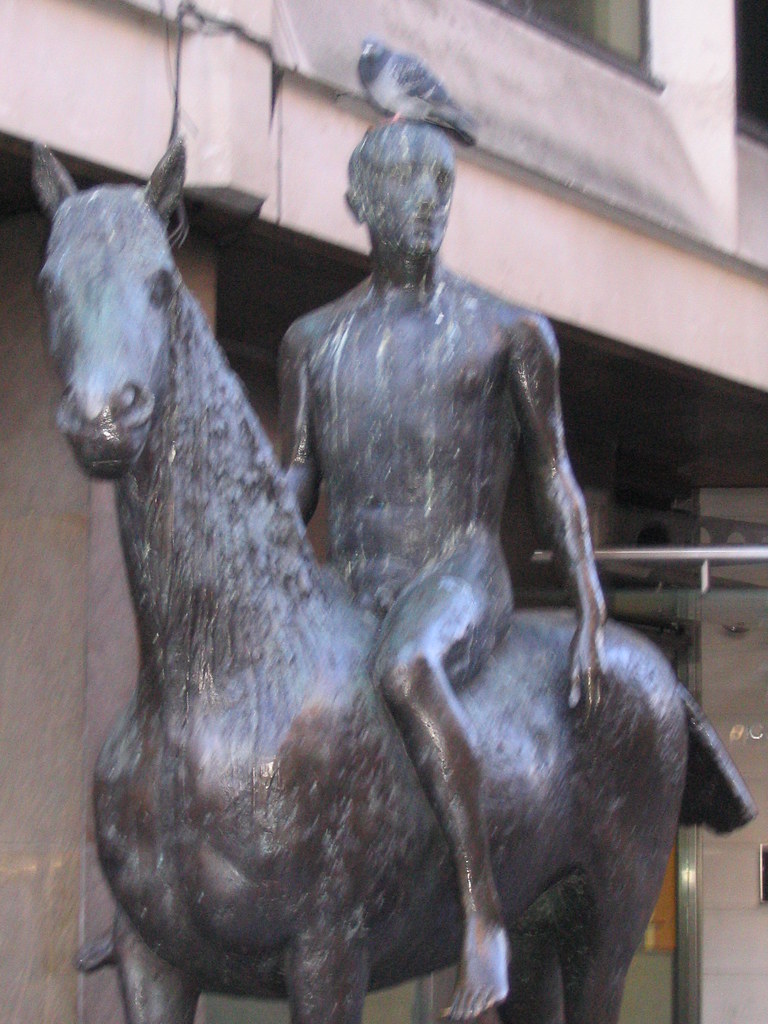
One for PigeonhedOutside Caffè Nerd on Dover Street, just off Piccadilly, is a small equestrian statue, usually with a pigeon on its head. I sat by it a few times before I realised it was an Elisabeth Frink, and I confess that I don’t recall why I began to pay attention to her. There was a small show at Woking I took myself off to a couple of years ago and materials at the Beaux Arts Gallery, London.

In my mental map, British twentieth-century scuplture was dominated by three names — Henry Moore, Barbara Hepworth and Eduardo Paolozzi — before we get into the Caros and the Gormleys and the more conceptual sculptors. Moore and Hepworth seem to occupy a curious middle ground between neoromanticism and modernism — shapes somewhere between the abstract and the bodily, sensual, demanding to be caressed. Paolozzi is plainly of the machine age — the aesthetics of collage and the cyborg, Lego bricks and circuit boards in bronze.

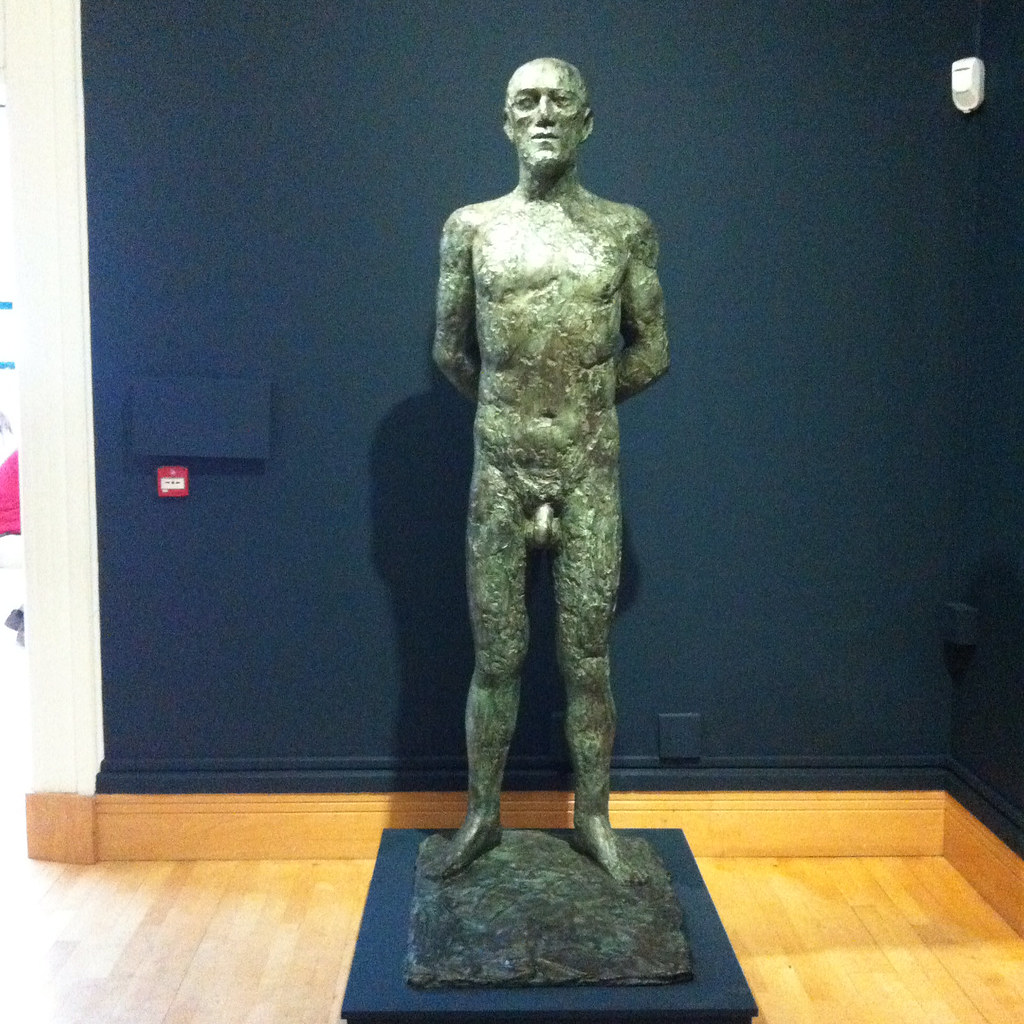
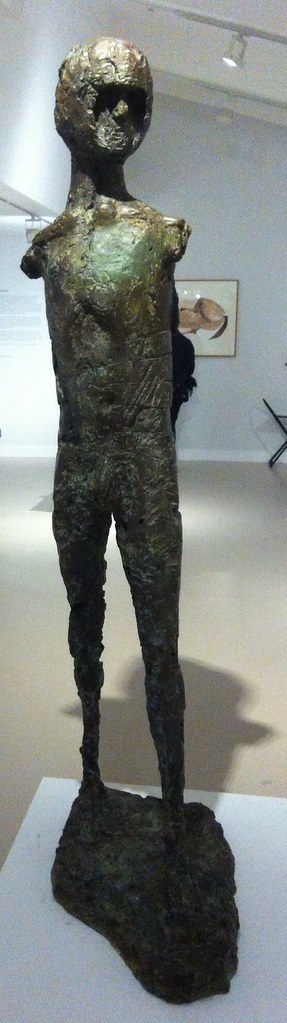
Standing ManWhilst all three are producers of solid work, Moore and Hepworth are more abstract and Paolozzi is more surreal than Frink. Frink’s sculpture has an extraordinary physicality to it. Her statues are of walking, running, jumping, flying and falling men — yeah, pretty well all men — and clearly there is tension between such movement and the fitness of bronze or concrete. Even the standing men seem to loom, arms behind their back, cock and balls hanging, solid presences, somewhere between threatening and sexualised.

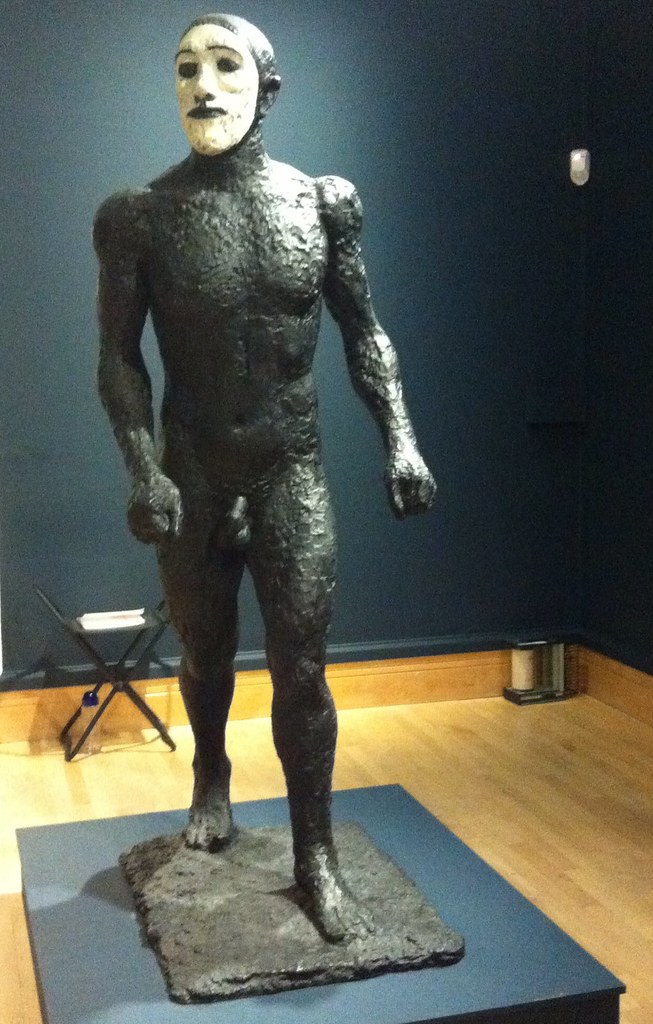
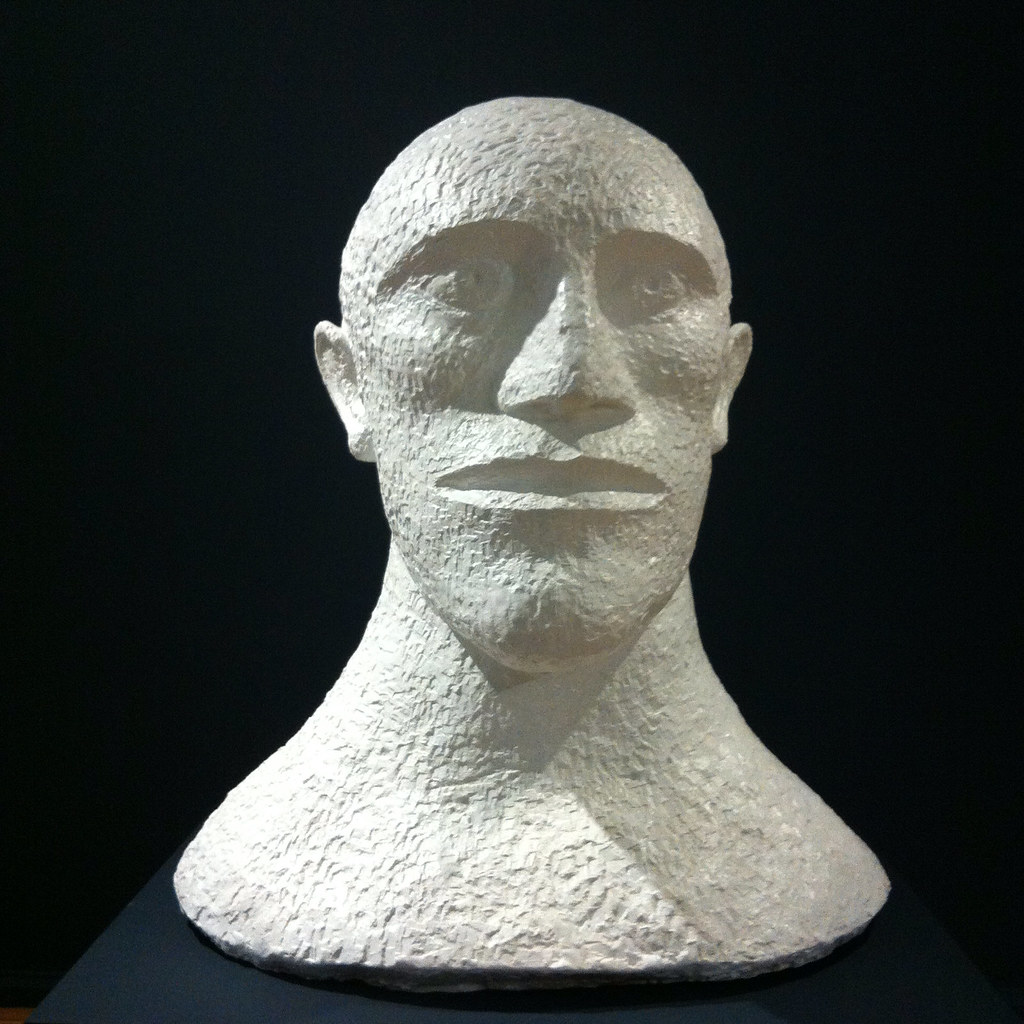
Riace IIIImagine: some of these were commissioned for the headquarters of W. H. Smiths. Remember that when you try to get your free chocolate bar with a copy of The Mail on Sunday. The Walking Man became one of the Riace, named for the bronze statues found in the sea in 1972, and is in white face, one of Frink’s odd experiments in coloured bronze. Apparently her statue of a dog was coloured; the Desert Quarter (1985) bronze is white. Are these angels or demons?
Desert Quarter
She’s presented here in a curiously dialectic way; on the one had she was a child during the Second World War although she knew of the horrors of Belsen and the atomic bombs, the anxieties of the Cold War; on the other hand her public commissions are associated with the Utopianism of the Garden City and New Town movement in the post-war rebuilding. Sculpture was meant to inspire people — whether outside civic buildings or shopping centres, or in the new Coventry and Liverpool Metro Cathedrals.

Her Christ, in a gouache, is muscular, the emphasis on the physicals over the divine. There are pictures here of the crucified Christ, the body emphasised over the cross. There is a Mary and a nun, and a study for Judas, which is also known as the warrior. Her military men — the flying men, the air men — always already seem traumatised, the sculptural equivalent of post-traumatic stress syndrome. And that makes me wonder about her Judas; he betrayed with a kiss, he was paid his thirty pieces of silver, he bought the field and hung himself. Was Judas a warrior — did he fight with his demons and lose?

BirdmanThere is her Birdman, apparently commissioned for a school but thought destroyed (like her first commission, but a damaged version was found this year), a tall, gangly man, with stubs on his back, decommissioned wings perhaps, a fallen angel among men. There is her Running Man (1978), not, apparently, an athlete, but rather a fugitive from some unspecified conflict. Her Flying Men (1982) are hang gliders but seem about to cast themselves into space — inspired by one Léo Valentin (1919-56) who made his own birdlike wings in a vain attempt to fly. Is he also her Falling Man (1961)?

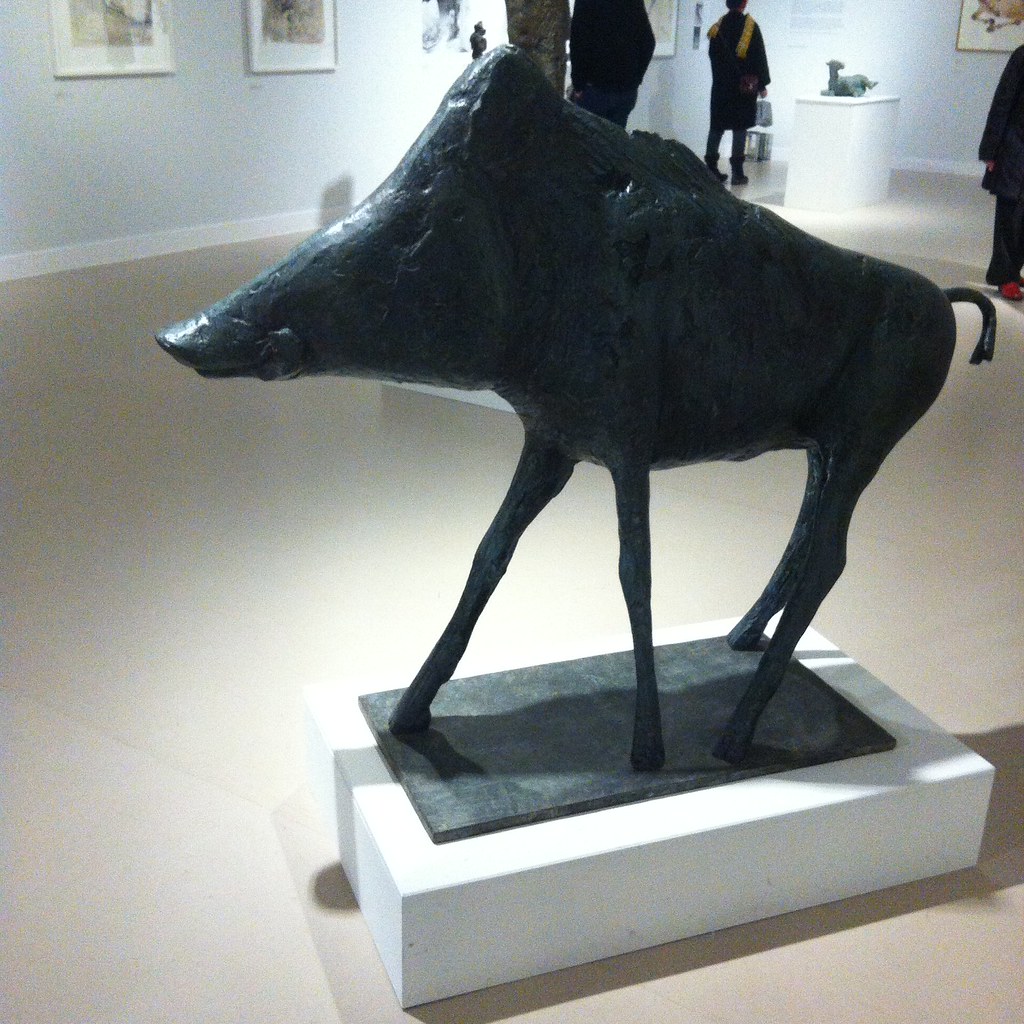
BoarThere are animals — lots of horses, sometimes with riders, a boar for Harlow, warthogs and dogs. Dogs whose heads you want to pat but mustn’t. There are birds, but of ill omen, her Harbinger Bird III (1961) and Warrior Bird (1953), corvids, menacing; on the other hand her eagles, often designed for pulpits and linked to the Kennedy assassination (there is also an uneasy sculpture, The Assassins, but all of them are uneasy).

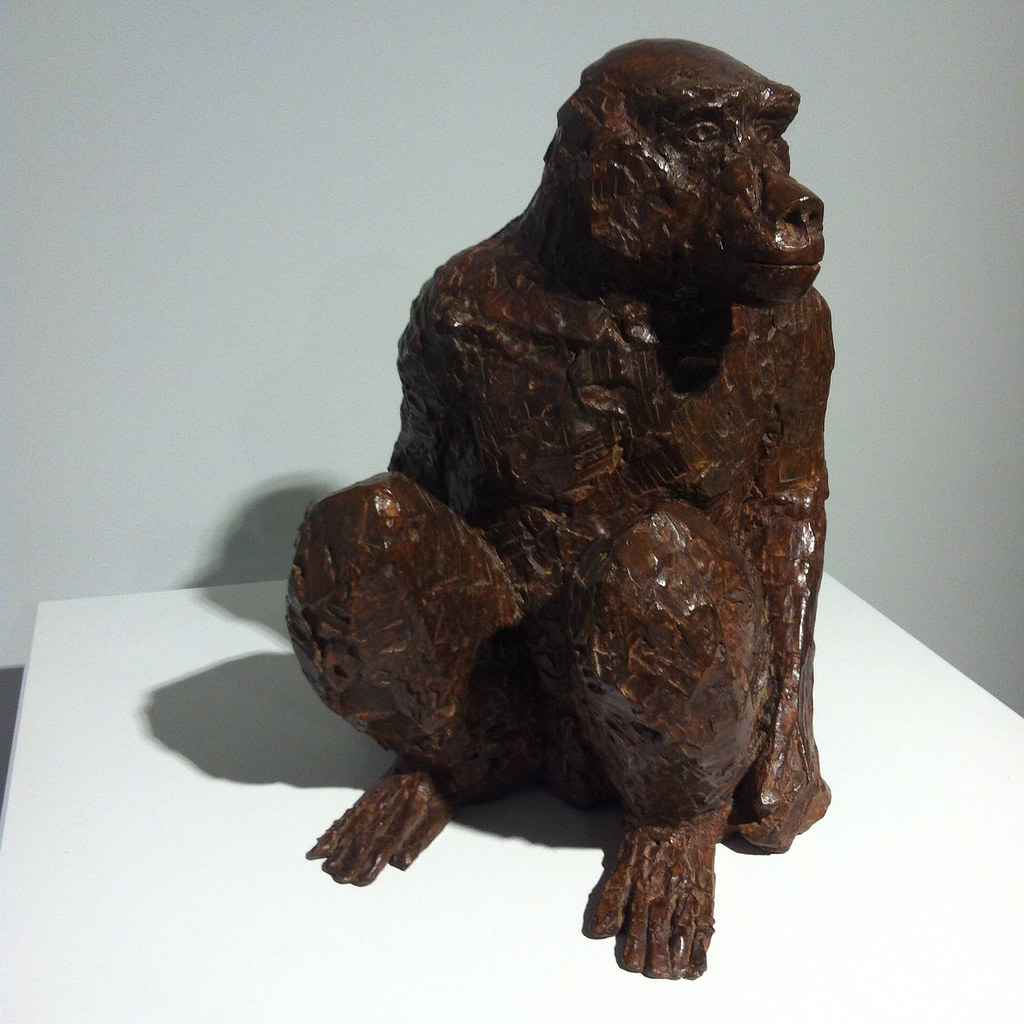
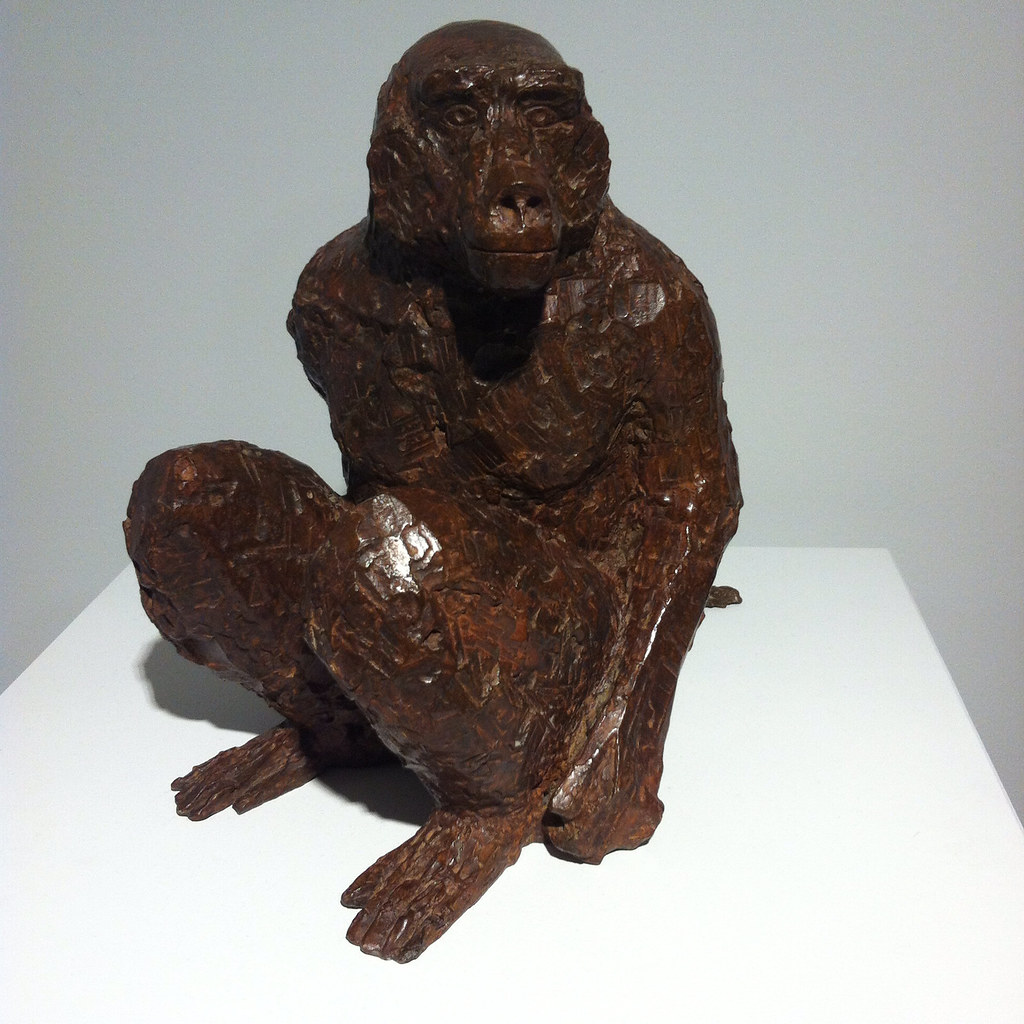
And of course, there is the baboon, commissioned for London Zoo, but it’s a different version here. And there’s a water colour, apparently inspired by an Australian trip although that makes little sense, of an encounter between a man and a baboon. Apparently the baboon is unimpressed by the man.

BaboonBaboon

So her subject is man rather than woman. She may have done mother and child pairs like Hepworth and Moore, but none are here on display, and she was clearly a mother. The few female statues here are caped or cowled. Is there an avoidance of female objectification? Is her aim to objectify men? There were warrior women she could have portrayed, traumatised refugees. But clearly that was not for her.

Bridget Courbevoie

Bridget Riley: Learning from Seurat (Courtauld Art Gallery, 17 September 2015–17 January 2016)

I tried to find the bridge (Bridge at Courbevoie (1886-87)) on Google maps but failed — the river Seine, the bridge, a distant factory, trees, fisher men, walkers. Georges Seurat’s brand of Post-Impressionism, pointillism, made up from coloured dots, half way between colour printing and cathode ray tubes. In another place, Roy Lichtenstein was to enlarge dots and make pop art of comics.

Copying is original.

Deliberately, if annoyingly, the copy and original hang either side of the doorway, challenging you to find a viewpoint from which they can be compared. You carry the memory of one to the other.
photo (2)

Bridget Riley may have seen the painting at the Courtauld – I presume it was at the Warburg Institute, Woburn Square in 1959, having recently moved from Portman Square? — but instead it struck her in R.H. Wilenski’s book on Seurat and she then decoded to paint her own version. It’s bigger, of course, but then the book may not have been clear how big the original was. I think she knew, really, so decided to make the dots larger, and so the intensity of the original is pushed even further from photorealism. The sky is curiously yellow, matching the colour in the water and the grass. He creates light from colour and that seems to be what fascinated Riley.

If the colours become abstract, then so do the shapes — triangles, poles, lozenges, anticipating Riley’s move from stripes into something more… foliated. The Lagoon paintings, for example.

sketch

And then, on an opposite wall, Pink Landscape (1960), the shimmer of summer heat in Sienna represented by dots of red and green and pink and orange and blue, and a child’s farmhouse of white walls and a red roof. The shapes of the fields form lozenges.

Wilenski writes of Bridge that “The little man in the bowler hat has missed his train back to Paris and will be scolded by his wife; the child will be late for tea and spanked, maybe, by its mother.”

Heigho.

But we would lose the narrative in Riley as the pinstripes become stripes.

Here we’re offered variants on stripes — Late Morning I (1967) with green and red and white and blue stripes insisting on length and direction, the vertical, Vapour (1970) with white, brown, purple, green stripes overlapping, question the plane and Ecclesia (1985), thicker stripes, taking on volume.

But Tremor (1962) draws the eye — black and white triables that also form curves and ribbons and you swear the painting rotates in front of you.

A painting approximates reality through strokes, dots, stripes and the pointillist returns it to dots. Riley’s insight was to occupy the geometry, to chase the relation of shape, in canvases that move both optically and emotionally, to create luminence.

Bibliography

  • Bridget Riley: Learning from Seurat (London: The Courtauld Gallery/Ridinghouse, 2015)
  • Wilenski, R. H., Seurat (London: Faber & Faber, 1949)

Mirthless in Brooklyn

Vampire in Brooklyn (Wes Craven, 1995)

It’s a bad sign when, even a week or so after watching, you are unclear whether you are watching a horror film or a comedy.

There was a time when Eddie Murphy was box office gold — actually he’s waxed and waned several times — and this film comes at a point where he’s tied into doing films for Paramount (for example Beverley Hills Cop (Martin Brest, 1984) and sequels, Coming To America (John Landis, 1988), Harlem Nights (Eddie Murphy, 1988), Boomerang (Reginald Hudlin, 1992)), but wants a break from doing comedy. Craven, meanwhile, had long harboured desires to move on from horror.

It is a match made in…

Well, somewhere damp.

The opening seems promising enough with a ship adrift and heading into a Brooklyn harbour in the fog — a nod back to Dracula somewhere along the line. But Murphy in weird wig and thick accent as vampire Maximillian from somewhere in the Caribbean is insufficiently horrific or comedic, displaying the same kind of tension that Jim Carrey sometimes does when playing straight. Maximillian is in search of a woman to continue the species, in the form of NYPD cop Rita Veder (Angela Bassett). Maximillian, meanwhile, has to pass as a preacher and an Italian criminal, allowing him space for the comic business that has largely been displaced onto his hapless, petty criminal assistant and valet, Julius Jones (Kadeem Hardison). These are some of the longest scenes in the movie.

Let’s note the theme of the untrustworthy family — Veder’s mother, some kind of paranormal anthropologist, is dead, and it almost seems as if Maximillian is her father, or a father figure, which leads us to incest. There are a couple of dream sequences, as she wakes from a nightmare, and Maximillian turns a squalid apartment into a mansion.

Meanwhile, we have a strong female lead — albeit with the slightly lovelorn Detective Justice (Allen Payne) to help her out — and indeed an African American lead (compare Poindexter “Fool” Williams (Brandon Adams) in The People Under the Stairs (1991)). In fact, Italians aside, there are very few white actors in the film — Joanne Cassidy has a cameo as Captain Dewey, as does Jerry Hall as a woman mugged in the park in a moment that ought to have political bite, but… We should note Zakes Mokae from The Serpent and the Rainbow (1988) as Dr Zeko, but have a creepy sense of the Haitian equivalent of Orientalism about both roles. Craven is trying.

But the film is trying — Murphy will go onto better things, and Craven was to put his tongue better in his cheek in the Scream franchise.

Old Red Eyes is Back

Red Eye (Wes Craven, 2005)

So the original plan was to watch a film that wasn’t work-related – Midnight in Paris (Woody Allen, 2011) – but that started skipping and so I went back to the Wes Craven pile I’ve been working through and should have written up but haven’t. Of course, this is a late entry in the oeuvre and I need to check out whether this or Cursed (2005) came out first. These were his penultimate non-Scream franchise movies.

I’m interested in these as works of an auteur and so the point is I suppose that this is thriller rather than horror, although it has hints of the home invasion horror that Craven began with in The Last House on the Left (1972). Craven was arguably the director who introduced the supernatural into the slasher, but he didn’t need it here or in many of his early films. Unusually, too, there is no playing around with reality and fantasy, although comic relief receptionist Cynthia (Jayma Mays) is wandering through a nightmare shift.

So we have Lisa Reisert (Rachel McAdams), a nervous flier on her way home to Miami from her grandmother’s funeral, making phone calls to an over protective dad, the great Brian marked-for-death Cox; you know it can’t end well. She strikes up a brief relationship with blue-eyed Jackson Rippner (Cillian Murphy) – indeed the film could have been called blue eyes – who turns out to be part of a plot to kill deputy Homeland Security guy Charles Keefe (Jack Scalia). She must move him into a suite where he can be assassinated or her father gets it. Most of the film is in the claustrophobic confines of the plane.

So, relatively common for Craven, we have a female lead – although at first you wonder whether she couldn’t fight back a little more. The decks seem stacked against her, but that’s the way the plot works. She comes good in the end, although (spoiler) she is denied the pay off.

There is a political subtext – the evils of the Homeland security – but oddly the film comes down on the side of them and the villains are mostly unseen and ill-defined off screen machinators. Should we see it as a critique of the TSA that the characters are so able to move on and off of aeroplanes, even on a domestic flight? The earlier Craven would have had a bit sharper teeth, but this is Amblin after all.

The families are less ambivalent than usual – the Keefe family seem adorable and whilst Lisa’s parents are split up, daddy seems nice if overprotective. Again, earlier films have critiqued the family, and in the avenging family there is a question of whether eye for eye justice is justified.

The climax, despite a largely unnecessary return to the hotel, is at the family home, mid remodelled, and somewhere along the line there is the sense of the uncanny as the familiar and he forgotten. The place of refuge and safety turns into a trap – Lisa moves from locking out into locking in. The police, obviously, can’t help as usual, and justice has to be personal. Her weapons are improvised – whilst villains have guns and knives, she has chairs and fire extinguishers and hockey sticks but an inexplicable failure to kick anyone in the balls. And, as I say, patriarchy reasserts itself.

I’m glad I’ve ticked this off the list, but it’s a by the numbers slick thriller with some nice touches.

How to Suppress #94

Back in the day I wrote a chapter on postmodernism and science fiction for The Cambridge Companion to Science Fiction. Space, as always, was tight, and as I recall, my focus was on the three key thinkers who characterise postmodern theory — for better or worse Jean Baudrillard, Fredric Jameson and Jean-François Lyotard. I certainly knew about Meaghan Morris’s The Pirate’s Fiancée: Feminism, Reading, Postmodernism (1988) and Donna Haraway’s “A Manifesto for Cyborgs” (1985) but it looks like neither get a mention. It might have been I assume one or other would be in a chapter on gender or feminism, but that’s no excuse.

More problematic — and I’m not going to go and check — is that all my fictional examples were by male authors.

The editors did not notice, but someone did:

Butler fails to mention even one science fiction text author by a woman or even one female literary theorist. How to suppress women’s writing? Butler’s article supplies an egregious answer. (Barr 153)

Yes, bang to rights.

Continue reading →