Exhibitions for Expotitions (February/March 2015)

I have a Google spreadsheet on which I keep a list of exhibitions that I am thinking of going to. It isn’t complete, it’s south-east centric and check before you travel if it’s on or open. (Plus if I’m not going to be interested in a thousand years, I don’t list it).

I’ve trued to be clever and list here the show opening or closing between now and 31 March 31, by ordered of urgency (THEY’RE CLOSING). Unfortunately, in switching between programs my highly logical European date format (day/month/year) have converted to the odd US ones (month/day/year) and I’ve no inclination to correct them this time.

Deus-ed Up, Or: All the Deus-Bros.

Ex Machina (Alex Garland, 2015)

Here be spoilers, although not really until paragraph eight onwards (nine if this is one). I’ve tried not to give the ending away. 

There’s a reading of Harrison Ford’s rather plank-like performance in Blade Runner (Ridley Scott, 1982 etc) as Rick Deckard that suggests it is in fact a rather nuanced representation of a replicant. It doesn’t make sense as a reading, but there you go (he can’t be one of the six escapees because…).

I got the same feeling about Domhnall Gleeson about ten minutes into Ex Machina. It doesn’t make sense as a reading, but then again, what does? I was also reaching for Bluebeard and Vertigo (Alfred Hitchcock, 1958), neither of which end well.

Bluebeard is the one when a duke invites his bride to stay in his castle whilst he goes off on a jolly, leaving her with the keys to all the rooms but instructions not to unlock the seventh door. Obviously she does, just as Eve ate the fruit and Pandora opened the box. It’s Story.

So Caleb (Caleb Williams, son of Jephunneh or son of Hezron, a villain in Buffy the Vampire Slayer, a computer game character who is a gunslinger) is a computer jockey who wins the golden ticket and gets to go to the chocolate factory the CEO of Bluebeard Bluebook’s secret lair. Before you it, know he’s flying across a landscape straight out of Jurassic Park (Steven Spielberg, 1993) to the secret lair. If Gleeson has a look of both Nathan/Justin from Queer as Folk, Oscar Isaac’s Nathan is more bearish, pummeling a punchbag, swigging a beer from a bottle and being furry under a vest. Apparently he is a genius. (Nathan — son of David, Nathan Fillion played Caleb…)

Caleb, before he goes any further in his bonding over beer, vodka and sushi with Nathan, has to sign all kind of non-disclosure agreements to make sure we feel uneasy.

Continue reading →

Coinage?

At one of the first sf conventions I went to, Tom Shippey used the word “intergenrification” in conversation with Iain Banks and Iain M. Banks. It seemed to be a useful word, for the ways in which genres collide and intermingle with each other, or the way in which a text belongs to several genres at once. This may well have been one of those moments when we were getting all excited over slipstream — the genre of fiction of postmodern sensibility — that comes along every year or so. A decade or so later, people were getting excited about interstitial texts, texts which belonged to no genres, although its name suggests that these are texts between genres. Despite this being, frankly, arrant nonsense, I was recruited to write on this subject, “Between the ‘Deaths’ of Science Fiction: A Skeptical View of the Possibility for Anti-genres”. For that matter, my contribution to the Festschrift (bless you) for John Clute and Judith Clute considered the fluidity of genre boundaries at the heart of (John ) Clute’s project. I reviewed Gary Wolfe’s Evaporating Genres for Science Fiction Studies, with the sense that for Wolfe the genre had not so much evaporated as never solidified in the first place.

And then, as part of a new module, Popular Genres and Popular Culture, I delivered a lecture on intergenrification I wanted to talk about the way in which the sitcom has overlaps with docusoap and fly on the wall documentaries and game shows and chatshows and I googled the word “intergenrification“.

It gives two results. The second is to a PDF, which apparently includes the quotation, “It may be the case that intergenrification is a staple of postmodernist literature, but there may be other readings of the novel.” Ah, a believer in PoMo, I presume.

The first is to something I wrote, “Thirteen Ways of Looking at the British Boom, my Pioneer Award-winning article: “As Steve Jeffery wrote in his review: ‘Levy’s debut is assured but tries perhaps too hard … to be too many things at once: sf thriller, fantasy, dystopia and romance’ (Jeffery 28). This intergenrification is typical, however, of the British Boom.” See how I use the word, confidently assuming that people will know what I mean?

I did some hunting around for my JFA piece, but failed to find a file on this computer and or  online, although there is a book that does at least cite it.

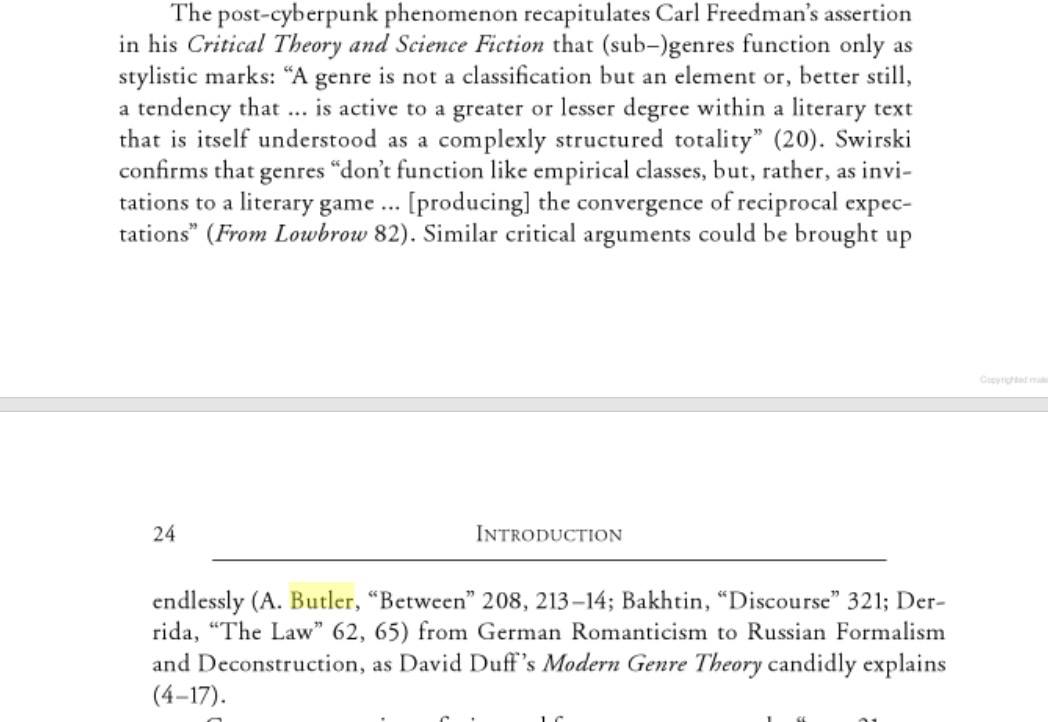
quote

Butler, Bakhtin, Derrida. Not bad company.

It looks as though, should the word ever make it into the OED, I’ve got dibs along with the other chap on the citation quotation – and, believe me, I checked for the entry.

It was only today that I’ve clicked on the other link, and discovered it’s a PDF of my PHD and presumably vaguely official. Who knew it was out there?

So, should I ever want to do more work on this, I have the primacy. I don’t have the JFA article to hand, but I have a draft, in which I write

We hold these truths to be self evident: i) no genre is ever pure, ii) no text ever belongs to a single genre, iii) no text is genreless. Our justification for the latter two truths comes in part from the essay by Jacques Derrida called “The Law of Genre” (1979). “As soon as the word genre is sounded,” he writes, “as soon as it is heard, as soon as one attempts to conceive it, a limit is drawn. And when a limit is established, norms and interdictions are not far behind” (224). But that limit is already transgressed. The law of genres is that genres are not to be mixed – but the law of the law of genre is that genres are contaminated, impure or parasitical. Individual texts overflow the boundaries, become larger than their limitations, transcend their classes. Derrida advances the thesis that a text does “not belong to any genre. Every text participates in one or several genres, there is no genreless text, there is always a genre and genres, yet such participation never amounts to belonging” (230). And, lest we forget, Brian Aldiss reached a similar point two decades earlier in a review: ‘[T]here is no sf novel that is purely an sf novel. At some stage all sf novels turn into something else’ (Aldiss, Brian (1964) ‘[Review of] Judgement at Jonbar’, S. F. Horizons 1: 22.). This is not just the case for sf novels.

But, obviously, if Professor Shippey wrote something down, I’d certainly admit priority to seniority.

Bibliography

  • Aldiss, Brian (1964) [Review of] Judgement at Jonbar, S. F. Horizons 1.
  • Butler, Andrew M. (2003) “Thirteen Ways of Looking at the British Boom”, Science Fiction Studies 30(3).
  • Butler, Andrew M. (2004) “Between the ‘Deaths’ of Science Fiction: A Skeptical View of the Possibility for Anti-genres”, Journal of the Fantastic in the Arts 15(3), pp. 208-216.
  • Butler, Andrew M. (2012) Review of Evaporating Genres: Essays on Fantastic Literature, Science Fiction Studies 39(1), pp. 155-158.
  • Derrida, Jacques (1979) “The Law of Genre”, Critical Inquiry 7(1), pp. 55-81.

Peter, Paul and Rubens

Rubens and His Legacy: Van Dyck to Cézanne, Royal Academy of Arts, London, 24 January-10 April 2015

Pretty well all I knew about Peter Paul Rubens was that he painted women … of a fuller figure. It was a surprise then to begin with a study for John Constable’s The Haywain. I’m guessing I’d only just seen this last year, when I’d done Tate Britain’s Late Turner and the V&A’s Constable exhibitions in one day. Both painters appear to have drawn on Rubens’s romanticised landscapes. I wonder – does this pad out an exhibition which had an odd corridor between rooms?

The fuller figures appear quite late, but then the thematic approach – Poetry, Elegance, Power, Compassion, Violence and Lust – obscures chronology. The tricksy subtitle – “From Van Dyck to Cézanne” – is odd, given the inclusion of Pablo Picaso and Oskar Kokoschka, who surely postdate Cézanne and French Impressionism. It’s in the falling of the damned that they are first visible – suggesting that gluttony may be a factor. In the penultimate room the women are described as “buxom” and “corpulent”. Tricksy thing, language.

Tricksy thing, influence. Oskar Kokoschka’s “Loreley” seems very distant from Rubens, but that’s a corpulent Victoria.

Loreli

Those painters are clearly copying that canvas – but that’s not in the show (“A Flemish Kermis“, for example), nor is there a reproduction.

Flemish Kermis

When it’s an altarpiece or a ceiling I guess it can’t always be reproduced. But still. A little visual context.

For me, though, the highlight of the exhibition was La Peregrina, a room of twentieth century artists inspired by Rubens, although it’s hard to see how Sarah Lucas’s fried eggs and kebab quite do that. Curated by Jenny Saville, her own black and white drawing “The Voice of the Shuttle” stands out, even among the company of Bacon, Warhol, Freud and Auerbach. These are corpulent rather than buxom.

I can’t say Rubens blew me away – I preferred Giovanni Battista Moroni, oddly, a couple of weeks back – but certainly this exhibition definitely held my interest for just short of two hours.


On the other hand, the RAA gallery assistants trying to sell audio tours are getting as bad as chuggers and I wish the RAA would decide where its ticket desk is.

Interstellar (Christopher Nolan, 2014)

The short version: it’s very pretty, so who cares about the flaws.

The longer version: remember that recent film that kills off a major character only for him to come back to the protagonist – except it’s all a hallucination due to oxygen starvation? Imagine waiting an hour, hoping it’s all a dream.

The even longer version:
We are haunted by 2001, A Space Odyssey. Like it or not, it has become the yardstick of the serious sf movie, the sf art film. It travels at the kind of pace that we rarely see in Hollywood film these days and when we do, I often find it self indulgent rather than joyous. Alternatively, given the action takes a couple of million years and travels to infinity and beyond – sorry, beyond infinity – that’s somewhat speedy as an average. The apes take a while and the stargate sequence really frustrates my students, but there is a joy in the miniatures and the classical music that has rarely been bettered. Hal 9000 created a new stereotype, the evil shipboard computer, to such an extent that I never trust a computer to run a ship.

And so comes along Interstellar, another pretender to the tradition, weighing in at 2hr 49 mins, nine minutes longer than its daddy, minus overture and intermission, or indeed Strauss, Ligetti and Wagner on the soundtrack. Nolan’s done interesting movies – I’ve a soft spot for Falling, a disappear up its own fundament psychological thriller, I enjoyed Memento, despite our not knowing much more at the end than the beginning and The Prestige is an interesting take of Priest’s novel, unfortunately shorn of its present day framing device. I eventually caught up with the Dicklite Inception on DVD and it has its moments, but too many of them seem to being situating women as less good than men. He did some comic book franchise, too, set in a dystopia where almost all women had died out.

So we have Interstellar, a film which I had singularly failed to find three hours to see prior to Saturday, and which I saw in one of the smallest cinemas in existence. We have nostalgic talking heads, telling us how things now have changed, We have Matthew McConaughy as Coop, an actor I last saw in Reign of Fire alongside Christian Bale, and the facial resemblance here suggests that so kind of synthespian shenanigans have been going on. We have a future in which the crops are failing one by one – Death of Grass anyone? – and the solution to this is to ruin the soil even more by growing the same crop in the same fields. Me, I’d be exploring hydroponics and such like. This is a world that needs more farmers and fewer engineers (although in guessing there’s a wriggle out of this) and where there’s a Sekrit Plan to evacuate Earth run by Michael Caine. But that is to get ahead of ourselves because there a Sekrit Messages being sent to Coop’s daughter, Murphy, including binary or Morse code coordinates for the Sekrit Rendezvous (because poltergeists, like the aliens from Close Encounters of the Third Kind, know where Greenwich Meridian Line is. Before you know it, Coop has met Dr Brand and her father, Michael Caine, who turns out to be an old friend and clearly marked for death in tragic circumstances at the three quarters point if the movie.

Look away now. Spoilers.

Continue reading →

Spinning Plates

I meant to write this entry six months ago and it would have begun “Yesterday (Friday), I was sent the finalised version of a chapter with a request for proofreading by the end of the weekend. I was annoyed, because I wanted to work on a book proposal.”

I’m always spinning plates. At any one time I could be:

  1. having an idea for a piece
  2. putting in a proposal
  3. drafting a piece
  4. rewriting a piece
  5. proofreading a piece.

Let’s see, at the moment I have various ideas for pieces and …

  • a paper to write for the Sideways in Time conference
  • a keynote to write for the SF postgrad conference
  • a book to read for review
  • a book proposal to finish
  • a conference paper to convert to an article
  • a secondary bibliography to annotate
  • two chapters to write for companions
  • an overdue biographical piece to write
  • an overdue survey chapter
  • an article that’s been bounced from a special issue but has been taken up and needs another thousand words adding
  • a book manuscript to rescue
  • a  submitted chapter that I’ve heard nothing back on
  • several reference book entries that are missing in action
  • a submitted chapter that may well need a proofread.

Meanwhile, there’s an edited collection due out with a chapter in it.

And none of that includes my research on brewing and drinking, that I’ve spent more time talking about in relation to KE and Impact than actually researching. I need to go away and read some Habermas, which incidentally is the thing I need to do for the book proposal although it’s not the same Habermas.

Looking at the list, that’s not much spinning plates as watching them crash. I have three lectures to deliver this week, only one of which has material to hand. My research day is tomorrow, but I fear the morning may have to be writing lectures.

I also have a stealth book I’m planning to assemble, but I’m not sure I’ve written any of the chapters yet. As conferences come up, I should be giving papers that would fit into that or the book proposal mentioned above — but the one for Sideways in Time is 1970s and something I missed from Solar Flares. Having looked at a call for papers for werewolves, I was thinking about something from entirely the wrong period for that proposal — although it wouldn’t fit on the face of it — nor in the stealth book. But it is on film, which I should be writing on.

At this point, I should really be saying no to projects, but then it’s an interesting venue or a cool editor or a sufficient cheque… A collection recently came out that I don’t have a chapter in, and it is clearly “my” thing, but any annoyance is balanced by the realisation that I in no way had time to write for it. I’m still open for business, but don’t be upset if I say no.

ETA: If you think I’m writing something for you and it’s not listed here — I am deliberately coy about the actual projects here for reasons of plausible deniability — email me. I may have entirely forgotten I said yes… Send me a message?

The Incredible Hulke

Michael Herbert (2014) Doctor Who and the Communist: Malcolm Hulke and his career in television (Nottingham: Five Leaves Publications), ISBN: 978-1910170090, 30 pages

I’d heard somewhere about the scriptwriter Malcolm Hulke being left of centre, although I’m not sure where from. I knew him through Doctor Who novelisations from the 1970s. Most were based on serials he’d written – although the titles were often changed from the television versions, none of which I’d seen. Some of them I had caught up with on TV or DVD over the years.

There was something about his aliens that was different. All too often, aliens stand in for difference, and thus a threat – within the Hollywood tradition as invaders, frequently to be read as the foreign threat of the age, typically the Communist. Invasion of the Body Snatchers (Don Siegel, 1956), say, can be read as McCarthyite parable (or a satire of McCarthyism … or an attack on normalising America). Only rarely – The Day the Earth Stood Still (Robert Wise, 1951), Close Encounters of the Third Kind (Steven Spielberg, 1977), ET, The Extra-terrestrial (Steven Spielberg, 1982), say – do they come in peace. Hulke’s aliens tended not to be the villains of the piece, although humans often assumed they were at first. He often used reptilian characters – the Silurians, the Sea Devils, the Draconians, the dinosaurs …. (well, duh). There’s an article in that to be written somewhere.

A week or so back an old comrade Mike Sanders drew my attention to a review of a pamphlet, Doctor Who and the Communist, in the Morning Star. This was published by Five Leaves Publications, a Nottingham-based radical small press who had published fascinating collections on Utopias and Map and appear to have opened a shop that is the natural successor to the much-missed Mushroom Bookshop.

The pamphlet, by socialist historian Michael Herbert, is thin. Well, obviously. Thirty pages. And what we seem to know about Hulke is thin. He was illegitimate at a point when it attracted much social stigma, he seemed to have gone to university, he joined and left the Communist Party at some point and worked for the Unity Theatre. I wonder how easy it would be to find out which university? I guess you’d need to go around each university? Has anyone asked Terrance Dicks? I suspect such information wouldn’t exist unless there was some letters or diaries. We don’t know when he joined the Communist Party or when he left – Herbert assumes 1956, with the invasion of Hungary, but that’s just a guess. Would there be a secret services file on him? I didn’t know where the Unity Theatre was and Herbert doesn’t tell us. It turns out it was in the King’s Cross area, now under housing, and home to a significant number of actors, writers and directors over the years.

Hulke doesn’t seem to have written for the Unity Theatre but wrote for radio and TV, including the Target Luna (1960), Pathfinders in Space (1960) Pathfinders to Mars (1960-1) and Pathfinders to Venus (1961) serials, early children’s sf from Sydney Newman. When he was working on an episode of The Avengers, “The Mauritius Penny” (10 November 1962), he called on the aid of an advertising copywriter he was renting a room to, Terrance Dicks, as a cowriter. Hulke wrote scripts for early Doctor Who, which weren’t used, including a historical, so it wasn’t until “The Faceless Ones” (8 April-13 May 1967) that his byline appeared on the series – a story about aliens stealing human identity. (Ok, that doesn’t seem so typical. Co-writer David Ellis had worked on Dixon of Dock Green and was about to work on Z Cars). Less than two years later, Dicks turned to Hulke to help cowrite “The War Games” (19 April-22 June 1969) as the production team had run out of usuable scripts and time. Dicks, continuing as script editor commissioned him both to write “Doctor Who and the Silurians” (31 January-14 March 1970) and help rewrite David Whittaker’s “The Ambassadors of Death” (21 March-2 May 1970). Hulke’s work is clearly some of the most interesting of the era – an era that backed itself into a narrative corner by stranding the Doctor on Earth. Each week an alien had to invade or a scientific discovery had to go wrong; the series’s centring on a Britain defending itself from attack was clearly politically very interesting.in terms of its narrative of English postimperial melancholy. As I write in Solar Flares: “At a point when Britain had a relatively low military profile – and before the resurgence of the Troubles in Northern Ireland – the UNIT narratives provide Britain with a role in world affairs without anyone having to go overseas (although occasionally they get to leave the planet).” (p. 117). Hulke seems to have been sceptical of the military, which introduces a tension in the UNIT stories.

Herbert spends about a paragraph on each of the serials, little more than brief summaries, noting significant actors, and so forth, before moving on to discuss those Target novelisations. (Dicks was series editor, unofficially I believe, but was both repaying a debt and giving work to a colleague who could produce the goods.) The political subtexts are noted, but not developed. Much of the Doctor Who materials appeared on a blog as a guest post. How does Hulke’s communism play out in his sympathetic aliens and his dangerous militias?

This pamphlet feels like a precursor to further work. Is there analysis to be written of Hulke’s sf or has it been done? I would imagine there are plenty of documents in the BBC’s archives, and I don’t know what criticism there is out there already, fannish or academic. I can’t see me doing any digging in the near future, so there it is, an idea parked.

I note, however, that coming soon is a biography, by John Williams, Mac: The Life and Work of Malcolm Hulke, which may answer such queries.

Bibliography

  • Doctor Who and the Cave-Monsters (London: Target, 1974) [“Doctor Who and the Silurians”]:
  • Doctor Who and the Doomsday Weapon (London: Target, 1974) [“Colony in Space” 10 April-15 May 1971].
  • Doctor Who and the Sea Devils (London: Target, 1974) [26 February-1 April 1972]
  • Doctor Who and the Green Death (London: Target, 1975) [“The Green Death” (19 May 1973-23 June 1973), by Robert Sloman]
  • Doctor Who and the Dinosaur Invasion (London: Allan Wingate, 1976) [“Invasion of the Dinosaurs” (12 January to 16 February 1974)]
  • Doctor Who and the Space War (London: Allan Wingate, 1976) [“Frontier in Space” (24 February-31 March 1973)]
  • Doctor Who and the War Games (London: Target, 1979)
  • Terrance Dicks, Doctor Who — The Faceless Ones (London: Target, 1986)
  • Terrance Dicks, Doctor Who — The Ambassadors of Death (London: Target, 1987)

Doctor Who and the Communist is available from the publisher’s website, I would guess their bookshop and Housman’s Bookshop, Caledonian Road, London near King’s Cross.

Upon this Key, Time Will Slide

I don’t recall how it was I first got into Tangerine Dream in the early 1980s. With Neil and Paul I shared an interest of making music although I was always on the production side. I don’t recall whether we got into Tangerine Dream because Neil had a keyboard or whether Neil got a keyboard because we were into Tangerine Dream. Pink Floyd and Led Zeppelin and Genesis were hanging around, perhaps drifting from older brothers’ bedrooms and there were two drama teachers who were to be our gurus to alt.culture. Jean-Michelle Jarre had released three albums – Oxygene was too abstract for me, Magnetic Fields felt too commercial and Equinox was just about right.

We were considered to be old enough to be allowed to go into town with friends or even on our own without adult supervision, and not only were there two or even three HMVs, but Selectadisc had two branches, probably three shops, and WH Smiths still sold vinyl. Brothers in Arms was yet to convince us that plastic boxes were the way forward. There may have been an Our Price and an (ho hum) Andy’s Records, and a market stall and – a miraculous discovery – Good Vibrations, a secondhand music shop raising money for Greenham Common protestors with a psychic cat who sat on the precise stack of LPs you wanted to look through next.

Of course, we must have heard some – it was regularly used in documentaries and we watched Horizon most weeks – or got into it somehow because one day I went into town and went from shop to shop checking prices. The cheapest two available were Phaedra and Rubycon and I suspect that I just thought that the ghostly blues of the sleeve were more pleasing than the drop of water on Rubycon.

It would be ten years or more before I was to read Walter Benjamin but already I got aura. A gatefold is a thing of beauty and a joy forever. The twelve inch of cardboard already gives a fantastic canvas, but a gatefold gives you a landscape. In time it gives you Roger Dean (and you end up with Avatar) and a whole new world. (Triple albums on the other hand I was in two minds about. Maybe they were a little … decadent? Pretentious?) The album held a magic that CDs never did – they were regressive in design terms, mere functional – and I cannot embrace to download, as a child of objects rather than services. I scoured the sleep for information – dates, personnel, who played what and noted a child’s face (a boy? a girl?) hidden in plain sight in the artwork.

And having got the bus home and the not then so Aged Ps being out at work, I could listen to Phaedra on the stereo in the living room. There is that moment of anticipation when you buy a record you know nothing about – if I could remember church services I might compare to the vicar raising the host or something – the moment of not knowing what sound is going to emerge or whether the stylus will not just scrape across that disk.

I can’t write about music and I can’t dance about architecture, but then you knew that. A seventeen minute thirty nine seconds instrumental using moogs, mellotrons, organs and sequencers – the flob flob flob running water/fan of the VCS3 – and somewhere in the mix guitars and bass and flute. It felt – at an age too young for drugs – like I’d been taken on a trip. Certainly I was already hooked.

Meanwhile Neil had gone out and bought Rubycon. He played it to me and I liked it but obviously it wasn’t quite as good as Phaedra, although it had that secret head hidden on it. We had a kind of unspoken agreement – home taping was killing music and so we would each buy a Tangerine Dream album and allow the other to record it. We went into town and – trust a thirty year memory – we bought Stratosfear and Tangram. (Might it have been Exit with its sell-out five minute tracks or Ricochet?) I can’t remember if Neil’s version of Tangram had an inner sleeve design or an insert, but some versions had them. We researched tangrams. We looked up the strange words from the track titles in dictionaries and thesauri. We went out and bought Force Majeure and Hyperborea and I liked both them rather more than Neil did who wasn’t sure if that had been a fiver well spent.

At some point Paul joined in – I think we let him buy Cyclone (oh poor pretentious children) and I think he bought White Eagle and I had this sense that was risking the pact because we weren’t keeping up in buying them all together (really? What was I thinking?). Over the next two years we collected all the Virgin studio albums and two live albums. The local library had – why I have no idea but someone must have ordered it – the OST for Sorcerer and one of us must have bought Thief and Le Parc. The double live album Poland came out and was maybe a little meh. The Virgin years were behind us. TD wise.

And we saw them live at Nottingham Concert Hall, sat in the front row and then we had everything they’d released (or we assumed) and the new stuff was too electronica my tastes. I saw them live again and again too much BPM. By then we were at uni and I listened to taped copies and the albums gathered dust – I bought some of Paul’s cast offs and filled in my gaps. Vinyl was over though.

How did we know what the gaps were? I suspect we scoured microfiche in the library and maybe there was a reference book. I’d borrowed Atem, Alpha Centauri and Zeit (“Shite”) from the library, but a boxset scored me copies along with Electronic meditation. Klaus Schulze had gone solo and I think I was the only one to really like him – although the fake strings of X (“Heinrich von Kleist”?) nearly swayed Neil’s classical loving Dad. Peter Baumann released two albums – poppy technoish – and so did Steve Joliffe – one about extra bodily experiences the other butterflies. Edgar Froese released solo work – but that was pretty well Tangerine Dream anyway, although I was less of a fan. I tried atonal music and Bach and dipped into Eloi, but never quite went the krautrock route. I collected Bo Hansson’s four albums and some of Gong and… the pretentious progrock of Yes.

Vinyl was dead. My brother bought me CD compilations and when I saw the other CDs in Fopp for a fiver I picked them up. I put some on my hard drive. My brother burnt me later albums onto CDs, I found bits on Spotify and YouTube but it lost the aura.

And now Edgar Froese is dead. Chris Franke aside, he was for me Tangerine Dream.

I’d only just played one of their CDs but don’t blame me.

It’s a whole chunk of my teen years – my eighties as uncanny echo of the then hated (by others) seventies, the decade that taste forgot. Did I write about them in Solar Flares? (I dance on the inside.) It was technology and culture and internationalism; it was Saturday mornings; it was friendships and altruism and rivalries; it was teenage bedrooms and joss sticks and a row of trainers by the front door; it was playing with keyboards and home made multitrack; it was a pile of TDK D90s. It was a way into baroque and to minimalism, although for me it wasn’t the diddly diddly diddly music our parents scorned but the minimalism that would change, the abstract that shifted into tune – the unexpected melody of a piano, the screech of electric guitar disguised. It was analogue fucking with digital. It was the thrill of the hunt, it was that pile of record sleeves. It felt real and it would last forever.

It didn’t. It probably wasn’t.

Exhibitions for Expotitions

I used to maintain a listing of exhibitions that might interest me – so I didn’t keep missing stuff. It was never completist, and had a south east/Midlands/Newcastle/Edinburgh bias because I tend to go there, but I figured it might be of use to people. I fell off this due to life and am slowly reconstructing from scratch. Check venues before travel – many galleries close Mondays. It’s messier than I’d prefer, because I want to post it.

Closes October 2014

Continue reading →

Welcome… By way of a meta(research)blog

I seem to have scattered myself around the social media and really ought to focus a bit more. But that’s not likely to happen, so I will use this to act as a jumping off point for various other blogs.

My photographs are at Flickr: https://www.flickr.com/photos/andrewmbutler/

This comes in fits and starts and is probably the most frequently updated.

My 1970s sf blog relating to Solar Flares is at http://flares.wordpress.com/ and was not as posted to as I planned. Writing the book (http://www.amazon.co.uk/Solar-Flares-Science-Fiction-Liverpool/dp/1781381178/ref=sr_1_1?s=books&ie=UTF8&qid=1409755636&sr=1-1 – now in paperback) seemed to take the energy for bloggage, but I will return to it as I come across further 1970s materials.

My blog on beer and drinking is at http://galaxychallenger.wordpress.com/. I’m hoping to come back to this.

There are a couple more blogs waiting in the wings… as projects become more concrete. I have a chapter that needs a rewrite this month and another not so long after that. There’s a chapter needs a draft, and short pieces in the queue.

Meanwhile, on the publications front:

Coming Soon:

Recently published:

  • ‘Doctor Who Symposium: Richard E. Grant’ Science Fiction Film and Television 7.2 (2014)
  • ‘Bearly Conscious?: Deconstructing Pullman’s Postmodern Marionettes’, Philip Pullman edited by Catherine Butler and Tommy Halsdorf (New Casebooks, 2014)

In press:

  • ‘Human Subjects/Alien Objects?: Abjection and the Constructions of Race and Racism in District 9’ Science Fiction and Tales of Transnationalism, edited by Ulrike Kuchler, Silja Maehl and Graeme A. Stout. Bloomsbury Academic USA, 2015.