Exhibitions for Expotitions

This is in no way complete… it’s mainly exhibitions that I could conceive of getting to, with a London/Southeastern bias. Although I can conceive Edinburgh, Newcastle, Gateshead, Liverpool and Manchester. Go figure. Check details before travel — galleries really don’t like Mondays.

Corrections welcome.

Yes, I know this is messy. Tidier next month.

Closing September 2015

Continue reading →

Manifest Pollocks

Blind Spots: Jackson Pollock (Tate Liverpool, 1 July 2015-17 October 2015)

Jackson Pollock was born in 1912 in Cody, Wyoming, but grew up in Arizona and California. Having gone to art school (and been expelled), he became an artist for the Federal Work Program. His big stylistic breakthrough was the all-over drip painting, although pouring might be a better word. The whole canvas is covered by oil or thinned enamel paint dripped from brushes or syringes; in most cases the paint over lies and is overlain with other paint, in some cases the canvas is visible.

Pollock was slotted into the abstract expressionism category — abstract because it wasn’t figurative, expressionist because he was expressing his feelings and emotions on the canvas. This wasn’t necessarily a term he liked and I will come back to it. Pollock was an alcoholic and went through Jungian psychoanalysis to attempt to cure this — the assumption is that his art can be understood in Jungian terms, presumably expressing a nonindividuated ego and archetypes. Early paintings had Greek mythic titles and he is also assumed to be drawing in an interest in Native American art.

I hope to return to this but I’m troubled — action painting gives access to the unconscious and more primitive stares of mind, such as that of the Native American.

Koffs.

Really?

In 1951, after a less successful exhibition of the kind of paintings we know Pollock for, he took a change in direction: the black paintings. These were largely blank canvases with thinned black enamel dribbled on them — sometimes calligraphy, sometimes faces, sometimes scribbles — and it is this set of paintings that becomes central to Blind Spots, the current exhibition. Whilst they’ve never been entirely ignored, they have been downplayed.

Pollock wasn’t the first to paint in black — Malevich’s black squares have been seen at at least two British shows in the last year, at Tate Modern and the Whitechapel. Willem de Kooning had a black and white painting, coincidentally also in the Tate at the moment. But Pollock painted just in black.

I was worried — I prefer twentieth to pre-twentieth-century art, but I don’t like all abstract art. I was worried that I’d be wasting my time seeing this, even though I prepared by reading three or four books on Pollock. Pollock is the epitome of the “My six year old can paint like that” school of art criticism; it’s said of Picasso, too. And bollocks. But I wasn’t sure I’d get it.

I don’t pretend this to be profound, but it struck me that there is an opposition between figurative and abstract, figure and ground, paint and canvas and so on. Paint is applied in layers — in three dimensions, however trivially, as new paint obscures old.

If abstract expressionism gives us access to the unconscious, how do we know it’s the artist’s unconscious rather than our own? Does that matter?

Of course, schooled in deconstruction, you’d expect me to pick away at the oppositions.

There are specks rather than spots in this exhibition — but blind spots are the part of your eye where the nerve and exits and lacks rods and cones, there the bit that wing mirrors can’t pick out (Pollock died in a car crash) and blind spots are the things critucs overlook. But there was for me a misprison — I thought of Paul de Man’s Blindness and Insight, the blind spot of a text or of the critic’s reading of it.

Hmmm.

At the start of the exhibition is a found collotype of a mother and child, mostly obscured in black ink.

Obscure vs. reveal. Mask vs. unmask.

The mother and child is a key trope — archetype of — of the history of art. The Madonna and Child. This is clearly a pop art version, but we need to keep an eye out for this in the exhibition. Pollock’s mother and Pollock? Maybe. Is the black ink covering them up or revealing them? It certainly draws attention — you look harder.

The idea of looking is set up for us in the first picture of the show. It is the keynote.

(To be continued…)

In Search of the Indigenous

From the Forest to the Sea: Emily Carr in British Columbia (Dulwich Picture Gallery, London, 1 November 2014-15 March 2015)

I confess that I had never heard of Emily Carr, apparently one of Canada’s best loved female painters. Of course, the list of female painters is depressingly short — although I’m fond of female surrealists such as Frieda Kahlo and Leonora Carrington, not to mention Laura Knight, Paula Rego, Elisabeth Blackadder and Bridget Riley… I presumed that she might have some connection to the Group of Seven, in part because the Dulwich Picture Gallery had a show of their work a few years ago.

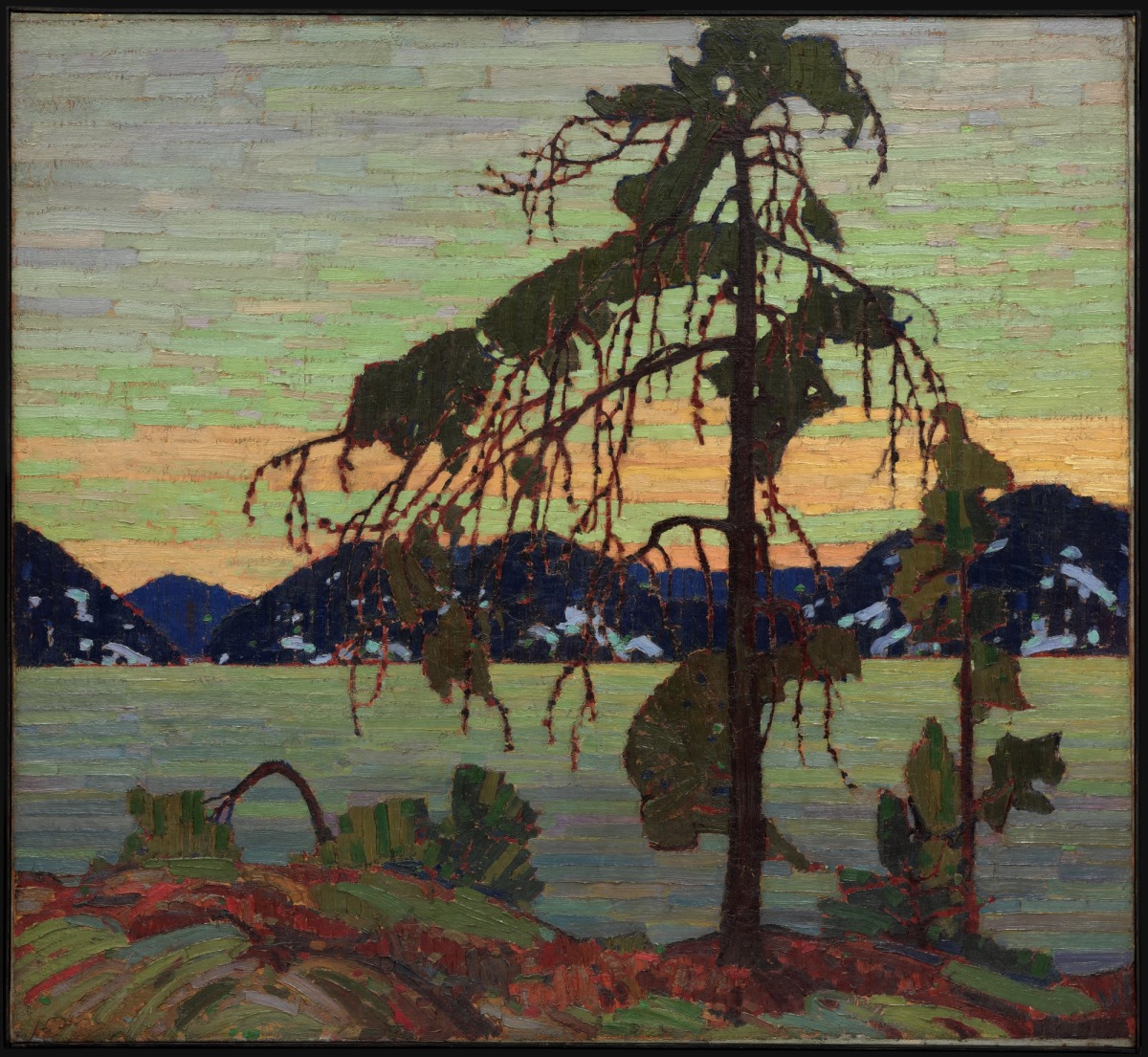
If memory serves there were a number of landscapes painted on wood, painted on location in the wilds of Ontario and points north, accompanied by full scale canvases. Slightly before them was Tom Thomson (1877–1917), who I think I saw a show by in Toronto (unless it was in Adelaide…). The landscapes are strangely depopulated, presenting Canada as a Terra Nullis, untouched by human hands. Of course, there were any number of indigenous native groupings, out of sight. It left me a little uncomfortable — but we’ll come back to that.

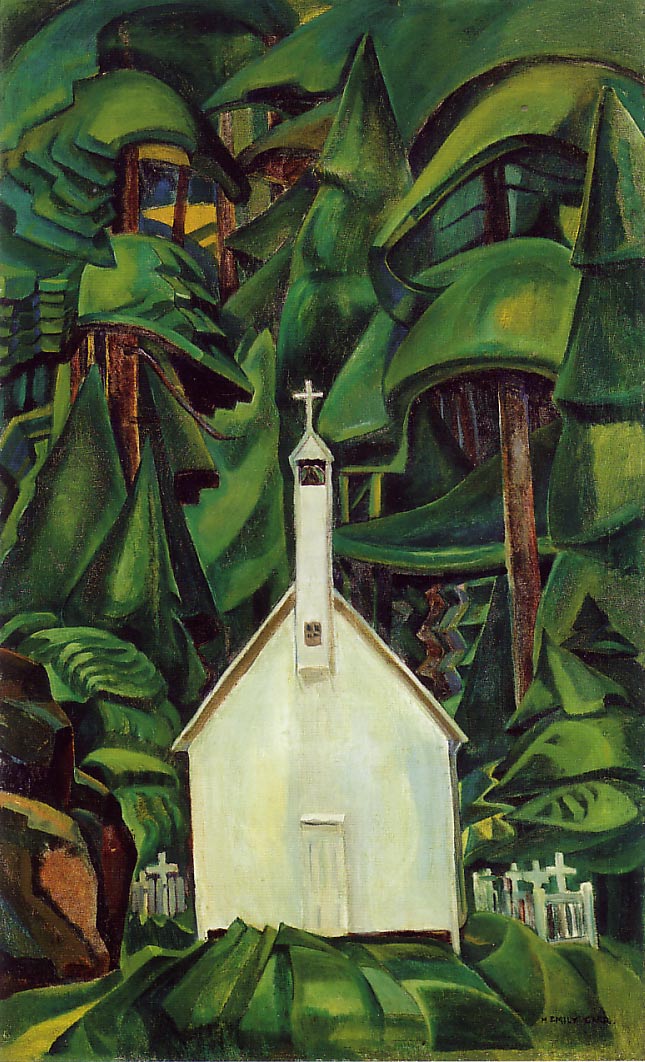
Emily Carr’s exhibition began with paintings of forest from the 1920s – in a sense toward the end of the story. The leaves spiral, there is a real sense of action in the painting – although, of course Carr writes “If there is no movement in the painting, then it is dead paint”. One of the most significant paintings is “Indian Church” (1929).

This is not Terra Nullis, because there is clearly the impact of western society on the forest, a whole way of thinking in the new world. But she was also interested in theosophy and mysticism and argues that “Metamorphosis between species and states is the only predictable feature of the cosmos”. Magic? Maybe.

Daughter of English immigrants to British Columbia, Carr had an interest from an early age in the wilderness outside the settlement. She had art lessons as a child and, despite the death of her parents, went to study at the California School of Design, San Francisco where she learned how to paint outside. On graduating she went to London, to the Westminster School of Art and took courses at places such as St Ives. Back in Canada she taught and painted, before travelling in 1907 to Alaska. She was inspired by Native American culture and art, and started trying to reproduce it in her paintings: “Indian art broadened my seeing, loosened the formal tightness … I was as Canadian-born as the Indian but behind me were the Old World heredity and ancestry”. Her paintings stay largely deserted – although some of the sites she depicted had been abandoned through disease or general depopulation. Here’s Janice Stewart: “Emily Carr found in her unproblematic identification with the Indians of the Canadian west coast a second skin to inhabit, which seems to have allowed her to paint and write beyond the gendered boundaries of contemporary conventional aesthetics. Carr identified the creative part of herself as Indian.” But Stewart is more interested in Carr’s writing than her paintings.

In 1910, Carr took a trip to Paris, where she was exposed to the Impressionism (and I guess early Post-Impressionism). Again, this would feed into her art – and it did strike me that some of her landscapes had the flavour of Vincent Van Gogh to them (whom she referred to as a “crazy poor chap”).

One striking painting is of Kwakwaka’wakw war canoes (1908 and 1912)– and this one does contain figures.

These are exactly the same boats as appeared in Edward S. Curtis Land of the Head Hunters (1914) – an extraordinary and deeply problematic drama where native culture was presented in a deliberately antiquated manner:

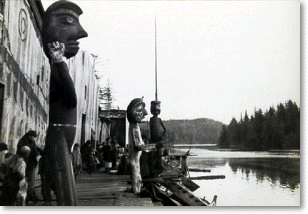
Inevitably she has taken a decision in the representation or not of indigenous peoples. A photograph of Blunden Harbour from 1901 (with people)

became the centre of a painting in 1930:

I’m torn – I don’t have enough data from the exhibition to know whether the elimination of the indigenous (whilst retaining their cultural productions) shows respect for them or is part of the Terra Nullis drive. As a female artist who kept not quite being taken seriously, she found something in the peopels she met to inspire her. But is is a form of romanticisation? Gerta Moray labels it “aestheticized nostalgia”, and suggests that Carr’s attempt to preserve what she perceived as a dying culture contributed to the decline.

Sources

  • Moray, Gerta (1993) Northwest Coast Culture and the Early Indian Paintings of Emily Carr, 1899-1913. Diss. University of Toronto, 1993.
  • Morra, Linda (2004) “‘Like Rain Drops Rolling Down New Paint’: Chinese Immigrants and the Problem of National Identity in the Work of Emily Carr,” American Review of Canadian Studies, 34(3): 415-438.
  • Stewart, Janice (2005) “Cultural Appropriations and Identificatory Practices in Emily Carr’s ‘Indian Stories’”, Frontiers: A Journal of Women Studies 26(2): 59-72.