You Know My Methods

“But you have retired, Holmes. We heard of you as living the life of a hermit among your bees and your books in a small farm upon the South Downs.”

*

My villa is situated upon the southern slope of the downs, commanding a great view of the Channel. At this point the coast-line is entirely of chalk cliffs, which can only be descended by a single, long, tortuous path, which is steep and slippery. At the bottom of the path lie a hundred yards of pebbles and shingle, even when the tide is at full. Here and there, however, there are curves and hollows which make splendid swimming-pools filled afresh with each flow. This admirable beach extends for some miles in each direction, save only at one point where the little cove and village of Fulworth break the line.

Mr. Holmes (Bill Condon, 2015)

So the conceit is that Sherlock Holmes is real and retired thirty-five years ago (from 1947) to Sussex, after a final, unsatisfactory case, a case that has been published by Watson and even filmed, but which Holmes cannot quite remember.

Holmes has one of those canons that is easily filled – how did he learn his skills? what are those cases we are told he solved but we’re not ready for? what did he do in the gap between “The Final Problem” and “The Empty House”? what happened to him after Watson put down his quill? And then there are the inevitable continuity errors that add further layers – was Watson shot in the leg or shoulder? why is Watson called James in “The Man With the Twisted Lip”? was Watson married twice? And despite an occasionally proprietorial estate – with little connection to Doyle, I believe – we have endeavoured to provide solutions.
So Holmes has been living on the South Downs (or edging into Romney Marsh at times, I suspect), forgetting. Forgetting and remembering is a theme – he remembers the case, he remembers dealing with Mycroft and a visit from Watson, he remembers his trip to Japan. He has forgotten coming out of retirement on the eve of World War One and “The Adventure of the Lion’s Mane”. Meanwhile, Roger (Milo Parker), the child of Mrs Munro (Laura Linney) his housekeeper, cannot remember his father, killed in the Second World War.
Holmes strives to retain and win back his powers of deduction, so he can resolve that last case, and to train up Roger to take over the bees, as the son he never had.

The word we’re looking for is redemption.

Curiously, redemption through stories and through lying to others.

So, Holmes is either lying or has forgotten that he has written two stories already: “The Adventure of the Blanched Soldier” and “The Adventure of the Lion’s Mane”. The stories themselves tell us he disputed some of Watson’s story-telling.

We’re meant to forget this.

We have McKellen, reunited with director Bill Condon who did the James Whale biopic Gods and Monsters (1998) with him – McKellen, one of those actors who’s always seemed old to me. I remember his coming out on Radio 3 – in 1987? I recall seeing his one man show, Acting Shakespeare. I was lucky enough to catch his Waiting for Godot with Patrick Stewart. I gather he’s done other movies and a sitcom (but Michael Hordern is Gandalf). Laura Linney is divine in a somewhat thankless role. John Sessions and Philip Davies have brief cameos, Roger Allam a bit more screen time. Colin Starkey needs a better agent (or there are bonus scenes). Virtually everyone plays it straight – aside from good old Frances de la Tour who seems to have wandered in from a sitcom (although not, I guess, Vicious) when they couldn’t afford Miriam Margolyes. If the film doesn’t work, it’s at the level of plot, not acting.

And what worried me, pondering at a hidden unhappy ending of the deaths we will not see, was the prickly ash that Holmes has brought home all the way from … Hiroshima. And then ingested. As, indeed, has Roger.
Maybe they end up with super powers?

The Secret Scapegoat

Every one of us has his, or her, dark side. Which is to overcome the other?

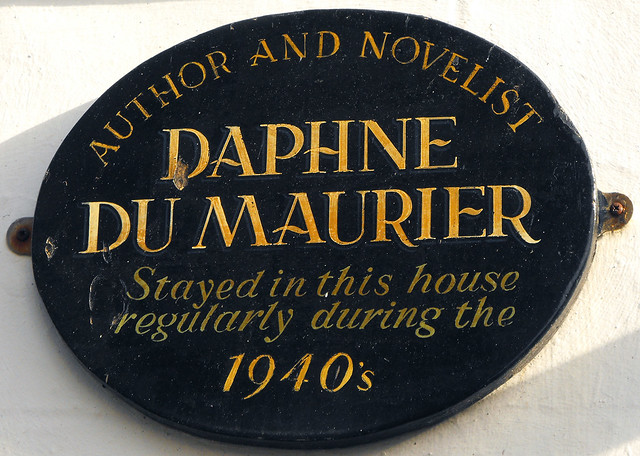
For reasons that escape me, a number of years ago I bought a boxset of Daphne Du Maurier novels. I must have thought this was good plan, because I then bought a second, and a couple of novels not included in either. I also bought the collection which contains the story that was the basis for ‘Don’t Look Now’. Note “The Birds”, Jamaica Inn and Rebecca. The most Hitchcockian of novelists – with perhaps the thought that Du Maurier was a Cornish Patricia Highsmith. The grand plan, being anal, was to read the novels in chronological order of publication, but that never happened and the boxes sat by my bed, gathering dust. So I picked one at random. Du Maurier Plaque Daphne Du Maurier, The Scapegoat (1957) John, a university lecturer, is on holiday in France, fantasising about the past and Joan of Arc, and imagining a secret life. He runs into his exact double, Jean de Gué, and the two go for a drink, in fact a series of drinks, before retiring to de Gué’s hotel room where John passes out. He wakes, in Jean de Gué’s clothes and is mistaken for the other – a Comte who has failed to negotiate favourable terms for the family glass foundry business, who has a morphine addicted mother, who hates (and is hated by) his brother and who is shagging half the female population of the locality. Rather than saying, Oh my good man, you have mistaken me for someone else, to the chaffeur, John decides to take over de Gué’s life and set about saving the family and the business. We are in melodrama territory – the morphine mum, the swooning pregnant wife, the visionary daughter who is on the one hand disappointed by her lying daddy and on the other hand prepared to lie for him. (There is an incident quite late on, a suspicious death that the daughter alibis as accidental.) It feels curiously nineteenth century – but we are in France and we are in the decade after the Second World War and neither detail is irrelevant. The mechanisms of plot are perhaps a little too visible – and one expects the first Mmme de Gué to burn down the chateau at some point… Note that John is given no surname (remember the central character of Rebecca is nameless), and that we can but wonder if he is a doppelganger or the same person, a psychotic twin (or unpsychotic), the result of some trauma. Is John Dr Jekyll or Mr Hyde? I was careful to avoid spoilers whilst reading the novel and avoided the introduction. What I did discover was that it has been filmed twice, once in 2012 with Matthew Rhys directed by Charles Sturridge and previously with Alec Guinness directed by Robert Hamer. Now that is a film I do want to track down – Guinness is perfects casting (and it’s a bit Graham Greene territory as a novel) and Hamer is better known for Kind Hearts and Coronets, with several Alec Guinnesses. Betty Davies plays the matriarch, which also seems like genius casting. And so I’m tempted to have another lucky dip, another Du Maurier.

Point and Break

Queen and Country (John Boorman, 2014)

And way back in 1987, John Boorman directed an autobiographical film which was a loving portrayal about living through the Second World War, Hope and Glory. I remember rich reds and oranges and sunsets and barrage ballons and the occasional bombsite. Nearly thirty years on, we see the celebration of the child at his schools having been bombed, before cutting to a decade later and life on an idyllic island on the Thames as a prelude to being conscripted into the British army.

It is 1952 and the British are fighting Korea (as part of the communism vs capitalism war) and the old king, who never wanted to be a king, is dying; Elizabeth is going to be crowned and the new Elizabethan Age is dawning. Alter ego Bill Rohan (Callum Turner) meets new BFF Percy (Caleb Landry Jones, who I think gets top billing) and both get put in charge of the typing school and briefing the new recruits. Life is made unbearable by stickler Bradley (David Thewlis) and bearable by shirker Redmond (Pat Shortt) – and the whole film is made bearable by Major Cross (Richard E. Grant).

Is that damning enough?

And there’s girls, glimpsed at a cinema, nurses, and the One, Orphelia (Tamsin Egerton), whom Rohan falls head over heels with despite the large warning light over her head (and the fact that she does get to talk sense about how men treat women in the period whilst still being damaged goods).

I guess this is all very mythic and there’s that whole generation of writers and directors too young for the (Second World) war who did national service and had Sensibilities Formed; some went to to private school, others failed the eleven plus, they’re all eighty or above now, if they’re still alive. If asked, I think I might have assumed that Boorman had died at some point.

The film’s conflicted; on the one hand grandfather despairs about the shame that Rohan has brought on the family, on the other I seem to recall it’s him who gets to dismiss the first Elizabeth. And Rohan is a cipher – neither communist nor capitalist, neither really betraying or supporting others, not quite seduced by his sister, not quite clear what he believes in (besides what he reads in The Times). He is, I fear, the least interesting character in the film. You wonder how Korea itself is going to be handled – an early sequence is not promising – and you slowly realise that virtually everyone over 25 has some kind of PTSD. But there’s just enough gentle comedy not to despair.

I doubt there will be a quarter century gap before this is turned into a trilogy – but I’m assuming a third film about joining the movie industry is envisaged, Pearl and Dean, say. Fun with the Dave Clarke Five. Dealing with Lee Marvin. Buggery in the woods. And Sean Connery in leather shorts.

Rainbow in Curved Paint

Bridget Riley – The Curve Paintings 1961-2014 (De La Warr, Bexhill on Sea, 13 June 2015-6 September 2015)

Stand still and look at the flat square.

The diamond.

Relax.

Look at the plane.

Slowly, inevitably, against your will, it begins to move. To dance, to ripple.

And yet.

Still a plane.

And yet.

You look away and there’s still an after image.

There’s no doubt a scientific explanation about the limitations of vision and the brain filling in the gaps – we can’t separate the white from the black or (later) the green, blue, grey.

Oh look, it’s Crest, again.

Riley’s curve paintings began with a black square, which seem to be everywhere at the moment. Malevich and all that. But she wasn’t happy – it didn’t express her failure as an artist enough.

So an experiment led to a circle and a square, Or rather a rectangle. The Kiss (1960).

And from that she got to her curve paintings – some black and white, others using greys, some playing with blue and green and red and grey. Take Cataract 2 (or 3, because I can find a picture of that one) and see how it refuses to lie flat. Cataract 2 is more like an arrow than this – note the stripes aren’t parallel, are offset.
In one room we see a wall of preparatory sketches, many of them on graph paper, and we consider how carefully the abstract must have been arrived at.

And then, in 1980, she stopped. She moved onto vertical lines.

The deckchair years.
But they didn’t vanish forever, as in 1997 there was a return. Lagoon 2 widens the vertical stripes and interrupts them, if not with curves then with segments of circles. The vertical lines are further disturbed by diagonals. In the area given to studies, we see variants that led to this and similar designs – trying out colours, rearranging segments, working on graph paper and tracing paper. “Lagoon” points us to something more organic than maths, something away from the abstract.

“The relation between the line and the curve can be compared to that between the circle and the oval,” she says in an interview. But it also breaks the apparent flatness of the plane.

The most recent piece in the exhibition I think (despite that 2014 date) is a wall painting, Rajasthan (2012) – red, orange, green, grey and the white of the wall. There’s not the same sense of the breaking of the plane, but there’s the breaking of the frame. Given what I’m currently reading about the (American?) battle between the wall and the easel, this feels timely.

Interference PatternBexhill’s De La Warr Pavilion is one of my favourite galleries – and in conjunction with the Jedward Jerwood makes a splendid day out. Indeed, although the effect may not work here, I’ve looked at the light-reducing blinds before and thought of them as op art. The Art Deco curves of the building seem to speak to Riley’s curves and the seaside setting seems to speak to some of those curves as sticks of rock (and I’m not entirely joking about the deckchairs, although none were on show here). It is a show to surrender to – even as it takes you over.

Abstract Goes the Easel

A Marriage of Styles: Pop to Abstraction (Mascalls Gallery, Paddock Wood, Kent, 28 March-6 June 2015)

This is, ish, very ish, the fiftieth anniversary of the second wave of British Pop Art and the University of Kent, and so Pop Art has decided to mark this by having three universities.

Ah, sorry, my mistake, the University of Kent have three exhibitions – one on campus, which I presume they didn’t feel the need to tell anyone about as I missed it, one on Paolozzi and Tony Ray-Jones, which I’ve written about for Foundation, and A Marriage of Styles at Mascalls Gallery. This gallery has a rather good exhibition policy, but it is a l-o-n-g mile’s walk from Paddock Wood station (thankfully on the flat) and is at a school, so I’ve not been as often as I’ve wanted to. I caught this show on the penultimate day and I’m so glad I did. I should note, also, that there are current two rooms at Tate Modern specifically devoted to Pop Art, even though you’d think that would be at Britain?

So what is Pop Art? Well, the word Pop was used in a slide by Eduardo Paolozzi at his presentation Bunk! at the inaugural meeting of the Independent Group in 1952 and Lawrence Alloway in 1958 was to apply it to art that drew on the visual language of advertising, comic books and everyday life, breaking down boundaries between high and low art. In the US, you’d put Andy Warhol and Roy Lichtenstein, who clearly pointed the way for the next generation of British artists, who were mostly at art college in the early 1960s. But if Pop Art constructs a reality through actual or implied collage, these artists were also influenced by more abstract, non-representational, images.

The Paddock Wood show had eleven paintings – I’m guessing one for each member of the the 1966 English worldcup football team – in its two rooms, mostly one to a wall. I’m going to talk about them one by one, mostly from my notes scribbled in the gallery. Continue reading →

Bigger, Faster, Louder, Better

Jurassic World (Colin Trevorrow, 2015)

You know precisely what you’re going to get.

You have the big sexy project that some people are wary about.

You have the ambivalent capitalist who may cut corners.

You have the amoral scientist.

You have the maverick expert.

You have the jeopardy parcel.

You have the people you want gotted, gotted.

You have the bloody obvious sequel hook (which they’ll probably ignore).

So, these kids’ parents are getting divorced for reasons that aren’t readily apparent and so whilst ma and pa lawyer up, dinosaur-obsessive (he’ll have to grow up) and emo-boy (he’ll have to lighten up) are sent to Jurassic World, run by Aunty Spinster who never seems to answer her phone (she needs to learn about motherhood).

Jurassic World, a sequel to Jurassic Park — yanno where so many people died — needs a new dinosaur to beef up visitor numbers and be bigger, faster, louder and better than the last one — yanno just like sequels in movie franchises. Meta. You remember the merchandising room in Jurassic Park (1993)? Just like that kind of meta. And comic-relief  technician/geek Lowery Cruthers (Jake Johnson) wears a Jurassic Park/Jurassic Park t-shirt. (He’s also told to take it off, because what kind of crazy tattooed scientist dude would wear an offensive shirt when there might be press around).

So, to get the bigger, faster etc dino they call in the fiendish Dr Wu (srsly) to miss up the DNA of Indominus rex, a name daft enough that at least the characters have the grace to laugh at. Rather late in the day, they’ve wondered if the walls surrounding it are high enough, although What Could Possibly Go Wrong? They’ve called in maverick expert (Chris Pratt — you know he’ll be a maverick because he lives in a trailer/cabin and tinkers with motorbikes) who warns them Things Could Go Wrong and we think Of Course They Can, Otherwise There’s No Movie.

It’s not clear whether he’s employed on another part of the island by the same company or he’s employed elsewhere or quite what we’re meant to think of his West African friend Barry (Omar Sy). The film’s not big on backgrounds.

So stuff goes wrong and they start closing down the park, only the Jeopardy Kids are still out there, at precisely the point where Rex is hovering. Small world. Big Jeopardy. They also get to find the original Jurassic Park and — well, I kept thinking, this world is smaller, faster, louder, worse, because the geography seems rather tight. I suspect we have a cut scene, too, as Emo asks Baby if he still has those matches even though we haven’t already seen them.

Oh there’s some neat stuff with velociraptors and a few jokes with feet being bird feet not dino feet and the T Rex is saved … but the final stand off is a rabbit out of a hat. Aunt Spinster is very odd — robot eyes at start (business woman out of depth?),  awkward at doing the Unresolved Sexual Tension, does a weird transform into action heroine thing without ditching the high heels, does — for once — grab the bloody gun. Aside from all the dinosaurs (presumably) she’s pretty well the only woman in the film — there’s tearful techy girl and divorcing ma, but that’s about it. Oh, no, I forgot, there’s her clueless PA.

There’s something going on too about not being quite qualified to drive though — John Hammond substitute Simon Masrani (Irrfan Khan) hasn’t quite learned to fly his helicopter, Emo boy hasn’t quite passed his driving test? If we’re being meta, we might consider we have a tentpole movie (which Legendary Pictures clearly need after their recent box office duds Seventh Son and Blackhat) being directed by someone who has only been low budget before. I suspect, however, all the real work is done in special effects and second units.

And I haven’t even gotten to say WTF about evil military guy Vic Hoskins (Vincent D’Onofrio) who figures the dinosaurs have military value, just like the Company in the Alien franchise. Let’s take off and nuke them from orbit.

ETA: this is pretty sharp on the attitude of the film to women:

A la recherche de notes perdus

“The Lost Notes” (2015)

So, of course, the voice isn’t quite right. Michael Palin is not Oliver Postgate — but he’s close. Cathy Butler suggested David Attenborough, but I think the natural history vibe would be too much. But, still, imagine the classic scene from Life on Earth with Attenborough and gorillas, but add Clangers.

It’s odd, though. We always call it The Clangers, although the definite article isn’t in the title screen. That familiar Earth in space, imagined first in a time when we’d hardly seen that view. The Moon’s there, too, which I think is new. Then the move through space to the Clangers’ planet (that took much longer in 1969, but consider on a £10 budget how much a slow zoom can save) and looking at the Clangers themselves. Compare today’s budget.

Pretty much as I remember them, no tubby Dalek redesign, and of course the planet is probably too curved to fit with the scale of the whole, with an angled shot to play with perspective. We even see them upside down. Neat. The dust from the surface — someone has thought about gravity but they never could have done the dust in 1969, and I’m guessing the first animation was pre-Armstrong and Aldrin.

It feels like a classic Clangers plot — the notes from the music tree have blown away and the Clangers go searching for them. This gives us cameos from the soup dragon and the iron chicken — no froglets, and what is that sky hippo from the credits? Seen it before, I’m sure. The fort da game is completed, of course — as I said to Chris last night, jeopardy is hard for children’s television. Restoration, but also change. An environmental subtext?

Oh, and adult subtexts: is the music as the storm gathers a hint of The Wizard of Oz? I hope Mother Clanger gets more to do than laundry and that’s a phallic telescope, Major Clanger. Granny asleep?

I believe I have moist eyes.

There’s a moral pointed, though. “Never give up, never surrender.” Heavy-handed? Maybe.

Memories of the Noise Machine

Despite preferring written to visual science fiction, I suspect I began with television sf. I suspect the first sf I encountered was The Magic Roundabout and The Clangers. Later today, the BBC will broadcast the first new episode of the later in forty years. Given the treatment of The Magic Roundabout, I am understandably nervous.

That actually needs a bit glossing – the sf part of The Magic Roundabout was a film, Dougal and the Blue Cat, of which we had the album, the soundtrack cut to about sixty minutes. The Magic Garden comes under threat from the Blue Voice and her minion, Buxton, the Blue Cat, and the garden’s inhabitants are thrown into prison. Only Dougal evades capture, going under cover as Blue Peter (the Blue Dog) and is sent on a mission to the Moon… I never saw the film until it was released on video, but I did eventually get to see it on a big screen. It resonates through my unconscious.

The Clangers, like The Magic Roundabout, was originally broadcast on BBC1. My memory is they came at the end of children’s television (Blue Peter, say) and before the evening news, but it clearly varied from week to week. The creators, Oliver Postgate and Peter Firmin had been producing paper- and puppet-based animations since 1958 in a converted cowshed just north of Canterbury. The earliest Clanger appeared in Noggin and the Moon Mouse (1967), a spin-off book from Noggin the Nog (1959–65); the concept evolved into a species who live on a small planet, converting rubbish and debris into useful stuff.

Firmin is still around, in his late 80s and I’ve occasionally seen him around, even sat next to him at a screening of The Clangers. His wife, Joan, is a bookbinder and artist, and they had six daughters, at least two of whom are artists (and Emily is the girl in Bagpuss). He still is active, as far as I can tell making limited edition linocuts and vinyl prints on an antique printing press. He was the creator of Basil Brush and worked with Rolf Harris and then Wally Whyton on children’s television in addition to his collaborations with Postgate.

Postgate PlaquePostgate, who died in 2008 in Broadstairs, is the more intriguing figure of the two, whose voice is engraved on my memory. He was the son of radical historian Raymond Postgate and Daisy Lansbury, the grandson of Labour party leader George Lansbury and classicist John Percival Postgate and great grandson of surgeon and food campaigner John Postgate, His aunt, Margaret Cole, was a Fabian politician and social campaigner, whose husband G.D.F. Cole cowrote The Common People, 1746–1946 (1946) with Raymond Postgate. Postgate was a conscientious objector and anti-nuclear campaigner, and the last episode of The Clanger was broadcast on the eve of the October 1974 election, satirising the political process at the time. (There used to be a blog of Postgate’s thoughts on the Iraq war – I have been unable to relocate this). It should be no surprise that a Malcolm Hulke-scripted episode of Doctor Who features the Master watching an episode of The Clangers.

The Clangers is a product of a different era. An innocent era, one might say, but only on the surface (Rolf Harris?). The Postgate and Firmin animations have a charm that I think stays the right side of whimsey, there is an inevitable slowness to them that would be closer to, say, the first of the Wallace and Gromit stop motion animations than the latest Shaun the Sheep. And for whatever reason, I find the Clangers (and the inhabitants of the Magic Garden), realer than most CGI.

There were only twenty-seven episodes of The Clangers ever made – and my heart sank when I heard there would be a remake. I’d shuddered at the Nigel Planer-voiced The Magic Roundabouts that Danot had made after Eric Thompson stopped (Mr MacHenry is not Scottish – know your canon), gave up partway through the Dougal movie and couldn’t bring myself to watch the new cartoons (apparently the line “‘Time for Bed,’ said Zebedee” was nixed because the audience might not be going to bed when they watched the episodes). I am scared.

But NuClangers has the involvement of Daniel Postgate, and I am sure he would want to honour the spirit of his father’s work. The Solar Eclipse episode was reassuring https://www.youtube.com/watch?v=EsAyyOKoTik but when I get to watching the new episodes, on iPlayer I suspect, I will feel a little trepidation.

Incidentally, a number of Postgate/Firmin puppets are on show at Canterbury Heritage Museum, but note that outside of Easter to September it is only opening during school holidays. There is also Postgate’s Becket frieze.

Take It On the Chin

When publishing, even in academia, your work is sometimes reviewed.

In fact, the only thing worse than being reviewed is not being reviewed.

Perhaps your book is so awful, no one wants to review it?

I’d say I’ve had a mix bag of reviews — and I have to say that I often find myself agreeing with some of the flaws the reviewers spotted. With Fifty Key Figures in Science Fiction (2009), we knew that the standard review would consist of “Why didn’t the authors include x, y or z?” and that few would note that that would lead the book to be renamed Fifty-Three Key Figures in Science Fiction. It wasn’t the fifty best, it wasn’t even the fifty key, it was fifty key. Other keys are available. I know one person who seems sweetness and light in person, but who has only really been critical of what I’ve written. So it goes.

So I was sent a review the other day and its author, who I don’t know, didn’t like the work in question. They raise a valid point, but that aside I didn’t get the sense that they’d engaged with the book. I could write a letter of response, get all defensive, but frankly I’ve never seen that kind of thing happen without the complainant looking like a dick.

There was the author a week or so back who demanded a retraction of a one-star review on Good Reads and who proceeded to make themselves look more and more of a dick. Eventually they deleted their comments — but the internet never forgets. Ironically, whilst this has given them all kinds of bad publicity, I would say that  it has probably brought some people to the book, too. In various fora  where there have been Puppies  vs non-Puppies debates, I’ve seen people say that they will now read the book by X because the opposition hate it so much.

No publicity is bad publicity.

So, I’m saying nothing more public or specific about the bad review. I’ve dealt a few myself, and I’m bound to get a few in return.

What I do want to say — and a perverse part of me is sniggering at this — is the reviewer was poorly served by their editor. I recently wrote trust the editor, they are there to save you from yourself. I would hope that the editor could spot the misspelt names in your review, the wrong word being used and the error of fact. Because it’s a thread to pull at in the meantime.

Meanwhile, revenge is filleting negative reviews for pull quotes …

… joking. Honest.

Not8chrs

When I first used a word processor — possibly something like WordStar or Works or LocoScript and then eventually Word 2 — there were a couple of limitations. I recall having to carry six floppy disks around with me to run the programme, and I think that was in addition to the actual file you were working on.

REMOVE DISK 5

INSERT DISK 3.

And those 3 1/2 inch disks were somewhat new fangled.

The other thing was that filenames were of the type abdcefgh.123. Eight characters and a suffix — txt, doc, ps. My PHD thesis, which I have most of electronically was

INTRO.DOC
1CHAP.DOC
2CHAP.DOC
CHAP3.DOC
CHAP4.DOC
CHAP5.DOC
CHAP6.DOC
CHAP7.DOC
CHAP8.DOC
CONCLUSI.DOC
BIBLIO.DOC

No, don’t ask me why the naming convention isn’t consistent.

These days we don’t have to use eight characters and we’re much more used to having nested folders — but equally used to using several machines, pendrives, clouds and gdrives. We can be sensible in our naming conventions.

Let us imagine that I am working on a chapter for a Cambridge Companion.[1] I write a file and I save it as CAMBRIDGE.DOC. That’s nine characters. Living on the edge.

Professor Neil James is editing a Cambridge Companion which consists of twelve chapters. So far, the day after the deadline, he has seven files called CAMBRIDGE.DOC.[2] This, obviously, is aggrannoying, so he renames them by contributor and then I get back a file called BUTLER.DOC. To go with the fifty or so I already have of that name.

Now, what would be more sensible is to have a naming convention where the project and author is clear. So call it CAMBRIDGE BUTLER.DOC. Or, maybe, BUTLER CAMBRIDGE.DOC, but I reckon the first will alphabeticise better. Then go a stage further and add a date or a version.

This is a whole other bundle of fun – I have a file called CAMBRIDGE FINAL.DOC. Which is fine, until I come to rewrite the file or I spot something else to change or there’s a possible edit to make but I don’t want lose the other version. So try something like CAMBRIDGE SUBMITTED JUNE 2015.DOC.

Ah, dating conventions.[3] To my eyes small, medium, large is sensible. So, day/month/year is superior to month/day/year. Fourth of July, not July fourth.

But alphabeticisation means CAMBRIDGE SUBMITTED 2015 6 14.DOC is better than CAMBRIDGE SUBMITTED 15 6 2015.DOC.

I’m noting that increasingly whatever version of Word it is I’m on, it opens the file as Read-Only and when I try to save as, I’m told the file already exists so CAMBRIDGE SUBMITTED 2015 6 14.DOC becomes CAMBRIDGE SUBMITTED 2015 6 14a.DOC. But maybe an archive of each version per day you’ve done is useful, even if you need to tidy up every few days. You risk editing older files in error if you’ve not sorted properly.

The next trick is to start investigating the tags and comments functions, to help you find the file that you are after in Windows Explorer (or equivalent). And to make sure I put this into action myself.

Notes
1. In fact I’m writing for two, but that’s another story.
2. The other five have yet to be submitted.
3. Split the bill.