The Stoppard Problem

To ask the hard question is simple:
Asked at a meeting
With the simple glance of acquaintance
To what these go
And how these do;
To ask the hard question is simple,
The simple act of the confused will.

The Hard Problem (2015; writer Tom Stoppard, director Nicholas Hytner, Dorfman Theatre, Royal National Theatre, London, via cinema relay)

For weeks I thought that “the hard problem” was a quotation. But I’m pretty sure I was confusing it in my head with “the hard question”. The hard problem is the problem of consciousness — what is it, where does it comes from, can it be created?

Stoppard has always been a writer of ideas — the talk of chance and probability in Rosencrantz and Guildernstern Are Dead, all kinds of philosophy in Jumpers, the coincidence of Joyce, Lenin and Tzara in Zurich in 1915 in Travesties, quantum mechanics in Hapgood and chaos theory in Arcadia. The recurrent accusation — beyond being too clever for his own good — is that alongside the philosophising and the theatrical gymnastics, Stoppard forgets to have a heart. Well, The Real Thing should have put paid to that.

The Hard Problem is the first Stoppard play I’ve seen since Arcadia; wrong places, wrong times. It’s his first play in years and I don’t think, alas, it’s vintage.

Loughborough University student Hilary (Olivia Vinall) is seeking advice from her lecturer Spike (Damien Molony) as she is applying for a job at the Krohl Institute for Brain Science. He questions her notions of altruism and good and is on the egotism/selfish gene side of human behaviour, especially when she reveals she prays. She gets the job — over a better mathematician, Amal (Parth Thakerar), who goes on to work for the hedge fund run by Krohl (Anthony Calf) which funds the institute — and climbs the greasy pole of research with or without ethics.

In this play, Stoppard is like those fan wank writers who make you feel intelligent. You know, like that episode of Sherlock that invents an underground station so we can be smug about knowing about “The Great Rat of Sumatra” (some people just aren’t ready). The film that preceded the screening had Rufus Sewell telling us how he felt more intelligent when performing in Arcadia. Stoppard begins the play by having Spike explain the prisoner’s dilemma — to be fair, Hilary is bored with how pedestrian that is — and before you know it (well, half a dozen scenes later), Hilary is faced with a situation where she can protest her innocence or claim guilt. Just like a prisoner’s dilemma. Spike tells us that there is no such thing as coincidence — but Hilary runs into an old friend from school, runs into Amal’s girlfriend, runs into Spike in Venice.

Small world.

Still, we never note all those times that someone doesn’t ring us just as we’re thinking of them.

That reunion allows the revelation about Hilary’s past that might lead to a coincidence or not. There was an audible gasp in the audience when that finally panned out. Audiences can be slow.

The problem for me — beyond an age-old wishing for funnier comedies — is that the play was not really about consciousness in any interesting way. There’s a few speeches where we speculate whether human beings are more complicated thermostats…

It’s Daniel Dennett territory:

There is no magic moment in the transition from a simple thermostat to a system that really has an internal representation of the world around it. The thermostat has a minimally demanding representation of the world, fancier thermostats have more demanding representations of the world, fancier robots for helping around the house would have still more demanding representations of the world. Finally you reach us.

And we get a version of the Chinese Box problems, so Searle’s in the mix, too. And that thing about bats is a reference to Nagel.

But this is sleight of hand.

In Hapgood, Stoppard paired idea with theatrical metaphor by asking if a quantum physicist was a spy or a double agent — you could never tell until you looked. I had no sense that the problem of consciousness was being performed here. No moment when Hilary is deluded that she’s conscious, or can’t trust her sense data or is a thermostat.

Instead, the issue is altruism vs egotism — is the good deed still a good deed if it’s for personal gain? Why did that person bring Hilary a cup of coffee? How many times will Spike offer Hilary a lift home in hopes of sex before he gives up? The market that funds the institute is notoriously unpredictable even though the equations of chaos have had a go, and I’m not clear when the play is meant to be set so we don’t have the spectre of 2008 to negotiate. Krohl is ruthless and the game is rigged in his favour — but he also seems a reasonable father. Is his institute altruism or egotism?

But Stoppard has here not worked hard enough to dramatise the speeches, with many scenes as two handers, and doesn’t seem to have the social comedy skills of Ayckbourn anymore to make some of the human interactions painfully, squirmingly funny. The game seems rigged in favour of Hilary — for the female characters in general — and against Spike. Vinall may be the better actor than Molony perhaps, as he is called upon to be eye candy and has a bit of a wandering accent.

And yet — and this is difficult to give full weight to without straying into spoiler territory — a small gesture toward Hilary at the end of the play (which tips the scales to altruism) is genuinely moving. There is a time for altruism and a time for egotism, or they are the same thing, plus time, but I’m not convinced we get any closer to solving the hard problem that way.
In Search of the Indigenous

From the Forest to the Sea: Emily Carr in British Columbia (Dulwich Picture Gallery, London, 1 November 2014-15 March 2015)

I confess that I had never heard of Emily Carr, apparently one of Canada’s best loved female painters. Of course, the list of female painters is depressingly short — although I’m fond of female surrealists such as Frieda Kahlo and Leonora Carrington, not to mention Laura Knight, Paula Rego, Elisabeth Blackadder and Bridget Riley… I presumed that she might have some connection to the Group of Seven, in part because the Dulwich Picture Gallery had a show of their work a few years ago.

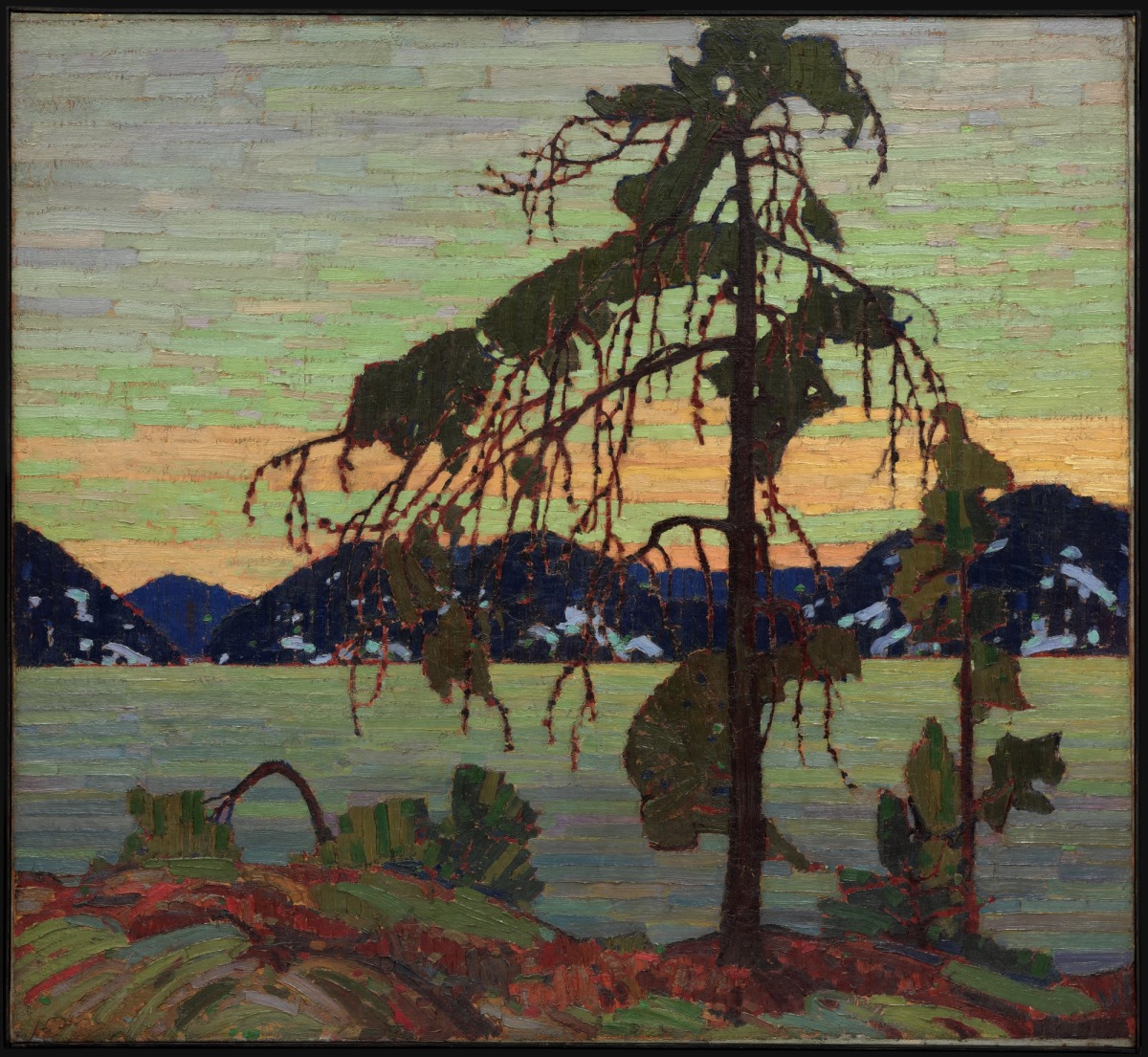
If memory serves there were a number of landscapes painted on wood, painted on location in the wilds of Ontario and points north, accompanied by full scale canvases. Slightly before them was Tom Thomson (1877–1917), who I think I saw a show by in Toronto (unless it was in Adelaide…). The landscapes are strangely depopulated, presenting Canada as a Terra Nullis, untouched by human hands. Of course, there were any number of indigenous native groupings, out of sight. It left me a little uncomfortable — but we’ll come back to that.

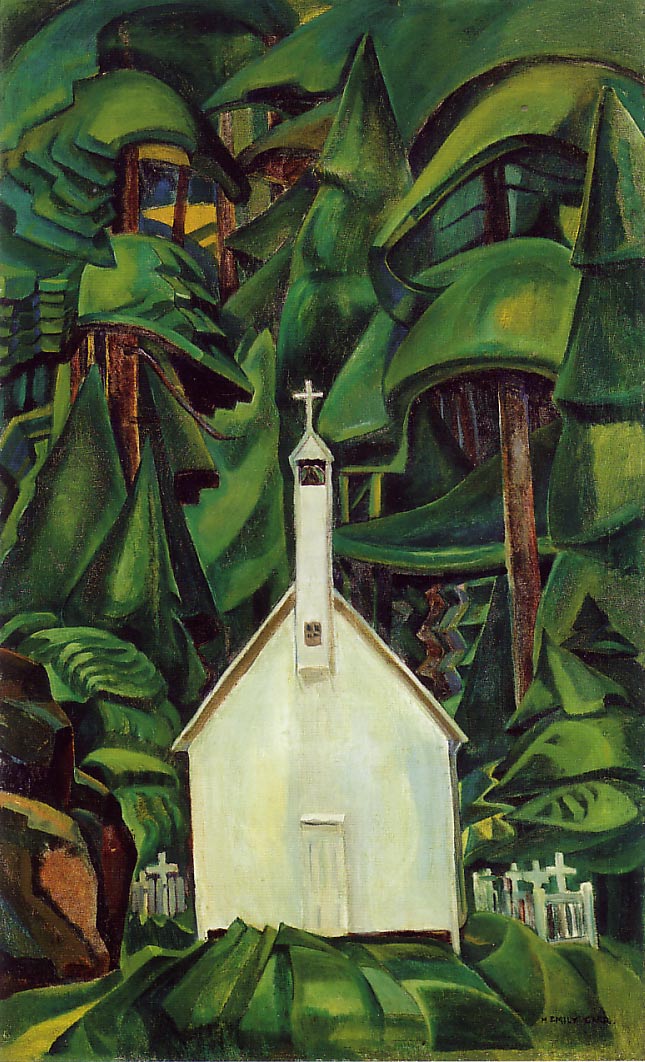
Emily Carr’s exhibition began with paintings of forest from the 1920s – in a sense toward the end of the story. The leaves spiral, there is a real sense of action in the painting – although, of course Carr writes “If there is no movement in the painting, then it is dead paint”. One of the most significant paintings is “Indian Church” (1929).

This is not Terra Nullis, because there is clearly the impact of western society on the forest, a whole way of thinking in the new world. But she was also interested in theosophy and mysticism and argues that “Metamorphosis between species and states is the only predictable feature of the cosmos”. Magic? Maybe.

Daughter of English immigrants to British Columbia, Carr had an interest from an early age in the wilderness outside the settlement. She had art lessons as a child and, despite the death of her parents, went to study at the California School of Design, San Francisco where she learned how to paint outside. On graduating she went to London, to the Westminster School of Art and took courses at places such as St Ives. Back in Canada she taught and painted, before travelling in 1907 to Alaska. She was inspired by Native American culture and art, and started trying to reproduce it in her paintings: “Indian art broadened my seeing, loosened the formal tightness … I was as Canadian-born as the Indian but behind me were the Old World heredity and ancestry”. Her paintings stay largely deserted – although some of the sites she depicted had been abandoned through disease or general depopulation. Here’s Janice Stewart: “Emily Carr found in her unproblematic identification with the Indians of the Canadian west coast a second skin to inhabit, which seems to have allowed her to paint and write beyond the gendered boundaries of contemporary conventional aesthetics. Carr identified the creative part of herself as Indian.” But Stewart is more interested in Carr’s writing than her paintings.

In 1910, Carr took a trip to Paris, where she was exposed to the Impressionism (and I guess early Post-Impressionism). Again, this would feed into her art – and it did strike me that some of her landscapes had the flavour of Vincent Van Gogh to them (whom she referred to as a “crazy poor chap”).

One striking painting is of Kwakwaka’wakw war canoes (1908 and 1912)– and this one does contain figures.

These are exactly the same boats as appeared in Edward S. Curtis Land of the Head Hunters (1914) – an extraordinary and deeply problematic drama where native culture was presented in a deliberately antiquated manner:

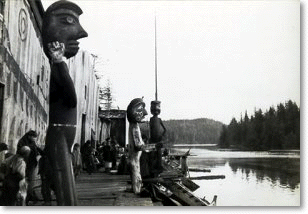
Inevitably she has taken a decision in the representation or not of indigenous peoples. A photograph of Blunden Harbour from 1901 (with people)

became the centre of a painting in 1930:

I’m torn – I don’t have enough data from the exhibition to know whether the elimination of the indigenous (whilst retaining their cultural productions) shows respect for them or is part of the Terra Nullis drive. As a female artist who kept not quite being taken seriously, she found something in the peopels she met to inspire her. But is is a form of romanticisation? Gerta Moray labels it “aestheticized nostalgia”, and suggests that Carr’s attempt to preserve what she perceived as a dying culture contributed to the decline.

Sources

  • Moray, Gerta (1993) Northwest Coast Culture and the Early Indian Paintings of Emily Carr, 1899-1913. Diss. University of Toronto, 1993.
  • Morra, Linda (2004) “‘Like Rain Drops Rolling Down New Paint’: Chinese Immigrants and the Problem of National Identity in the Work of Emily Carr,” American Review of Canadian Studies, 34(3): 415-438.
  • Stewart, Janice (2005) “Cultural Appropriations and Identificatory Practices in Emily Carr’s ‘Indian Stories’”, Frontiers: A Journal of Women Studies 26(2): 59-72.

Don’t Mention Mike Yarwood

Inventing Impressionism (National Gallery, London, 4 March-31 May 2015)

There are two groups of painters that to my mind seem awfully old-fashioned and chocolate box, and having seen their work I feel the need for a blast of Howard Hodgkin or Leonora Carrington. And yet, despite being immensely popular crowd pleasers now, in their time they were as revolutionary as YBAs. I mean the Preraphaelites and the Impressionists.

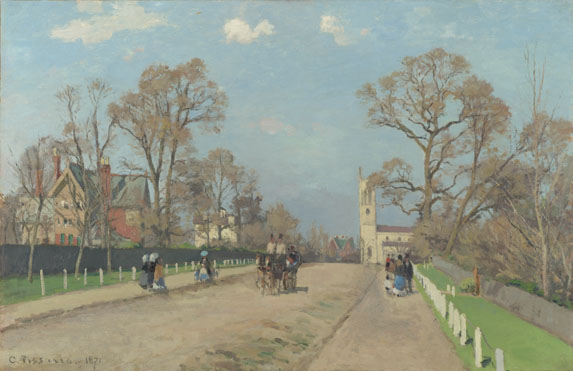
This seems an innocent enough landscape, a suburban church on a spring day. It’s Sydenham, in 1871. The church is still there, although Camille Pissarro makes the tower taller.

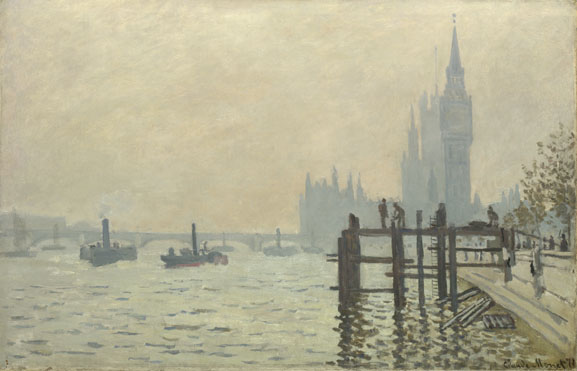
And here’s Monet’s Westminster in 1871. That tower looks wrong.

These and about eighty other paintings were brought together in an exhibition at the National Gallery, based around the dealer,  Paul Durand-Ruel, who was a champion of the Impressionists. He had inherited the painting business from his father, and saw potential for an emerging group of artists in Paris in the 1860s. He bought cheap when the market was low, then sold at a huge profit. He seems also to have manipulated the market at times to bid up prices. In 1870 he left Paris, to get away from the Franco-Prussian War, and in a London gallery began a series of shows of French artists. He also met artists such as Claude Monet and Camille Pissarro, who were also living in London. If the French weren’t interested, maybe the British would be. He paid artists a monthly wage and focused on individual artists for catalogues and exhibitions. Whilst his business was subject to the rises and falls of the French economy, he clearly was a hugely successful dealer. And he looked from Europe to America, where a new market awaited, sending one of his sons out there to manage affairs.

And yet critics had conniptions at some of the paintings. Pierre-Auguste Renoir’s “Study: Torso, Sunlight Effect” (1875-6)


Albert Wolff in Le Figaro wrote “Try to explain to Monsieur Renoir that a woman’s torso is not a mass of decomposing flesh with those purplish green stains that denote a state of complete putrefaction in a corpse.” Imagine if they saw a Paula Rego or a Lucian Freud. They’d have heart attacks.

I guess it’s a failure on my part to think myself back into the 1870 mindset — it doesn’t feel revolutionary. It feels nice.


,

The Good Companions

I have two chapters for companions on the to do list — a chronological survey for one, something meatier for the other, and Current Events seem to be swelling the materials for the latter, which does need to be written first. I would like to write something soon that doesn’t involved holding my nose. Heigho.

In the meantime, the survey is definitely a game of two halves and I’m pondering quite how I swing things around, given that there’s a large no go zone which is the other chapter on the same materials. I am the cause of reaction and a reaction to that reaction. I can see where I’m going to end, but I need to stick the teleology in the mix and work out the route there. All very post hoc, of course. At some point I’ll need to talk to the other writer on the shadow chapter. And work out how much of the three thousand words I wrote in November are usable.

Don’t Put Your Daughter on the Stage, Mrs Hovick

Gypsy (dir. Jonathan Kent, Savoy Theatre, April 2015, transfer from Chichester)

There was a moment toward the end of Gypsy (1959) when I got a flash of Death of a Salesman. It’s a very different piece, of course, what with being a musical and all, but both are about the delusional side of the American Dream.

Anyone can make it.

Most don’t, of course.

I didn’t know anything about Gypsy Rose Lee, beyond some kind of rhyming slang, so I wasn’t aware that she was a leading stripper with a style that berated the audience. I thus didn’t know about her politics, her support for Spanish loyalists, attendance at communist meetings or investigation by HUAC, or her novels and movies. I don’t recall knowing about June Havoc , her sister, who made it in Hollywood, just about.

The Willy Loman here is Rose, abandoned by her own mother, now wanting to get her daughter Baby June on the stage, with her plain and disregarded daughter Louise along for the ride and her sewing skills. Rose leaves Seattle to make their way in vaudeville, with the dream being bookings on the Orpheum circuit. Vaudeville is dying, of course — movies are the mass entertainments along with radio and there’s a depression (and eventually a war) to negotiate. The act, of course, isn’t very good, but through pure force of will Rose gets on, just about, and picks up Herbie as agent and potential, strung along, fourth husband. When June jumps ship, Rose promotes her older daughter. Sooner or later they end up in burlesque.

I’m not actually a fan of musicals — although this is the second I’ve seen in a year after Women on the Verge of a Nervous Breakdown and I don’t think I recognised more than one or two of the songs. The lyrics are Stephen Sondheim’s, post West Side Story, and before he got to write the music too. Arthur Laurents wrote the book and Jule Styne the music; I know the first name but not the second (I haven’t seen Funny Girl). There was a huge amount of energy from the cast, with an odd mix of good materials which are diegetic and bad which are songs within the diegesis. From the first, however, Imelda Staunton grabs the production by the scruff of the neck, although it’s able to survive the sequences where she is given a chance to catch her breath. She’s never exactly likeable — you root for her only because you want her daughters to succeed. And as the musical progresses you get the sense of what a monster she is — like Willy Loman she believes her stories. One more gig will make it alright; one more success and she will marry.

She’s living vicariously, of course, and you get the sense that Lee’s success almost comes as a punishment of and rebuke to her mother. The earlier songs were full of spectacle — flags, a pantomime cow, canes to throw  and twirl — but this builds further when the dream is revealed. Lara Pulver as Louise has a tricky transition from ugly duckling to swan and I think she succeeds.

Peter Davidson, meanwhile, has rather less to do as Herbie — a few musical numbers, but we know he can sing because we’ve seen Button Moon. Rather than hard-bitten agent he has to be mooncalf and mouse and slides off stage. This is a bit of an issue, of course, as so many characters are left behind by the performers’ travel. There’s grandfather — there’s that stage manager — and farewell. Where are they now?

But we’re carried away by the tremendous energy of Staunton – so different from her role in Pride (2014) and surprising me when we get to the point when we realise she isn’t the gypsy of the title.


The Sorrows of (Not So) Young Werdna

Inevitably this contains several plot spoilers


In criticism we – I – start from where we know and head into new territory. We have a political or critical viewpoint – Marxism, feminism, aesthetics – and apply it to a new text. Or we use a text to explain an idea or an idea to explain a text. (There’s a line somewhere from Mallarmé – shameless name drop – about the folly of saying clearly what the author has said opaquely.) We needn’t reinvent the wheel, of course, we build on the shoulders of giants. Sometimes people haven’t seen the giants, so we get people suggesting that no one has written about Katherine Burdekind or that everything thinks John Wyndham is cosy, when, in fact, he isn’t.

Continue reading →

Gold to Guilt

Cotton to Gold (Two Temple Place, London, 31 January-19 April 2015)

“Doubtless prompted by the hardships endured by the workers, the industrialists of the North West supported a wide range of cultural causes that benefitted the inhabitants of the cotton town.”

This exhibition brings together the collections of several textile, rope and other industrial magnates as donated to their local museums — the Townley Hall, Burnley, the Haworth Art Gallery, Accrington and Blackburn Museum and Art Gallery. If you want to know what surplus labour is, have a look at this.

In the Good Old Days, the artisan weaved in their own home, but the process became machine-led and stream-driven and centred on the factories in ever-growing towns, especially in Lancashire. Try this: “One machine could produce around 40 yards of plain weave calico each day.” A single worker could operate eight machines. Calico is presumably made from cotton, that just happened to be lying around. Or brought in from the colonies. We’ll come back to them. Nearby there are the clogs worn by men, women and children in the factory – I forget whether the factory is for rope or textiles, but it hardly matters. The cotton rope on display is “less likely to break while powering the looms, thereby increasing productivity and profit.”

And, presumably, be safer for the workers. If that matters. I suppose it does.

One of the industrialists amassed a collection of eight hundred books, including rare early editions of Chaucer and Spenser, a Third Folio of Shakespeare, a Torah, books in Arabic and from Persia, Buddhist texts… Frankly he couldn’t have read chunks of it — his workers were presumably illiterate on the whole. There’s a first edition of Gulliver’s Travels. Covets.

We have coins and icons and stuffed birds — the collector preferred paintings but still had a range of corpses, a fan of leucistic specimens apparently — and Millais drawings and Japanese prints and Turner watercolours (who doesn’t have one?! I’ve seen thousands of the buggers in municipal galleries) and ivory carvings. There’s a warning about this but there’s an Incan corpse from the twelfth century collected by William T. Taylor, who appears to have been involved in archaeology, but more to the point worked in hydroelectric dams in Kashmir, Nepal, Mexicon and Peru. Apparently “he seems to have paid scant regard to the claims of the local people to the objects he brought back.” No shit.

At the start, the curators claim that “the exhibition highlights the circumstance of the exceptional accumulation” of objects. To a point, yes, to a point.

The industrialists put money into galleries and museums, as well as into churches and cathedrals. They endowed schools and … orphanages. How many of the orphans worked in the factories? How many were orphaned by the factories?

At the same time, one has a sneaking respect for the owner of Burnley Brewing Company, Edward Stocks Massey (whose legacy was used to buy other collections), who promised a large sum of money to the Burnley Corporation, but the amount would drop every time one of his 150 pubs lists its license. Fortunately for Burnley, he died fairly soon.

Of course, very few museums have ethical collections. It’s just that it is rarely so flagrant and hinted at but not entirely visible. There are undoubtedly some beautiful objects here — for me the highlight is a rather crappy Blake drawing. As proven by many dozens of municipal galleries, industrialists had lousy tastes (or kept the good stuff).*

The downfall came in the 1940s when India, apparently the destination for fifty per cent of Lancastrian cotton, boycotted it. The market fell and there were times when a factory a week closed. Bloody colonials, with their demands for independence…
* In this, of course, I may well be being unfair to self-made men. But made on the back of the labour of others.

Son of the Spinning Plates

So, let’s look at the to-do list based on 26 January  2015 and updated 15 March 2015:

  • a paper to write for the Sideways in Time conference needs turning into chapter
  • a keynote to write for the SF postgrad conference
  • a book to read for review
  • a book proposal to finish — I’ve had some ideas
  • a conference paper to convert to an article
  • a secondary bibliography to annotate
  • two chapters to write for companions — lots of ideas for one, no further than Christmas for the other
  • an overdue biographical piece to write — submitted 
  • an article that’s been bounced from a special issue but has been taken up and needs another thousand words adding
  • a book manuscript to rescue — I printed out chapter one…
  • a  submitted chapter that I’ve heard nothing back on chased
  • several reference book entries that are missing in actionchased
  • *new*: an appreciation of Pratchett — submitted