
Nicole Eisenman: What Happened (Whitechapel Gallery, 11 October 2023–14 January 2024)
Born in Verdun, France, in the 1960s, Eisenman practices in Brooklyn and I’m very glad I caught this just before it closed – although a more awake me would have spent longer and a more alert me would have made the link to Ridykeulous at Nottingham Contemporary. (I seem to keep missing stuff here – maybe it’s just the wrong part of not central London. But engineering works led me, via the Dulwich Picture Gallery and Rubens to Blackfriars and the District Line…) It formed quite a contrast from the relative elegance of the Rubens oil on panels – especially as the theme of that exhibition was to evade the Rubenesque – and I felt much more in a R. Crumb/George Condo/Philip Guston tradition of the grotesque.
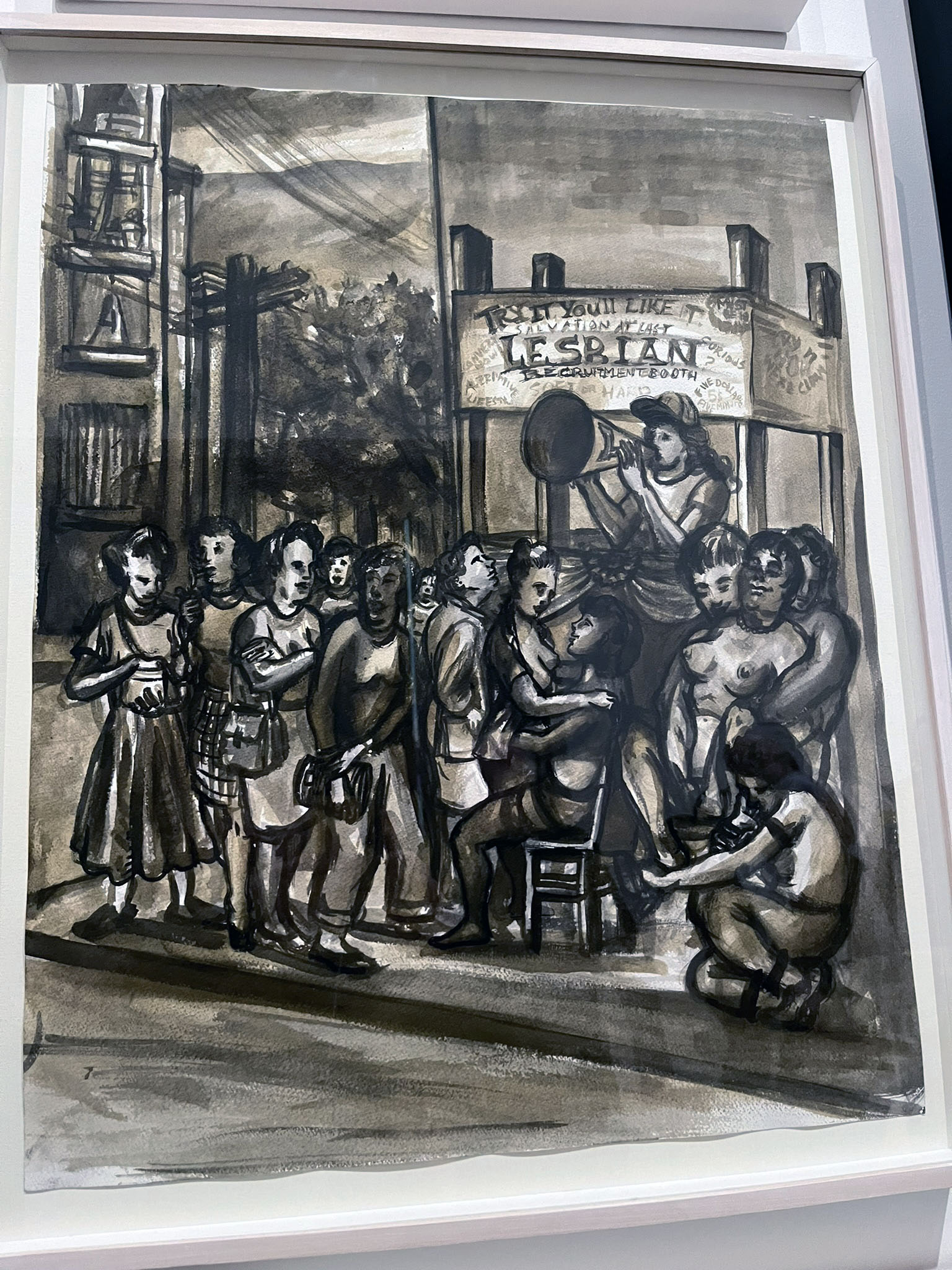
And I guess Rabelaisian and Bakhtinian are the adjectives to reach for, with overflowing sexuality, castration, birth scenes and urine flowing into lemonade stalls… I’m not sure I could share many of the images on WordPress – Betty and Thelma from The Flintstones having sex, Alice getting intimate with Wonder Woman… There are a couple of walls of sketches and a narrated film of lost murals (hilariously skewering consumerism, amongst other targets) and cartoons even form graffiti on some of the gallery columns.
Early fêting turns into gallery neglect – according to the curation – and the theme of the artist becomes more prominent, as the world seems to darken. Were-Artist (2007) has an artist undergoing transformation into a werewolf, a dubious looking full moon (or bulb reflected on the curtain and window), a red nose and rosy cheeks suggesting drunkenness. Is the artist a monster and do we want them to be?

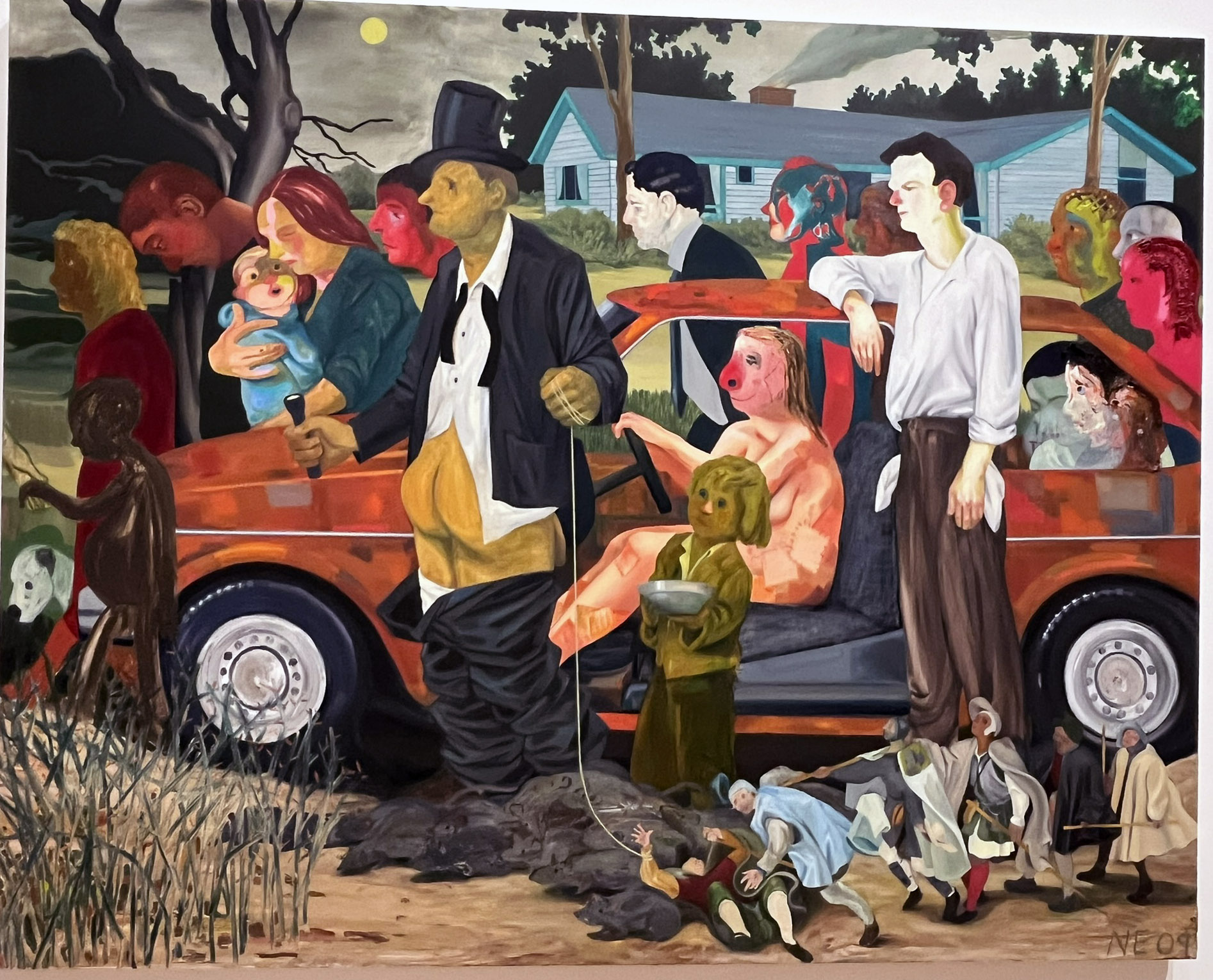
In the contemporary background is George W. Bush, 9/11 and the 2008 financial collapse – so alongside various depictions of art community friends in a beer garden – Beer Garden with Ulrike and Celeste (2009) and Beer Garden with Ash (2009), there are people wading through water in Coping (2008) and The Triumph of Poverty (2009). I believe there are two more Beer Garden paintings (possibly Beer Garden with Big Hand, Brooklyn Biergarten II, Biergarten at Night?). There’s a curious sense of misery among the drinkers, beside the cats (and the beer). This is no bacchanalia. Are there more cats in the background? The Triumph has an inverted version of Pieter Bruegel the Elder’s The Blind Leading the Blind(1568) and a titular nod to a Han Holbein the Younger painting (c. 1533-34) destroyed in a fire in 1752 and surviving as drawn copies. Everyone looks miserable – from the dog to the man with turned out pockets. A man in top hat and formal dress, bow tie untied, is carrying a torch, which is clearly useless, and has his trousers falling down. He’s clearly – literally – ass backwards. Even the rats in the foreground are miserable.

The politics come through in Tea Party (2011), a nod to the Boston Revolutionary and the Republican fiscal conservatives. A sleeping figure in shirt cradles a rifle, two men assemble sticks of dynamite, a threadbare Uncle Same holds an eagle mug in one hand and a teabag in the other. There’s a brass steam kettle on an old-fashioned stove, explosives, water and cans of Bumble Bee tuna (which occur in other paintings – Warhol?). A later generation of revolutionaries comes in Dark Light (2017), four men in a pickup truck (one in a MAGA cap), driving around to add carbon to the atmosphere. I note that the figures are all male. The procession is also seen in The Darkward Trail (2018), part of the Tate collection – a figure with a torch as a variant on the one in Dark Light, a figure with a drone from another painting, a Bruegelian fat person on an ass. The Tate suggests there’s a nod to Philip Guston here, and that’s pretty clear.


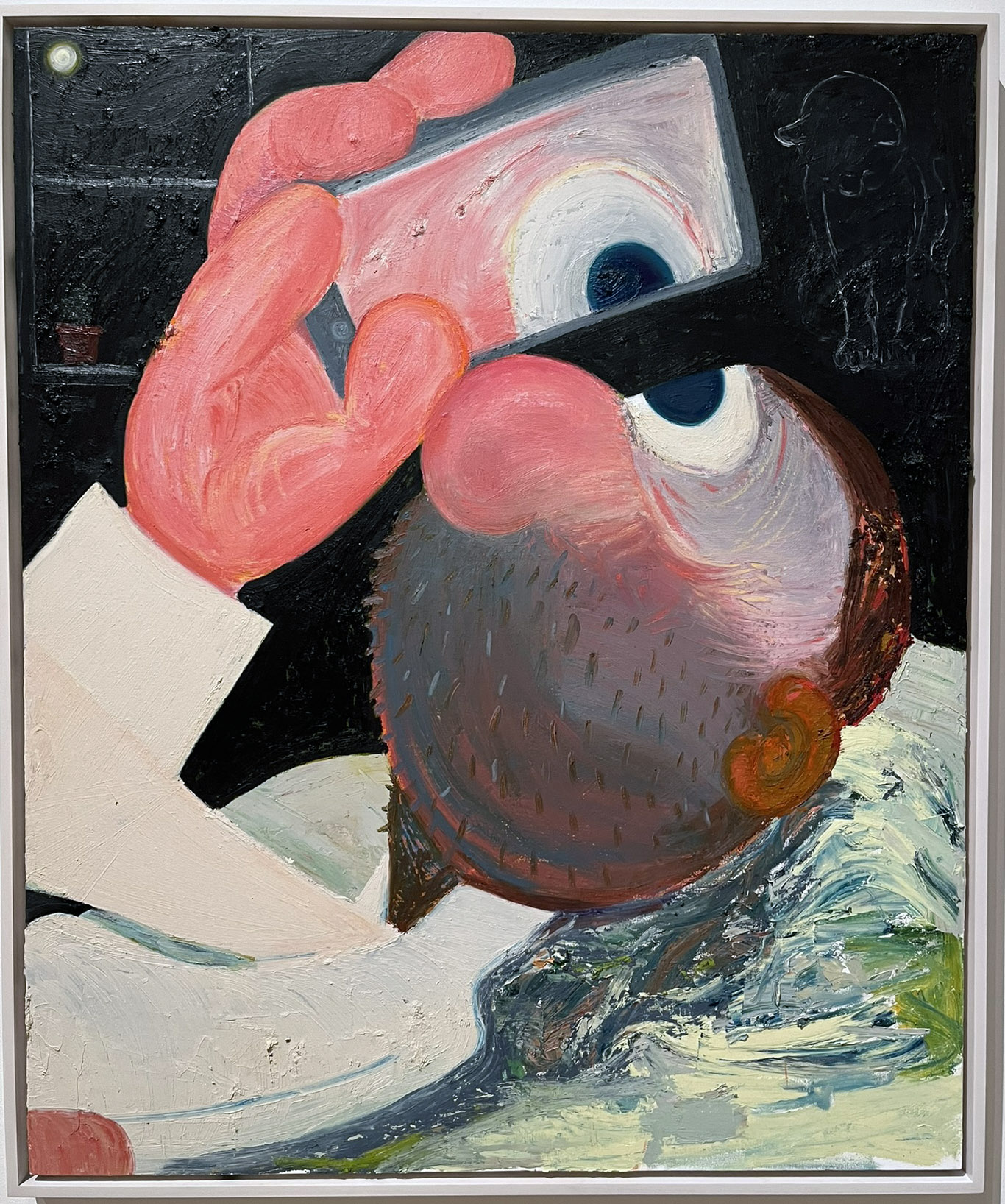
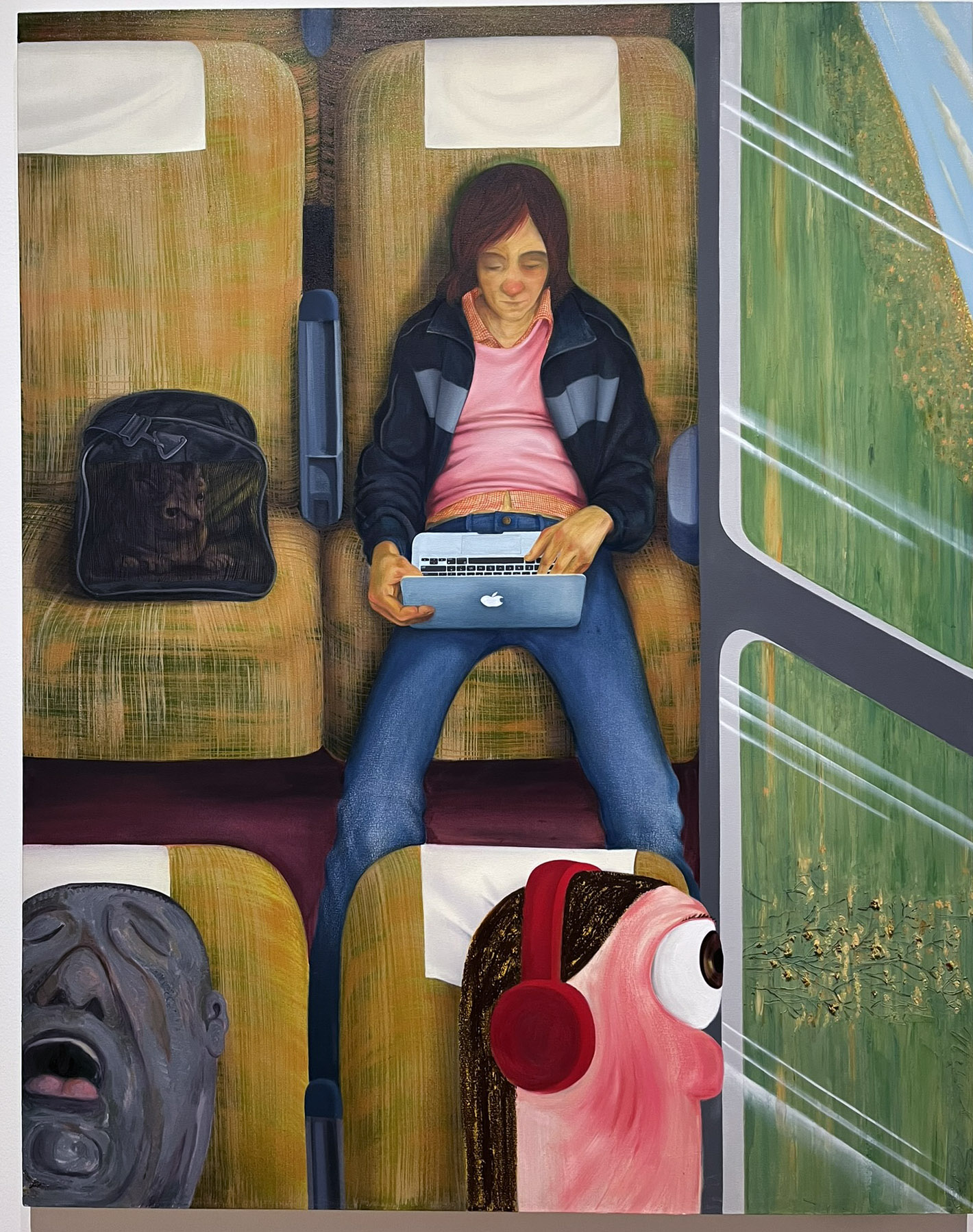
Forms of alienation come in the giant eyeball of Selfie (2014), a figure repeated in Weeks on the Train (2015) – although I’m drawn to the cat in the cat basket and the woman on her Mac. (Is this the same figure from Were-Artist?) There’s something askew about the perspective – it’s raised but not bird’s eye, there’s almost a feel of a film strip about it, a sense of the Van Gogh in orientation but the colours are more concerned with delineating materials. And a cat, again, in Reality Show (2022), that figure from the train I suspect, watching tv, with a fantasy removal of bricks from the wall to see from behind the TV. (I think Seder has a perspective from a menu; there’s an art class painting from the top of someone’s drawing pad.)

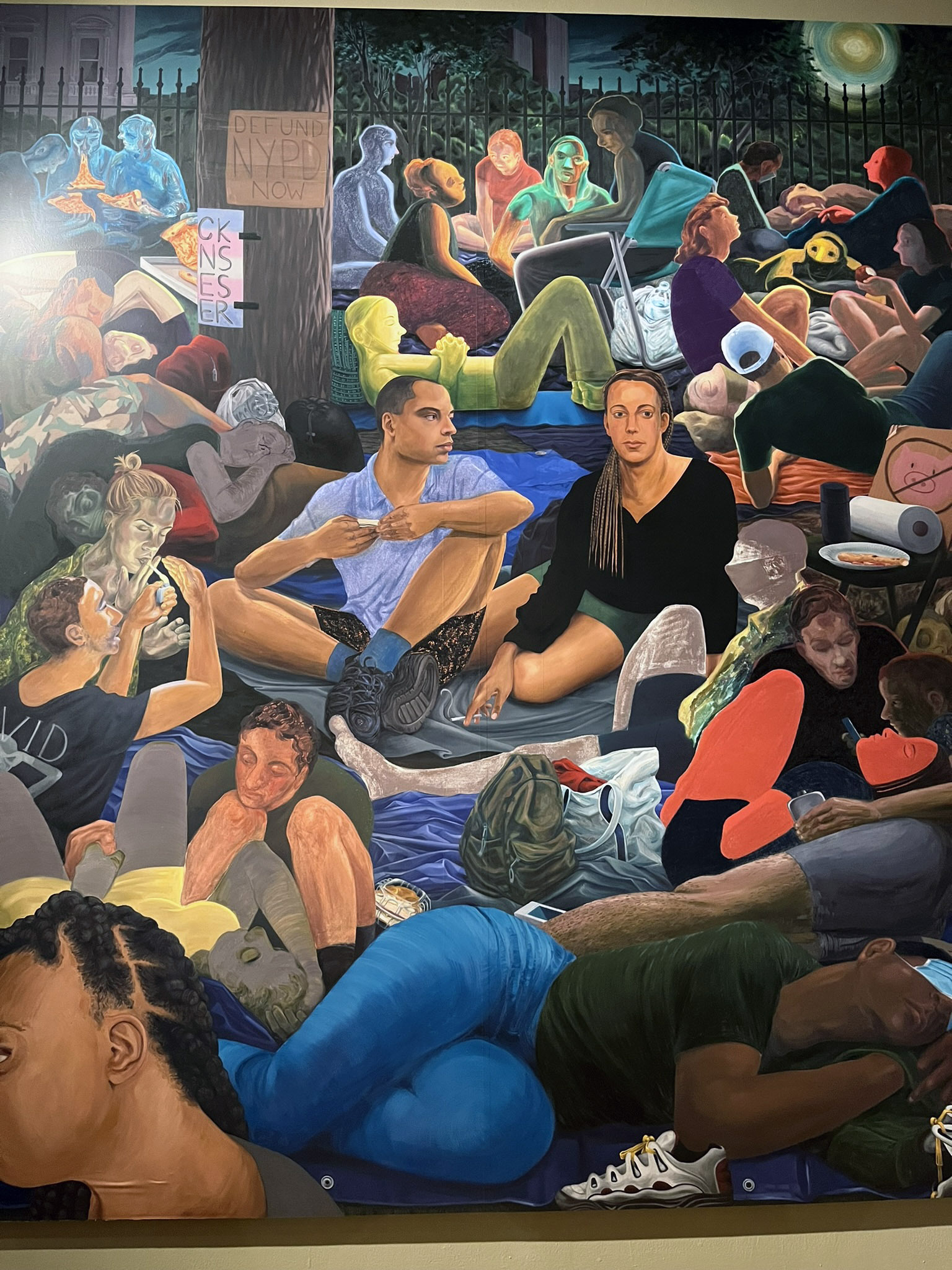
In a free section of the gallery, there’s a sculpture of a potter at work, Maker’s Muck (2022), surrounded by maquettes, with fat fingers endlessly working the clay. Opposite this is a reproduction of The Abolitionists in the Park (2022), a group of figures including the artist and her family, people from the art community and others at an Occupy City Hall protest in the context of Covid lockdown, the murder of George Floyd, the #MeToo movement and #BlackLivesMatter. There’s a sense of solidarity here – but again no one seems happy. This is a curious and challenging paradox – a History Painting but present day.
 Subject to Change