Unknown's avatar

Posts by flares

I am a critic and researcher of sf, with interests in queer theory, postmodernism, psychoanalysis and other long words. I have various blogs.

What Goes Around

Der Kreis (The Circle, Stefan Haupt, 2014)

A minute or so into Der Kreis, a film I knew nothing about beyond that it was being shown as part of LGBT History Month, it struck me that the main two interviewees were coming across like an old married couple. This is not the world’s greatest observation, since Ernst Ostertag and Röbi Rapp are married. Doh. It’s still not something you see that often on film.

Zurich, 1956, and not-yet-certified schoolteacher and semi-closeted Ostertag (Matthias Hungerbühler) is visiting the editorial offices of Der Kreis, a homoerotic magazine in three languages that is tolerated by the authorities. Through this he learns of the balls the magazine organises and at one of these he meets and falls in love with Rapp (Sven Schelker), who he at first mistakes for a woman. As the relationship between the two develops, a number of murders within the Swiss gay community leads to a crackdown on the magazine, the balls and the gay bars and Ostertag risks all by becoming more involved in the magazine.

I was a little torn, watching this, as I gladly would have watched more of the interviews with the surviving participants, and I gladly would have watched more of the dramatisations. The traditional disclaimer at the end of the film notes that some characters have been invented or tweaked, and I did wonder at a couple of moments how we knew X had happened or why we didn’t see Y.  At the same time, there’s a risk of tin bath nostalgia — an abortion scene in a Nottingham Playhouse production of Saturday Night and Sunday Morning (1964) was spoilt for me by the person behind me noting that they had that sort of bath once. If the mix of Der Kreis wasn’t quite right, I’m not sure what I would have sacrificed.

Like Forbidden Love: The Unashamed Stories of Lesbian Lives (Lynne Fernie and Aerlyn Weissman, 1992), this is a testament to real lives that seem both a long way from now and all too familiar. The shift in attitudes in Switzerland show how easily public opinion and legal toleration can change. The cast is excellent, the talking heads instructive, and a little piece of history is preserved.

The Gun Over the Fireplace in Act One

Birdman or (The Unexpected Virtue of Ignorance) (Alejandro González Iñárritu, 2014)

Film has three kinds of meta – the film about the film, which attempts to bite the hand that feeds it without ever really drawing blood (think The Player (Robert Altman, 1992), the film about TV, which is about how inauthentic and cynical that medium is (Network (Sidney Lumet, 1976)), and the film about theatre, which is about a huge cultural cringe and the superior authenticity of the stage. There’s a cameo role on Birdman for Lindsay Duncan, a fine actor, who steals the film as Tabitha Dickinson, theatre critic, in a film full of more acting per square centimetre than is entirely comfortable; she gets to tell Riggan Tomson, former star of three superhero movies, about how awful it is that such folk are taking up space in Broadway Theatreland and that they can’t act for toffee. Ah, one on the chin. A palpable hit.

Tomson is played by Michael Keaton, who was in the first two Batman movies back in the day, and a few movies since but hardly any you could name without looking them up (Jackie Brown (Quentin Tarantino, 1998), Out of Sight (Steven Soderbergh, 1998), Jack Frost (Troy Miller, 1998) and others, and a lot of voice work, it turns out). Tomson’s long-cherished dream is to repay a debt to unwitting mentor, Raymond Carver, by writing, directing and starring in a Broadway adaptation of a Carver story. The previews are not going well, and there is strife with a male costar Ralph, Jeremy Shamos, who is (un)fortunately knocked out by a falling spotlight. A new actor is brought in, Mike Shiner, played by Edward Norton – who was in the semi successful The Incredible Hulk (Louis Leterrier, 2008). Meanwhile, there are potshots at Robert Downey Jr. (Ironman (Jon Favreau (2008, 2010, Shane Black, 2013) and George Clooney (who killed the 1990s run of Batman films with Batman and Robin (Joel Schumacher, 1997)) and a Man of Steel poster on the skyline. (It’s a neat touch that the theatre chosen is opposite one playing The Phantom of the Opera.) It’s a close-run thing whether any of the actors will make it to opening night, let alone that the play will open.

There’s the ex-wife (Amy Ryan), in town for the premiere, the druggie daughter (Emma Stone), looking for redemption, an ex-girlfriend (Naomi Watts) uncertain of her place, a female costar (Andrea Riseborough) who’s in a relationship with Shine and a best friend/lawyer/agent/producer (Zach Galifianakis) trying to hold it together. Fairly soon, you are ready to concede that Duncan’s critic has a point. Who cares about these people?

What ratchetts up the tension is that Tomson is either going through a major nervous breakdown or has both a Sekrit Identity and super-powers. Todorov eat your heart out. Has he? Hasn’t he? Was the accident with the spotlight an accident? Why can’t he control them better? There’s a sense that this is bordering on horror – I misheard Riggan as Regan (as in The Exorcist (William Friedkin, 1973)) at first and the endless tracking shots down theatre corridors began to echo The Overlook Hotel. Redrum! Redrum!

Oh yes, the film is composed of endless tracking shots, pursuing characters from room to room, picking up conversations and actions, kicking sand in Hitchcock’s face for pitiful ten minute takes in Rope. I guess there’s a sense of claustrophobia and being trapped and basically the director can. The director of photography, Emmanuel Lubezki, seems to think that this is the first time anyone has done this. Oh dear. The Player is one example, although it abandons the conceits after the first shot.

And then there’s a highly telegraphed climax where the film really has its cake and eats it, parts of which are visible from the first act and most of which is not as clever as it thinks it is. It’s a wonder that everyone doesn’t wake up and realise it’s all a dream. Or maybe everyone else did but me. I have to say I was reminded of the elegance of Tom Stoppard’s The Real Thing (1982), which folded real life into play into other people’s materials with an eleganc this lacked.

Oh, and in a year where there were complaints about the music soundtrack drowning out the dialogue in Interstellar (Chris Nolan, 2014), we appear to have the soundtrack from Whiplash (Damien Chazelle, 2014) or the longest drum solo in recorded history.

A Plague on Both Your Tin Mines

The Plague of the Zombies (John Gilling, 1966)

The first zombie movie was released in 1968 – this must be true, as I heard this on the radio several times last year (and an article doesn’t quite say it ). So clearly I hallucinated this DVD of a 1966 film I encountered as I work my way through the Ultimate Hammer Boxset. (Although, let it be said, that this boxset is far from ultimate as boxsets go.)

There is a reasonably familiar horror/Hammer narrative. People from London travel to remote village full of suspicious locals and disturbing events. Rather than the bloodsucking vampires of the Dracula films, we have blooddraining zombie masters, and the incomers are a London-based doctor (André Morell) and his daughter (Diane Clare), responding to a letter from a local GP (Brook Williams) about a mysterious plague. Rather than a mittel-European village, surrounded by not even trying day-for-night filming, there’s a Cornish village. They are worried about incomers, just not necessarily about the right incomers.

The vampire narrative is easy to read in Marxist terms, indeed, Marx explicitly writes about capitalists sucking blood and surplus labour/profit being undead. “Capital is dead labour, that, vampire-like, only lives by sucking living labour, and lives the more, the more labour it sucks” he writes in Capital, elsewhere he discusses “British industry, which, vampire like, could but live by sucking blood, and children’s blood, too.” Engels adds, “But here, too, necessity will force the working-men to abandon the remnants of a belief which, as they will more and more clearly perceive, serves only to make them weak and resigned to their fate, obedient and faithful to the vampire property-holding class.“

In Plague we have peasants being turned into zombified labourers through the manipulation of blood. Perhaps to maintain heteronormativity, it’s female rather than male blood being drained. The peasants as zombified slaves are counterparted by drummers from the Caribbean, with the kind of casual racism of Hammer’s She (Robert Day, 1965).

If the real villains of the piece are the squire (John Carson) and the huntsmen, the peasants seem disturbingly disposable – it’s the professional middle classes we’re meant to be concerned for. Indeed, just like Jonathan Harker in the original Dracula, although the doctor Sir James Forbes is closer in class to Dr Seward. We’re not even that bothered about the good local doctor’s wife, Alice Mary Tompson (Jacqueline Pearce), as we know she’s going to turn into Servalan.

It perhaps should be objected that if you want an efficient workforce in your tin mine, than a zombie workforce may not be the best choice. Such has struck me before – in the various cyberslave armies in new Doctor Who somewhat ad nauseam, although that itself possibly begins with the robomen in “The Dalek Invasion of Earth” (21 November 1964–26 December 1964).

CFP: Current Research in Speculative Fiction (CRSF) 2015

University of Liverpool
Monday 8th June 2015
With Keynote Lectures from:
Dr. Andrew M. Butler (Canterbury Christ Church University)
Dr. Sarah Dillon (University of Cambridge)
Returning for its fifth consecutive year, CRSF is a one day postgraduate conference designed to promote the research of speculative fictions, including SCIENCE FICTION, FANTASY and HORROR; showcasing some of the latest developments in these dynamic and evolving fields. CRSF attracts an international selection of delegates and provides a platform for postgraduate students to present their current research, encourages discussion with scholars in related subjects and the construction of crucial networks with fellow researchers. The University of Liverpool, a leading centre for the study of speculative fiction and home to the Science Fiction Foundation Collection, will host the conference.
We are seeking abstracts relating to speculative fiction, including, but not limited to, papers on the following topics:
  • Alternate History
  • Alternative Culture
  • Animal Studies
  • Anime
  • Apocalypse
  • Body Horror
  • Consciousness
  • Cyber Culture
  • Drama
  • Eco-criticism
  • Fan Culture
  • Gaming
  • (Geo)Politics
  • Genre
  • Gender
  • Graphic Novels
  • The Grotesque
  • The Heroic Tradition
  • Liminal Fantasy
  • Magic
  • Meta-Franchises
  • Morality
  • Monstrosity
  • Music
  • Non-Anglo-American SF
  • Otherness
  • Pastoral
  • Poetry
  • Politics
  • Post-Colonialism and Empire
  • Proto-SF
  • Psychology
  • Quests
  • Realism
  • Sexuality
  • Slipstream
  • Spiritualism
  • Steampunk
  • Supernatural
  • Technology
  • Time
  • TV and Film
  • Urban Fantasy
  • Utopia/Dystopia
  • (Virtual) Spaces and Environments
  • Weird Fiction
  • World Building
  • Young Adult Fiction.
Please submit an abstract of 300 words for a 20 minute English language paper and a 100 word biography to CRSF.team@gmail.com by Monday 9th March 2015.
—————————————————————————————————————–
For further information email the conference team at CRSF.team@gmail.com or visit our website: www.currentresearchinspeculativefiction.blogspot.com
CRSF is only able to accept proposals for papers by postgraduate students and the recently qualified. However, all are welcome to attend the conference as delegates. See the website for more information.

Exhibitions for Expotitions (February/March 2015)

I have a Google spreadsheet on which I keep a list of exhibitions that I am thinking of going to. It isn’t complete, it’s south-east centric and check before you travel if it’s on or open. (Plus if I’m not going to be interested in a thousand years, I don’t list it).

I’ve trued to be clever and list here the show opening or closing between now and 31 March 31, by ordered of urgency (THEY’RE CLOSING). Unfortunately, in switching between programs my highly logical European date format (day/month/year) have converted to the odd US ones (month/day/year) and I’ve no inclination to correct them this time.

Deus-ed Up, Or: All the Deus-Bros.

Ex Machina (Alex Garland, 2015)

Here be spoilers, although not really until paragraph eight onwards (nine if this is one). I’ve tried not to give the ending away. 

There’s a reading of Harrison Ford’s rather plank-like performance in Blade Runner (Ridley Scott, 1982 etc) as Rick Deckard that suggests it is in fact a rather nuanced representation of a replicant. It doesn’t make sense as a reading, but there you go (he can’t be one of the six escapees because…).

I got the same feeling about Domhnall Gleeson about ten minutes into Ex Machina. It doesn’t make sense as a reading, but then again, what does? I was also reaching for Bluebeard and Vertigo (Alfred Hitchcock, 1958), neither of which end well.

Bluebeard is the one when a duke invites his bride to stay in his castle whilst he goes off on a jolly, leaving her with the keys to all the rooms but instructions not to unlock the seventh door. Obviously she does, just as Eve ate the fruit and Pandora opened the box. It’s Story.

So Caleb (Caleb Williams, son of Jephunneh or son of Hezron, a villain in Buffy the Vampire Slayer, a computer game character who is a gunslinger) is a computer jockey who wins the golden ticket and gets to go to the chocolate factory the CEO of Bluebeard Bluebook’s secret lair. Before you it, know he’s flying across a landscape straight out of Jurassic Park (Steven Spielberg, 1993) to the secret lair. If Gleeson has a look of both Nathan/Justin from Queer as Folk, Oscar Isaac’s Nathan is more bearish, pummeling a punchbag, swigging a beer from a bottle and being furry under a vest. Apparently he is a genius. (Nathan — son of David, Nathan Fillion played Caleb…)

Caleb, before he goes any further in his bonding over beer, vodka and sushi with Nathan, has to sign all kind of non-disclosure agreements to make sure we feel uneasy.

Continue reading →

Coinage?

At one of the first sf conventions I went to, Tom Shippey used the word “intergenrification” in conversation with Iain Banks and Iain M. Banks. It seemed to be a useful word, for the ways in which genres collide and intermingle with each other, or the way in which a text belongs to several genres at once. This may well have been one of those moments when we were getting all excited over slipstream — the genre of fiction of postmodern sensibility — that comes along every year or so. A decade or so later, people were getting excited about interstitial texts, texts which belonged to no genres, although its name suggests that these are texts between genres. Despite this being, frankly, arrant nonsense, I was recruited to write on this subject, “Between the ‘Deaths’ of Science Fiction: A Skeptical View of the Possibility for Anti-genres”. For that matter, my contribution to the Festschrift (bless you) for John Clute and Judith Clute considered the fluidity of genre boundaries at the heart of (John ) Clute’s project. I reviewed Gary Wolfe’s Evaporating Genres for Science Fiction Studies, with the sense that for Wolfe the genre had not so much evaporated as never solidified in the first place.

And then, as part of a new module, Popular Genres and Popular Culture, I delivered a lecture on intergenrification I wanted to talk about the way in which the sitcom has overlaps with docusoap and fly on the wall documentaries and game shows and chatshows and I googled the word “intergenrification“.

It gives two results. The second is to a PDF, which apparently includes the quotation, “It may be the case that intergenrification is a staple of postmodernist literature, but there may be other readings of the novel.” Ah, a believer in PoMo, I presume.

The first is to something I wrote, “Thirteen Ways of Looking at the British Boom, my Pioneer Award-winning article: “As Steve Jeffery wrote in his review: ‘Levy’s debut is assured but tries perhaps too hard … to be too many things at once: sf thriller, fantasy, dystopia and romance’ (Jeffery 28). This intergenrification is typical, however, of the British Boom.” See how I use the word, confidently assuming that people will know what I mean?

I did some hunting around for my JFA piece, but failed to find a file on this computer and or  online, although there is a book that does at least cite it.

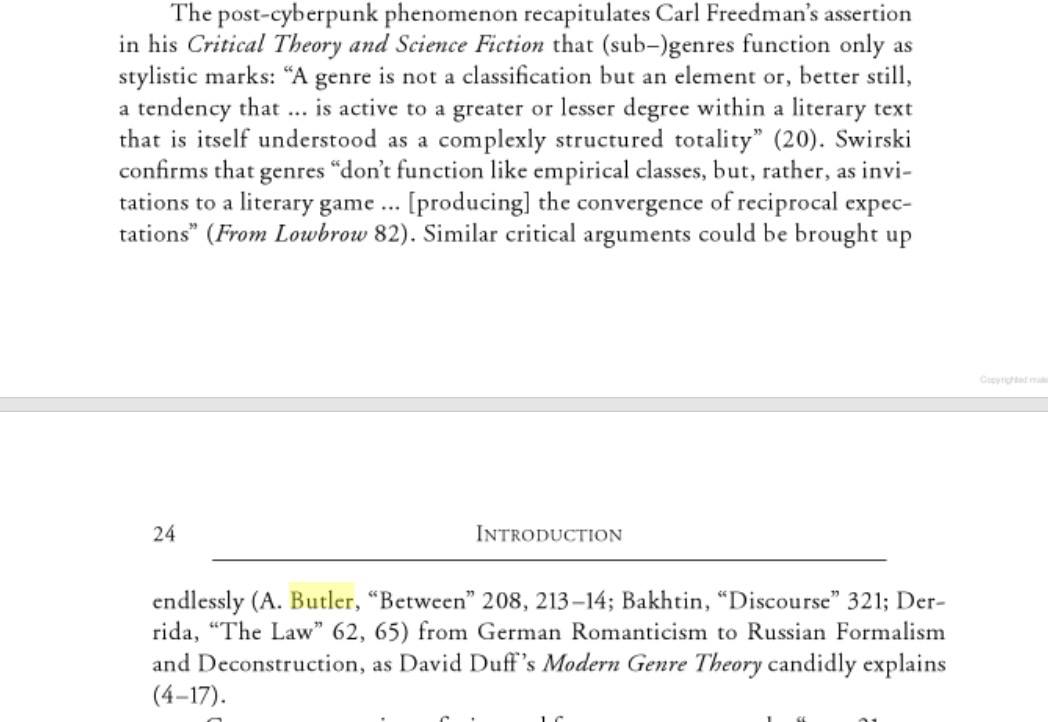
quote

Butler, Bakhtin, Derrida. Not bad company.

It looks as though, should the word ever make it into the OED, I’ve got dibs along with the other chap on the citation quotation – and, believe me, I checked for the entry.

It was only today that I’ve clicked on the other link, and discovered it’s a PDF of my PHD and presumably vaguely official. Who knew it was out there?

So, should I ever want to do more work on this, I have the primacy. I don’t have the JFA article to hand, but I have a draft, in which I write

We hold these truths to be self evident: i) no genre is ever pure, ii) no text ever belongs to a single genre, iii) no text is genreless. Our justification for the latter two truths comes in part from the essay by Jacques Derrida called “The Law of Genre” (1979). “As soon as the word genre is sounded,” he writes, “as soon as it is heard, as soon as one attempts to conceive it, a limit is drawn. And when a limit is established, norms and interdictions are not far behind” (224). But that limit is already transgressed. The law of genres is that genres are not to be mixed – but the law of the law of genre is that genres are contaminated, impure or parasitical. Individual texts overflow the boundaries, become larger than their limitations, transcend their classes. Derrida advances the thesis that a text does “not belong to any genre. Every text participates in one or several genres, there is no genreless text, there is always a genre and genres, yet such participation never amounts to belonging” (230). And, lest we forget, Brian Aldiss reached a similar point two decades earlier in a review: ‘[T]here is no sf novel that is purely an sf novel. At some stage all sf novels turn into something else’ (Aldiss, Brian (1964) ‘[Review of] Judgement at Jonbar’, S. F. Horizons 1: 22.). This is not just the case for sf novels.

But, obviously, if Professor Shippey wrote something down, I’d certainly admit priority to seniority.

Bibliography

  • Aldiss, Brian (1964) [Review of] Judgement at Jonbar, S. F. Horizons 1.
  • Butler, Andrew M. (2003) “Thirteen Ways of Looking at the British Boom”, Science Fiction Studies 30(3).
  • Butler, Andrew M. (2004) “Between the ‘Deaths’ of Science Fiction: A Skeptical View of the Possibility for Anti-genres”, Journal of the Fantastic in the Arts 15(3), pp. 208-216.
  • Butler, Andrew M. (2012) Review of Evaporating Genres: Essays on Fantastic Literature, Science Fiction Studies 39(1), pp. 155-158.
  • Derrida, Jacques (1979) “The Law of Genre”, Critical Inquiry 7(1), pp. 55-81.

Peter, Paul and Rubens

Rubens and His Legacy: Van Dyck to Cézanne, Royal Academy of Arts, London, 24 January-10 April 2015

Pretty well all I knew about Peter Paul Rubens was that he painted women … of a fuller figure. It was a surprise then to begin with a study for John Constable’s The Haywain. I’m guessing I’d only just seen this last year, when I’d done Tate Britain’s Late Turner and the V&A’s Constable exhibitions in one day. Both painters appear to have drawn on Rubens’s romanticised landscapes. I wonder – does this pad out an exhibition which had an odd corridor between rooms?

The fuller figures appear quite late, but then the thematic approach – Poetry, Elegance, Power, Compassion, Violence and Lust – obscures chronology. The tricksy subtitle – “From Van Dyck to Cézanne” – is odd, given the inclusion of Pablo Picaso and Oskar Kokoschka, who surely postdate Cézanne and French Impressionism. It’s in the falling of the damned that they are first visible – suggesting that gluttony may be a factor. In the penultimate room the women are described as “buxom” and “corpulent”. Tricksy thing, language.

Tricksy thing, influence. Oskar Kokoschka’s “Loreley” seems very distant from Rubens, but that’s a corpulent Victoria.

Loreli

Those painters are clearly copying that canvas – but that’s not in the show (“A Flemish Kermis“, for example), nor is there a reproduction.

Flemish Kermis

When it’s an altarpiece or a ceiling I guess it can’t always be reproduced. But still. A little visual context.

For me, though, the highlight of the exhibition was La Peregrina, a room of twentieth century artists inspired by Rubens, although it’s hard to see how Sarah Lucas’s fried eggs and kebab quite do that. Curated by Jenny Saville, her own black and white drawing “The Voice of the Shuttle” stands out, even among the company of Bacon, Warhol, Freud and Auerbach. These are corpulent rather than buxom.

I can’t say Rubens blew me away – I preferred Giovanni Battista Moroni, oddly, a couple of weeks back – but certainly this exhibition definitely held my interest for just short of two hours.


On the other hand, the RAA gallery assistants trying to sell audio tours are getting as bad as chuggers and I wish the RAA would decide where its ticket desk is.

Interstellar (Christopher Nolan, 2014)

The short version: it’s very pretty, so who cares about the flaws.

The longer version: remember that recent film that kills off a major character only for him to come back to the protagonist – except it’s all a hallucination due to oxygen starvation? Imagine waiting an hour, hoping it’s all a dream.

The even longer version:
We are haunted by 2001, A Space Odyssey. Like it or not, it has become the yardstick of the serious sf movie, the sf art film. It travels at the kind of pace that we rarely see in Hollywood film these days and when we do, I often find it self indulgent rather than joyous. Alternatively, given the action takes a couple of million years and travels to infinity and beyond – sorry, beyond infinity – that’s somewhat speedy as an average. The apes take a while and the stargate sequence really frustrates my students, but there is a joy in the miniatures and the classical music that has rarely been bettered. Hal 9000 created a new stereotype, the evil shipboard computer, to such an extent that I never trust a computer to run a ship.

And so comes along Interstellar, another pretender to the tradition, weighing in at 2hr 49 mins, nine minutes longer than its daddy, minus overture and intermission, or indeed Strauss, Ligetti and Wagner on the soundtrack. Nolan’s done interesting movies – I’ve a soft spot for Falling, a disappear up its own fundament psychological thriller, I enjoyed Memento, despite our not knowing much more at the end than the beginning and The Prestige is an interesting take of Priest’s novel, unfortunately shorn of its present day framing device. I eventually caught up with the Dicklite Inception on DVD and it has its moments, but too many of them seem to being situating women as less good than men. He did some comic book franchise, too, set in a dystopia where almost all women had died out.

So we have Interstellar, a film which I had singularly failed to find three hours to see prior to Saturday, and which I saw in one of the smallest cinemas in existence. We have nostalgic talking heads, telling us how things now have changed, We have Matthew McConaughy as Coop, an actor I last saw in Reign of Fire alongside Christian Bale, and the facial resemblance here suggests that so kind of synthespian shenanigans have been going on. We have a future in which the crops are failing one by one – Death of Grass anyone? – and the solution to this is to ruin the soil even more by growing the same crop in the same fields. Me, I’d be exploring hydroponics and such like. This is a world that needs more farmers and fewer engineers (although in guessing there’s a wriggle out of this) and where there’s a Sekrit Plan to evacuate Earth run by Michael Caine. But that is to get ahead of ourselves because there a Sekrit Messages being sent to Coop’s daughter, Murphy, including binary or Morse code coordinates for the Sekrit Rendezvous (because poltergeists, like the aliens from Close Encounters of the Third Kind, know where Greenwich Meridian Line is. Before you know it, Coop has met Dr Brand and her father, Michael Caine, who turns out to be an old friend and clearly marked for death in tragic circumstances at the three quarters point if the movie.

Look away now. Spoilers.

Continue reading →

Spinning Plates

I meant to write this entry six months ago and it would have begun “Yesterday (Friday), I was sent the finalised version of a chapter with a request for proofreading by the end of the weekend. I was annoyed, because I wanted to work on a book proposal.”

I’m always spinning plates. At any one time I could be:

  1. having an idea for a piece
  2. putting in a proposal
  3. drafting a piece
  4. rewriting a piece
  5. proofreading a piece.

Let’s see, at the moment I have various ideas for pieces and …

  • a paper to write for the Sideways in Time conference
  • a keynote to write for the SF postgrad conference
  • a book to read for review
  • a book proposal to finish
  • a conference paper to convert to an article
  • a secondary bibliography to annotate
  • two chapters to write for companions
  • an overdue biographical piece to write
  • an overdue survey chapter
  • an article that’s been bounced from a special issue but has been taken up and needs another thousand words adding
  • a book manuscript to rescue
  • a  submitted chapter that I’ve heard nothing back on
  • several reference book entries that are missing in action
  • a submitted chapter that may well need a proofread.

Meanwhile, there’s an edited collection due out with a chapter in it.

And none of that includes my research on brewing and drinking, that I’ve spent more time talking about in relation to KE and Impact than actually researching. I need to go away and read some Habermas, which incidentally is the thing I need to do for the book proposal although it’s not the same Habermas.

Looking at the list, that’s not much spinning plates as watching them crash. I have three lectures to deliver this week, only one of which has material to hand. My research day is tomorrow, but I fear the morning may have to be writing lectures.

I also have a stealth book I’m planning to assemble, but I’m not sure I’ve written any of the chapters yet. As conferences come up, I should be giving papers that would fit into that or the book proposal mentioned above — but the one for Sideways in Time is 1970s and something I missed from Solar Flares. Having looked at a call for papers for werewolves, I was thinking about something from entirely the wrong period for that proposal — although it wouldn’t fit on the face of it — nor in the stealth book. But it is on film, which I should be writing on.

At this point, I should really be saying no to projects, but then it’s an interesting venue or a cool editor or a sufficient cheque… A collection recently came out that I don’t have a chapter in, and it is clearly “my” thing, but any annoyance is balanced by the realisation that I in no way had time to write for it. I’m still open for business, but don’t be upset if I say no.

ETA: If you think I’m writing something for you and it’s not listed here — I am deliberately coy about the actual projects here for reasons of plausible deniability — email me. I may have entirely forgotten I said yes… Send me a message?