William Eggleston: Portraits (National Portrait Gallery, 21 July-23 October 2016)
Tag / art

While Someone Else is Sleeping
Bruegel in Black and White: Three Grisailles Reunited (Courtauld Gallery, 4 February–8 May 2016)
I knew Pieter Bruegel the Elder from that W.H. Auden poem, about Icarus and life going on, and I went away and looked at reproductions of his extraordinary canvases back in the day to see what W.H. was on about. Most years I turn to Bruegel’s Battle of Carnival and Lent to illustrate Bakhtin’s ideas of carnival – or at least, the historical sweep.
The Courtauld Gallery has given us a unique chance – one of the works cannot leave the gallery – to look at his three authenticated grisailles for the first time.
No, I had no idea what they were either.
A grisaille is a painting more or less in black and white, although shades of grey seem possible. Sometimes, I gather, in brown. These can be used to extraordinary effect – the depiction of night and darkness, perhaps, or a three dimensional impact on a plane. One of the locations of such works is on the closed flaps of altarpieces in Dutch churches – and so a religious subject is often presupposed and Hieronymus Bosch had already produced some of these. What Bruegel seems to have done is to lay down an area of white on wood – compare L.S. Lowry’s use of white paint to prime his canvases – a drawing added in charcoal or red chalk, a thin black wash added to most of the canvas and then Bruegel painted on top of that, presumably mostly in greys. The grisailles seem to have been painted in a hurry, with alterations whilst the paint dried.
Until the mid-twentieth century, two examples were known: The Death of the Virgin and Three Soldiers, with a third, A Woman Taken in Adultery coming up for auction in 1952 and eventually being bequeathed to the Samuel Courtauld Trust collection. Two of these clearly have religious themes, and the existence both of prints of these and of a Resurrection suggests that there is at least one more yet to be found.
 The Death of the Virgin is dated c. 1562-5 and is a nocturnal, almost chiaroscuro, depiction of the dying moments of the Virgin Mary surrounded by worshippers, partly lit by a candle in her hands, but also luminescent. Everyone is in (then) contemporary dress, of course – it is an extra-Biblical interpolation. Life goes on, too, of course, a cluttered table and chair are at the end of the bed, someone is asleep in the corner and, best of all, a cat is in the prime position by the fire. These details show up better in the 1574 print version by Philips Galle, where the light levels are considerably higher and some of the awkward perspectives of a chair are rectified. On the other hand, that chair perhaps nods to Van Gogh to come. One the other hand, that underplays the religious significance of the light of Mary set against the candles and the fire.
A Woman Taken in Adultery is taken from the He-that-is-without-sin bit of John (8.1-11) – although why Christ is writing this rather than saying it out loud eludes me. Christ is leaning over on the left hand side of the picture, scratching in the dust in Dutch, his head just overlapping the woman, and the Pharisees are on the right of the picture, stones to the ready on the paving. Note Christ is either on a lower step or (I can’t quite tell from the perspective) there is a gap between his paving and the Pharisees’. There is a crowd in the background – some passing by, others gawping. The fact that Christ is writing with his right hand suggests this was an original work rather than a preparation for prints.
Pieter’s son Jan sent the grisaille to patron Cardinal Federico Borromeo in Milan, but the latter felt this was too generous, had a copy made in about 1825, and sent it back. Pieter Perret made a print in 1579 – again this is much light, with a foreground text – and Jan had painted a copy roughly 1597, which brings us slightly closer to the foreground foursome and isolated the crowd more distinctly. None of these have the vitally of Bruegel’s original. Pieter’s son, Pieter Bruegel the Younger, also copied the painting, apparently several times, with a colour one on display here. The realism and the individuation of the figures is at the expense of the spiritual dimension – it feels less religious.
The Three Soldiers (1568) seem not to be a religious subject – there is a drummer and a fifer and in the background a soldier with a flag. The best guess is that these are Landsknechte, mercenaries, which could have fought for Spain or the Holy Roman Empire. My dim and distant history A Level reminds me of the ongoing wars in Europe – the Netherlands, Spain, Italy, the Holy Roman Empire – and the forces of Catholicism, various flavours of Protestantism and the counter-reformation. It is perhaps a plea for religious tolerance? At one point, the grisaille was owned by the future Charles I, although it briefly left the royal collections during the Commonwealth, it seems to have passed from William III to a private secretary, William van Huls.
Two more grisailles round out the exhibition — The Visit to the Far (c. 1600), attributed to Jan Brueghel the Elder, and Frans Pourbus the Elder’s The Last Supper (c. 1570). The former had been thought to be by Pieter, but is reckoned to be inferior – a series of figures in a farmhouse, with a nurse and baby in the foreground. It may be a copy of a lost Bruegel painting, it may be a pastiche. Again the absence of a religious subject must be noted – but of course non-religious examples may have been lost.

Art vs Empire
Artist and Empire (Tate Britain, 25 November 2015–10 April 2016)
The initial question was, which artist, which empire?
Well, of course, this is Tate Britain, so the British Empire, but you don’t want to ignore the French, the Spanish, the Portuguese, the Belgian, the Ottoman, the Viking, the Roman … And that is to limit ourselves to a Eurocentric model. African and Asian empires… My history knowledge is insufficient. Is there a league table of evil empires?
Am I assuming the British Empire is evil from the get go?
And here, of course, we are in the heart of the Tate, a space built on the profits of the sugar trade:
The Tate Gallery Liverpool is based in the Albert Dock complex, on the north bank of the river Mersey. In order for the dock to be opened in 1846, a public house, several houses and a previous dock had to be demolished. One of its major commodities was sugar, and Henry Tate was one of those who used the docks to import the sugar needed for his business. The sugar initially came from cane cut by slaves on the plantations of the Caribbean, though formal slavery was gradually abolished throughout the nineteenth century. In 1889, Tate donated a collection of 65 contemporary paintings to the nation, together with a substantial bequest for a gallery to show them, and 1897, the National Gallery of British Art opened in Millbank, London, on the north bank of the river Thames.
As far as I can tell — and the exhibition is silent on this — Tate’s business was built in the second half of the nineteenth century and thus after the slave trade as such. It is in the era of indentured labour and apprentices, better than pure slavery but clearly in an infrastructure that was first built with slavery in mind. There are few depictions of slavery that I recall from the exhibition — perhaps only part of one landscape and in the margins of Walter Crane’s supposedly radical map. I don’t think there are any depictions of sugar or tea or cocoa or tobacco or even bananas — the cash crops of empire.
The first room, “Mapping and Marking”, shows the various charts that filled in the blank parts of the world for the British explorer, the unveiling of Australia, the breadth of the pink parts of the world and views of exotic climes. In applying cartography, a western politician convenience is imposed upon existing indigenous models of land use and land ownership, existing names are subsumed under British toponyms. There is a nod to Ireland, too, perhaps the first British colony, if Wales is excluded…
(And Scotland? Are we Trainspotting‘s bunch of effete wankers or did the invitation to James VI mean the Scots colonised us? In any case, the early part of exploration was an English-and-Welsh-colony. Oh, but what about the chunks of France we had?)
There are African flags, relics of colonising, but their creators are speechless.
In “Trophies of Empire” we see the purpose of empire — to find objects to fill zoos and museums and botanical gardens, public spaces and entertainments sometimes aside asylums, sometimes in the cause of temperance. The spoils of empire here are not sugar or tea or cocoa or tobacco or even bananas, but plants and animals; the dingo, the Tasmanian tiger, the crane, flowers… There are also the carvings and niknaks of anonymous tribes people, rarely ascribed to an actual maker. I recall looking around the Brenchley collection in Maidstone Art Gallery and Museum and wondered how much of it was plundering and how much the Victorian equivalent of “They went to the Pacific Northwest and All They Got Me Was This Lousy Headdress”. The objects are literally from all over the world, but without the rigour of the Pitt-Rivers Museum classification by function. It is not at this point clear what the sorting narrative of the exhibition is — but there’s a broad chronologucal approach.
 The third room, “Imperial Heroics”, is a space for eighteenth and nineteenth century history painting, with accounts of massacres and last stands and slaughtered colonists. Little of it, frankly, is any good and the answer to the question not quite posed by the exhibition’s title is that we were not good at looking at empire. The best that can be said is the art undercuts its own messages — the symbolism of Queen Victoria giving a bible to a native leader (Thomas Jones Barker (c. 1863)) or Britannia slaughtering a tiger (Edward Armitage’s Retribution (1858)) cries out for critique. Are some of these paintings depictions of people rightfully defending themselves from invasion?

One representation that clearly requires further head scratching is William Blake’s The Spiritual Form of Nelson Guiding Leviathan (c.1805–9), which I don’t think I’ve seen before and perhaps needs to be located in his cosmic history of the world that links Biblical to British history. Nelson for him would be current affairs — Blake does do satire too — but odd to see Nelson as a Hindu god and a mannacled slave ready to be rescued.
The fourth room, “Power Dressing”, has depictions of colonists in nature dress and natives dressed in colonial dress. Inevitably there’s going to be issues of appropriation, patronisation, various levels of Orientalism, and again there’s a low quality threshold. I suspect the colonialist cannot win, as it were, in terms of ethics. I wonder also if there’s a problem with using the term “power dressing” — which I associate with women trying to be successful in the workplace in the 1980s — in the curation and the term “cross-dressing”, with its gender connotations, in the booklet.
The penultimate room, “Face to Face”, is a series of portraits, some by westerners of the indigenous, some by the colonised of the coloniser. I don’t recall if there were any self-portraits of the natives. There are also figurines or statuettes, but again there’s uneasiness from the anonymity of the artists (a legacy of the looter or the commissioner or the purchaser) and the geographical spread of the objects. Australasia melts into India melts into Africa. It’s all the same empire.
The final room is divided in two, “Out of Empire” and “Legacies of Empire”, I suspect the smallest space of the six. This covers the century of decolonisation and independence, a period when colonial artefacts had reached western museums and influenced (read: were appropriated by) western artists. Henry Moore springs to mind, but he isn’t here. Artists came to Britain from the colonies having studied art or to study art — a Sidney Nolan I don’t recall seeing before springs to mind as an exemplar. A handful of artists get to represent the Commonwealth artists’ commentary on empire — centrally Donald Locke’s Trophies of Empire, an open cabinet of curiosities of jars and pots and objects almost shaped like sex toys, with shackles and handcuffs. This is one of the few representations of slavery in the exhibition. There are also photos by Locke’s son Hew Locke, statues of colonial figures, Edmund Burke and Edward Colston, overlaid with bling.

I don’t think in the end that the artists here really faced up to empire – the “postimperial” ones, maybe, but I think the exhibituon needs a lot more contextualisation than the casual observer who hasn’t bought the catalogue can give it. In the bookshop, you can buy Franz Fanon or read about King Leopold’s slave, but that kind of discourse isn’t in the show.
”
Take A Chance On Me
Take a Chance on Me
Risk (Turner Contemporary, 10 October 2015-17 January 2016)
The Anthea Turner — a gallery whose Chipperfield design works better in Wakefield — is committed to always showing some J. M. S. Turner and contemporary art, for which read the past one year’s except when it suits them. They’ve had some great solo shows (Mondrian and Colour was frankly more interesting than the Liverpool Tate show), which are interspersed with themed shows. The second exhibition, about Youth, was amazing, Curiosity had some good items but wasn’t more than the sum of its parts and the Self left me a little cold.
So, Risk. Art which puts the artist at risk or may offend against dominant values?
Well, yes, Ruth Proctor films herself falling off a scaffold onto cardboard boxes (here is the scaffold, here are the boxes), Bas Jan Ader documents the start of his transAtlantic voyage that was never completed, Ai Weiwei gives various landmarks the finger. Meanwhile we have surgery footage of Orlan’s cosmetic surgery, Gregor Schneider’s faintly uncanny film of two neighbouring houses redecorated to be identical, Martha Abramovic leaning back from a bow and arrow pointed at her heart.
But then it’s extended to chance and fate. Gerard Richter scrapes back at his paint with a squeegee, post Minimalists let their art hang according to gravity, Marcel Duchamp drops string and Chris Burden drops steel beams into wet concrete.
And then, brace yourself, Turner experiments to see how different paints dry or soak into paper.
Careful now.
There’s a print of an old life jacket and a reconstruction of an ancient Chinese earthquake detector.
What there isn’t is any Jackson Pollock who also allowed chance into his aesthetic through pouring and dripping or Helen Frankenthaler with her too-wet paint or Frank Bowling’s dribbles. One might object that being open to chance is an abandonment of craft, but presumably there’s a selection process. There’s a film (whose makers I forget) which is a kind of mouse trap sequence, where rolling ball sets off a chain reaction. We don’t see however many versions didn’t work. And we don’t see what Duchamp did with the templates he made from the string.
There wasn’t any art that has been banned or challenged (Mapplethorpe’s photos, Magritte’s nudes might have been interesting, some of the vandalised art show at Tate Britain a couple of years back).
The biggest risk here, of course, is that there is such a show in a multimillion pound gallery in one of the more deprived corners of England — Margate was a Portas town, its twin industries of TB recovery and funfair being undermined by progress. Like Gateshead’s BALTIC, another venue which is curated rather than collected, it could simply do crowd pleasers (such as Grayson Perry), but instead challenges its clientele. It has to risk failure.
With a few exceptions, alas, in this it was a success.
Meanwhile, a ten minute walk, a megabaguette, a thirty minute bus ride and another ten minute walk away there is the UpDown Gallery, which specialises mainly in limited edition prints. ive not caught every show there, but those I have I’ve liked.
Upstairs, ending really soon, is the work of Loukas Morley, a ready-made artist in the tradition of Beauys with the colour sense of Hodgkin. Painting on various types of wood, either circular or rectangular or squaregular, clearly on the flat, he builds up layers of paint and resin, abstract yet active, usually allowing the ghost of the grain below. There are also witty sculptures – a board rubber, plastic lids from spray paints, crumpled metal á la John Chamberlain, a lemon as still life. He has been curated by Cedric Christie in the past and I suspect a cross-influence.

Meanwhile, downstairs, ending really soon, is Martin Grover and his (to be honest, annoyingly titled) The Peoples Limousine. It would be unfair to call Grover (like Magritte) a one-joke artist, even if it is a funny joke. He specialises in fake bus stop signs, wring out variants on the symbols, possible stops and kinds of route. One refer to Talking Heads songs, another to British movies set in London (Going Places: The London Nobody Knows/Meantime & High Hopes/Seven Days to Noon/The Fallen Idol/The Bells Go Down). Yes, it’s arbitrary, but it’s done with wit and charm.

There are also lists of lists, masquerading as compilation albums, depictions of famous musicians (Barry White, Marvyn Gaye) wandering around London or past CarpetRight. And then my favourites: The South London Procrastination Club (Established: not just yet). There’s a hint of the thirties railway destination poster about his more straight forward prints, but any of them should put a smile on your face.
It’s too late for this show — unless you go on Sunday — but keep an eye out.
Watts the Name of the Gallery
The Art of Bedlam: Richard Dadd (Watts Gallery, 16 June-1 November 2015)
I wonder when we first associated art with madness? Perhaps the cave painters were seen as magical because of perceived links between bison and lunch. Certainly by the time of the Greeks we get all the stuff about muses and possession. We are fascinated by Blake and his angels and Syd Barrett and his madcap laughs and Spike Milligan and his depressions.
In the early to mid-nineteenth century we have mad poet John Clare and mad painter Richard Dadd.
Dadd was born 1817 in Chatham to a father who was clearly an intellectual mover and shaker, involved with the local philosophical and literary society. But they moved to London, specifically to Sussex Street, just around the corner from the Royal Academy of Arts (pre Somerset House days and pre-Burlington House presumably), and little Richard began to train as an artist. His reputation seems to have been made by a painting of Puck, a large child-like figure sat in the centre of a round picture in front of a crescent moon, with smaller fairies dancing around him.
 He was commissioned in 1842 to travel with former Newport mayor and barrister Sir Thomas Phillips (1801–1867) on a grand tour, painting his way in Greece and Egypt and the Holy Land. There is a stunning picture of a campfire in the desert, a stripy blue sky, and, most curiously, the moon pierced on the top of a lance, although this is thought to have painting after his return. The painting, The Artist’s Halt in the Desert (c. 1846), disappeared into private hands, only to be rediscovered on The Antiques Road Show in the 1980s.
By then, Dadd’s mental health was already deteriorating — perhaps due to the heat, perhaps due to the exoticism, perhaps due to an existing condition. He was sent home. Back in England, whilst on a walk, he murdered his father and escaped to the continent. He might have escaped, but on the train he tried to kill two of his fellow passengers. He was overpowered and arrested and sent to prison in France for a year. In time he was deported to England, where he was put on trial but was declared criminally insane. For two decades he was incarcerated in Bethlem, then on the site of what was to become the Imperial War Museum, before being moved to the newly built Broadmoor where he died and was buried in 1886. As Nicholas Tromans points out, his period in the asylum coincides with the Foucauldian epistemological break of the regulation of mental health by doctors, and the growth of case records.
Whilst in the asylum, he was allowed to paint with greater or lesser freedom and resources, with one of his physicians, Charles Hood, becoming a collector of his work. This was partly therapy, partly because Hood was a connoisseur. There is a picture, Portrait of a Young Man, which is thought to be a portrait of Hood in an imagined leisure garden at the asylum; on the other hand there is a satiric piece The Curiosity Shop, which features a “connoisseur” looking at a picture through binoculars. Was Dadd playing games with Hood? Meanwhile he produced a series, Sketches to Illustrate the Passions — hatred, agony/raving madness, Ingratiation or self-contempt, deceit or duplicity, anger, grief or sorrow and patriotism — that seem to be a diagnostic set of mental conditions. The latter features two elderly military types, smoking pipes, in front of a map “A General Plan of the City of Olabolika” and a plan in incredibly tiny print.
All of these pictures are on display in this Watts Gallery exhibition, but that is to get ahead of ourselves.
Continue reading →
Exhibitions for Expotitions
This is in no way complete… it’s mainly exhibitions that I could conceive of getting to, with a London/Southeastern bias. Although I can conceive Edinburgh, Newcastle, Gateshead, Liverpool and Manchester. Go figure. Check details before travel — galleries really don’t like Mondays.
Corrections welcome.
Yes, I know this is messy. Tidier next month.
Closing September 2015
- Wakefield Hepworth Sculpting the Line: British Sculptors as Printmakers 20/9/2014 06/09/2015 http://www.hepworthwakefield.org/whatson/sculptingtheline/
- Cambridge Fitzwilliam Museum Courtyard Entrance staircase A Young Man’s Progress 24/3/2015 6/9/2015 (Photography) Free http://www.fitzmuseum.cam.ac.uk/whatson/exhibitions/article.html?4945
- Cambridge Fitzwilliam Museum Octagon Close-up and personal: eighteenth-century gold boxes from the Rosalinde and Arthur Gilbert Collection 24/3/2015 6/9/2015 Free http://www.fitzmuseum.cam.ac.uk/whatson/exhibitions/article.html?4885
- Cambridge Fitzwilliam Museum Adeane Gallery (12) Treasured Possessions From Renaissance To Enlightenment 24/3/2015 6/9/2015 Free http://www.fitzmuseum.cam.ac.uk/whatson/exhibitions/article.html?4884
- Norwich Norwich Castle Museum ARTIST ROOMS: Jeff Koons – Norwich 09/05/2015 06/09/2015 http://www.tate.org.uk/whats-on/other-venues/display/jeff-koons-norwich-castle-museum-art-gallery
- Wakefield Hepworth Hepworth In Yorkshire 16/5/2015 06/09/2015 http://www.hepworthwakefield.org/whatson/hepworth-in-yorkshire/
- Edinburgh Scottish National Portrait Gallery Lee Miller and Picasso 23/5/2015 6/9/2015 (Photography) https://www.nationalgalleries.org/whatson/exhibitions/lee-miller-and-picasso
- Birmingham Birmingham Museum and Art Gallery Gas Hall Love is Enough: William Morris and Andy Warhol 25/05/2015 06/09/2015 http://www.birminghammuseums.org.uk/bmag/whats-on/love-is-enough-william-morris-and-andy-warhol
- Bexhill De La Warr Pavilion Bridget Riley – The Curve Paintings 1961-2014 13/06/2015 06/09/2015 Free http://www.dlwp.com/event/bridget-riley-the-curve-paintings
- London Barbican Light Echoes 27/06/2015 06/09/2015 Free http://www.barbican.org.uk/artgallery/event-detail.asp?ID=18300
- London Tate Britain Fighting History 9/6/2014 13/9/2015 http://www.tate.org.uk/whats-on/tate-britain/exhibition/fighting-history
- Edinburgh National Gallery Jean-Étienne Liotard, 6/6/2015 13/9/2015 https://www.nationalgalleries.org/whatson/exhibitions/jean-etienne-liotard
- Eastbourne Towner East Sussex Open 2015 11/7/2014 20/9/2015 Free http://www.townereastbourne.org.uk/exhibition/east-sussex-open-2015/
- Edinburgh Scottish National Portrait Gallery Collecting Now 8/5/2015 20/09/2015 (Photography) Free http://www.nationalgalleries.org/whatson/exhibitions/collecting-now
- London RAA The Architecture Space Stories from the Past — Visions of the Future: The Royal Academy and its Buildings 20/5/2015 20/9/2015 Free https://www.royalacademy.org.uk/exhibition/stories-of-the-past-visions-of-the-future
- London Courtauld Gallery Unfinished… Works from The Courtauld Gallery 18/6/2015 20/9/2015 http://courtauld.ac.uk/gallery/what-on/exhibitions-displays/unfinished-2
- London Courtauld Gallery The Gilbert and Ildiko Drawings Gallery Display Jonathan Richardson By Himself 24/6/2015 20/9/2015 http://courtauld.ac.uk/gallery/what-on/exhibitions-displays/jonathan-richardson
- London Gagosian Davies Street THOMAS RUFF 6/8/2015 26/9/2015 Free http://www.gagosian.com/exhibitions/thomas-ruff–august-06-2015
- London Victoria and Albert What is Luxury? 25/4/2015 27/9/2015 http://www.vam.ac.uk/content/exhibitions/what-is-luxury/
- St Ives Tate St Ives ARTIST ROOMS: Dan Flavin – Tate St Ives 23/5/2015 27/09/2015 http://www.tate.org.uk/whats-on/tate-st-ives/display/artist-rooms-dan-flavin
Anguished Martian
Agnes Martin (Tate Modern, 3 June–11 October 2015)
In the ongoing round of suppressing women’s writing, so to speak, it is striking how rare a solo-female artist show is in a major institution show. In the moloch of the Tate, things are getting better — there’s the Hepworth show at Britain and the Sonia Delaunay at Modern overlapped with this. I confess to not having heard of Agnes Martin — who I guess historically fits into Abstract Expressionism pigeon hole and was associated with Sol LeWitt and Donald Judd.
Born in Canada in 1912, she moved to Washington to study in 1931 and was influenced by Zen Buddhism scholar D.T. Suzuki. The early work includes various biomorphic forms, dominos, game boards and claws, with Earth colours of brown, yellow, grey and white being prominent. But clearly she was striving toward the square and the grid, with an evident dislike of the curve.
Three years ago, Tate Modern had a Yayoi Kusama, with thousands of spots, apparently symptomatic of her struggle with mental breakdowns and her willingly living in a psychiatric institution. Here we get the square grid as expression of Martin’s schizophrenia.

The obsession, the repetition, the very straight lines.
H’mm. I don’t know. I’m not sure the diagnosis is helpful.
But you can see that she works a very narrow range of variants on the grid and the stripe, the faded deck chair. By the time you get to The Island, a series of white squares with grey lines, the impact is very subtle and yet loud. It invokes eastern formlessness, apparently, but that again is a tad essentialist.

The later paintings of black rhomboids on grey fields are positively excessive by comparison.
I’m not sure that at the end of the day I was hugely impressed by her. Certainly I’m glad to have made her acquaintance, so to speak, and it’s always useful to get a wider sense of a period of art. But it didn’t feel, alas, like coming across a long lost friend.
Sickert to ’em (Down, Down, Diepper and Down)
Sickert in Dieppe (Pallant House, Chichester, 4 July—4 October 2015)
So, in my head, I get him mixed up with James Whistler. Or possibly John Singer Sargent. He’s the one that Stephen Knight and Patricia Cornwell reckon to be Jack the Ripper. Whatever. So, he’s born in Munich in 1860, son and grandson of an artist, who initially wanted to be an actor in London, but became a pupil of Whistler (ha!). In 1883 he went to Paris and met Edgar Degas – whose paintings and sculptures include dancers – and learned from him about impressionism. Oddly, he seems to have learned to avoid all the en pleine air nonsense and was advised to make drawings and work in a studio. Splendid. Back in London, he started making pictures of music halls. Splendid. Later he was to become part of the Camden Town group.
He was described as flamboyant and bohemian — and the portraits and photos endorse this. He’d later hang out with Audrey Beardsley and give him a painting lesson. And so it is somewhat of a surprise to me that he first came to Dieppe on his honeymoon with Ellen Cobden (daughter of the anti-Corn Law guy) in 1885. Dieppe was a fashionable seaside resort, increasingly popular with the Bohemian fraternity, and initially Sickert produced seascapes, on small oak panels, before focusing more on architecture. Whilst apparently he had been more interested in portraiture in Britain, now he moved to landscapes. Having spent a number of “seasons” in Dieppe (alongside a trip to Venice), he settled there as his marriage disintegrated and before his divorce was finalised. He found a mistress, Augustine Villain, and lived in the harbour area for a period. In 1912 he bought a house in the Dieppe countryside, with his second wife Christine Angus, but was forced back into town by the outbreak of war. Having returned to England, it was not until 1919 that he got back to Dieppe, but within a couple of years Christine died of tuberculosis. Degas worked once more on the seafront also sketched then painted people at the casino. There were also a series of dark pictures of figures in bedrooms – probably alluding to the Camden Town murder.
 The paintings are mostly street scenes – the Hôtel Royal, the Rue Notre Dame, the church of St. Jacques and the statue of Admiral Duquesne – and the tone is overall rather brown and muddy. Wendy Baron writes: “His main harmony was generally based on hardly more than two colours corresponding to the dark and midtones, with the addition of creamy buff for the lights [… h]e often used blue-black with brown or mauve.” (69). Four commissioned landscapes intended for a restaurant – but rejected by the owner – seem to distill this and you face one of these as you enter the exhibition. There is clearly the essence of Impressionism here, with wet paint applied on wet paint in layers, but you get the sense that it is planned to appear improvised. There are various squared drawings and canvases that show the careful recording of buildings, which then can be painted back in any of his several studios.
 I’m pleased I saw this exhibition – on a day I’d anticipated that I’d actually be in Brighton and after a journey from hell – but I can’t say I warmed to him. He was described as “the Canaletto of Dieppe” – and of course his time there included him working on canvases imagined in Venice. There is a sense of the mysterious to some of the pictures, and the moral commentary that may be in the late casino paintings. There’s a room of painters influenced by Sickert that’s also worth a look – and elsewhere a fascinating if largely black and white collection “St. Ives and British Modernism”, the George and Ann Dannatt Collection.
I can’t help but share a (paraphrased) comment from George Dannatt: “The objection to this art is often that ‘My child can do it’. So give it to a child. The answer is often silence.”
Bibliography
- Wendy Baron, Sickert (London: Phaidon Press, 1973).
The Enlightenment Condition
Jean-Étienne Liotard National Gallery of Scotland, 4 July-13 September 2015, Royal Academy of Arts, 24 October 2015-31 January 2016)
 I confess I had never heard of Jean-Étienne Liotard. He was born in Geneva in 1702 and began his training there before going to Paris for further training. He then travelled to Naples and Rome in the 1730s, as well as travelling several times to Constantinople. Much of what he did were portraits, both of the famous people he met and of the people who were effectively on a grand tour. Many of them — including himself — dressed up as if they were Turks, in a clear example of orientalism.
Back in Western Europe, he was much in demand oas a portraitist of the royals families in Vienna, Paris and London, sometimes in oil, sometimes in pastels. Supposedly they are more relaxed and intimate than the typical royal portraits — he had an incredulity to court formality. His depiction of hands is striking — so to speak — or of fingers, almost as if he was showing off. He was very open to making money from his work through mezzotints and engravings. He also painted many self portraits and pictures of his family (it would have been helpful to have these by the side of some of the royal portraits on show at The Queen’s Gallery, Holyrood).
I was slightly confused by the chronology of the exhibition — are the royal and society portraits (actors, actresses) not later than the pictures of Constantinople? Still, the incredible trompe l’oieil of the paintings in the third room are worth seeing last.
I was, naturally, struck by the picture of Count Jean Diodati at his villa c.1762-70; just over forty years later this was to be the birthplace of Frankenstein.
Not the Town in Surrey
The Amazing World of M.C. Escher (Modern Two, Edinburgh, 27 June-27 September 2015, Dulwich Picture Gallery, London, 14 October 2015-17 January 2016)
I have three memories.
Viewing an Escher exhibition in Manchester in the mid-1980s.
A family holiday in the Lake District, after the best part of a year spent in Hull, clinging onto the side of a hill with vertigo.
A colleague showing us paintings at the National Gallery and pointing out the Dutch interest in squares.
The first memory is almost certainly false – I suspect the only previous Escher show in the UK I could have seen was at Croydon in the 1990s and I’m pretty sure I didn’t see that, nor when it moved north.
Maurits Cornelis Escher was born in Leeuwarden, Friesland, in 1898, son of a civil engineer, and went to school in Arnhem, which was a dreadful experience. He was a good drawer, but he was initially expected to train as an architect. However, it was speedily agreed that his talents lay in the visual arts. He travelled around Western Europe and, whilst in Italy, met and fell in love with Jetta Umiker. Their parents agreed an allowance for the couple, whilst Escher began a career as an artist specialising in woodcuts.
 In 1922 he designed a grouping of eight heads, “Eight Heads”, which cut be fitted together indefinitely and seems to have been the earlier example of an interest in tessellations. When he was to come to the Alhambra in Granada later that year and admire the Moorish tiles there, it was already part of his set of interests. Over the next five decades he was to play with birds, fish, lizards and all kinds of animals in a series of tessellations.
 But before he developed that theme, he was to work on landscapes, especially those seen on his travels. The Tower of Babel (1928) is a nod to Brueghel, but generates a vertiginous sense in us by depicting it from above. Castrovalva (1930) – a name familiar to me from Doctor Who — depicts a series of buildings, a monastery perhaps, high on a hill, with a village deep below. I suspect that there is a play with vanishing points here, as there is so often, so that the distance is increased in several directions. I cannot help but feel that Escher, as someone from a flat country, would have felt the hills and cliffs of Europe to be steeper than they really are. Indeed, the landscapes that have a real-world counterpart are apparently exaggerated.
 He was to move from the possible to impossible – the fantastical Dream (Mantis Religiosa) (1935) has an ambiguity over whether it is a bishop dreaming he is a praying mantis or a praying mantis dreaming she is a bishop, with an Alhambra palace architecture behind. In a street scene he balances rows of books against buildings, as it transforms into a bedside table. In a mirror, the street outside the room is reflected, but not the room. All of this is rendered in wood cut, occasionally wood print or lithograph, rarely mezzotint.
His work came to the attention of two mathematicians, Coxeter and Penrose. H. S. M. Coxeter, a British-born Canadian, was an expert in geometry and tessellations and was impressed with Escher’s apparently instinctive approach. In correspondence with Escher, he came up with a better way to represent infinitely tessellating fish in a circle – the way you do. Meanwhile Roger Penrose and his father Lionel Penrose were inspired to devise an impossible triangle – which Escher was to use in his endless Waterfall (1961) – and endless stairs – which Escher used in Ascending and Descending (1960). (Penrose’s uncle was Roland Penrose who was husband to photographer Lee Miller and whose library is in Modern Two.)
His work continued to play with perspective, some of it incorporating the staircases and halls from his hated school. A final piece of work was a tangle of snakes and chain, based around the circle motif. By then he was already being subsumed into popular culture – although he said no to Jagger and Kubrick who wanted his services.
I was suddenly reminded on seeing relatively straightforward work such as Three Worlds (1955), with fish in the water reflecting the sky and trees, how far his play with the play has influenced my own photographic aesthetic. I am a sucker for reflected surfaces.
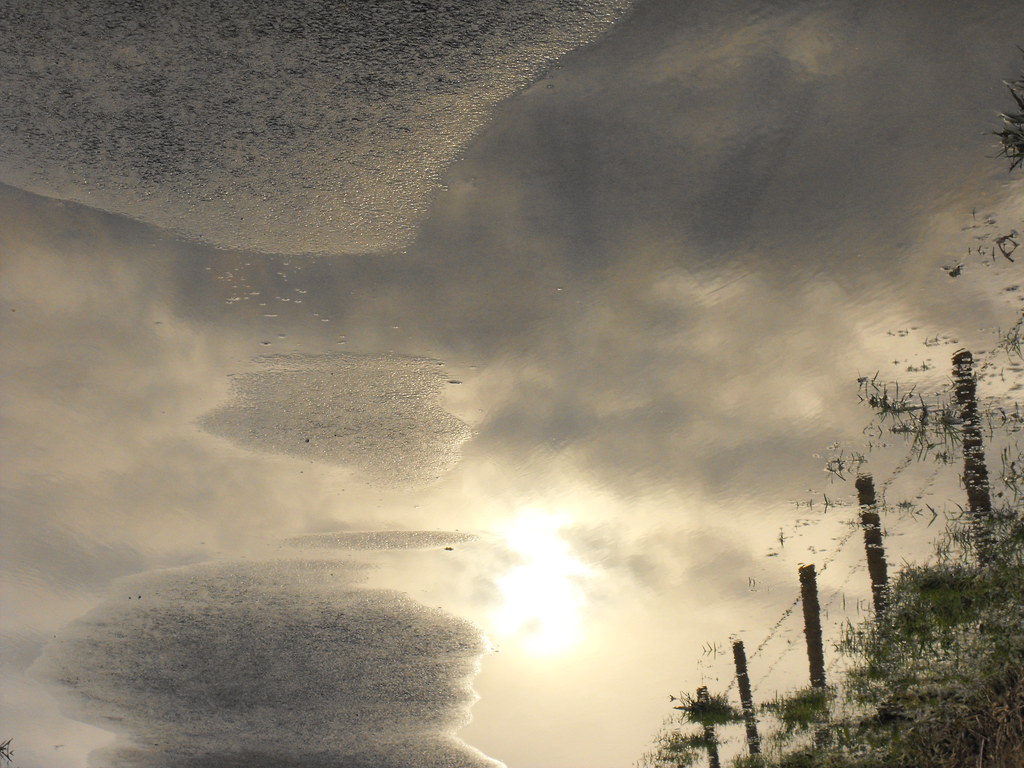
Apparently there is only one Escher work in a British collection, Night and Day (1938) in the Hunterian, Glasgow, and that only because it interested a geographer. He would seem to be just too popular – and also, one suspects, there is a bias toward oils and watercolours over prints.
So go see Escher in Edinburgh if you can – it may be more convenient for the metropolitans in Dulwich, but I’m not sure they can fit in all the work and Modern Two has a rather more generous scale. I fear it will be heaving.
 Subject to Change
