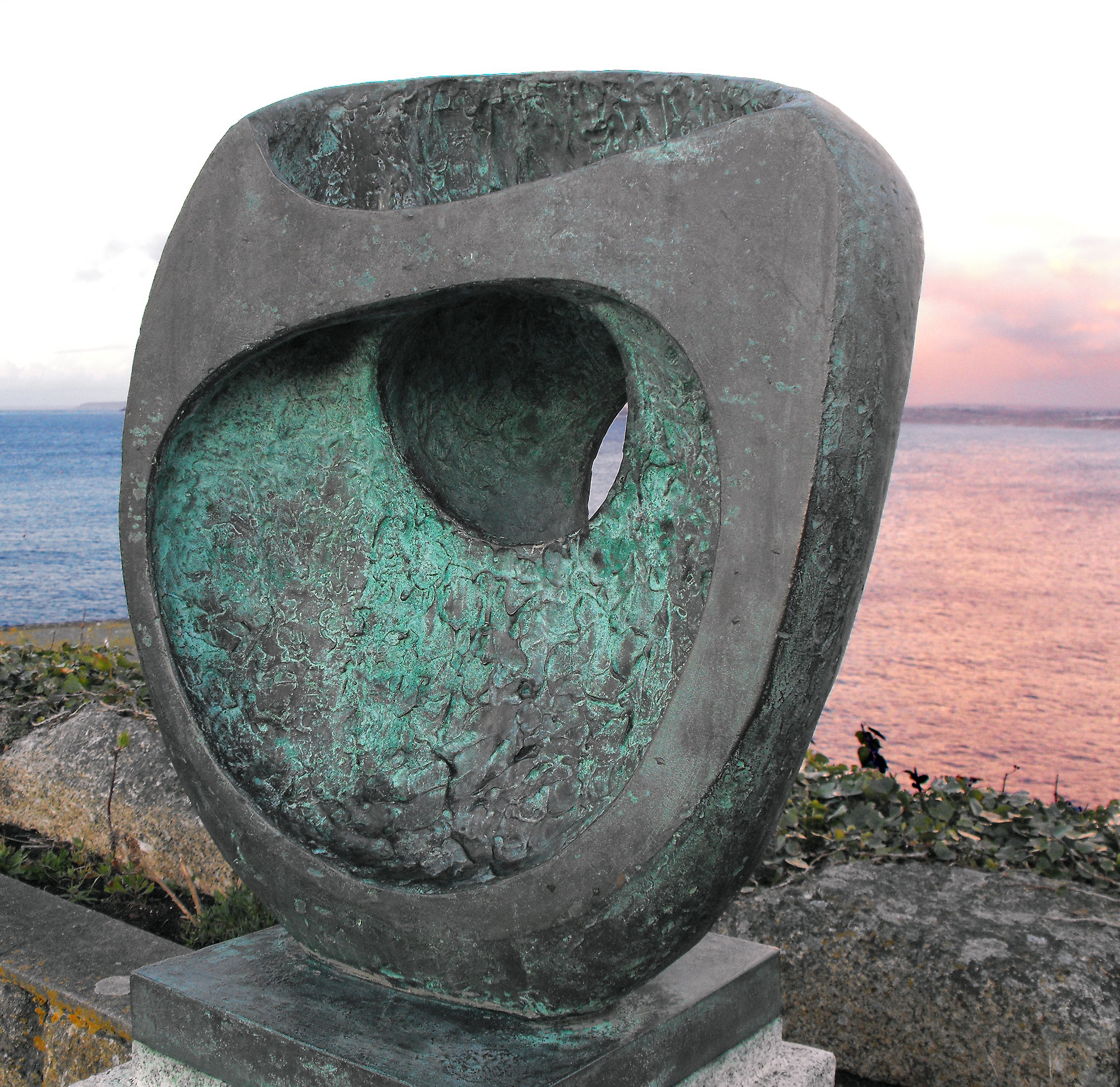
Not the Town in Surrey

The Amazing World of M.C. Escher (Modern Two, Edinburgh, 27 June-27 September 2015, Dulwich Picture Gallery, London, 14 October 2015-17 January 2016)

I have three memories.

Viewing an Escher exhibition in Manchester in the mid-1980s.

A family holiday in the Lake District, after the best part of a year spent in Hull, clinging onto the side of a hill with vertigo.

A colleague showing us paintings at the National Gallery and pointing out the Dutch interest in squares.

The first memory is almost certainly false – I suspect the only previous Escher show in the UK I could have seen was at Croydon in the 1990s and I’m pretty sure I didn’t see that, nor when it moved north.

Maurits Cornelis Escher was born in Leeuwarden, Friesland, in 1898, son of a civil engineer, and went to school in Arnhem, which was a dreadful experience. He was a good drawer, but he was initially expected to train as an architect. However, it was speedily agreed that his talents lay in the visual arts. He travelled around Western Europe and, whilst in Italy, met and fell in love with Jetta Umiker. Their parents agreed an allowance for the couple, whilst Escher began a career as an artist specialising in woodcuts.

In 1922 he designed a grouping of eight heads, “Eight Heads”, which cut be fitted together indefinitely and seems to have been the earlier example of an interest in tessellations. When he was to come to the Alhambra in Granada later that year and admire the Moorish tiles there, it was already part of his set of interests. Over the next five decades he was to play with birds, fish, lizards and all kinds of animals in a series of tessellations.

But before he developed that theme, he was to work on landscapes, especially those seen on his travels. The Tower of Babel (1928) is a nod to Brueghel, but generates a vertiginous sense in us by depicting it from above. Castrovalva (1930) – a name familiar to me from Doctor Who — depicts a series of buildings, a monastery perhaps, high on a hill, with a village deep below. I suspect that there is a play with vanishing points here, as there is so often, so that the distance is increased in several directions. I cannot help but feel that Escher, as someone from a flat country, would have felt the hills and cliffs of Europe to be steeper than they really are. Indeed, the landscapes that have a real-world counterpart are apparently exaggerated.

He was to move from the possible to impossible – the fantastical Dream (Mantis Religiosa) (1935) has an ambiguity over whether it is a bishop dreaming he is a praying mantis or a praying mantis dreaming she is a bishop, with an Alhambra palace architecture behind. In a street scene he balances rows of books against buildings, as it transforms into a bedside table. In a mirror, the street outside the room is reflected, but not the room. All of this is rendered in wood cut, occasionally wood print or lithograph, rarely mezzotint.

His work came to the attention of two mathematicians, Coxeter and Penrose. H. S. M. Coxeter, a British-born Canadian, was an expert in geometry and tessellations and was impressed with Escher’s apparently instinctive approach. In correspondence with Escher, he came up with a better way to represent infinitely tessellating fish in a circle – the way you do. Meanwhile Roger Penrose and his father Lionel Penrose were inspired to devise an impossible triangle – which Escher was to use in his endless Waterfall (1961) – and endless stairs – which Escher used in Ascending and Descending (1960). (Penrose’s uncle was Roland Penrose who was husband to photographer Lee Miller and whose library is in Modern Two.)

His work continued to play with perspective, some of it incorporating the staircases and halls from his hated school. A final piece of work was a tangle of snakes and chain, based around the circle motif. By then he was already being subsumed into popular culture – although he said no to Jagger and Kubrick who wanted his services.

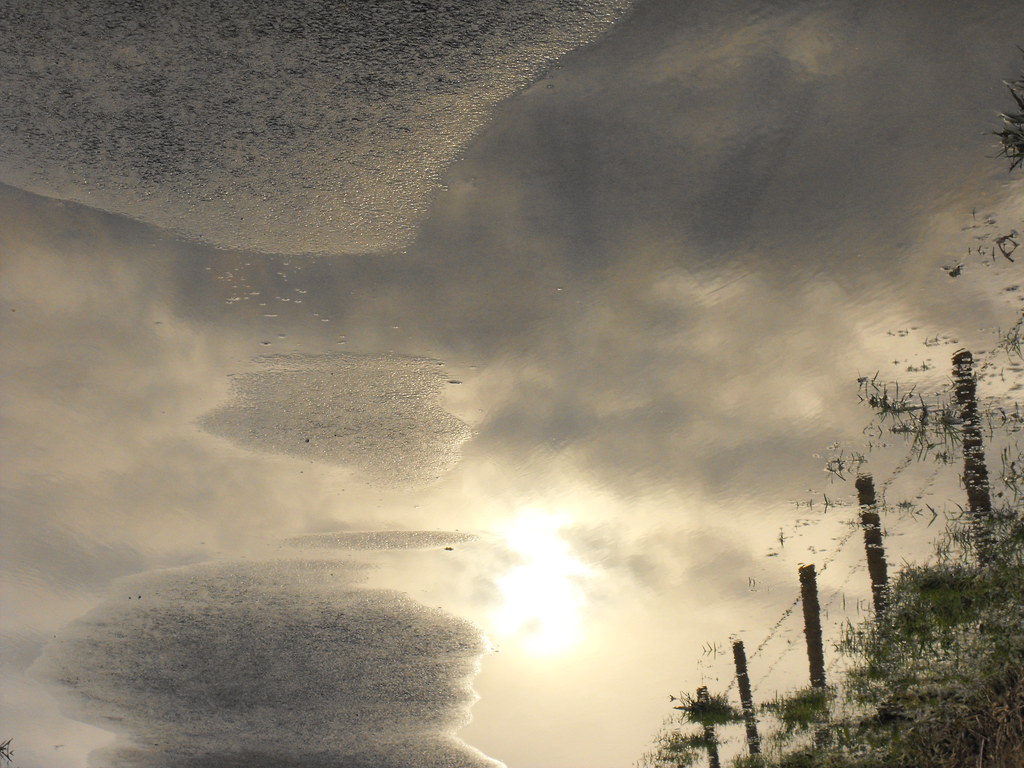
I was suddenly reminded on seeing relatively straightforward work such as Three Worlds (1955), with fish in the water reflecting the sky and trees, how far his play with the play has influenced my own photographic aesthetic. I am a sucker for reflected surfaces.
Elements
Apparently there is only one Escher work in a British collection, Night and Day (1938) in the Hunterian, Glasgow, and that only because it interested a geographer. He would seem to be just too popular – and also, one suspects, there is a bias toward oils and watercolours over prints.

So go see Escher in Edinburgh if you can – it may be more convenient for the metropolitans in Dulwich, but I’m not sure they can fit in all the work and Modern Two has a rather more generous scale. I fear it will be heaving.

My Darling Caro

Caro in Yorkshire (Yorkshire Sculpture Park, 18 July-1 November 2015)
Caro in Yorkshire (The Hepworth Wakefield, 18 July-1 November 2015)


As far as I can see, twentieth-century British sculpture was dominated by Barbara Hepworth and Henry Moore and, whilst you would be unlikely to mistake the two, there is a sense of continuity. Both are very organic in form and were committed to sculpture in public spaces. Whilst both did work in bronze and other metals, there is a background in manual carving in wood, marble and so on. The aura of the handcrafted. Bronze, on the other hand, usually requires a foundry and experts in metal.

Since the late 1960s there has been the more conceptual — walk as sculpture, glass of water on shelf as sculpture (of a tree).

Before this, however, there was Anthony Caro (1924-2013), a generation younger than Moore — and one of his studio assistants. Caro’s early works would involve a hands on roach — lumpy bronzes, a twisted human form and drawings or painting that seem to me reminiscent of Henri Gaudier-Brzeska. But a trip to the USA in 1959 sent him down a more industrial route — large pieces of metal welded together. Whilst he was to play with bronzed surfaces — rusted, waxed and so forth — the break through works were painted in a limited range of colours.

Caro’s work in sculpture brings together painting and architecture, pushing the boundaries. Being metal, being forged, they are clearly solid and heavy, but at the same time they are often suspended or balanced, seemingly lightweight. “They’ve got an inside but they’ve got no centre,” he said of them. His Table Pieces are often suspended on the edge of tables or shelves, and presumably have a very carefully placed centre of gravity.

What he is also credited with is the disappearance of the plinth. I have a few thoughts about this to follow up, but once a huge lump of metal is placed upon the ground, the frame between world and art is wafer thin. From this comes the possibility of the texture in the grass or a pile of aggregates. Some of the work looks like a climbing frame or an adventure playground — if the Hepworth and Moore sculptures demand to be felt, than these demand to be climbed. In some cases, the sculptures offer a kind of Wendy house, but mostly there are attendants to stop you.

Across one hillside at the Yorkshire Sculpture Park there are a range of different bronzes — curves and planes, verticals and horizontals, holes and towers. Across the other side of the site are the early works, preparatory drawings (and you can see he draws figures like Moore), as well as works from across nearly fifty years. Alongside steel and bronze there is also the use of Perspex — apparently glass turned out to be unwieldy. He also sculpted in paper and plaster imitations of paper. Meanwhile the works at the Hepworth cover the period from the 1960s to his death.


I didn’t take a note of the architect, but for a period he tried to codesign a tower; unable to find the funding or whatever, he appropriated the shape as sculpture but turned it upside down. At this point I was reminded of the work of Eduardo Paolozzi, and the mosaic of machinery he explored.

I liked these works more than I expected to — there is an aesthetic to them that is pleasing as they balance the solid and the ethereal. There is space and nonspace. And whilst this may end up disappearing the artist, there’s an infection of the real world as art — the scaffolding becomes installation (indeed, Cedric Christie and others have made sculpture from scaffold poles).

All photos here

Never Marry Your Cousin

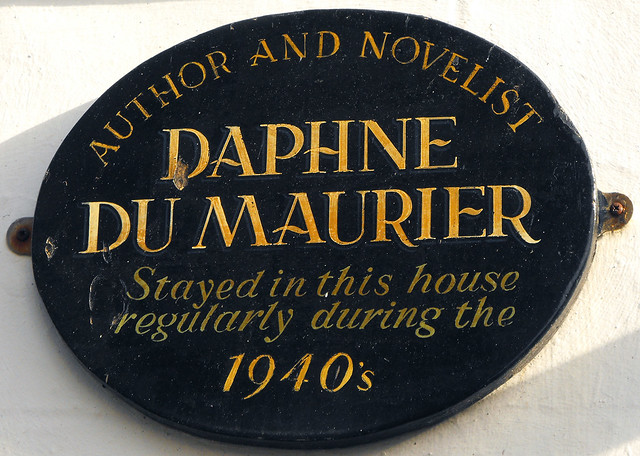
For reasons that escape me, a number of years ago I bought a boxset of Daphne Du Maurier novels. I must have thought this was good plan, because I then bought a second, and a couple of novels not included in either. I also bought the collection which contains the story that was the basis for ‘Don’t Look Now’. The most Hitchcockian of novelists – with perhaps the thought that Du Maurier was a Cornish Patricia Highsmith. The grand plan, being anal, was to read the novels in chronological order of publication, but that never happened and the boxes sat by my bed, gathering dust. So I picked another one at random. Du Maurier Plaque

“This, I suppose, was what men faced when they were married. Slammed doors, and silence.
Dinner alone.”

Daphne Du Maurier, My Cousin Rachel (1951)

Little Orphan Philip lives on a big Cornish estate at some point in time – it’s never entirely clear when, but the lack of trains would put it at some point in the early nineteenth century. His Confirmed Bachelor uncle, Ambrose, fully anticipates that Phil will inherit everything, the lazy brat, but that is before he goes on a holiday to Italy and meets, falls in love with and marries Rachel. Phil’s cousin.

Before you can say, “Cradle snatcher”, it becomes clear that Ambrose is unwell and Philip makes a mad dash across Europe, only to find his uncle dead and his mysterious cousin absent. He returns to Cornwall and begins to run the estate, blind to the sudden charms of the local unmarried women who are awaiting his proposal.

And after a few months he is joined by Rachel – whom at first he is determined to dislike because, yanno, probable homicide, but who he gets a crush on. If there were justice (and she isn’t just an evil schemer), Rachel would get the estate, and Philip seems to do everything he can to give it to her, made complicated by everything being in trust until his twenty-fifth birthday.

What is not clear here, of course, is how reliable the self-serving Philip is. Is it really wise to want to marry a cousin with a dodgy back story? Is it good taste to marry one’s uncle’s widow? Or is Rachel perhaps just poor at handling money and the victim of an infantile young man brought up in a homosocial environment?

Cutting It Fine

The Final Cut (Mike Vardy, 1995)

Following House of Cards and To Play the King, we get the third adaptation of Michael Dobbs’s Francis Urquhart trilogy.

Only Dobbs got his knickers in a twist because it dared to conceive of a dead Margaret Thatcher.

If only she were dead and buried.

By now Prime Minister Urquhart is in full Macbeth mode — with continued flashbacks to <spoiler> from part one and less often to <spoiler> from part two — suggesting he has a conscience after all. In addition to this we get Back Story of his time in Cyprus as a soldier and flashbacks to two violent deaths. This hasn’t seemed to have troubled him before, but presumably the attempt to find a settlement between Greek and Turkish Cyprus is the cause here. But clearly an era is ending and he’s looking top be provided for — a nice little earner of an insider deal.

The minnows are circling and the successors are lining up — can he fend them off as well as the relatives of the Cyprus dead? I guess if we follow the tragic structure we know what will happen, but I’m not sure I buy the mechanism of betrayal (although there’s been hints of an affair between a major and less major character). Again, Richardson carries the series as Urquhart; everyone else just reminds you of someone you’ve seen since on tv.

(Follows House of Cards and To Play the King)

A Jack for a King

To Play the King (Paul Seed, 1993)

The second in the House of Cards trilogy, with Seed’s direction marginally better and cutaways in the first or two episodes to beggars and the homeless. As before, Ian Richardson’s acting is superb and this sells the series.

Having begun the first series with dispensing of Thatcher, this begins with the crowning of a new king who I suspect is never actually named. If this were more willing to be sf — to embrace its parallel world — then they would name him and tell Michael Kitchen to stop doing a Prince Charles impression. There is Princess Charlotte, an ex-wife, although it’s not clear who it is, because it’s not the King’s ex-wife, who is blonde and has a son. Princess Charlotte, meanwhile, has a line about being warned about a car accident if she steps out of line.

So Francis Urquhart (Ian Richardson) is prime minister and bored and sees a new challenge in facing down the political views of the new King. The new King, meanwhile, feels he should Have His Say, at the risk of bringing the constitution to a crisis point. (As opposed to writing secret spidery letters, say.) There’s a game of cat and mouse about who stays in their seat, but we know there’s part three.

Meanwhile, Urquhart gains a new advisor, Sarah Jarding (Kitty Aldridge), a kick-ass pollster who can poll any opinion you need. And the King has an advisor or two, a gay white man David Mycroft (Nicholas Farrell) and a Black Briton Chloe Carmicahel (Rowena King). And because no one can keep it in their trousers in these dramas, affairs start even though there are elections in the offing. Are you people stupid?

Another subplot had Urquhart’s former colleague as a whip become Chairman of the party and then denied a cabinet place after the election — a similar thing having happened to Urquhart in series one. I guess this is dramatic irony, but you’d think FU would be aware of the insensitivity.

In summary, watchable but faintly ludicrous, as the bodies build up.

(Follows House of Cards and followed by The Final Cut

I’ll Buy That For A Dollar

RoboCop 3 (Ted Dekker, 1993)

The third film of a franchise comes with low expectations – by then none of the original cast are in it, or the protagonist faces an evil double, or everything is shot in 3D, or the original premise is junked. Diminishing returns doesn’t come into it.

Yet RoboCop 3 is better than it has any right to be. RoboCop (Paul Verhoeven, 1987) was the director’s now trademark hyper violent satire on the corporate world, in which an almost fatally wounded cop (Alex Murphy (Peter Weller)) is made into a cyborg and forced to fight crime. He/it is the property of OCP (Omni Consumer Products) who clearly have an eye on the privatisation of the state for profit. In the sequel – directed by Irvin Kershner who directed the best (and second) instalment of a certain other trilogy – OCP are foreclosing on Detroit for non-payment. Detroit, by then, is a criminal warzone, by OCP envisaging a new gleamy city, which they will fund and profit from.

That city is still the Promised Land in the third film, but Detroit residents are being evicted supposedly to make way for the development. Functions of the state are clearly privatised and outsourced, with a new villain in the shape of Paul McDaggett (John Castle) and a new CEO in the shape of Rip Torn from The Larry Sanders Show. The Detroit police become increasingly wary of McDaggett’s plans, as rebels fight back in Old Detroit. When RoboCop’s (now Robert Burke) partner Anne Lewis (Nancy Allen) is killed – she really ought to wear that armour she has – he sides with them against OCP, erasing the fourth directive which should prevent such things. OCP, meanwhile, are facing financial ruin and a corporate takeover from Japan. Head office send in an agent, Otomo (Bruce Locke), to try and reassert control.

It is satisfying if ironic, of course, to see the skewering of a corporation in a Hollywood movie – although of course Orion went belly up in 1999. One character tells us “There is no silver lining, only corporate scumbags who want to line their pockets” and McDaggett snarls at the CEO “If you’re just now figuring out the line between big business and war is a little blurry, then you’re further over the hill than they say you are.” OCP’s ownership of people and land is reasserted again and again – memories are property, ideas are property. The media colludes in corporate brainwashing.

Detroit was, of course, the powerhouse of the American economy, the centre of the car industry – and it is telling that RoboCop is compared to a Chevy when he needs repairs. It appears that, albeit for a brief period, the tension lines of race could be ignored in the face of working class solidarity in industrial capitalism. But outsourcing and rationalisation led to the almost complete destruction of the industry and Detroit was indeed to declare bankruptcy. African American ghettoes surrounded by declining white suburbs was the result. Motown moved to Hollywood.

The trilogy has a range of African American characters, albeit their race is not commented on at all – Johnson (Felton Perry) is a Vice President throughout, surviving when many others don’t, a visible success story. Sgt Warren Reed (Robert DoQui) is the grizzled police sergeant, who becomes the moral heart of the film. Meanwhile, the new character Bertha (C. C. H. Pounder) is a smart and charismatic leader of the rebels. (There’s another character, a pimp (Ron Leggett), who feels rather more stereotypical of Hollywood film, an echo of the mayor from the second film and a criminal from the first.)

Age has not been kind to some of the special effects – whilst the stop motion animation of the police robot was always clearly a model, flying RoboCop is clearly blue screened in. Alongside the ultraviolence and a rather awkward use of the word “slag”, we also have a child protagonist, Nikko (Remy Ryan), of mixed ethnicity and, surprisingly, less cute than you’d fear. She is a computer genius – echoes of from Lex (“Oh – a UNIX!”) Murphy Jurassic Park. Indeed, RoboCop’s feminist credentials are stronger than Jurassic World.

Of course, what doesn’t sit well is the final climactic shoot out which leaves the Detroit Police as heroes. We are clearly meant to punch the air: “It’s time to show how real cops kick ass”. But news stories about the police have been problematic of late. Here, the Repressive State Apparatus wins out over corporatism – and that is perhaps a hollow victory for the citizen.

Meanwhile, the CEO of OCP – an anagram of COP, of course, even if I kept hearing it as OCD – has visions of corporate rebirth: “I realize that it looks bad but, I mean, maybe our plans were overambitious. Let’s start a skoshy bit smaller. Let’s gentrify this neighbourhood, build strip malls, fast food chains, lots of popular entertainment. Whadda you think?”

Regeneration as land grab. Still so familiar.

Hep Hep Hooray (Part Two to Follow)

Barbara Hepworth: Sculpture for a Modern World (Tate Britain 24 June-25 October 2015)

Hepworth plaqueI really like Barbara Hepworth’s work. It has a kind of tactility to it, a sensuousness — it cries out to be touched and caressed. I’ve been up to Wakefield and looked at the plasters and maquettes and the blue plaques, and down to St Ives to see the studio and at some point saw the hospital drawings.

So I was looking forward to this Tate overview, in the same space where they showed Henry Moore.

I’m going to do two write ups, because I want to do it justice. But this time round, I’m going to be critical whilst thinking you should really go.

Major galleries still rarely do one women shows (although note Tate Modern this spring and summer).

There’s always a danger when providing context that this takes away rather than enriches your appreciation of the materials. In the first room, there are lots of hand carved sculpture, not all by Hepworth. We’re told that one of her strengths was direct carving — inspired in this by Henri Gaudier-Brzeska, Jacob Epstein and Eric Gill, but also by the fact that the was apparently a whole lot more of this than we realised. Everyone was up to it. One missing name was Leon Underwood, whom I might well come back to, who was a tutor to Henry Moore. Was she that special?

Before she married Moore, she married Ben Nicholson and before that John Skeaping — another direct carver — and there is a room of works by Nicholson responding to hers and vice versa. I like Nicholson’s work, but, again, I’m a little worried it takes away from her. I suspect not, but.

Hepworth SculptureIn a later room there’s a documentary, Figures in a Landscape (Dudley Shaw Ashton, 1953), with Cecil Day-Lewis reading bad poetry over footage of the Cornish coast, telling us about how history and then Man has sculpted the landscape — you know that “invisible” sexism that defaults to and his? You want to scream, YOU KNOW HEPWORTH IS A WOMAN, YES? Eventually her sculptures start appearing in the landscape, and for a more you assume the apes will start worshiping them and a certain theme will appear on the soundtrack. Or you assume it’s the inspiration for Led Zeppelin’s Presence.

At the end of the show, there’s a recreation of the Rietveld Pavilion from a Dutch sculpture garden, with sculpture finally naked — up to then, more or less, everything is in vitrines. I know that hands can leave marks and grease and patina — but I don’t recall Moore’s being so glassed off. Were there ropes? It’s great to get a full 360 view of them, but it makes the exhibition a maze (where have they hidden the label this time?) and its frustration because you just wanna touch. And at the end it’s not clear if you can.

Hepworth died in 1975.

The pavilion was 1965.

Did she not sculpt for a decade? Was the later work earlier? Or was it all large scale stuff like the UN piece or the John Lewis’s one?

It just stops.

Did I miss a chronology of the artist? Okay, the exhibition guide tells you she died in a fire, but it still feel a little off-key.

The really sad thing is there is fantastic stuff here, but I’m not sure justice is done to it. I will go back, I suspect in late August now, having read the catalogue, and say more.

Be Afraid, Be Very Afraid…

“Sleeping/Waking: Politicizing the Sublime in Science Fiction Film Special Effects” in Sean Redmond and Leon Marvell, Endangering Science Fiction Film (New York and London: Routledge, 2016).

There is a moment in Andrew Ross’s account of sf when he cautions against a history of the genre that is ‘overlaid by prejudices against the North American vulgarization of the high-minded and a socially critical European SF created by respectable intellectuals’ (1991: 104). Sf as a genre is the product of an industrialized age – either a loosely defined branch of fiction produced within the niche market of magazines or the streamlined mechanism of the Hollywood system. The industrial revolution transformed Europe and parts of North America from rural to largely urban societies and workers changed from being laborers, artisans and craftspeople to an alienated workforce undertaking regulated shifts. Popular culture, itself a product and representation of mass industry, occupies an ambiguous position that serves to make industrial society bearable, whether through providing a sense of escapism and relief (albeit a catharsis that risks perpetuating the power structure) or allowing the envisaging of alternatives (that might challenge these structures). One pleasure associated with popular culture is the experience of spectacle and the sublime. These can have a transformative effect upon the individual, whether it creates contentment with the system or provokes a more dangerous, revolutionary response. In this chapter I will link various notions of the sublime as evoked by special effects to sf as ‘cognitive estrangement’ (Suvin 1979) and note some of the political implications of such effects. I will focus on films such as They Live (John Carpenter, 1988), Monsters (Gareth Edwards, 2009), Gravity (Alfonso Cuarón, 2013), Ender’s Game (Gavin Hood, 2013), 2001: A Space Odyssey (Stanley Kubrick, 1968), Avatar (James Cameron, 2009), and Moon (Duncan Jones, 2009). This discussion will not assume a North American/European binary to the genre, although it largely focuses on Hollywood films.

Routledge webpage

Card Sharp

House of Cards (Paul Seed, 1990)

I never saw House of Cards on first broadcast in 1990 — television viewing was limited as a student although I did see Twin Peaks. It had the good fortune to be broadcast just as the Conservative leadership election was underway and we were to leave Thatcherism behind forever. Hooray.

Koff.

So chief whip Francis Urquhart (Ian Richardson) is expecting a cabinet post in the aftermath of Thatcher’s successor’s election but is let down. He seeks revenge by deciding to manufacture a scandal that will bring him down and engineer things so that he gets to be the next leader of the conservative party and prime minister.

Here we have a modernisation of various Shakespeare plots — Richard III (although maybe not hugely — do I recall an acting out of the Olivier version?) and Macbeth, with Urquhart’s wife (Diane Fletcher) playing a greater role than in the Michael Dobbs book and clearly being a Lady Macbeth. I suspect there are shades of Iago there, too. Richardson is glorious immoral/amoral and the device of talking to the camera has the self-serving/self-deluding impact of Shakespearean monologues, especially Iago’s.

Of course, the series doesn’t stay with his point of view — it does skip around the other MPs and aides, but more to the point we have a lady journalist, Mattie Storin (Susannah Harker), who Urquhart uses to his benefit. It should be noted that all the jobs that women can do, lady journalist seems to scare the dramatic horses least. And she also falls into the thing that so frequently annoys me as cheap drama — sleeping with the story/suspect. You just wouldn’t. You also feel she would be a little less trusting of him.

But there are shenanigans.

Whilst the drama itself feels current — although big desktop computers! dial telephones — the direction by Paul Seed does not. It is of course very talky and there’s distinct telling not showing, but somehow that never stopped The West Wing. There were moments when I thought it a fine radio play.

And then there were the various cuts to rats.

Whatever can that mean?

NO, DON’T TELL ME — THAT WAS IRONY.

Koffs.

Heavy-handed, much?

If LoveFilm sends me the sequels, then I shall write briefly about those. (I did — To Play the King and The Final Cut)

Back to the Drawing Board

I’m just reading a puff piece from Sight and Sound, getting excited about the use of computer animation in a forthcoming movie.

“One could only imagine the uses to which visionaries like Lucas could put computer imaging”, they gush.

A few years later, of course, he would start buggering about with the Holy Trilogy and gift us Jar Jar Binks.

Meanwhile, we’re teased with possibilities:

“With the ability to create and revise the whole thing almost by himself, a director could continue changing characters, backgrounds, props, colours and lighting effects until the time of a movie’s showing. Michael Cimino, whose $35 million epic Heaven’s Gate barely breathed at the box office, might have wished to be able to go back to an electronic drawing board.”

The movie in question had a budget of $17 million and box office $33 million. Not exactly a runaway hit.