More than a Load of Pollocks

Abstract Expressionism (Royal Academy of Arts, September 2016—2 January 2017)

There’s a story that in the late 1940s, the CIA funded Abstract Expressionism. It was an exercise of soft power, from the people who funnelled money into the animated Animal Farm and exploding cigars. The Soviets were busy with their Socialist Realism, whilst the Americans were channelling the chap with the lily pads with bigger brushes. The AES paint big, really big, and it takes a lot to transport all those canvases around the world. In one version the Tate wasn’t able to afford a huge exhibition and an benefactor gave the money. The story is the money came from the CIA.

If Abstract Expressionism didn’t bring down the Berlin Wall, then at least it came up with pretty cool murals.

It’s the sort of thing that can leave you cold, but if you surrender to it it’s pretty amazing.

Just like capitalism.

The cavernous spaces of the Royal Academy seem appropriate, although they’ve never quite got the walk through right. These are huge, abstract paintings, determinedly non-representation, yet in theory expressing an inner emotion. Of course, we don’t always know what that emotion is, but you can always supply your own.

The first room was a kind of overture, showing paintings from many of the big names prior to the glory days. Some of these are portraits, few of them are great, but you can see the roots in Barnett Newman’s green stripes on dark red. There’s a curious Mark Rothko, Gethsemane (1944), presumably alluding to the night of Christ’s betrayal, and sort of cruciform, but it might be an eagle with an American football. And a weird cloud flag.

Clyfford’s Still’s PH-726 (1936) has wobbly male and female bodies inscribed within a block — a two dimensional version of what Moore and Epstein were carving at about the same time. A new name to me, I confess, but one I will return to later.

And so the various stars come out — and the rooms which focused on one or two artists were stronger than those which offered dubious thematic arrangements. That being said, I don’t get on with Arshile Gorky, having bounced off his Tate Modern show a few years ago. A numbers of them look like oddly painted figures in a room — say Diary of a Seducer (1947) — and I see I’ve made the note to myself, “bad photoshop”.

Jackson Pollock, on the other hand, is truly sublime. I never quite wrote up all my notes from Liverpool, but the late, black pour, works feel like the figurative abstracted. Like Rorschach tests, you can find the sail boat if you squint right. He gives in to the chaos of the drip, somewhere between randomness, automatic painting and the unconscious at work. There’s a huge mural, designed for Peggy Guggenheim’s New York apartment, with “a prancing, bestial presence” which maybe you wouldn’t want to live with. You don’t get a lot of help from the titles — even Summertime (1948) isn’t that helpful, with its wide, short overlapping of colours and drizzles. The trajectories of flies on a summer’s evening? There’s his Blue Poles (1952), with its striking, vertical totems, daring you to distinguish figure from ground. There are other colours, of course, (black grey white) but it’s striking how often he returns to red, blue and yellow, as if he’s unravelled a Piet Mondrian.

[and there, tucked on one wall, is Lee Krasner, not quite the token woman — though it does have to be said that AE is a very blokey genre with its SIZE DOES MATTER statements in oil — who takes four years to come to terms with Pollock’s stupid death in a car crash, who only then can “wrestle” with his ghost to produce The Eye is the First Circle (1960), which inevitably has to be read as homage and imitation rather than the work of an artist in her own right. Later, we’ll come across Helen Frankenthaler, whose exhibition I missed at the Turner, with Europa (1957) although I saw no bull.]

Mark Rothko is glorious, as always, and the room of his work at Tate Modern can reduce me to tears. As always the paintings seem to ride the walls, rather than be hung on the them, the layers, the laminates of colour lumess and dammit that is a word. You are surrounded by them in an octagonalroom, dwarfed, and I was annoyed to see people taking selfies against them — not because of any objection to such narcissism, but because my instinct is to disappear into these canvas rather than superimpose myself upon them. There are exquisite vertigo.

I don’t think I’ve come across Clyfford Still’s work before, but I’ve put his museum in Denver on my long term to do list (when the US is more sensible about the TSA…). These are vast canvases, representing vast landscapes, abstracted into colours. My favourite was PH247 (1951), also known as Big Blue, a luminous canvas of many blues, interrupted by dark brown and orangish vertical strokes. This, too, is a room to get lost in.

Less successful is Willem de Kooning’s work, here dominated by his paintings of women, of which he wrote “I wanted them to be funny … so I made them satiric and monstrous, like sibyls”. Gee, thanks. These are women as landscapes, rather than in, to my eyes deeply misogynistic. His other landscapes, notably Dark Pond (1948), which I misread as and viewed as Duck Pond, are better, but I don’t feel inclined to follow him up.

The shared rooms were on the whole less successful, with less of a chance to get to know the range of the artists’ work. A few women sneak in here — Joan Mitchell, Helen Frankenthaler, Janet Sobel — and I suspect the only Black artist, Norman Lewis. I wanted to know much more about his work. A room of drawings, books, prints and photographs got a little unruly, as the labels and pictures were not always as clear as they might be in the crowds. The final room gives space to Joan Mitchell’s four huge canvases of Salut Tom, echoing Postimpressionism as much as Abstract Expressionism, and represents late work of some of the big names — although of course Pollock was long since dead.

One final room to draw attention to is the one of Barnett Newman and Ad Rheinhardt, who interrupt swathes of colour with zipped colours or focal zones. Rheinhardt retreated into the Malevich black square for fourteen years — 60″ x 60″ canvases painted all back. The spartan austerity is striking. But Newman was the revelation, and I wonder if he was the inspiration for the Abstract Expressionist Rabo Karabekian’s The Temptation of Saint Anthony in Kurt Vonnegut’s Breakfast of Champions (1973). Eve (1950) is a mostly red canvas with a dark red stripe on the right hand side and its twin Adam (1951-52) is brown with three red stripes of different widths. I have know idea if they connect, but he somehow feeds into Bridget Riley‘s stripes. Newman writes “only those who understand the meta can understand the metaphysical and his paintings are as much their paint as anything else — the rich blues and reds.

Of course, these artists went through a whole range of political experiences from Pearl Harbor to Watergate, and I guess they mark the point when the art world shifts from Paris to New York, with Rauschenberg and Warhol waiting in the wings (and O’Keeffe‘s rather different abstracts predate, postdate and overlap with their heyday). They are, of course, always on the edge of being the emperor’s new clothes, just paint on canvas, randomness. But in the vast spaces of the Royal Academy most of the work transcends that caveat.

Beyond the Lady Garden

Georgia O’Keeffe (Tate Modern 6 July-30 October 2016)

you hung all your own associations with my flowers on my flowers and you write about my flowers as I think and see what you think and see of the flowers and I don’t”

“Miss O’Keeffe’s drawings … were of intense interest from a psycho-analytical point of view” Camera Work MDCCCCXII

Joanna Russ’s How to Suppress Women’s Writing is a blistering anatomy of the ways in which critics dismiss female authors. I suspect the same is true in the way we treat female artists. So many of them are just plain ignored, not part of the history, whereas others get related to more famous (artist) husbands. The recent Barbara Hepworth exhibition at Tate Britain is a case in point — the juxtaposition of her work with Ben Nicholson’s (much as I like him), risks privileging the influence in one way.

The muse is female.

And so we come to Georgia O’Keeffe (1887-1986), who I in my ignorant way had assumed was just a painter of flowers (see also Mrs Delany with her collages and Winnifred Nicholson). And those flowers were, well, obviously, yanno, well, um.

Yonic.

Vaginal.

If the pen is the penis, then the paintbrush might as well be a, um.

Flowers.

Lady gardens.

What should be immediately clear from this exhibition — too big an exhibition I suspect, as is often the Tate Modern way — is that there is much more to her flowers and indeed they form a tiny part of her output. Even, perhaps, the least interesting part.

She’s born in Wisconsin and moves to Virginia, but comes to the attention of photographer and curator Alfred Stieglitz, undeniably a fine photographer. He’s married, but tempts her across to New York and shows her work in the 219 gallery he owns.

Not only that, but he takes photographs of her — not all nudes, but a goodly deal of the ones on display were, close in on breasts, torsos, stomachs, belly button and genitalia. Great photos, yes, but a woman dissected for our pleasure, and apparently he’d done much the same to .

O’Keeffe’s work is largely abstract at this point — vertical ribbons of colour with curves or diagonals cutting across them. I always find myself in a Rorsach diagnosis with abstract, narrativising them perhaps, and you can read them as curtains (a domestic space) or even as legs or …

Quite.

A painting such as Grey Lines with Black, Blue and Yellow (c. 1923) was in fact a response to head of the Teachers College, Columbia University, Alon Bement playing music, and a lot of these paintings seem to be responses. Meanwhile, another of Stieglitz’s protégés, Paul Strand is mixing street photography with photos of objects flattened into abstract patterns of black and white. Stieglitz was to turn more abstract and photograph clouds as part of his Equivalent States series — a homage perhaps to John Constable, but also an influence on O’Keeffe’s trajectory.

As Stieglitz and O’Keeffe set up life together, in a circle that included Paul and Rebecca Strand, John Marin, Paul Rosenfeld, Marsden Hartley and Dorothy Norman, the hunt was on to find a distinctly American artistic voice, a means of responding to New York, although the two aims were likely incompatible, at least for O’Keeffe. Strand went about it by sneaking photos of the passers by, but also with almost abstract images of commuters walking past Wall Street buildings. Marin produced a stunning painting of Downtown New York, whereas Stieglitz took photos from the various apartments in skyscrapers they occupied. O’Keeffe painted the skyscrapers at night, often from street level, but also elevated views across the city — Untitled (New York) and East Pier No 3 show the river, the factory, the cranes and derricks and a single church spire. It’s like an L. S. Lowry, although just predates them.

They had a holiday home at Lake George, where he took photographs and she painted (Strand took a great photo of a baby buggy there, but felt he was trespassing on another man’s territory.) O’Keeffe’s landscapes of the lake are almost symmetrical along a horizontal line, the hills and mountains reflected, the composition tightly cropped like a photo. There she could also paint flowers, the Jimson weeds, pansies, iris, poppies, huge, overblown, but almost cropped.

We might associate flowers with the feminine, although it was Blake’s rose that was sick, along with nature and domestic spaces, but we mare projecting. I don’t think that there is a single painting of a human being in any of the paintings on display here — her A Man from the Desert (1941) is presumably a scarecrow. There’s Lake George, Coat and Red (1919) which may include Stieglitz’S black cape with a red lining, but he’s not there. The body, that abject definition of the female, is absent and so perhaps we project that onto the canvases. Taking our cue from Stieglitz and the early reviews of her work, she is painting anatomy but sublimated. Clearly those flowers are —

Really?

I mean, I’m not exactly a connoisseur, but I think that reading takes a great deal of squinting, even if some feminist art critics seemed to follow that up. It seems a way of making her interesting whilst dismissing her; the paintings aren’t quite proper. Stieglitz as patron, editor of the journal Camera Work, boyfriend and husband, was managing her reception. O’Keeffe was to deny the interpretation and, despite the fact that she might not be best placed to perceive her own unconscious psyche, I’d take her at her word.

A wider world was calling. Strand takes her up to Canada and she paints Nature Forms — Gaspé (1932), landscape as abstract, a storm in a spiral, full of flow and power, blurring sky, sea and land. It’s sublime rather than frightening. And she follows Hartley down to New Mexico, where a wealthy woman on her second husband heading to her third, with an unlikely collection of surnames, Mabel Dodge Luhan, is collecting artists. The land is red and yellow, to my eyes barren and sterile, but I suspect to her utterly fertile. The churches and other buildings are made from clay, adobe, there’s a church that might date back to 1000AD (which definitely gives me pause). It’s a landscape carved out by indigenous people and Spanish colonisation and… she finds America.

Someone said that New York is not America, but an island off the coast of America. For O’Keeffe the authentic America is west of the Hudson River, into the south west, what she calls the Faraway.

(Wasn’t that Enid Blyton? Maybe it’s somewhere near Whileaway.)

Ansel Adams is documenting the people and the buildings in photographs, and snaps a few of her too. She’s a whole woman, even if she seems to be masquerading.

There are few flowers here, but there are lots of bones. There are deer skulls, mule skulls, and so forth, in European art language part way to a memento mori, the mutability of life, or part of a Dalí-Esther surreal juxtaposition of the skin beneath the skull. The juxtaposition of a white skull with blue and red stripes points toward an American symbolism. For O’Keeffe, the bones were more alive than the animals that they were once part of, they were solid rather than surreal. It’s hard to shake off the echoes, though, as a skull of a ram reminds me of the very European Herne the Hunter. But then there’s Mule’s Skull with Pink Poinsettia (1936) and From the Faraway, Nearby (1937) itself, stunning works, seizing control of scale and perspective.

Stieglitz was clearly trying to keep control. She decided to ship a barrel of bones back East, but Stieglitz co-opted them, photographing her hands and a skull before she could paint them. He tried to keep his territory marked.

He’s not a villain, of course, I like his work, but still. And from all accounts they remained in love even if she was moving away (and he toward Norman). Driving away, even.

At least this time it was her hands.

She’d rented a place in Alcade, New Mexico, and found a new landscape of interest, a set of limestone cliffs in the Chama River Valley near Abiquiú, known as the White Place, and in 1934 spends time at the Ghost Ranch, where she finds a rock formation that becomes known as the Black Place. She painted both locations, along with the ranch, repeatedly, although the exhibitions focuses more on the black than the white. Here we have clefts and vertiginous heights, again hinting of bodies and buttocks and, well, maybe, but it is a stunning set of works that continue into the Second World War.

Eventually she buys the Rancho de los Burros on the Ghost Ranch, because of the views from the patio, and an inspiring door in the wall in its courtyard. She is to return to this door — an echo of a teaching exercise she had set decades before about the use of painterly space: draw a square and add a door. Domestic space becomes abstract — in at least one painting, My Last Door (1952-54) becomes almost a Malevich black square on a terracotta background. She is also painting the cottonwood trees and the blue skies — a return to skies — viewed through holes in the bones. Oddly the bones are flattened — white with grey — with an almost concave sky visible in the space.

She is returning to her earlier abstracts, with vertical stripes disrupted by diagonals and smoke, such as Blue I (1958) and Blue II (1958). I want to read them as the sky viewed through drapes, but I’m domesticating them again. And then there are the paintings of native, local culture.

She has also seen this landscape from above, from a plane, and she paints this new perspective — desert and plain and sky. Sometimes it looks like airbrush or acrylic, Rothko as landscape, but it is her own language. Stieglitz had died in 1946, and she was definitely her own artist now.

The exhibition leaves her in the 1960s, although she has a decade of painting left, with failing eyesight and health. Like Hepworth, we don’t see the physical decline.

There is no need to sexualise her and there is no need to make special pleading for her as a woman painter. She is an artist. She made deals, she negotiated, she is more than “just” the flowers. And this show depicts her in a wealth of detail.

Beyond the Lady Gardens

Georgia O’Keeffe (Tate Modern 6 July-30 October 2016)

“you hung all your own associations with my flowers on my flowers and you write about my flowers as I think and see what you think and see of the flowers and I don’t”

“Miss O’Keeffe’s drawings … were of intense interest from a psycho-analytical point of view” Camera Work MDCCCCXII

Joanna Russ’s How to Suppress Women’s Writing is a blistering anatomy of the ways in which critics dismiss female authors. I suspect the same is true in the way we treat female artists. So many of them are just plain ignored, not part of the history, whereas others get related to more famous (artist) husbands. The recent Barbara Hepworth exhibition at Tate Britain is a case in point — the juxtaposition of her work with Ben Nicholson’s (much as I like him), risks privileging the influence in one way.

The muse is female. Continue reading →

Ray-Jones of Light

I don’t think that Tony Ray-Jones was a name known to me, but I’m pretty sure I’d seen a photo or two — I’m thinking couple having a picnic at the Glynebourne festival, surrounded by cows. And then Martin Parr curated an exhibition of his photos and his own work, which I think opened the Media Space at the Science Museum I suspect an attempt to ease their presence out of Bradfoford, but that’s another story. That show, Only in England, has toured and I missed it by a day at Liveroool. Now a selection has come to Canterbury’s Beaney, supported by a talk by my comrade Karen Shepherdson.

There’s a curious tension in the photos — modernity and nostalgia, realism and the comic, celebration and, maybe, condescension. That last one is arguable. Shepherdson, whose own practice includes working on the harbour at Broadstairs, has enjoyed eavesdropping on the gallery’s viewers, noting their engagement and their memories.

Ray-Jones was born in 1941, son of Raymond Jones, a painter and etcher and part of the St Ives school (he had changed his name to Ray-Jones to help his image) who died when the photographer was an infant. After an unhappy time at Christ’s Hospital school in Horsham, he studied at the London College of Printing and won a scholarship to Yale, as spending time at the Design Lab, Manhattan, where he was introduced to street photography. He returned to England with a new aesthetic and credo, partly as an outsider in the era of British pop art and the Mersey sound and Swinging London.

Shepherdson pointed out the significance of the seaside to British photography. In the U.K. We are never further than seventy miles from the sea and it became the default destination for the working class day out or holiday. From the early days of photography in the Victorian era, businesses set up on the beach or promenade, taking walker that would be developed and sold to the subject within minutes. Companies had props and backdrops, and portable developing facilities or darkcars. Hundreds of photographs would be taken each day — in the early days ambrotypes and ferrotypes. It became a precious memento of a family jolly, rare in the century before camera phones. The beach is also a carnival space — it is a holiday, even if a day trip, alcohol might have been involved and the family is off duty. Morality … slips. At the same time there is a curious formality — most people would have had work clothes and best clothes, so the beach visitors are often in suit and tie.

Whilst Ray-Jones did not only take photographs at the seaside — and had used colour film in America — the beach photos were part of a self conscious project cut short by his death in 1973 from leukaemia. Among his notes are lists of seaside towns — Ramsgate, Margate, Broadstairs, Bridlington and so on — with the one visited ticked off. The south east was more completed than the north east. He toured round England in a dormobile 1966-79 with his wife, seeking to capture an England at risk of becoming Americanised. The seaside towns frequently document nineteenth century resorts in decline — and to my mind offer a sequel to the charabanc trip in Uses of Literacy.

In a series of notes to himself, he lists his credo: “Don’t take boring pictures”. He wanted to avoid mid shots in for close ups, to be part of the action. “Be more aggressive.” “Get in closer.” “Not all at eye level.” It seems good advice.

Karen showed a picture of people on a boat trip — it gets labelled somewhere like Scarborough but in fact is off Beachy head. A crew member and several passengers are on a pleasure boat, looking in all directions, including a figure you might read as a shepherd in a Yorkshire context. At the centre are a casually dressed young couple, kissing and embracing, he in glasses, she looking like she’s walked off a French new wave film. Je t’Aime. Je t’Aime. They are the only people of their generation in view. The picture was cropped from the original — she is bare footed, a scantily clad woman is off frame. I also notice an older woman in glasses, the only person apparently aware of Ray-Jones at work. Despite Ray-Jones’s injunction to take fewer photos, there were about seventy on the boat.

Parr paired Ray-Jones’s pictures with his Nonconformist series, mostly taken around Hebdon Bridge as it made an awkward transition from manufacturing town to a trade based on tourism. He records rituals and routine, again the observation of the every day, with an eye to the absurd. There’s a tableau Shepherdson showed us of a mayoral buffet, a scrum of people at a table, some with filled plates, some yet to reach through, and again a single figure in the background eyeing the photographer. Like Ray-Jones the framing is both perfect and there a sense of people coming in and out of frame, and towards and away from the photographer’s (and our) viewpoint.

Parr’s seaside photos – many again in Thanet, perhaps most striking a series at New Brighton in the early days of Thatcherism after he had spent two years in Ireland – are in a garish colour, for me teetering on camp or kitsch, rather like the resorts themselves. There is an honesty and a knowingness – and I recall Parr saying that the beach was a laboratory for his wider photographic practice.

Shepherdson notes a sense of estrangement at the heart of both photographers – they make us look again at the every day. At the same time, this risks making the ordinary look alien. In taking these anonymous people and making them into – well, if not art then a quasi-ironised representation (although I’m happy for it to be art, baggage and all) – there’s the risk of being accused of looking down. The photographer here takes his telling image and moves on, having used. Maybe. Shepherdson suggests they refract rather than reflect.

But it is up to us to empathise and celebrate and recognise — and as Karen said, perhaps quoting Parr or Ray-Jones, walk like Alice through the looking glass.

A Boy’s Best Friend is his…

L. S. Lowry: The Art & the Artist (The Lowry, Salford Quays)

A few years ago I was lucky enough to have the Tate Britain exhibition of L. S. Lowry to myself for my birthday.

Well, maybe for a minute.

Ten seconds.

But it was mine.

About twenty years ago I went to Salford for a job interview and looked at the Lowrys on display in the Salford Museum and Art Gallery, which was since moved to a purpose-built gallery on Salford Quays. In the meantime I’d visited Berwick on Tweed and South Shields — Lowry holiday spots — an exhibition of drawings (at Sunderland?) and the Jerwood Lowry and the Sea exhibition.

All of this showed he was more than the naive artist of the matchstalk men and matchstalk cats and dogs claim; for a start he was taught painting for a number of years in the Manchester and Salford area.

Going to the Lowry — the largest public collection of his art — reveals an even richer story, although there are perhaps too many pieces of work to deal with in a single trip.

It all hangs on the mysterious Portrait of Ann and his repeated claims that his art — even of phallic columns in the sea — is a series of self portraits.

He was born into a reasonably well off family and lived in a nice part of Manchester — his father a lay preacher and a clerk expecting to become a partner and his mother a piano teacher. But they were living beyond their means and moved to Pendlebury, with Lowry having to get a job as a rent collector rather than becoming an artist. He used his first wage packet to pay for lessons, but his growing interest in representing the industrial north west did not win him British customers — although he was successful in mainland Europe. The death of his father left him in debt and led his mother to take to her bed until she died.

Lowry had found his vision after a Manchester Guardian critic had told him his paintings were too dark — he started priming his canvases with layers of white paint to create a lighter background. Frequently he adds a railing or a curb or a brown shade along the bottom edge of his canvas as if it is a proscenium arch.

At the Tate Britain show, they were selling copies of Luigi Pirandello’s Six Characters in Search of an Author without any explanation – apparently it was a favourite play and it expires a certain amount of meta drama and the issue of representing the real.

Meanwhile we have the Portrait of Ann,his offering to a Royal Academy show and atypical of how he was thought. Who was this woman? Sometimes he said she was a model, a daughter of a Yorkshire industrialist, a god daughter, other times a prima Donna ballerina, presumably for the Rambert. She was Ann Herder or maybe Ann Hilder. But apparently she has never been traced and yet she appears across dozens of paintings.

An ex? A model glimpsed in the streets?

In footage shown at the gallery, a suited Lowry — looking for all the world like a William S. Burroughs — explains his favourite composers are Donazetti and Bellini, the latter recommended to him…

…by Ann.

Once Lowry started earning money from his paintings he started buying art — an early Lucian Freud, various late Dante Gabriel Rosettis. These, apparently, were hung in his bedroom and were mostly portraits of Jane Morris.

These were perhaps his impossible girl, a woman forever out of reach.

The guide to the exhibition pointed to a painting The Funeral Party (1953) with nine distinct and disconnected figures — possibly Lowry’s father to the far right, a Lowry as child on the left, apparently wearing a dress. The boy is looking at a young girl in shorts. Cross-dressing or a phenomenon of hand me downs, I wonder? Nine figures in search of an artist.

Would this make one of the women his mother?

There’s a double portrait where a Lowry-like figure over laps with an Ann; male and female. His nightmarish self portrait Head of a Man is apparently painted over an earlier self portrait on top of a portrait of a woman, possibly of his mother. There is, apparently, a portrait of Ann of the same dimensions.

It seems as if Lowry could never quite please his mother, could never be the son she wanted — more to the point, could never be the daughter she wanted. The Anns and the later pictures of miniskirted young women clearly offered an erotic charge for him — given a comment in the gallery’s documentary about “innocent girls playing tennis”, I wonder if he ever saw that Athena poster of a tennis player — but we also need to remember that he saw all of his art as a self portrait. He also painted erotica, found after his death, destroying or tearing up some of it.

Whilst we must not ignore the class analysis at the heart of his art — the thoughts of a friend that Salford gallery or art school was not the place for the likes of them, the social climb and fall, the thin line between making do and poverty, the snobbery of the London sophisticates — there seems to be an attempt to heal a wound in his art. This seems to have failed.

Lowry never married — perhaps he was too involved in supporting his mother, perhaps he wasn’t interested in women that way… It’s a wild kind of speculation, but was there some kind of masquerade or cross dressing, did he try to become — in art or reality — the daughter? Was Ann an imaginary friend?

I honestly don’t know. Maybe Ann was just Ann, but why mislead so often and wildly about her in interviews?

And meanwhile, crazily, I hear the strains of a Bernard Herrmann score and a vision of Mrs Bates….

To Be Frink

Elisabeth Frink: The Presence of Sculpture (Djanogly Gallery, Nottingham Lakeside Arts, 25 November 2015–28 February 2016)

My sculptures of the male figure are both man and mankind. In these two categories are all the sources of all my ideas for the human figure. Man, because I enjoy looking at the male body and this has always given me and probably always will, the impetus and the energy for a purely sensuous approach to sculptural form. I like to watch a man walking and swimming and running and being. I think that my figures of men now say so much more about how a human feels than how he looks anatomically. I can sense in a man’s body a combination of strength and vulnerability — not as weakness but as the capacity to survive through stoicism or passive resistance, or to suffer or feel

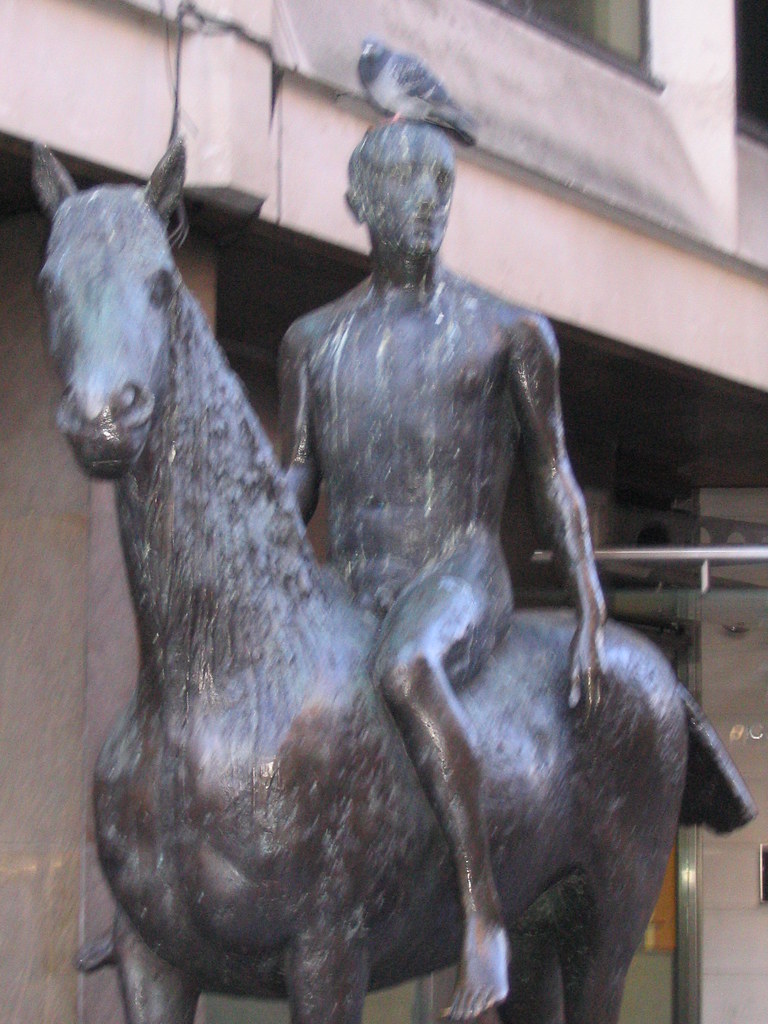
One for PigeonhedOutside Caffè Nerd on Dover Street, just off Piccadilly, is a small equestrian statue, usually with a pigeon on its head. I sat by it a few times before I realised it was an Elisabeth Frink, and I confess that I don’t recall why I began to pay attention to her. There was a small show at Woking I took myself off to a couple of years ago and materials at the Beaux Arts Gallery, London.

In my mental map, British twentieth-century scuplture was dominated by three names — Henry Moore, Barbara Hepworth and Eduardo Paolozzi — before we get into the Caros and the Gormleys and the more conceptual sculptors. Moore and Hepworth seem to occupy a curious middle ground between neoromanticism and modernism — shapes somewhere between the abstract and the bodily, sensual, demanding to be caressed. Paolozzi is plainly of the machine age — the aesthetics of collage and the cyborg, Lego bricks and circuit boards in bronze.

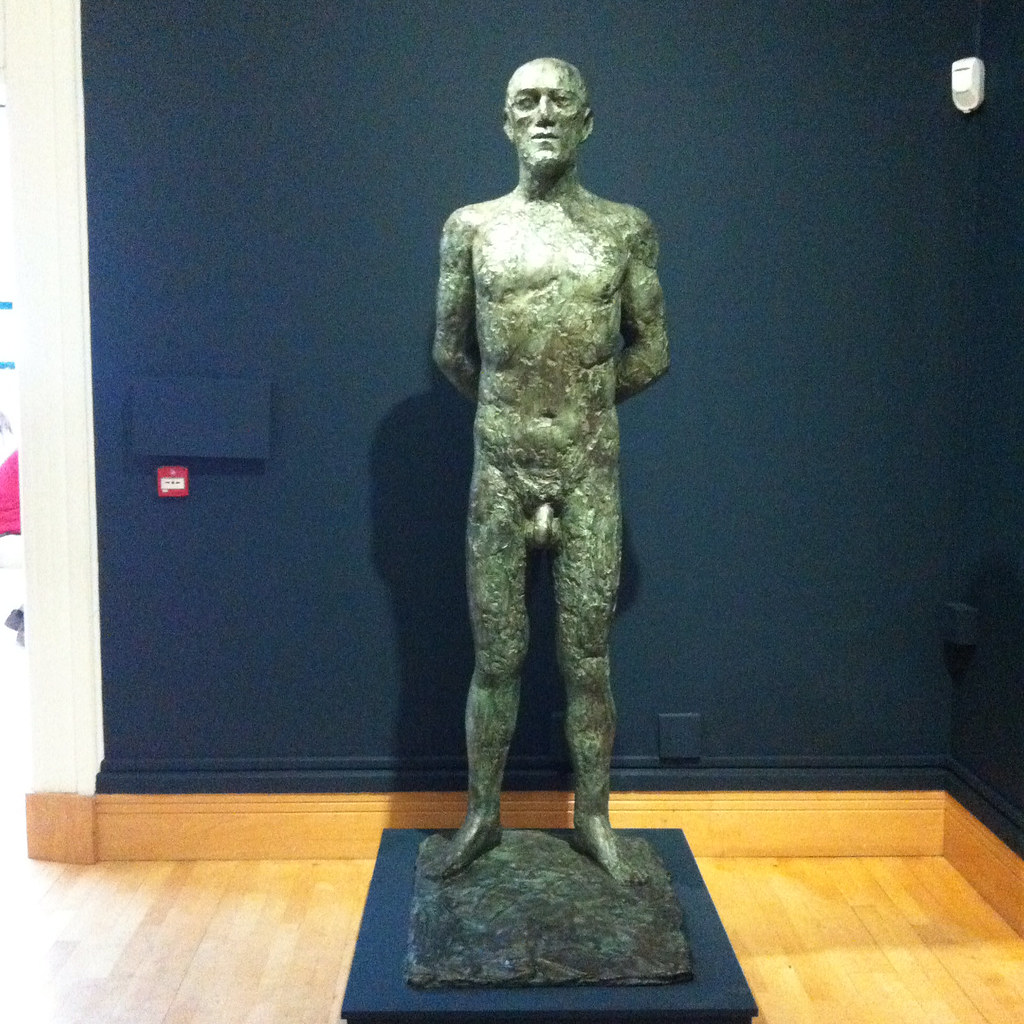
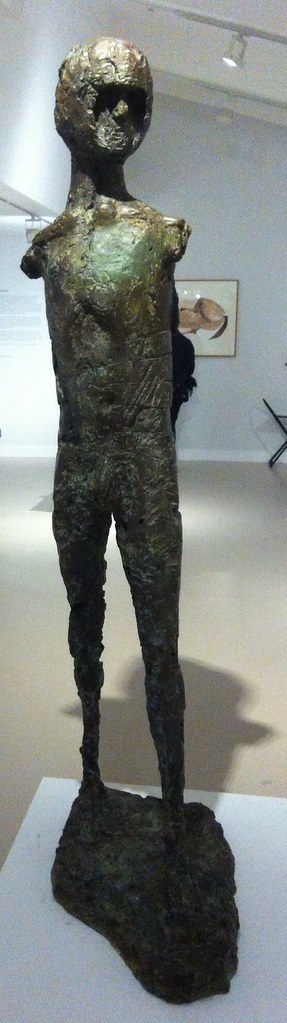
Standing ManWhilst all three are producers of solid work, Moore and Hepworth are more abstract and Paolozzi is more surreal than Frink. Frink’s sculpture has an extraordinary physicality to it. Her statues are of walking, running, jumping, flying and falling men — yeah, pretty well all men — and clearly there is tension between such movement and the fitness of bronze or concrete. Even the standing men seem to loom, arms behind their back, cock and balls hanging, solid presences, somewhere between threatening and sexualised.

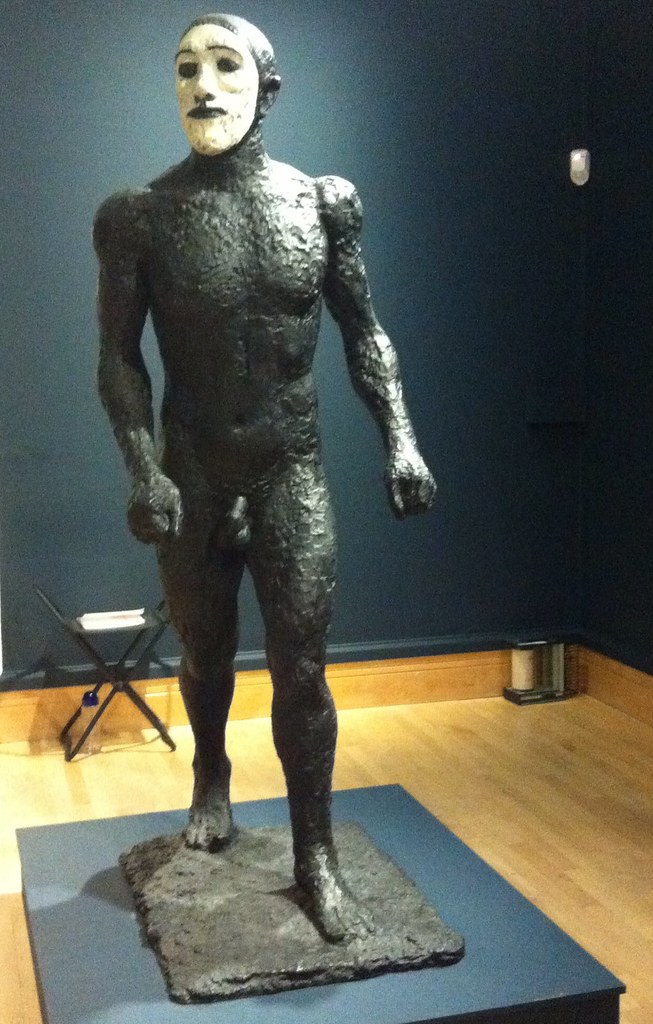
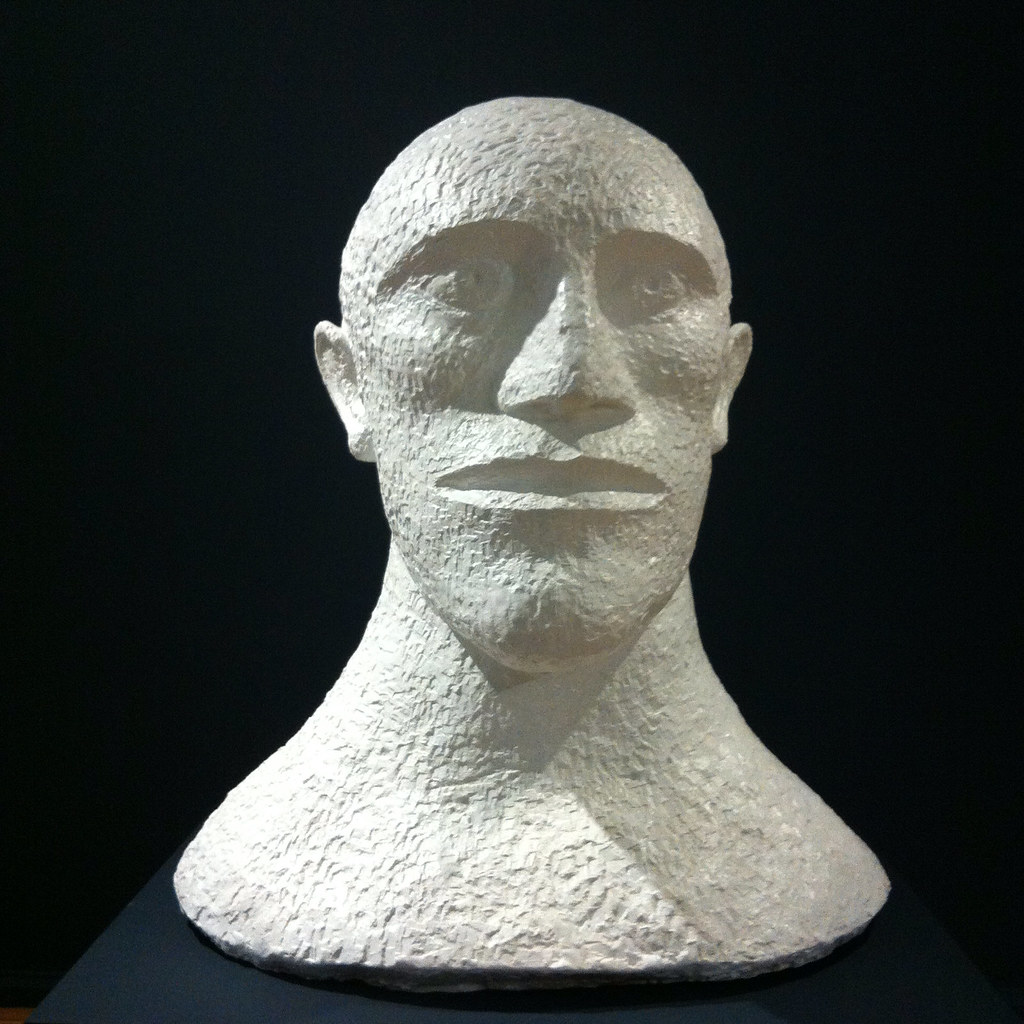
Riace IIIImagine: some of these were commissioned for the headquarters of W. H. Smiths. Remember that when you try to get your free chocolate bar with a copy of The Mail on Sunday. The Walking Man became one of the Riace, named for the bronze statues found in the sea in 1972, and is in white face, one of Frink’s odd experiments in coloured bronze. Apparently her statue of a dog was coloured; the Desert Quarter (1985) bronze is white. Are these angels or demons?
Desert Quarter
She’s presented here in a curiously dialectic way; on the one had she was a child during the Second World War although she knew of the horrors of Belsen and the atomic bombs, the anxieties of the Cold War; on the other hand her public commissions are associated with the Utopianism of the Garden City and New Town movement in the post-war rebuilding. Sculpture was meant to inspire people — whether outside civic buildings or shopping centres, or in the new Coventry and Liverpool Metro Cathedrals.

Her Christ, in a gouache, is muscular, the emphasis on the physicals over the divine. There are pictures here of the crucified Christ, the body emphasised over the cross. There is a Mary and a nun, and a study for Judas, which is also known as the warrior. Her military men — the flying men, the air men — always already seem traumatised, the sculptural equivalent of post-traumatic stress syndrome. And that makes me wonder about her Judas; he betrayed with a kiss, he was paid his thirty pieces of silver, he bought the field and hung himself. Was Judas a warrior — did he fight with his demons and lose?

BirdmanThere is her Birdman, apparently commissioned for a school but thought destroyed (like her first commission, but a damaged version was found this year), a tall, gangly man, with stubs on his back, decommissioned wings perhaps, a fallen angel among men. There is her Running Man (1978), not, apparently, an athlete, but rather a fugitive from some unspecified conflict. Her Flying Men (1982) are hang gliders but seem about to cast themselves into space — inspired by one Léo Valentin (1919-56) who made his own birdlike wings in a vain attempt to fly. Is he also her Falling Man (1961)?

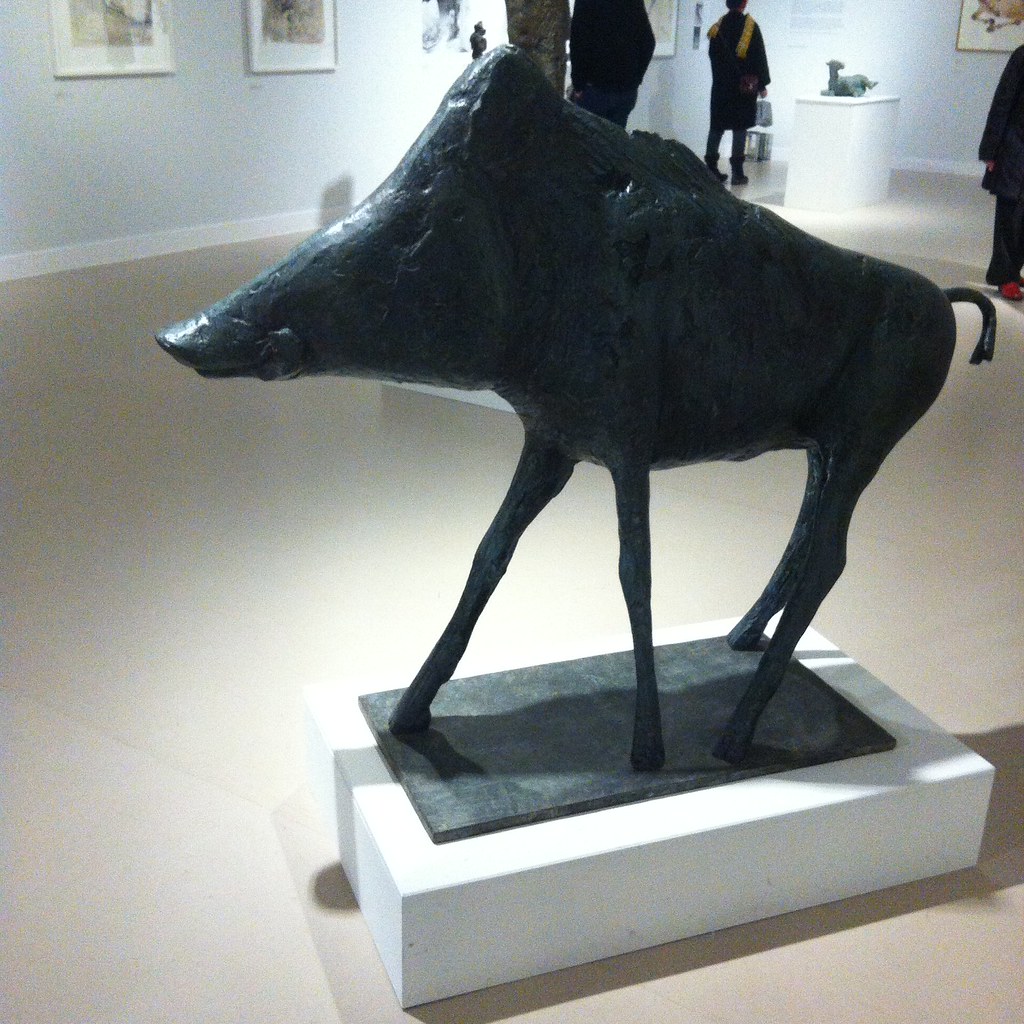
BoarThere are animals — lots of horses, sometimes with riders, a boar for Harlow, warthogs and dogs. Dogs whose heads you want to pat but mustn’t. There are birds, but of ill omen, her Harbinger Bird III (1961) and Warrior Bird (1953), corvids, menacing; on the other hand her eagles, often designed for pulpits and linked to the Kennedy assassination (there is also an uneasy sculpture, The Assassins, but all of them are uneasy).

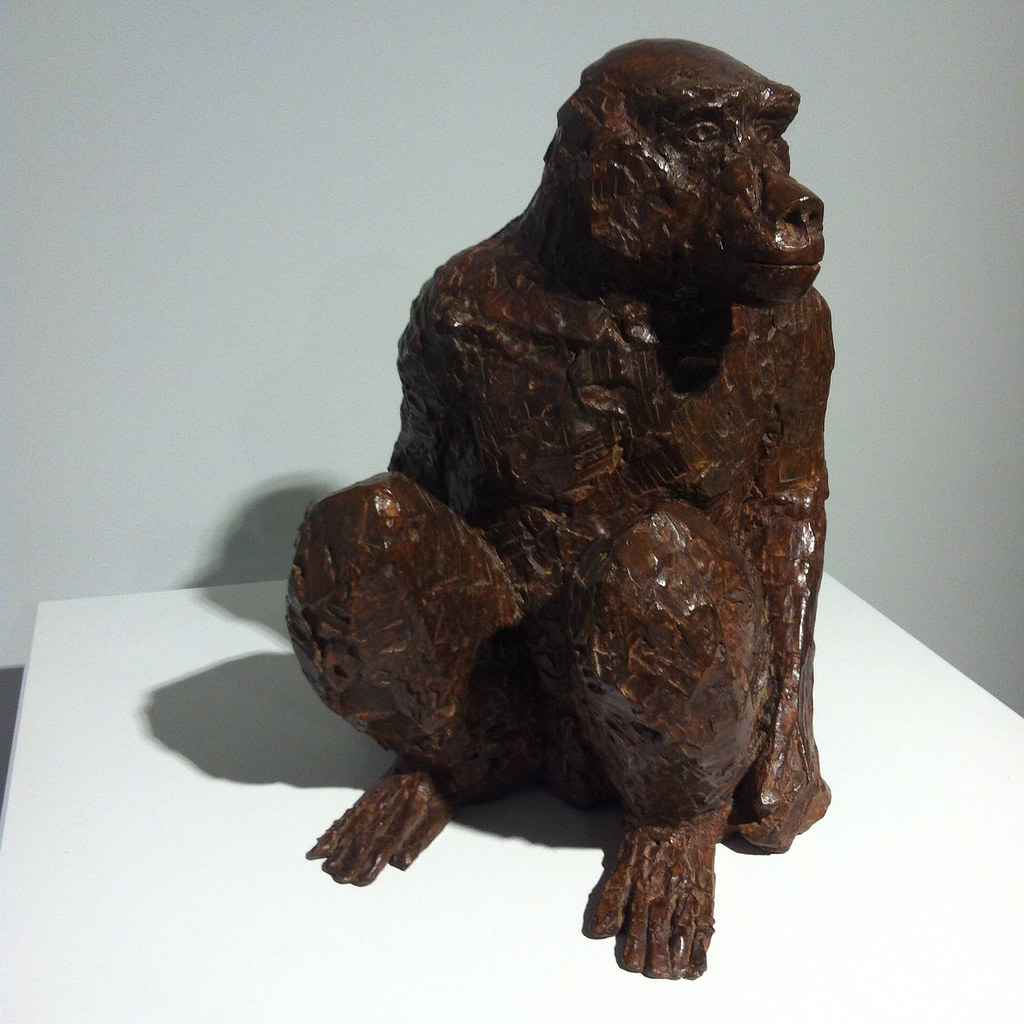
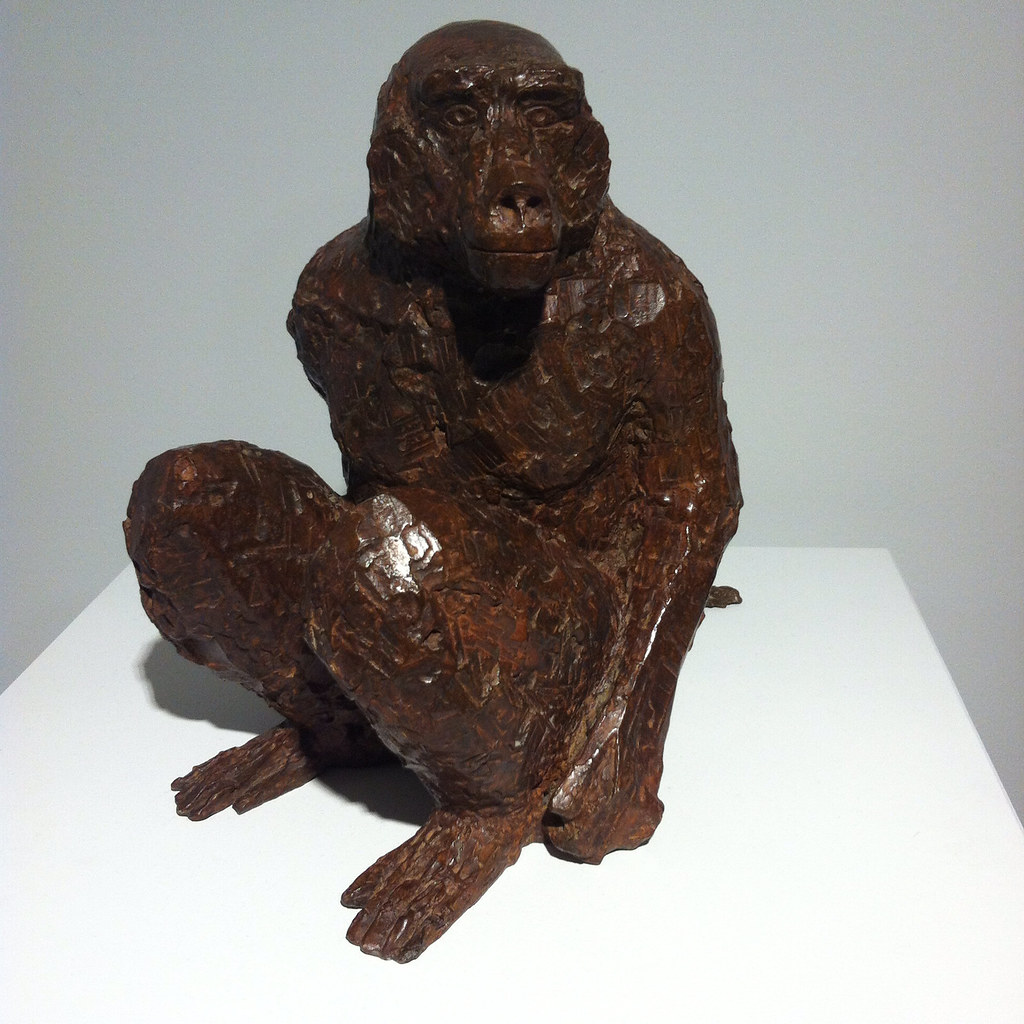
And of course, there is the baboon, commissioned for London Zoo, but it’s a different version here. And there’s a water colour, apparently inspired by an Australian trip although that makes little sense, of an encounter between a man and a baboon. Apparently the baboon is unimpressed by the man.

BaboonBaboon

So her subject is man rather than woman. She may have done mother and child pairs like Hepworth and Moore, but none are here on display, and she was clearly a mother. The few female statues here are caped or cowled. Is there an avoidance of female objectification? Is her aim to objectify men? There were warrior women she could have portrayed, traumatised refugees. But clearly that was not for her.

Bridget Courbevoie

Bridget Riley: Learning from Seurat (Courtauld Art Gallery, 17 September 2015–17 January 2016)

I tried to find the bridge (Bridge at Courbevoie (1886-87)) on Google maps but failed — the river Seine, the bridge, a distant factory, trees, fisher men, walkers. Georges Seurat’s brand of Post-Impressionism, pointillism, made up from coloured dots, half way between colour printing and cathode ray tubes. In another place, Roy Lichtenstein was to enlarge dots and make pop art of comics.

Copying is original.

Deliberately, if annoyingly, the copy and original hang either side of the doorway, challenging you to find a viewpoint from which they can be compared. You carry the memory of one to the other.
photo (2)

Bridget Riley may have seen the painting at the Courtauld – I presume it was at the Warburg Institute, Woburn Square in 1959, having recently moved from Portman Square? — but instead it struck her in R.H. Wilenski’s book on Seurat and she then decoded to paint her own version. It’s bigger, of course, but then the book may not have been clear how big the original was. I think she knew, really, so decided to make the dots larger, and so the intensity of the original is pushed even further from photorealism. The sky is curiously yellow, matching the colour in the water and the grass. He creates light from colour and that seems to be what fascinated Riley.

If the colours become abstract, then so do the shapes — triangles, poles, lozenges, anticipating Riley’s move from stripes into something more… foliated. The Lagoon paintings, for example.

sketch

And then, on an opposite wall, Pink Landscape (1960), the shimmer of summer heat in Sienna represented by dots of red and green and pink and orange and blue, and a child’s farmhouse of white walls and a red roof. The shapes of the fields form lozenges.

Wilenski writes of Bridge that “The little man in the bowler hat has missed his train back to Paris and will be scolded by his wife; the child will be late for tea and spanked, maybe, by its mother.”

Heigho.

But we would lose the narrative in Riley as the pinstripes become stripes.

Here we’re offered variants on stripes — Late Morning I (1967) with green and red and white and blue stripes insisting on length and direction, the vertical, Vapour (1970) with white, brown, purple, green stripes overlapping, question the plane and Ecclesia (1985), thicker stripes, taking on volume.

But Tremor (1962) draws the eye — black and white triables that also form curves and ribbons and you swear the painting rotates in front of you.

A painting approximates reality through strokes, dots, stripes and the pointillist returns it to dots. Riley’s insight was to occupy the geometry, to chase the relation of shape, in canvases that move both optically and emotionally, to create luminence.

Bibliography

  • Bridget Riley: Learning from Seurat (London: The Courtauld Gallery/Ridinghouse, 2015)
  • Wilenski, R. H., Seurat (London: Faber & Faber, 1949)

Take A Chance On Me

Take a Chance on Me

Risk (Turner Contemporary, 10 October 2015-17 January 2016)

The Anthea Turner — a gallery whose Chipperfield design works better in Wakefield — is committed to always showing some J. M. S. Turner and contemporary art, for which read the past one year’s except when it suits them. They’ve had some great solo shows (Mondrian and Colour was frankly more interesting than the Liverpool Tate show), which are interspersed with themed shows. The second exhibition, about Youth, was amazing, Curiosity had some good items but wasn’t more than the sum of its parts and the Self left me a little cold.

So, Risk. Art which puts the artist at risk or may offend against dominant values?

Well, yes, Ruth Proctor films herself falling off a scaffold onto cardboard boxes (here is the scaffold, here are the boxes), Bas Jan Ader documents the start of his transAtlantic voyage that was never completed, Ai Weiwei gives various landmarks the finger. Meanwhile we have surgery footage of Orlan’s cosmetic surgery, Gregor Schneider’s faintly uncanny film of two neighbouring houses redecorated to be identical, Martha Abramovic leaning back from a bow and arrow pointed at her heart.

But then it’s extended to chance and fate. Gerard Richter scrapes back at his paint with a squeegee, post Minimalists let their art hang according to gravity, Marcel Duchamp drops string and Chris Burden drops steel beams into wet concrete.

And then, brace yourself, Turner experiments to see how different paints dry or soak into paper.

Careful now.

There’s a print of an old life jacket and a reconstruction of an ancient Chinese earthquake detector.

What there isn’t is any Jackson Pollock who also allowed chance into his aesthetic through pouring and dripping or Helen Frankenthaler with her too-wet paint or Frank Bowling’s dribbles. One might object that being open to chance is an abandonment of craft, but presumably there’s a selection process. There’s a film (whose makers I forget) which is a kind of mouse trap sequence, where rolling ball sets off a chain reaction. We don’t see however many versions didn’t work. And we don’t see what Duchamp did with the templates he made from the string.

There wasn’t any art that has been banned or challenged (Mapplethorpe’s photos, Magritte’s nudes might have been interesting, some of the vandalised art show at Tate Britain a couple of years back).

The biggest risk here, of course, is that there is such a show in a multimillion pound gallery in one of the more deprived corners of England — Margate was a Portas town, its twin industries of TB recovery and funfair being undermined by progress. Like Gateshead’s BALTIC, another venue which is curated rather than collected, it could simply do crowd pleasers (such as Grayson Perry), but instead challenges its clientele. It has to risk failure.

With a few exceptions, alas, in this it was a success.

Meanwhile, a ten minute walk, a megabaguette, a thirty minute bus ride and another ten minute walk away there is the UpDown Gallery, which specialises mainly in limited edition prints. ive not caught every show there, but those I have I’ve liked.

Upstairs, ending really soon, is the work of Loukas Morley, a ready-made artist in the tradition of Beauys with the colour sense of Hodgkin. Painting on various types of wood, either circular or rectangular or squaregular, clearly on the flat, he builds up layers of paint and resin, abstract yet active, usually allowing the ghost of the grain below. There are also witty sculptures – a board rubber, plastic lids from spray paints, crumpled metal á la John Chamberlain, a lemon as still life. He has been curated by Cedric Christie in the past and I suspect a cross-influence.

Meanwhile, downstairs, ending really soon, is Martin Grover and his (to be honest, annoyingly titled) The Peoples Limousine. It would be unfair to call Grover (like Magritte) a one-joke artist, even if it is a funny joke. He specialises in fake bus stop signs, wring out variants on the symbols, possible stops and kinds of route. One refer to Talking Heads songs, another to British movies set in London (Going Places: The London Nobody Knows/Meantime & High Hopes/Seven Days to Noon/The Fallen Idol/The Bells Go Down). Yes, it’s arbitrary, but it’s done with wit and charm.

There are also lists of lists, masquerading as compilation albums, depictions of famous musicians (Barry White, Marvyn Gaye) wandering around London or past CarpetRight. And then my favourites: The South London Procrastination Club (Established: not just yet). There’s a hint of the thirties railway destination poster about his more straight forward prints, but any of them should put a smile on your face.

It’s too late for this show — unless you go on Sunday — but keep an eye out.

Because You’re Hepworth It

Barbara Hepworth: Sculpture for a Modern World (Tate Britain, 24 June-25 October 2015)

I’ve already written a rather grumpy account of this exhibition, which has a few things that annoyed me. I should also add that the plinths bearing the sculptures could do with a second label describing the work, since sod’s law meant that on almost every occasion I would look at the other three sides first. Sometimes, of course, the label turns out to be on the wall. Grr.

I was fairly sure, however, that the work would transcend my caveats — and so, having read the catalogue, I went back for a second look.

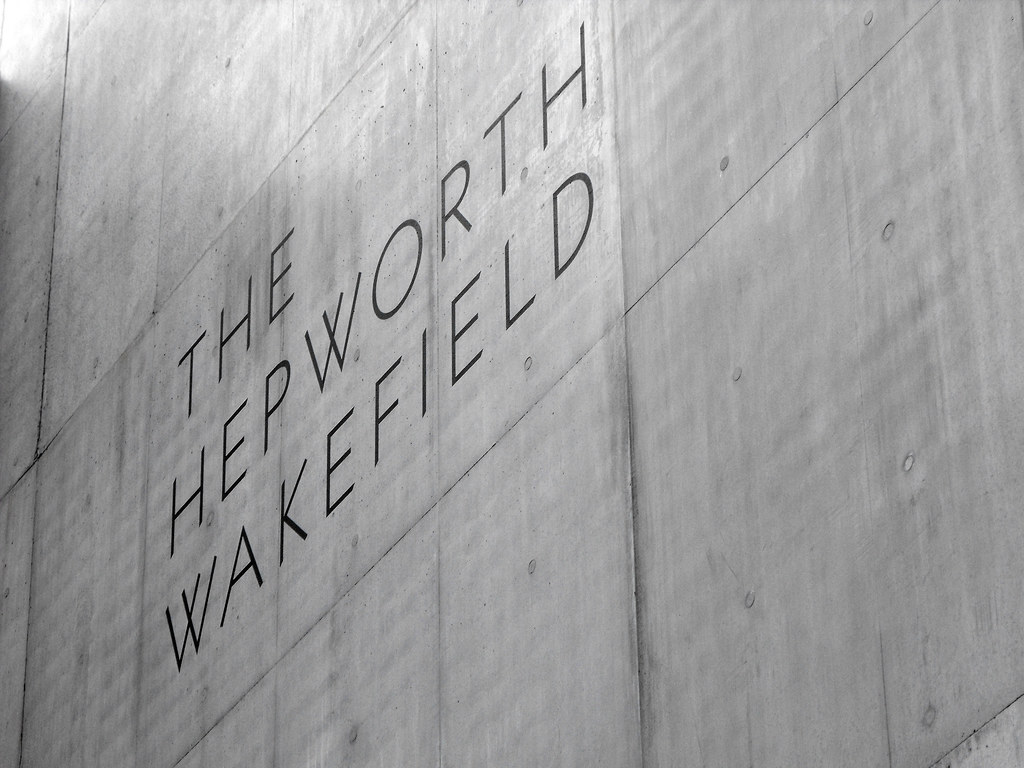
WakefieldMeanwhile, up in Wakefield, the Hepworth is showing a film of the 1968 Tate Hepworth retrospective made by Bruce Beresford. What strikes me immediately about this is how many of the works of art are freely visible and not behind glass. I guess that she was still alive then and could have repaired anything that got broken — the insurance is presumably much higher now. It is so frustrating though. We’re told (she tells us? — and I get the sense from this film of Hepworth speaking unlike the bloody awful Dudley Ashton Shaw Sculpture in a Landscape documentary where a highly theatrical Cecil Day-Lewis intones Jacquetta Hawkes’s poetry in an odd example of barking despite having a dog of your own) that she is interested in the oval, the vertical and the human. From my notes — maybe from the film — I’ve written

inner and outer form, nut in shell, child in womb, shell/crystal, puritanical and geometric spiritual

And then I’ve added (and this is me): modern or romantic (and that is a ponder for another post).

So we’ll walk through the rooms again — beginning with the maze of vitrines. This is her early handcarvings, broadly speaking figurative, realist, mimetic. There are animals, torsos, seated figures and a baby. These works are direct carved on various kinds of wood and marble, and the missing name here is Leon Underwood, who seems to have been the master of the technique.

Hepworth’s shown here among her contemporaries, largely — husband John Skeaping, Henry Moore, Jacob Epstein and I noted two women, Ursula Edgcumbe and Elsie Henderson for future reference. The cynical side of me wonders if this downplays her — she was not unique. Skeaping’s Buffalo (1930) in lapis lazuli is beautiful and I think her side by side doves (1927) are better than Epstein’s one on top of the other (1914-15), but frankly you want your Picasso for doves and Epstein’s strengths lie elsewhere. The positive side is that she can hold her own in a wider community of sculptors between the wars. Infant (1929) is perhaps the most striking, the narrow Torso (1932), made from African blackwood and more like a totem, is the most Hepworthian.

By this point, of course, she had been born in Wakefield in 1903 and studied art in Leeds (meeting that Henry Moore chappy), moving to London where it was as cheap and as easy to get to Paris and Europe than back to Yorkshire. (There’s your north/south divide in a nutshell.) She was runner up to a prize that took her to Italy and which was to inspire her work and led her to marry the actual winner, John Skeaping.

She split from Skeaping in 1933 — the catalogue suggests in part that he was not sympathetic to her Christian Science — and had already met Ben Nicholson who at that point (1931) was married to the artist Winifred Nicholson. The two became lovers and moved in together. So in the second room we have the fruits of their lives together, with artists of different ages inspiring each other. The cynical reading is he helped her, the radical reading is she helped her. I write as a fan of Ben Nicholson — who triangulated romantic landscape, still life, abstraction and the faux naïf. His landscapes flatten into abstraction, and through the 1920s and 1930s the shapes became simplified into squares and rectangles — in time he met with Mondrian, although I think the link was more through Winifred. In time he removed colour, to produce a kind of white, almost flat, sculpture. His art seems to be an exploration of how much can be removed from an image and remain something you can see.

It has to be said that the influence of Hepworth on Nicholson is more obvious than the reverse — I’d be clearer in seeing her as a muse to him than vice versa. Throughout his pictures there are a series of double faces in profile, reduced to lines, intersecting, overlapping, Mr and Mrs. We see this motif in her self portrait in sonogram, and perhaps in one of the sculptures where the face appears to be two intersecting faces. It wasn’t immediately clear what else aesthetically she was getting out of the deal, beyond shifting to a point when she gave more abstract descriptive names for her work. Perhaps he gave her a scratchier sensibility. He was apparently more sympathetic to her religious beliefs than Skeaping had been.

With Nicholson she travelled again in mainland Europe, meeting Hans Arp, Pablo Picasso and Piet Mondrian. She contributed photos of her work to art journals such as Circle and Abstraction-Création (which included Marlow Moss, I see, and had odd ideas about alphabetical order). Mondrian was later to live downstairs from them in London, before his final move to New York. A lot of her pieces of the later 1930s seem to be two smooth pieces — often discs, placed together on a plinth. Apparently both pieces weren’t necessarily fixed, so a degree of adjustment could then be made. Among these pieces were works called Mother and Child — the Madonna and Child trope being oddly missing from the first room — although apparently she broke from tradition by having these as distinct rather than single pieces.


In 1943, she seems to have started adding string to her work. I seem to recall Moore did something similar, but I don’t know who got there first. Sculpture and Colour (Oval Form) Pale Blue and Red (see what I mean about those titles?) is white, almost eye shaped, but hollowed out with two holes. In one you can see the blue interior, and red strings from the edge of the hole to a single, vanishing, point. It is as if goes to infinity. Through the other, side, hole, you can see the strings from a different angle.

By the fourth room we’re up to the Second World War. One side has some of the drawings and paintings she did in a hospital of various operations, after her daughter was ill, apparently intrigued by the similarities between doctors’ and artists’ hands — and I think I saw more of these at Mascalls Gallery once. You need a strong nerve. Another wall has more abstract pieces — the exegetical text tells us she didn’t have time or space for more during the war, but the Hepworth in Wakefield notes the way that she used two dimensional work as a way into sculpture as well as on its own merits. But central to the room are four pieces of carved wood, Pendour (1947), Pelagos (1946), Wave (1943-44) and Oval Sculpture (1943), some plane, some elm, all but hollowed out and curled. They perhaps have the look of hazelnuts nibbled by squirrels, but are beautiful and the best pieces in the exhibition.


By the fifth room time begins to trip over itself. At some point she’s moved to St Ives and has a studio where she lives with a garden space and has rented the Palais de Danse as a second studio. She has become more ambitious, wanting to make bigger pieces; the catalogue notes her wish to crack America. Around three walls we see photos of some of her works in the studio and in situ, her big pieces for Mullard electronics (1956), John Lewis (1963) and the United Nations (1961-64), and we also see her montages imagining sculpture in rural or modernist locations. This is also the room with the ropey documentary.

Behind it, the exhibition redeems itself — four pieces made from a heavy African wood called guarer. The catalogue explains there is a mystery as to who got the wood for her and who paid for it, and what happened to the parts left over. They are larger cousins to the wooden pieces in the previous room; they seem to be experiments in how much you can take away from a form and still have some form.

Ah, you can look, but you mustn’t touch…

Finally, there’s the recreation of the Rietveld Pavilion (1956); concrete air bricks for a wall, partly filled in, some kind of wooden roof, and (here) an end wall purporting to be forest. Hepworth’s work was shown here in 1965 and since. It doesn’t fool us we’re outside, but there are five or so bronze pieces. Some have forms within forms, are twisted, some might be weathered anvils. These are clearly not mimetic, but nor do they feel organic — they are their own thing. Their sublime beauty is enough to make you forget that it’s not until 1975 that Hepworth died, in a fire.


But Hepworth is at her best in St Ives and Wakefield and the Yorkshire Sculpture Park and Edinburgh Botanical Gardens and at the front of Tate Britain and in a garden on Attebury Street.