Anguished Martian

Agnes Martin (Tate Modern, 3 June–11 October 2015)

In the ongoing round of suppressing women’s writing, so to speak, it is striking how rare a solo-female artist show is in a major institution show. In the moloch of the Tate, things are getting better — there’s the Hepworth show at Britain and the Sonia Delaunay at Modern overlapped with this. I confess to not having heard of Agnes Martin — who I guess historically fits into Abstract Expressionism pigeon hole and was associated with Sol LeWitt and Donald Judd.

Born in Canada in 1912, she moved to Washington to study in 1931 and was influenced by Zen Buddhism scholar D.T. Suzuki. The early work includes various biomorphic forms, dominos, game boards and claws, with Earth colours of brown, yellow, grey and white being prominent. But clearly she was striving toward the square and the grid, with an evident dislike of the curve.

Three years ago, Tate Modern had a Yayoi Kusama, with thousands of spots, apparently symptomatic of her struggle with mental breakdowns and her willingly living in a psychiatric institution. Here we get the square grid as expression of Martin’s schizophrenia.

The obsession, the repetition, the very straight lines.

H’mm. I don’t know. I’m not sure the diagnosis is helpful.

But you can see that she works a very narrow range of variants on the grid and the stripe, the faded deck chair. By the time you get to The Island, a series of white squares with grey lines, the impact is very subtle and yet loud. It invokes eastern formlessness, apparently, but that again is a tad essentialist.

Holiday

The later paintings of black rhomboids on grey fields are positively excessive by comparison.

I’m not sure that at the end of the day I was hugely impressed by her. Certainly I’m glad to have made her acquaintance, so to speak, and it’s always useful to get a wider sense of a period of art. But it didn’t feel, alas, like coming across a long lost friend.

Hep Hep Hooray (Part Two to Follow)

Barbara Hepworth: Sculpture for a Modern World (Tate Britain 24 June-25 October 2015)

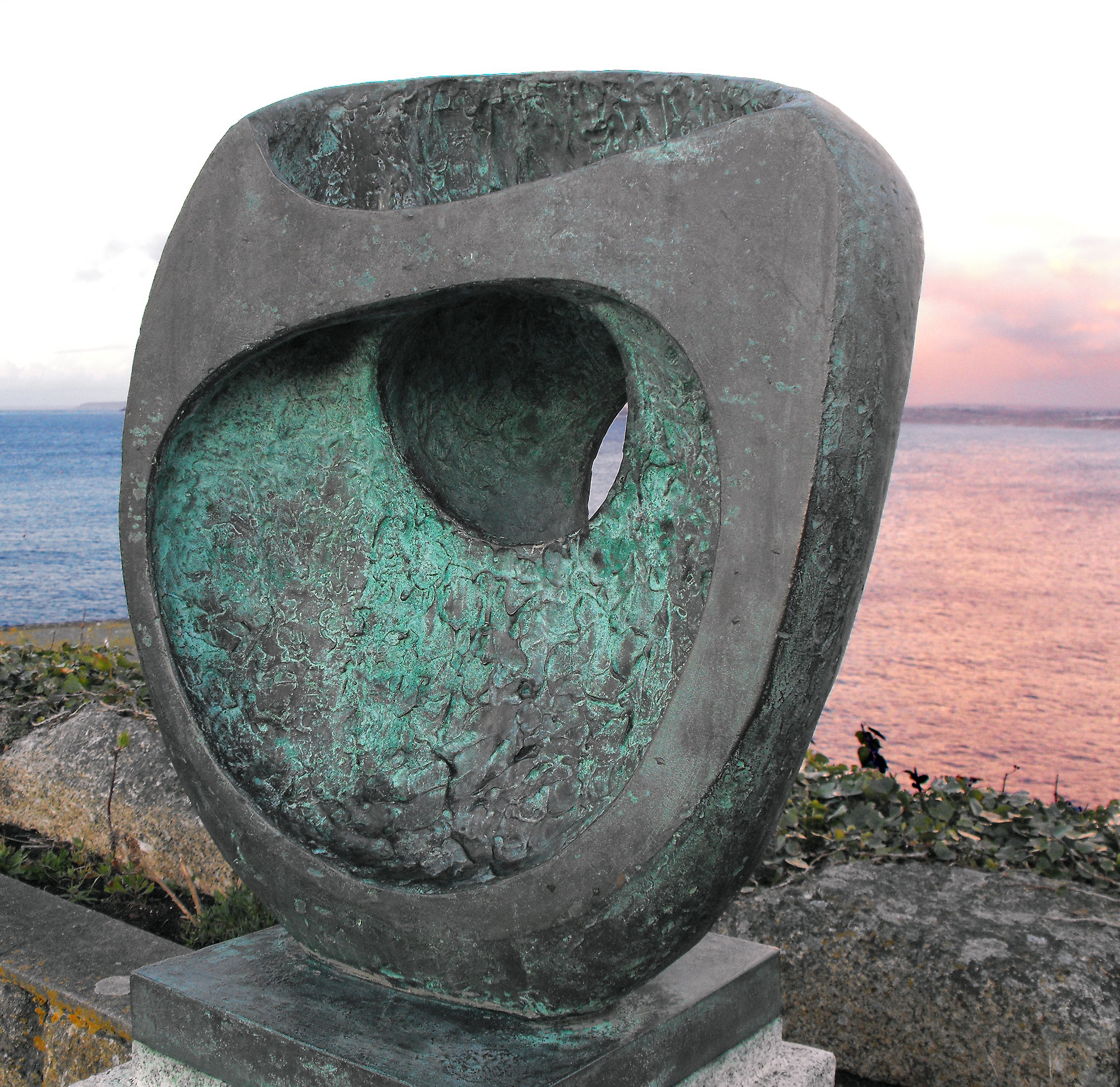
Hepworth plaqueI really like Barbara Hepworth’s work. It has a kind of tactility to it, a sensuousness — it cries out to be touched and caressed. I’ve been up to Wakefield and looked at the plasters and maquettes and the blue plaques, and down to St Ives to see the studio and at some point saw the hospital drawings.

So I was looking forward to this Tate overview, in the same space where they showed Henry Moore.

I’m going to do two write ups, because I want to do it justice. But this time round, I’m going to be critical whilst thinking you should really go.

Major galleries still rarely do one women shows (although note Tate Modern this spring and summer).

There’s always a danger when providing context that this takes away rather than enriches your appreciation of the materials. In the first room, there are lots of hand carved sculpture, not all by Hepworth. We’re told that one of her strengths was direct carving — inspired in this by Henri Gaudier-Brzeska, Jacob Epstein and Eric Gill, but also by the fact that the was apparently a whole lot more of this than we realised. Everyone was up to it. One missing name was Leon Underwood, whom I might well come back to, who was a tutor to Henry Moore. Was she that special?

Before she married Moore, she married Ben Nicholson and before that John Skeaping — another direct carver — and there is a room of works by Nicholson responding to hers and vice versa. I like Nicholson’s work, but, again, I’m a little worried it takes away from her. I suspect not, but.

Hepworth SculptureIn a later room there’s a documentary, Figures in a Landscape (Dudley Shaw Ashton, 1953), with Cecil Day-Lewis reading bad poetry over footage of the Cornish coast, telling us about how history and then Man has sculpted the landscape — you know that “invisible” sexism that defaults to and his? You want to scream, YOU KNOW HEPWORTH IS A WOMAN, YES? Eventually her sculptures start appearing in the landscape, and for a more you assume the apes will start worshiping them and a certain theme will appear on the soundtrack. Or you assume it’s the inspiration for Led Zeppelin’s Presence.

At the end of the show, there’s a recreation of the Rietveld Pavilion from a Dutch sculpture garden, with sculpture finally naked — up to then, more or less, everything is in vitrines. I know that hands can leave marks and grease and patina — but I don’t recall Moore’s being so glassed off. Were there ropes? It’s great to get a full 360 view of them, but it makes the exhibition a maze (where have they hidden the label this time?) and its frustration because you just wanna touch. And at the end it’s not clear if you can.

Hepworth died in 1975.

The pavilion was 1965.

Did she not sculpt for a decade? Was the later work earlier? Or was it all large scale stuff like the UN piece or the John Lewis’s one?

It just stops.

Did I miss a chronology of the artist? Okay, the exhibition guide tells you she died in a fire, but it still feel a little off-key.

The really sad thing is there is fantastic stuff here, but I’m not sure justice is done to it. I will go back, I suspect in late August now, having read the catalogue, and say more.

Rainbow in Curved Paint

Bridget Riley – The Curve Paintings 1961-2014 (De La Warr, Bexhill on Sea, 13 June 2015-6 September 2015)

Stand still and look at the flat square.

The diamond.

Relax.

Look at the plane.

Slowly, inevitably, against your will, it begins to move. To dance, to ripple.

And yet.

Still a plane.

And yet.

You look away and there’s still an after image.

There’s no doubt a scientific explanation about the limitations of vision and the brain filling in the gaps – we can’t separate the white from the black or (later) the green, blue, grey.

Oh look, it’s Crest, again.

Riley’s curve paintings began with a black square, which seem to be everywhere at the moment. Malevich and all that. But she wasn’t happy – it didn’t express her failure as an artist enough.

So an experiment led to a circle and a square, Or rather a rectangle. The Kiss (1960).

And from that she got to her curve paintings – some black and white, others using greys, some playing with blue and green and red and grey. Take Cataract 2 (or 3, because I can find a picture of that one) and see how it refuses to lie flat. Cataract 2 is more like an arrow than this – note the stripes aren’t parallel, are offset.
In one room we see a wall of preparatory sketches, many of them on graph paper, and we consider how carefully the abstract must have been arrived at.

And then, in 1980, she stopped. She moved onto vertical lines.

The deckchair years.
But they didn’t vanish forever, as in 1997 there was a return. Lagoon 2 widens the vertical stripes and interrupts them, if not with curves then with segments of circles. The vertical lines are further disturbed by diagonals. In the area given to studies, we see variants that led to this and similar designs – trying out colours, rearranging segments, working on graph paper and tracing paper. “Lagoon” points us to something more organic than maths, something away from the abstract.

“The relation between the line and the curve can be compared to that between the circle and the oval,” she says in an interview. But it also breaks the apparent flatness of the plane.

The most recent piece in the exhibition I think (despite that 2014 date) is a wall painting, Rajasthan (2012) – red, orange, green, grey and the white of the wall. There’s not the same sense of the breaking of the plane, but there’s the breaking of the frame. Given what I’m currently reading about the (American?) battle between the wall and the easel, this feels timely.
Interference PatternBexhill’s De La Warr Pavilion is one of my favourite galleries – and in conjunction with the Jedward Jerwood makes a splendid day out. Indeed, although the effect may not work here, I’ve looked at the light-reducing blinds before and thought of them as op art. The Art Deco curves of the building seem to speak to Riley’s curves and the seaside setting seems to speak to some of those curves as sticks of rock (and I’m not entirely joking about the deckchairs, although none were on show here). It is a show to surrender to – even as it takes you over.

Abstract Goes the Easel

A Marriage of Styles: Pop to Abstraction (Mascalls Gallery, Paddock Wood, Kent, 28 March-6 June 2015)

This is, ish, very ish, the fiftieth anniversary of the second wave of British Pop Art and the University of Kent, and so Pop Art has decided to mark this by having three universities.

Ah, sorry, my mistake, the University of Kent have three exhibitions – one on campus, which I presume they didn’t feel the need to tell anyone about as I missed it, one on Paolozzi and Tony Ray-Jones, which I’ve written about for Foundation, and A Marriage of Styles at Mascalls Gallery. This gallery has a rather good exhibition policy, but it is a l-o-n-g mile’s walk from Paddock Wood station (thankfully on the flat) and is at a school, so I’ve not been as often as I’ve wanted to. I caught this show on the penultimate day and I’m so glad I did. I should note, also, that there are current two rooms at Tate Modern specifically devoted to Pop Art, even though you’d think that would be at Britain?

So what is Pop Art? Well, the word Pop was used in a slide by Eduardo Paolozzi at his presentation Bunk! at the inaugural meeting of the Independent Group in 1952 and Lawrence Alloway in 1958 was to apply it to art that drew on the visual language of advertising, comic books and everyday life, breaking down boundaries between high and low art. In the US, you’d put Andy Warhol and Roy Lichtenstein, who clearly pointed the way for the next generation of British artists, who were mostly at art college in the early 1960s. But if Pop Art constructs a reality through actual or implied collage, these artists were also influenced by more abstract, non-representational, images.

The Paddock Wood show had eleven paintings – I’m guessing one for each member of the the 1966 English worldcup football team – in its two rooms, mostly one to a wall. I’m going to talk about them one by one, mostly from my notes scribbled in the gallery. Continue reading →