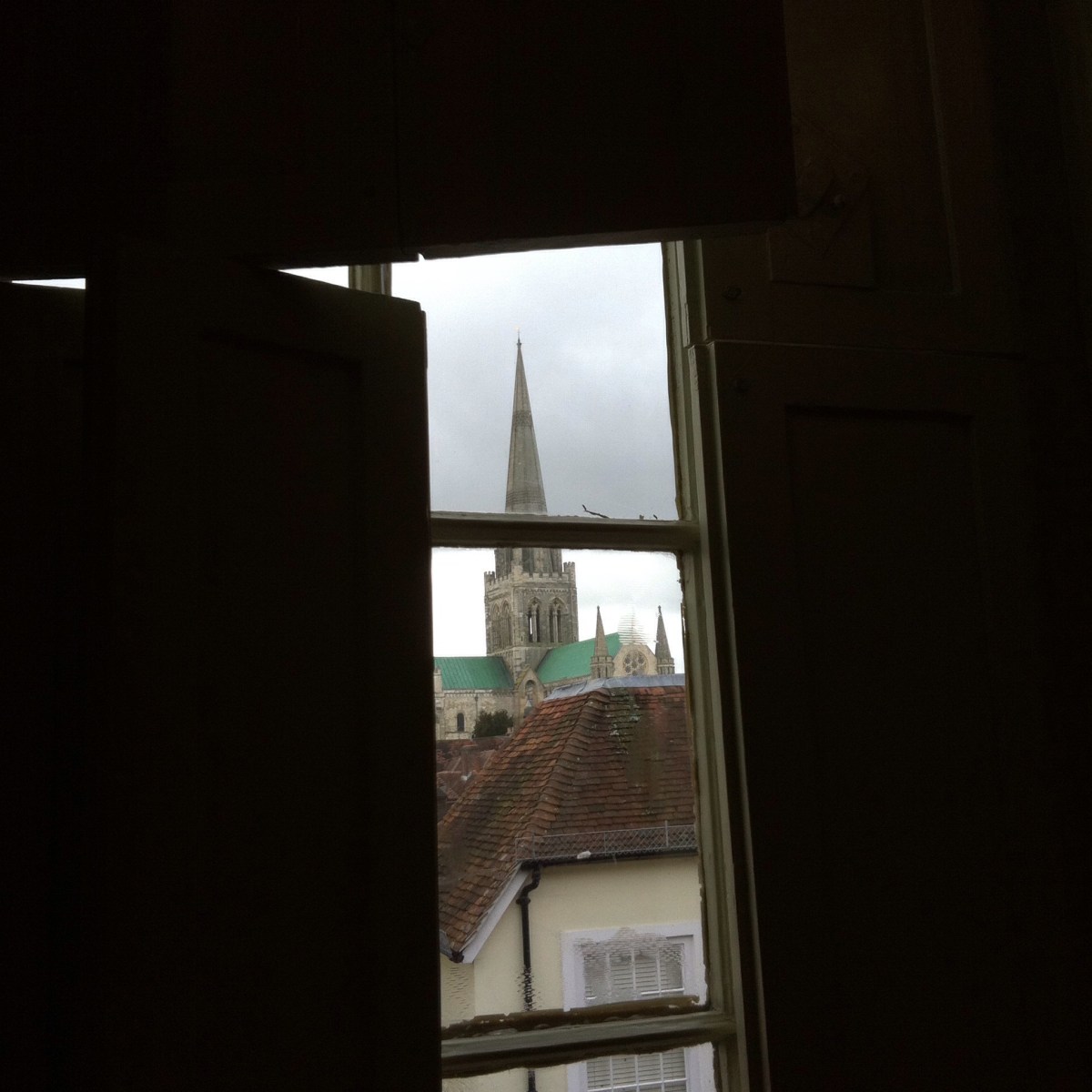
Manifest Pollocks

Blind Spots: Jackson Pollock (Tate Liverpool, 1 July 2015-17 October 2015)

Jackson Pollock was born in 1912 in Cody, Wyoming, but grew up in Arizona and California. Having gone to art school (and been expelled), he became an artist for the Federal Work Program. His big stylistic breakthrough was the all-over drip painting, although pouring might be a better word. The whole canvas is covered by oil or thinned enamel paint dripped from brushes or syringes; in most cases the paint over lies and is overlain with other paint, in some cases the canvas is visible.

Pollock was slotted into the abstract expressionism category — abstract because it wasn’t figurative, expressionist because he was expressing his feelings and emotions on the canvas. This wasn’t necessarily a term he liked and I will come back to it. Pollock was an alcoholic and went through Jungian psychoanalysis to attempt to cure this — the assumption is that his art can be understood in Jungian terms, presumably expressing a nonindividuated ego and archetypes. Early paintings had Greek mythic titles and he is also assumed to be drawing in an interest in Native American art.

I hope to return to this but I’m troubled — action painting gives access to the unconscious and more primitive stares of mind, such as that of the Native American.

Koffs.

Really?

In 1951, after a less successful exhibition of the kind of paintings we know Pollock for, he took a change in direction: the black paintings. These were largely blank canvases with thinned black enamel dribbled on them — sometimes calligraphy, sometimes faces, sometimes scribbles — and it is this set of paintings that becomes central to Blind Spots, the current exhibition. Whilst they’ve never been entirely ignored, they have been downplayed.

Pollock wasn’t the first to paint in black — Malevich’s black squares have been seen at at least two British shows in the last year, at Tate Modern and the Whitechapel. Willem de Kooning had a black and white painting, coincidentally also in the Tate at the moment. But Pollock painted just in black.

I was worried — I prefer twentieth to pre-twentieth-century art, but I don’t like all abstract art. I was worried that I’d be wasting my time seeing this, even though I prepared by reading three or four books on Pollock. Pollock is the epitome of the “My six year old can paint like that” school of art criticism; it’s said of Picasso, too. And bollocks. But I wasn’t sure I’d get it.

I don’t pretend this to be profound, but it struck me that there is an opposition between figurative and abstract, figure and ground, paint and canvas and so on. Paint is applied in layers — in three dimensions, however trivially, as new paint obscures old.

If abstract expressionism gives us access to the unconscious, how do we know it’s the artist’s unconscious rather than our own? Does that matter?

Of course, schooled in deconstruction, you’d expect me to pick away at the oppositions.

There are specks rather than spots in this exhibition — but blind spots are the part of your eye where the nerve and exits and lacks rods and cones, there the bit that wing mirrors can’t pick out (Pollock died in a car crash) and blind spots are the things critucs overlook. But there was for me a misprison — I thought of Paul de Man’s Blindness and Insight, the blind spot of a text or of the critic’s reading of it.

Hmmm.

At the start of the exhibition is a found collotype of a mother and child, mostly obscured in black ink.

Obscure vs. reveal. Mask vs. unmask.

The mother and child is a key trope — archetype of — of the history of art. The Madonna and Child. This is clearly a pop art version, but we need to keep an eye out for this in the exhibition. Pollock’s mother and Pollock? Maybe. Is the black ink covering them up or revealing them? It certainly draws attention — you look harder.

The idea of looking is set up for us in the first picture of the show. It is the keynote.

(To be continued…)

And He Painted Matchstalk Men and Matchstalk Cats and Sharks

Lowry by the Sea (Jerwood Gallery, Hastings, 11 June 2015-1 November 2015)

Whilst my birthday is all too often a series of examples of bad timing, I was lucky enough to have one which coincided with a members’ private view of the L.S. Lowry exhibition at Tate Britain. For a few glorious moments, I had the exhibition to myself. Lowry is one of those artists we’re not meant to like because people like him and because there was a one-hit wonder in the 1970s about him.

What that exhibition made clear was that Lowry was a greater artist than given usually credit for – although I suspect his faux naivitée could be objected to. Whilst Alfred Wallis was self-taught, Lowry attended the Manchester School of Art and was trained by French Impressionist Pierre Adolphe Valette. Lowry made sense in terms of Impressionism, even if you don’t accept his own constructions of working class realities as art in their own right.

I stumbled across the fact that there was a Lowry show at the Jedward Jerwood Gallery, a newish and controversial space at Hastings. It’s a fifteen minute train ride back from Bexhill (where Riley is) or a two-hour walk. The Jerwood is home to the Jerwood Collection, the philanthropic gathering of art by a pearl company which also gives prizes for painting, drawing and sculpture. The collection is mainly early twentieth century British, but I have to say it can come across as a bit muddy and grey in its pallette. I think I’ve been disappointed by the two big exhibition rooms on the right as you enter – I can’t recall a show blowing me away there. At the moment it’s a selection from the Fraser Collection, along with Scottish artists from the Jerwood, and I confess to being underwhelmed. There was some interesting sculptural pieces in the space where there was the Marlow Moss show.

But the hit or miss part of the Jerwood is the two upstairs rooms that tend to have temporary shows. At the moment, it’s Lowry, representing the seaside. Should we be surprised that his choice of holiday destination was Berwick on Tweed, South Shields and Sunderland? The Jerwood does like its sea exhibitions, but this is a good one.
There’s only really one Lowry that is immediately recognisable as a Lowry, July, the Seaside (1943), a series of tiny incidents on the beach – games being played, a punch and judy kiosk, sitting, lying, walking, prams, swings. It is the urban crowd transplanted from factory gates and football matches to the sea – possibly in north Wales. What is striking is that the people are dressed much the same – there is no concession to sea and sun. Still, there’s a war on.
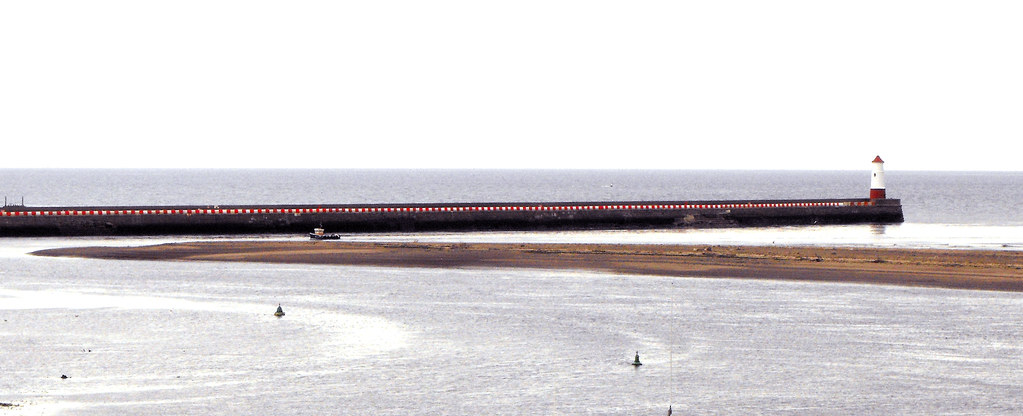

Berwick Jetty
The figures are more impressionist in his Spittal Sands (1960) – perhaps it’s a mistier day, but I reognise the spot which is just south of Berwick. And is that the same harbour arm in Untitled (Beach Scene with Central Monument and Chimney), sketched in felt tipped pen? There’s a chimney or two that makes me think of the (fish?) smoking chimney in Spittal.

There’s also South Shields – Waiting for the Tide (1960) – showing Lowry’s love of solitude and quiteness and isolation. Am I misrecognising A Ship (1965) as Tynemouth?

Is that a version of the aerials next to Tynemouth Priory? But there’s a harbour arm he will have lost (and yet I recall two paintings of the same scene, I think Sunderland, where towers were moved. He’s an artist who will recompose landscapes.)
Then, there’s the Self-Portrait as a Pillar in the Sea (1966), awfully phallic. It’s not a surprise to me – do I recall drawn versions of this at Sunderland? There is another painting like this, also 1966, in Sunderland.

Lowry writes, somewhere, “Look at my seascapes, they don’t really exist you know, they’re just an expression of my own loneliness.” In some paintings the sea and sky merge – the elemental boundaries merge. And then, somewhere again, he writes, apparently about the world of art, “I spent my whole life wondering what it all means, I can’t understand it, don’t understand it at all, can’t see any point in it myself. Still, there it is, you keep on working, and you keep on wondering what it all means, and it goes on and on and on and, there you are.” It reminds me of childhood reading, it reminds me of Eeyore.

And I had to laugh.

There’s a Lowry cartoon called The Shark (1970) where the shark is the art world and the person in the shark’s mouth is Lowry. Better than Damien Hirst’s shark. There are other people in the sea. Waving. Or drowning.

I had a sudden flash, at this point, of someone else that had a reputation for being gloomy, but was also blackly comic. I wondered if they ever could have met – the other one was an insurance clerk, but Lowry was a rent collector. I thought, for a moment, he worked for the Pru. Ah well.

But this is a show to see.

Rainbow in Curved Paint

Bridget Riley – The Curve Paintings 1961-2014 (De La Warr, Bexhill on Sea, 13 June 2015-6 September 2015)

Stand still and look at the flat square.

The diamond.

Relax.

Look at the plane.

Slowly, inevitably, against your will, it begins to move. To dance, to ripple.

And yet.

Still a plane.

And yet.

You look away and there’s still an after image.

There’s no doubt a scientific explanation about the limitations of vision and the brain filling in the gaps – we can’t separate the white from the black or (later) the green, blue, grey.

Oh look, it’s Crest, again.

Riley’s curve paintings began with a black square, which seem to be everywhere at the moment. Malevich and all that. But she wasn’t happy – it didn’t express her failure as an artist enough.

So an experiment led to a circle and a square, Or rather a rectangle. The Kiss (1960).

And from that she got to her curve paintings – some black and white, others using greys, some playing with blue and green and red and grey. Take Cataract 2 (or 3, because I can find a picture of that one) and see how it refuses to lie flat. Cataract 2 is more like an arrow than this – note the stripes aren’t parallel, are offset.
In one room we see a wall of preparatory sketches, many of them on graph paper, and we consider how carefully the abstract must have been arrived at.

And then, in 1980, she stopped. She moved onto vertical lines.

The deckchair years.
But they didn’t vanish forever, as in 1997 there was a return. Lagoon 2 widens the vertical stripes and interrupts them, if not with curves then with segments of circles. The vertical lines are further disturbed by diagonals. In the area given to studies, we see variants that led to this and similar designs – trying out colours, rearranging segments, working on graph paper and tracing paper. “Lagoon” points us to something more organic than maths, something away from the abstract.

“The relation between the line and the curve can be compared to that between the circle and the oval,” she says in an interview. But it also breaks the apparent flatness of the plane.

The most recent piece in the exhibition I think (despite that 2014 date) is a wall painting, Rajasthan (2012) – red, orange, green, grey and the white of the wall. There’s not the same sense of the breaking of the plane, but there’s the breaking of the frame. Given what I’m currently reading about the (American?) battle between the wall and the easel, this feels timely.
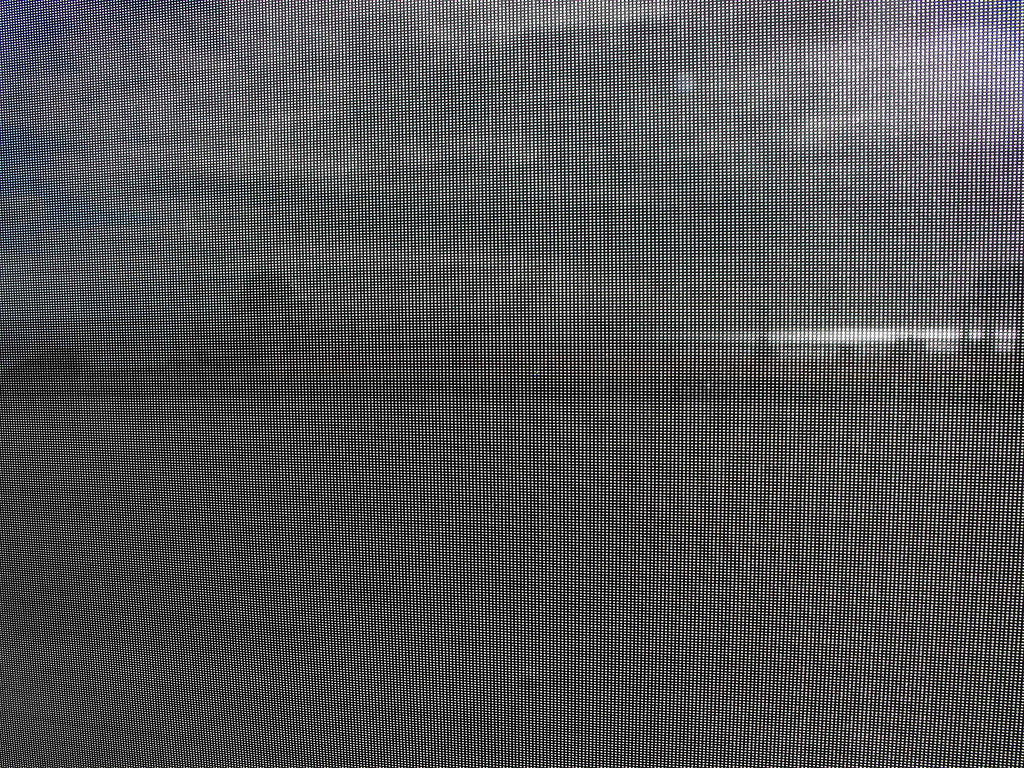
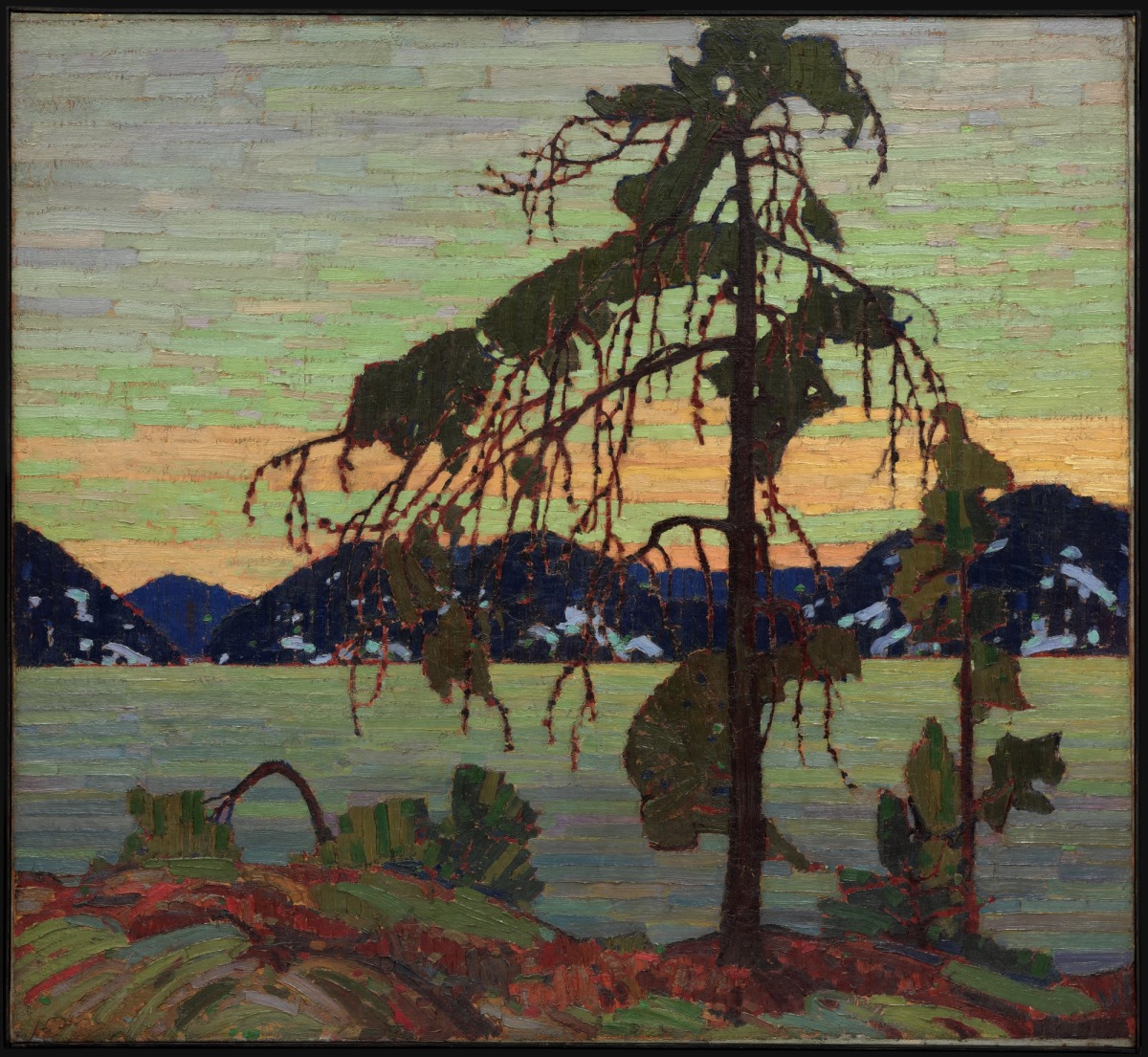
Interference PatternBexhill’s De La Warr Pavilion is one of my favourite galleries – and in conjunction with the Jedward Jerwood makes a splendid day out. Indeed, although the effect may not work here, I’ve looked at the light-reducing blinds before and thought of them as op art. The Art Deco curves of the building seem to speak to Riley’s curves and the seaside setting seems to speak to some of those curves as sticks of rock (and I’m not entirely joking about the deckchairs, although none were on show here). It is a show to surrender to – even as it takes you over.

Abstract Goes the Easel

A Marriage of Styles: Pop to Abstraction (Mascalls Gallery, Paddock Wood, Kent, 28 March-6 June 2015)

This is, ish, very ish, the fiftieth anniversary of the second wave of British Pop Art and the University of Kent, and so Pop Art has decided to mark this by having three universities.

Ah, sorry, my mistake, the University of Kent have three exhibitions – one on campus, which I presume they didn’t feel the need to tell anyone about as I missed it, one on Paolozzi and Tony Ray-Jones, which I’ve written about for Foundation, and A Marriage of Styles at Mascalls Gallery. This gallery has a rather good exhibition policy, but it is a l-o-n-g mile’s walk from Paddock Wood station (thankfully on the flat) and is at a school, so I’ve not been as often as I’ve wanted to. I caught this show on the penultimate day and I’m so glad I did. I should note, also, that there are current two rooms at Tate Modern specifically devoted to Pop Art, even though you’d think that would be at Britain?

So what is Pop Art? Well, the word Pop was used in a slide by Eduardo Paolozzi at his presentation Bunk! at the inaugural meeting of the Independent Group in 1952 and Lawrence Alloway in 1958 was to apply it to art that drew on the visual language of advertising, comic books and everyday life, breaking down boundaries between high and low art. In the US, you’d put Andy Warhol and Roy Lichtenstein, who clearly pointed the way for the next generation of British artists, who were mostly at art college in the early 1960s. But if Pop Art constructs a reality through actual or implied collage, these artists were also influenced by more abstract, non-representational, images.

The Paddock Wood show had eleven paintings – I’m guessing one for each member of the the 1966 English worldcup football team – in its two rooms, mostly one to a wall. I’m going to talk about them one by one, mostly from my notes scribbled in the gallery. Continue reading →

In Search of the Indigenous

From the Forest to the Sea: Emily Carr in British Columbia (Dulwich Picture Gallery, London, 1 November 2014-15 March 2015)

I confess that I had never heard of Emily Carr, apparently one of Canada’s best loved female painters. Of course, the list of female painters is depressingly short — although I’m fond of female surrealists such as Frieda Kahlo and Leonora Carrington, not to mention Laura Knight, Paula Rego, Elisabeth Blackadder and Bridget Riley… I presumed that she might have some connection to the Group of Seven, in part because the Dulwich Picture Gallery had a show of their work a few years ago.

If memory serves there were a number of landscapes painted on wood, painted on location in the wilds of Ontario and points north, accompanied by full scale canvases. Slightly before them was Tom Thomson (1877–1917), who I think I saw a show by in Toronto (unless it was in Adelaide…). The landscapes are strangely depopulated, presenting Canada as a Terra Nullis, untouched by human hands. Of course, there were any number of indigenous native groupings, out of sight. It left me a little uncomfortable — but we’ll come back to that.

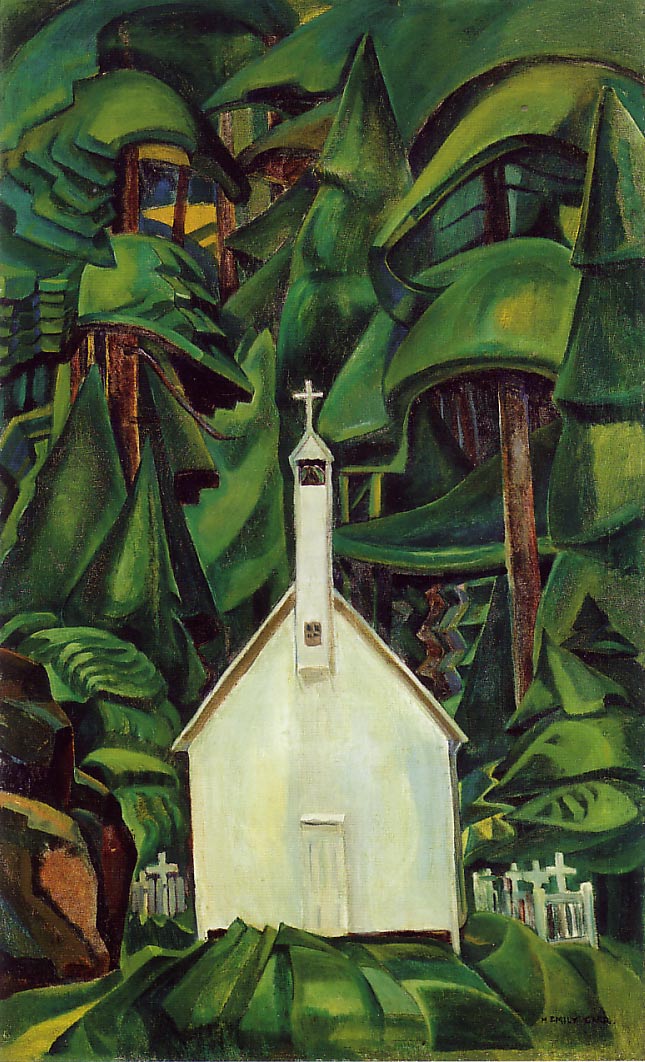
Emily Carr’s exhibition began with paintings of forest from the 1920s – in a sense toward the end of the story. The leaves spiral, there is a real sense of action in the painting – although, of course Carr writes “If there is no movement in the painting, then it is dead paint”. One of the most significant paintings is “Indian Church” (1929).

This is not Terra Nullis, because there is clearly the impact of western society on the forest, a whole way of thinking in the new world. But she was also interested in theosophy and mysticism and argues that “Metamorphosis between species and states is the only predictable feature of the cosmos”. Magic? Maybe.

Daughter of English immigrants to British Columbia, Carr had an interest from an early age in the wilderness outside the settlement. She had art lessons as a child and, despite the death of her parents, went to study at the California School of Design, San Francisco where she learned how to paint outside. On graduating she went to London, to the Westminster School of Art and took courses at places such as St Ives. Back in Canada she taught and painted, before travelling in 1907 to Alaska. She was inspired by Native American culture and art, and started trying to reproduce it in her paintings: “Indian art broadened my seeing, loosened the formal tightness … I was as Canadian-born as the Indian but behind me were the Old World heredity and ancestry”. Her paintings stay largely deserted – although some of the sites she depicted had been abandoned through disease or general depopulation. Here’s Janice Stewart: “Emily Carr found in her unproblematic identification with the Indians of the Canadian west coast a second skin to inhabit, which seems to have allowed her to paint and write beyond the gendered boundaries of contemporary conventional aesthetics. Carr identified the creative part of herself as Indian.” But Stewart is more interested in Carr’s writing than her paintings.

In 1910, Carr took a trip to Paris, where she was exposed to the Impressionism (and I guess early Post-Impressionism). Again, this would feed into her art – and it did strike me that some of her landscapes had the flavour of Vincent Van Gogh to them (whom she referred to as a “crazy poor chap”).

One striking painting is of Kwakwaka’wakw war canoes (1908 and 1912)– and this one does contain figures.

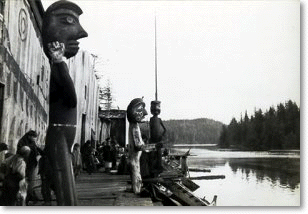
These are exactly the same boats as appeared in Edward S. Curtis Land of the Head Hunters (1914) – an extraordinary and deeply problematic drama where native culture was presented in a deliberately antiquated manner:

Inevitably she has taken a decision in the representation or not of indigenous peoples. A photograph of Blunden Harbour from 1901 (with people)

became the centre of a painting in 1930:

I’m torn – I don’t have enough data from the exhibition to know whether the elimination of the indigenous (whilst retaining their cultural productions) shows respect for them or is part of the Terra Nullis drive. As a female artist who kept not quite being taken seriously, she found something in the peopels she met to inspire her. But is is a form of romanticisation? Gerta Moray labels it “aestheticized nostalgia”, and suggests that Carr’s attempt to preserve what she perceived as a dying culture contributed to the decline.

Sources

  • Moray, Gerta (1993) Northwest Coast Culture and the Early Indian Paintings of Emily Carr, 1899-1913. Diss. University of Toronto, 1993.
  • Morra, Linda (2004) “‘Like Rain Drops Rolling Down New Paint’: Chinese Immigrants and the Problem of National Identity in the Work of Emily Carr,” American Review of Canadian Studies, 34(3): 415-438.
  • Stewart, Janice (2005) “Cultural Appropriations and Identificatory Practices in Emily Carr’s ‘Indian Stories’”, Frontiers: A Journal of Women Studies 26(2): 59-72.

Don’t Mention Mike Yarwood

Inventing Impressionism (National Gallery, London, 4 March-31 May 2015)

There are two groups of painters that to my mind seem awfully old-fashioned and chocolate box, and having seen their work I feel the need for a blast of Howard Hodgkin or Leonora Carrington. And yet, despite being immensely popular crowd pleasers now, in their time they were as revolutionary as YBAs. I mean the Preraphaelites and the Impressionists.

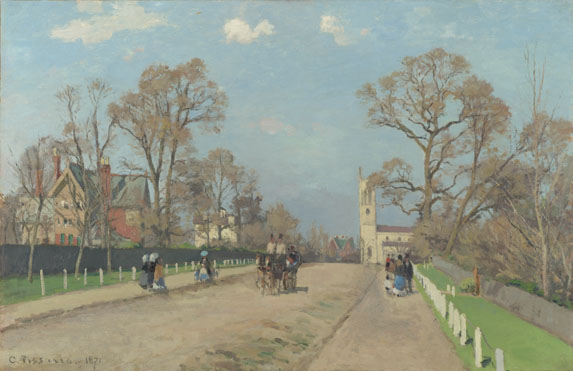
This seems an innocent enough landscape, a suburban church on a spring day. It’s Sydenham, in 1871. The church is still there, although Camille Pissarro makes the tower taller.

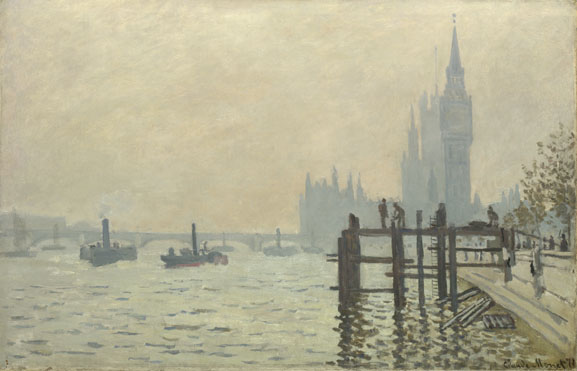
And here’s Monet’s Westminster in 1871. That tower looks wrong.

These and about eighty other paintings were brought together in an exhibition at the National Gallery, based around the dealer,  Paul Durand-Ruel, who was a champion of the Impressionists. He had inherited the painting business from his father, and saw potential for an emerging group of artists in Paris in the 1860s. He bought cheap when the market was low, then sold at a huge profit. He seems also to have manipulated the market at times to bid up prices. In 1870 he left Paris, to get away from the Franco-Prussian War, and in a London gallery began a series of shows of French artists. He also met artists such as Claude Monet and Camille Pissarro, who were also living in London. If the French weren’t interested, maybe the British would be. He paid artists a monthly wage and focused on individual artists for catalogues and exhibitions. Whilst his business was subject to the rises and falls of the French economy, he clearly was a hugely successful dealer. And he looked from Europe to America, where a new market awaited, sending one of his sons out there to manage affairs.

And yet critics had conniptions at some of the paintings. Pierre-Auguste Renoir’s “Study: Torso, Sunlight Effect” (1875-6)


Albert Wolff in Le Figaro wrote “Try to explain to Monsieur Renoir that a woman’s torso is not a mass of decomposing flesh with those purplish green stains that denote a state of complete putrefaction in a corpse.” Imagine if they saw a Paula Rego or a Lucian Freud. They’d have heart attacks.

I guess it’s a failure on my part to think myself back into the 1870 mindset — it doesn’t feel revolutionary. It feels nice.


,

Gold to Guilt

Cotton to Gold (Two Temple Place, London, 31 January-19 April 2015)

“Doubtless prompted by the hardships endured by the workers, the industrialists of the North West supported a wide range of cultural causes that benefitted the inhabitants of the cotton town.”

This exhibition brings together the collections of several textile, rope and other industrial magnates as donated to their local museums — the Townley Hall, Burnley, the Haworth Art Gallery, Accrington and Blackburn Museum and Art Gallery. If you want to know what surplus labour is, have a look at this.

In the Good Old Days, the artisan weaved in their own home, but the process became machine-led and stream-driven and centred on the factories in ever-growing towns, especially in Lancashire. Try this: “One machine could produce around 40 yards of plain weave calico each day.” A single worker could operate eight machines. Calico is presumably made from cotton, that just happened to be lying around. Or brought in from the colonies. We’ll come back to them. Nearby there are the clogs worn by men, women and children in the factory – I forget whether the factory is for rope or textiles, but it hardly matters. The cotton rope on display is “less likely to break while powering the looms, thereby increasing productivity and profit.”

And, presumably, be safer for the workers. If that matters. I suppose it does.

One of the industrialists amassed a collection of eight hundred books, including rare early editions of Chaucer and Spenser, a Third Folio of Shakespeare, a Torah, books in Arabic and from Persia, Buddhist texts… Frankly he couldn’t have read chunks of it — his workers were presumably illiterate on the whole. There’s a first edition of Gulliver’s Travels. Covets.

We have coins and icons and stuffed birds — the collector preferred paintings but still had a range of corpses, a fan of leucistic specimens apparently — and Millais drawings and Japanese prints and Turner watercolours (who doesn’t have one?! I’ve seen thousands of the buggers in municipal galleries) and ivory carvings. There’s a warning about this but there’s an Incan corpse from the twelfth century collected by William T. Taylor, who appears to have been involved in archaeology, but more to the point worked in hydroelectric dams in Kashmir, Nepal, Mexicon and Peru. Apparently “he seems to have paid scant regard to the claims of the local people to the objects he brought back.” No shit.

At the start, the curators claim that “the exhibition highlights the circumstance of the exceptional accumulation” of objects. To a point, yes, to a point.

The industrialists put money into galleries and museums, as well as into churches and cathedrals. They endowed schools and … orphanages. How many of the orphans worked in the factories? How many were orphaned by the factories?

At the same time, one has a sneaking respect for the owner of Burnley Brewing Company, Edward Stocks Massey (whose legacy was used to buy other collections), who promised a large sum of money to the Burnley Corporation, but the amount would drop every time one of his 150 pubs lists its license. Fortunately for Burnley, he died fairly soon.

Of course, very few museums have ethical collections. It’s just that it is rarely so flagrant and hinted at but not entirely visible. There are undoubtedly some beautiful objects here — for me the highlight is a rather crappy Blake drawing. As proven by many dozens of municipal galleries, industrialists had lousy tastes (or kept the good stuff).*

The downfall came in the 1940s when India, apparently the destination for fifty per cent of Lancastrian cotton, boycotted it. The market fell and there were times when a factory a week closed. Bloody colonials, with their demands for independence…
* In this, of course, I may well be being unfair to self-made men. But made on the back of the labour of others.

Caspar: The Ori Gersht

John Virtue: The Sea (Towner Gallery, Eastbourne, 17 January 2015-12 April 2015)

Ori Gersht: Don’t Look Back (Towner Gallery, Eastbourne, 7 February 2015-26 April 2015)

Where we perceive a chain of events, he sees one single catastrophe which keeps piling wreckage and hurls it in front of his feet. The angel would like to stay, awaken the dead, and make whole what has been smashed. But a storm is blowing in from Paradise; it has got caught in his wings with such a violence that the angel can no longer close them. The storm irresistibly propels him into the future to which his back is turned, while the pile of debris before him grows skyward. This storm is what we call progress.

As an incomer to southron lands, I guess I should never speak ill of Kent, but Sussex has the edge over it in terms of galleries — Updown, Anthea Turner Contemporary, Mascall’s and Sidney Cooper weighed up against Pallant House, the De La Warr Pavilion, the Jedward and the Towner, not to mention Brighton. Against Chipperfield’s retread of his Wakefield Hepworth design in the (oh go on then) Turner Contemporary, they have a number of glorious modernist or modernist-style buildings and (oh go on then) the Jerwood. More to the point, alongside exhibitions there are collection strategies, but that’s another story.

Towner

That being said, as with the De La Warr, the Towner needs a lick of paint.

First to the top floor, and John Virtue’s monochromatic renderings of the sea. I went to see Maggie Hambling’s Walls of Water, in part because of the virtriolic review by Jonathan Jones,  and that works on a similar principle of abstract expressionist versions of naturalism. Whilst Hambling allows herself colour, Virtue barely gets to grey. Would the Blakeney Tourist Board be chuffed? I was a little disappointed by the paintings simply having numbers and dates (I like that kind of hermeneutic unpacking) and I wondered how some of them can take three years… And yet, that sizeable floor space of the Towner allows for distance and, once you stop, pause, focus, lose yourself, there is something powerful. I reckon you need Ralph Vaughan Williams’s symphony being played, but there is something going on here. Despite myself, I liked.

And then to Ori Gersht, on the second floor, and a photographer who teaches in Rochester.  Central to this show are two films — and I confess to a certain amount of impatience with art films (as opposed to film as art). All too often it’s poor cinematography and I’ve got the joke fairly quickly and how the hell can you view it properly in gallery conditions?

First here, though, a room of photographs, treescapes, mountainsides, a little blurred, a little resembling an album cover, something by Led Zeppelin?

Something, someone, at the back of my head — Caspar David Friedrich, the romantic artist of the mountain top?

Through to a second room — there’s a double, jarring, out of alignment photo of a tree, a silver birch? I have a memory of a painting, I think by Johan Christian Dahl, of a tree, that represented Norway.

And then a further memory, more recent, of someone who did this for Germany. The mind is blank.

Is Gersht in this tradition? [ETA: yes, well, of course… see below]

Onto the film Evaders (2009), a twin screen production which begins… well you watch it on a loop, so you come in partway through, and I’ve lost track, but we have a bearded man in a hotel room, and we have him walking in the dark, and we have wind, we have a storm, we have mountainsides. There is a voiceover, reading Walter Benjamin’s “Theses on the Philosophy of History” in relation to Paul Klee’s Angelus Novus, and Gersht is clearly making a link between Benjamin’s words and his fateful attempted walk to freedom in 1940 from Nazi occupied France across the Pyrenees to Spain. But emigration from Portbou was forbidden  and Benjamin, in ill-health, faced deportation back to a concentration camp. He chose to kill himself. Benjamin is played by Clive Russell (I knew I recognised him) and the music is by Scanner.

A number of the photographs shown near the tree were taken almost blindly out of a moving window, from a train Gersht travelled on between Krakow and Auschwitz — a route Jewish prisoners would have been taken on to the camps, but on windowless trains. There’s a problem with art “about” the holocaust, about aestheticizing atrocity — Adorno’s line “Kulturkritik findet sich der letzten Stufe der Dialektik von Kultur und Barbarei gegenüber: nach Auschwitz ein Gedicht zu schreiben, ist barbarisch, und das frißt auch die Erkenntnis an, die ausspricht, warum es unmöglich ward, heute Gedichte zu schreiben”, normally paraphrased something like “no [lyric] poetry after Auschwitz”, springs to mind. But it must be engaged with. The moving camera gives an uncanny blurring; in the next room, Gersht is in Galicia, modern western Ukraine, home of his father and other ancestors. These are overexposed, tending to white out, again haunted. Friedrich is invoked in the notes, the romanticisation of the landscape.

This brings us to the second film, The Forest (2005), again on a loop, mostly of a forest and stillness, but with slow, dreadful, ear-splitting, felling of trees. The film slows into slow motion (he filmed at high speed?), again playing with the durée of the image. The loop means you lose the beginning and the end, until there’s a fade to and from black. Where does the work (of art in the age of mechincal reproduction) begin?

The words “The Clearing” allude to Martin Heidegger, and his sense of Being as standing out as in a clearing.

In the midst of beings as a whole an open place occurs. There is a clearing, a lighting… Only this clearing grants and guarantees to us humans a passage to those beings that we ourselves are not, and access to the being that we ourselves are.

In the film, the labour is invisible,  missing, and I think from an ecological perspective, the clearing hear is ambivalent at back. Sustainable forestry? A century or two of growing over in an extend second of fall? And again, we are viewing this within the context of the mid-twentieth century atrocities of the Second World War. There is a sublimity at work here, but a terrible beauty was born.

ETA:

 Der Einsame Baum

Caspar David Friedrich, Der Einsame Baum (The Lonely Tree, 1822, Alte Nationalgalerie, Berlin)

A little digging pointed me to Der einsame Baum (The lonely tree, 1822) by Caspar David Friedrich. I’m not entirely sure where I came across it — possibly in a book on Peder Baulke (who was Norwegian but active in Germany). The consensus is that this tree is an oak, and among the interpretations is that it represents the German people — although in 1822 it was still Prussia. The Riesengebirge/Krkonoše mountains in the background (if it is them) are now in the Czech republic but marked a division between Bohemia and Silesia. I’ve been unable to find a copy of Gersht’s photo, which looked to my untrained arboreal eye to be a silver birch. It’s a very different image from Friedrich’s, of course, but  it’s still within the context of German identity.

Nor Any Drop To Drink

Canterbury’s Sidney Cooper Gallery is one I overlook all too often, unforgivably. It’s a single room – well, a single room with a small room with a screen, situated on the high street at the west station end of town. I guess because it is so close, and so small, I don’t make the same kind of effort as I have with, say, Mascall’s Gallery at a school in Paddock Wood.


Still, I’ve seen a number of interesting shows over the years there, and Louise Bourgeois is coming up. (Colour me sceptical though as I like her sculptures and her narratives, but her drawings are a little bit “I’m-art-because-I’m-drawn-by-an-artist”.)


The current exhibition, which ends Saturday, is Tania Kovats, whose work I saw either at the Yorkshire Sculpture Park or Jupiter Land. File under sculpture, the work I saw before was a number of glass bottles of water from rivers around Britain, in a boathouse Iver a lake. The work here is similar – several hundred bottles of water from all the seas of the world. Ther is a laminated list of the bottles, and it’s notable, having crowd sourced the collection, that some seas are more popular than others. There is clearly a row of North Sea samples – although the rackage prevents you from being clear which is which, short of a methological counting. On the face of it, sea water is sea water is sea water, although the is clearly some settlement in some of the containers. The Dead Sea didn’t stand out. The obsessive in me would like to se a chemical analysis of the water – salt concentration and trace elements….


Meanwhile le there are a number of sculptures of layers, dramatising the impact of pressure upon stratification and relations of basalt. Perhaps the most striking is a slack and White coicture that is abstract in nature, and I suspect the impact of salt water on something, but I didn’t note down what. There’s a short film, uncredited but I’m guessing the work of Ben Rowley.

If You Tolerate This Your Children Will Be Next

Conscience and Conflict: British Artists and the Spanish Civil War (Pallant House, Chichester) 

One of my favourite art spaces is the Pallant Gallery in Chichester, in theory three hours away by train (although Southern/South Eastern buggeration made this three and a half) – via something from the market and a coffee first and then a pint post charity shops. There’s a twenty-first century extension, which either filled a gap or replaced some indifferent building, and the Georgian era gallery complete with squeaky floor boards. The Pallant collection specialises in twentieth century art, mainly British, with London and Sussex artists well represented, plus smart local collecting. That the nearby cathedral was and is sympathetic helps.

imageI think I’ll have more to say about Conscience and Conflict: British Artists and the Spanish Civil War, which closes on 15 February 2015 but moves to the Laing Gallery, Newcastle from March. I only know the barest outlines of the war, I’m afraid, a bloody struggle between Nationalists (supported by the Nazis) and Republicans (supported by Russians), in effect extending the Second World War back to 1936. It became a rallying cause for the Left in Britain, with poets, writers and artists heading off to fight or drive ambulances, largely on the Republican side. One atrocity led to Picasso’s astounding Guernica, shown in Britain at the Whitechapel, among other venues. A tapestry version was at the UN for many years, and was covered up when Colin Powell and John Negroponte spoke in front of it in 2003 during the lead up to the conflict in Iraq. The tapestry was moved to be shown at the Whitechapel – it was astounding when I saw it – and apparently is now in San Antonio. The Nationalists won and Spain became an authoritarian society until the death of General Franco in 1975.

Aside from participating in the conflict, there were a variety of responses from British artists. Partly there were various posters and portfolios, raising money or drawing attention to the suffering, starvation and refugees, clearly propaganda but bipartisan as the fund raising drew no distinction between Nationalist and Republican. Most artists were pro-Republican, seeking for Neville Chamberlain to change his neutral stance at the point that he was also appeasing Hitler. Roger Penrose and three other artists spirited Chamberlain masks at a May Day protest. (Burra was ambivalent, distressed apparently by the destruction of churches – a number of cartoons in the exhibition critique the Catholic church; one artist whose name I forget was pro-Nationalist, Wyndham Lewis was also broadly pro-Franco). A number of British artists had visited Spain in the 1930s, perhaps drawn by the light, and so there was the sense of a familiar landscape being destroyed. John Armstrong painted isolated ruins against blue skies – in devastating pictures that recall the surreal cities of Max Ernst. Of course, many of these artists were inspired by surrealism and were part of a British surrealist movement, linked to Picasso via Penrose. The Spanish Civil War seems to be the unconscious to their art – and also the work of Moore and Hepworth. The nightmares of the sleep of reason can also be found in Goya’s incredibly disturbing prints The Disasters of War, inspired by the Spanish Peninsula Wars (1808-14), which I first saw at the Whitworth, and which were shown at the Victoria and Albert Museum in 1938 and provided a language for a response to such atrocities.

There are all kinds of striking works – Burra’s watercolours, Walter Nessler’s Premonition (1937) of an apocalyptic London  and Clive Branson’s (faux?) naïve socialist realism of Daily Worker selling on the streets. Oddly one of the pieces here – Picasso’s “strip cartoon” The Dream and Lie of Franco I – is also on show at the Rubens exhibition at the RAA.

I’m so glad I saw this before it closed — if you can see it in Newcastle do so.