Wild Untutored Phoenixes… Phoenices… er…

At the start of Philip Pullman’s great His Dark Materials, Lyra is a wild child, a seeming orphan, playing in the grounds and on the roofs of an Oxford college, who needs to be chased away from the fruit trees. A sensitive reader might remember Eve from the Garden of Eden, at least in her unfallen state, and the connection is made explicit for us by The Amber Spyglass (2000):”The girl, then, is in the position of Eve, the wife of Adam, the mother of us all and the cause of all sin” (71). Having obtained the alethiometer, a sort of divining instrument, she is able to comprehend and use it, without any training.

As I wrote in “The Republic of Heaven: The Betrayal of Philip Pullman’s His Dark Materials Trilogy”, Pullman allows Lyra to retreat from a character able to communicate with everyone and who has agency, to a much more subservient character. In fact, as soon as she meets Will Parry, she is very much more girly and cooks him breakfast, albeit badly, and then spends much of the final volume in a coma. At some point, she falls, in a sequence I think we have to read as sexual (but involves marzipan) and loses that innocence. By the end of the novel, she is destined to have a formal education of the kind she had scorned at the outset of Northern Lights and may at best hope for a bluestocking existence. She has to be taught to use the alethiometer.

Of course, this innocence/experience thing is drawing on William Blake (his Songs of Innocence and Experience, which feature a sleeping Lyca) and Heinrich von Kleist’s parable of “On the Marionette Theatre” (1810). Let me quote myself:

This story describes a brief encounter between the narrator and a dancer, Herr C., in the town of M. in 1801. The two see a performance of string puppets and Herr C. claims the marionettes have a grace that dancers could learn from. The puppets, being artificial, “would never be affected” because they are not self-conscious. Self-consciousness for humans is “inevitable because we have eaten of the tree of knowledge. And Paradise is bolted, with the cherub behind us; we must journey around the world and determine if perhaps at the end somewhere there is an opening to be discovered again.” The narrator responds with a story of a graceful young man who pulled a thorn out of his foot; seeing himself in a mirror, the young man recognised his likeness to a similarly-posed statue. Afterwards he became self-conscious and narcissistic. Herr C. then tells a further story, about how he fenced with a Russian family and then fought a tethered bear. Try as he might, Herr C. was unable to defeat the bear. The human’s self-conscious actions were unable to defeat the animal’s unconscious actions. Herr C. concludes that humanity’s grace can be eventually regained: “grace returns after knowledge has gone through the world of the infinite, in that it appears to best advantage in that human bodily structure that has no consciousness at all — or has infinite consciousness — that is, in the mechanical puppet, or in the God.” Grace can be regained by eating for a second time from the Tree of Knowledge.

Great things can be done unconsciously – or, rather, without consciousness – by those in a state of grace.

When I wrote both chapters, I’d clearly forgotten France Gray’s concept of the “Wild Untutored Phoenix”.* Gray discusses the various ways in which we deny that women are funny or have a sense of humour – they are too prudish or gossip too much or… It’s a variant on How to Suppress Women’s Writing. Gray suggests “When women are visible making people laugh, deny the existence of a conscious creative process” (8). It’s just an accident, it’s just chance.

But it was of the Wild Untutored Phoenix I thought when thinking about Rey in Star Wars: The Force Awakens. Obviously we all have our theories about who one of her parents is, but what is clear is that she can use the force without the, admittedly limited, training that Luke had, a training which when returned to is cut short. Do we read this as a real talent and skill, or do we end up with some essentialised wild girl, running around, having to be chased away from the fruit trees? At what point will discipline chop off her agency.

Pleasing although Finn is as a character, could he be the Will to her Lyra? Will she modify her needs in favour of his and will she – like Han, who was not a Jedi – be put into a sleep? Will she keep her agency? We have the example of Leia to look back to – canny and strong in the first (fourth) movie, slave in the third (sixth) (although she has a few weapons left to her). Can a woman be allowed to stay strong and her talents not get undermined?

We’ll see.


Note


* As far as I can see, this is a reference to an article on D. H. Lawrence by F. R. Leavis in Scrutiny. This is an odd – Lawrence would say queer, no doubt – linkage that I need to think through more.

Bibliography

  • Butler, Andrew M. “Bearly Conscious? Deconstructing Pullman’s Postmodern Marionettes”, Philip Pullman. Edited by Catherine Butler and Tommy Halsdorf, London: Palgrave Macmillan, 2014: 96-112.
  • Butler, Andrew M. “The Republic of Heaven: The Betrayal of Philip Pullman’s His Dark Materials Trilogy.” Children’s Fantasy Fiction: Debates for the Twenty First Century. Edited by Nickianne Moody and Clare Horrocks. Liverpool: ARPF/Liverpool JMU, 2005: 285-298.
  • Gray, Frances. Women and Laughter. London: Macmillan, 1994.

Conference 2016 Messengers from the Stars – Episode IV

Science Fiction and Fantasy International Conference

Faculty of Letters, University of Lisbon

http://messengersfromthestars.letras.ulisboa.pt/

CALL FOR PAPERS

Science Fiction and Fantasy objects are a permanent part of today’s cultural industry.  From the margins to mainstream culture, their ubiquity demands critical debate beyond the preconception of pop culture made for mass entertainment. The University of Lisbon Centre for English Studies (ULICES) invites you to take part in the 4th International Conference Messengers From the Stars: On Science Fiction and Fantasy to be held at the School for Arts and Humanities, University of Lisbon, November 16-18, 2016. We welcome papers of about 20 minutes (maximum) and also joint proposals for thematic panels consisting of 3 or 4 participants. Postgraduate and undergraduate students are also welcomed to participate.

Topics may include but are not limited to the following:

  • Artificial Intelligence
  • Comic Books/Graphic Novels
  • Fan Fiction/Fandom
  • Fantasy and Children’s Literature
  • Fantasy and Science Fiction on Screen (Cinema, TV, Web, etc.)
  • Fantasy and the Gothic
  • Imagination and Fantasy
  • Journey
  • Music and Science Fiction
  • Place and Non-place
  • Science and Fiction
  • Utopias/Dystopias
  • Videogames

Confirmed keynote speakers:

Andrew M Butler – School of Media, Art and Design (Canterbury, UK)

Katherine Fowkes – High Point University (NC, USA)

Deadlines:

Individual papers, as well as thematic panel proposals, should have 250 words maximum and be sent to mensageirosdasestrelas@gmail.com along with a short biographical note (100 words maximum) by May 31, 2016.

Notification of acceptance will be sent by June 30, 2016.

Working Languages: Portuguese and English

Registration:

Early bird registration:  July 1st – September 15th

70 € / Students: 30 €

Late bird registration: September 16th –October 31st

80 € / Students: 40 €

Note:

  1. Only after proof of payment is registration effectively considered.
  2. Participants are responsible for their own travelling arrangements and accommodation.
  3. Undergraduate and post-graduate students must send proof of student status with their registration.


Moby Duck

Moby Dick (Trey Stokes, 2010)

Curiously the DVD has a trailer for another version of Moby-Dick, with Danny Glover and … dragons. I want.

In this version we have Captain Ahab (Barry Bostwick) as one of two survivors of an attack by an incredibly huge white whale on a submarine in Soviet waters in 1969. Ahab has stolen, or at least acquired, a nuclear sub and kidnaps the leading whale expert to try and track the behemoth down. He has a tape of the whale he wants her to play to call it into a position where they can kill it.

So the whale goes all bat-shit and attacks tourist boats and a cruise liner until a fight with the USS Essex and a showdown with the Pequod. Ahab rants hilariously, as the other characters exchange looks of disbelief, perhaps at his madness, perhaps at the dialogue. Derek Scott as the whale expert’s assistant manages to steal the film from beneath their noses.

Oh yes, this is bad, but in a way that Jupiter Ascending can only aspire to.

Splash II

In the Heart of the Sea (Ron Howard, 2015)

Moby-Dick doesn’t have the weight of heritage on me that I guess it has on Americans — default answer, got but not read, and I confess I never got much beyond the stuff by the sublibrarian at the start, let alone to “Call me Ismael.”

Phones in the nineteenth century?

Odd.

I gather it’s about a man chasing a whale and it’s responsible for a coffee shop chain; post-Rainbow Warrior and Heathcote Williams you cannot help be feel sorry for the whale.

I mean, he’s not event credited in the cast, for fuck’s sake.

So this is the story behind the story of the hunt for the Dickster — Melville (Ben Wishaw) turns up at the guest house owned by the drunken Thomas (Brendan Gleeson), sole survivor of the ill-fated Essex whaling expeditition, in search of a story. (We really don’t want to know what he did to get hold of the idea for Billy Budd.) The camera wobbles, as if we’re at sea.

Get it?

So then we flash back to Thor and his pregnant wife; he’s going to sign onto a whaling ship, e pectins to be captain, but usurped by someone who is someone’s son. These guys are gonna clash. And behind them is Nantucket, all CGI and stuff, and alongside them are all kinds of prominently-boned actors who can only act in nineteenth-century era movies.

Hi ho — the life of a sailor and rum, buggery and the lash.

Little of all three.

There’s a storm to test them and then the first whale, before they hear tell of a majorly big behemoth, who is minding his own business in the Pacific. Who gets understandably narked when they disturb him.

And then it’s all boo hoo hoo.

Of course, this is all told from the point of view of greenhorn Tom the Cabin Boy, even though he isn’t in every scene.

And lots of CGI.

Indeed, there’s a moment when you forget yourself and wonder why a hobbit and Aragorn have gone to sea.

Of course, Wishaw and Gleeson are almost in a different movie to the rest of the cast. Me, I was rooting for the whale.

Maybe I need to go away and watch Moby Dick.

The Ghost of Academia Future Perfect Subjunctive

So another year over, and what have we done…

In the published corner:

  • ‘Disfigured Myth: The Destruction of London in Postmillennial SF Film’, Foundation, 122 (2015): 122-32.

  • ‘Sleeping/Waking: Politicizing the Sublime in Science Fiction Film Special Effects’. Endangering Science Fiction Film. Edited by Sean Redmond and Leon Marvell, New York and London: Routledge, 2016: 117-31.

  • ‘Human Subjects/Alien Objects? Abjection and the Constructions of Race and Racism in District 9’, Alien Imaginations: Science Fiction and Tales of Transnationalism. Edited by Ulrike Küchler, Silja Maehl and, Graeme Stout, New York: Bloomsbury, 2015: 95-112.
  • ‘Iain M./ Banks’, Twenty-First Century British Writers (Dictionary of Literary Biography). Edited by Tom Ue, Chicago?: Gale, 2015.

Somewhere out there — and I don’t like to talk about work in progress before the ink is dry — are chapters on Adam Roberts, British sf short stories, queer YA sf and perhaps one I forget — editorial work on someone.

I am about to put to bed an article on The Clarke Award and a chapter on a period of sf.

Downsides — the article proposal turned down (but there was some small compensation in that the editor reassured me that I might be able to place it elsewhere, may be in a peer-reviewed venue) and the chapter rejected after much time but short shrift (it may well be crap, but it was not a well-handled project).

To do in 2016:


  • I failed to convert one conference paper into a chapter and probably have missed the boat on that book, but it can feed into another commission I have;
  • to convert the paper on Quest for Love into a chapter;
  • to convert the paper on Mieville I gave at a conference into a chapter (I seem to have fallen off a mailing list there);
  • to return to a book that was bounced and needs work;
  • to produce a book proposal that I’ve been pondering for too many years;
  • to sort out two book proposals for projects that came up some years ago and stalled;
  • beer and brewing and drinking research. I need to be priming the pump.

And I need to do some writing on sf film — maybe go back to the Moon paper and the keynote for the CRSF.

Have I missed anything any of you have asked me to do?

Clearly this is too much for a year. We’ll see.

I See Dead London

“Disfigured Myth: The Destruction of London in Postmillennial SF Film”, Foundation 122, pp. 122-32.

There is a moment in Rob Bowman’s Reign of Fire (2002) when the hero, Quinn Abercromby (Christian Bale), climbs a wall from a river and gazes across at a semi-destroyed Palace of Westminster and says, ‘Well, this town’s gone to Hell.’ It is not the only landmark to have survived several decades of destruction: Tower Bridge has also made it through. This article explores the symbolism and meaning of such landmarks, drawing upon the ideas of Charles Peirce, Roland Barthes and Sigmund Freud, within a number of recent British science fiction films: Reign of Fire, 28 Days Later (2002) and its 2007 sequel, and Children of Men (2006). To already indicate the instability of a British identity that these films work to prop up, only 28 Days Later is a fully British production whereas the others are co-productions. The director of Reign of Fire is American, of 28 Weeks Later Spanish, and of Children of Men Mexican, but they all feature a British-born star (although the protagonist of 28 Days Later is Irish-born).

This is a version of the paper “London Death Drives” I gave at the Worldcon in August 2014, fleshed out and theory-enriched. It strikes me that there are a couple more films that could also be included here (I watched Doomsday (2008) and Flood, but neither quite fitted in the word count) and I’m sure I’ll return to British sf film soon.

May be we are set in our ways — I note here I am still in the Freudian paradigm with the uncanny and the death instinct — but note also the importance of Tom Shippey’s chapter, “The Fall of America in Science Fiction”, in Tom Shippey, ed. Fictional Space, (Oxford: Basil Blackwell for The English Association, 1990), pp. 104–32. That Shippey collection was some of the first serious sf criticism I read and it influences me more than I usuallly realise.

When We Were Very Young

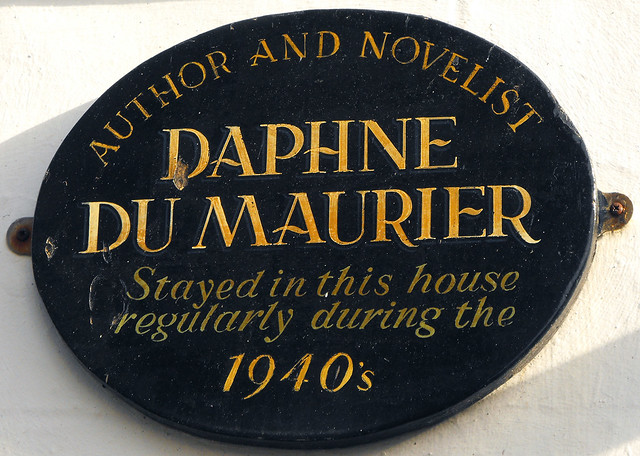
For reasons that escape me, a number of years ago I bought a boxset of Daphne Du Maurier novels. I must have thought this was good plan, because I then bought a second, and a couple of novels not included in either. I also bought the collection which contains the story that was the basis for ‘Don’t Look Now’. The most Hitchcockian of novelists – with perhaps the thought that Du Maurier was a Cornish Patricia Highsmith. The grand plan, being anal, was to read the novels in chronological order of publication, but that never happened and the boxes sat by my bed, gathering dust. So I picked another one at random. Du Maurier Plaque

Daphne du Maurier, I’ll Never Be Young Again (1932)

I’ll Never Be Young Again is very much a book of two halves. In the first, Call-Me-Dick is about to throw himself into the Thames, having been estranged from his Famous Author Father for writing pornographic poetry. For the sake of the first person narration, he is rescued by Jake, a young man recently released from jail having served a sentence for manslaughter. The two decide to go to Scandinavia — partly working their passage, partly tourists. Call-Me-Dick is plainly a dick, he being miserable and contrariwise half the time and it’s a wonder that Jake doesn’t drop him in the nearest fjord at the fjirst opportunity.

In the second half, he settles in Paris, initially adrift, sacked from job after job, pretending to be a writer, and set up at first by selling his rights to the pornographic poems. Think Henry Miller without the explicit sex scenes. Somewhere along the line he picks up an American music student, Helva, who becomes his partner and muse and is generally messed around by Call-Me-Dick.

It’s a brave thing, to have a protagonist and first person at that who is such a whiny. It’s pretty episodic, of course, with a vague theme of growing up and becoming accepted by one’s father. Jake isn’t sure he wants Call-Me-Dick to grow up — perhaps he’s a bit of a manchild too.

What would have made the characters grow up? There’s no shadow of war on the scene — assuming CMD is twenty in 1932 (when the novel was published), he would have been two to six when it took place. Too young to fight, obviously, but still a shadowy memory? If it’s set even earlier, then even more of a memory. I began assuming that there was a Victorian setting — the manslaughter, the fog on the Thames — but there’s a gramophone and then there’s cars and the characters go to the cinema. Early twentieth century then? Are there mentions of phones at the end? It’s all a little … closed in.

Inevitably, there’s some amateur psychoanalysis to undertake – du Maurier, the bisexual, putting herself into the viewpoint of a man who moves from effete to pugilist (Jake was a boxer, who defended a young woman’s honour, incidentally.) there’s a sense of CMD being picked up by Jake and an odd love-hate attitude to the sailors, a sense of CMD throwing himself at the ladies that I don’t think Jake echoes.

The novel, in that alibi-ing, disavowing dance, even has a character ask CMD:

“Are you a sodomite?” […]
“No, I haven’t sufficient rhythm.”

Oscar Wilde was accused of “Posing as a sodomite” (or, rather, a somdomite, the Marquis of Queensbury being presumably better at rules than spelling). Late in the novel, we learn that CDM’s dialogue in his novel (or is it his play?) is meant to be Wildean. Hmm.

This is a mixed bag — some exciting scenes of action, some dull scenes of domestic life, a very weird ending where the joke seems to be on Dick. But, after all, this was her second novel.

Gucci Gucci Goo

Blood Cells (Joseph Bull and Luke Seomore, 2014)

So there’s a moment when a character in this film explains to someone that the light from those stars was shining years ago and has only just arrived — then and now. For that matter, the light from the cinema screen left microseconds ago — then and now. And the film was made a year or so ago — then and now. Cos that is just like memories innit — then and now.

So Adam (Barry Ward), the first man, the elder son, is haunted by the death of his father some years ago due to fall out from the BSE crisis and frankly he’s gone off the rails. There is no farm any more, he’s got a string of women across the UK and still does bits and pieces of casual farmwork. But now, Aiden, the younger son, is having a baby, or his partner is, and Adam’s got to go home and get his shit together.

So obviously he looks up old friends and ex-lovers, because that’s the best way to get one’s shot together. There’s hitchhiking past pylons, there’s bus journeys past pylons, there’s car journeys past pylons and there’s taxi rides past pylons and there’s walking past pylons.

If you like pylons, then we have a movie for you.

The rest of us not so much.

Shit gathering seems to involve much drinking and gate crashing birthday parties of 18 years olds and hanging out with jailbait girls. Adam seems to prefer young women — although the woman in Rhyl is not quite that young. I guess he hasn’t quite grown up — and we see Adam and Aiden in flashback as children too. Then and now.

We get a lot of shots of characters from behind — which is as well because Ward kept reminding me of Greg from the 1970s version of Survivors. The back of the neck keep us focused. Of course, if he were a Sontaran he’d have a probic vent that we could use to knock him out. Ward has one of the finest back of necks I’ve seen all week.

So it turns out this was a debut film — and whilst the debut Slow West was a long 84 minutes because it was packed with details, this is a looooooooooooooooong 86 minutes because it’s packed with the back if necks and bloody pylons and windfarms for variety.

So it also turns out that Gucci funded this micro budget film as part of the Venice Biennale and it’s the first British film to be so funded. I hoping it’s the last as Gucci should stick to fragrances rather than film making because this is a stinker.

Imagine if filmmakers made fragrances. HAL9000 by Kubrick. Competition with The Duke of Burgundy, which listed its perfumes as I recall. And was Citizen Kane in comparison.