To Be Frink

Elisabeth Frink: The Presence of Sculpture (Djanogly Gallery, Nottingham Lakeside Arts, 25 November 2015–28 February 2016)

My sculptures of the male figure are both man and mankind. In these two categories are all the sources of all my ideas for the human figure. Man, because I enjoy looking at the male body and this has always given me and probably always will, the impetus and the energy for a purely sensuous approach to sculptural form. I like to watch a man walking and swimming and running and being. I think that my figures of men now say so much more about how a human feels than how he looks anatomically. I can sense in a man’s body a combination of strength and vulnerability — not as weakness but as the capacity to survive through stoicism or passive resistance, or to suffer or feel
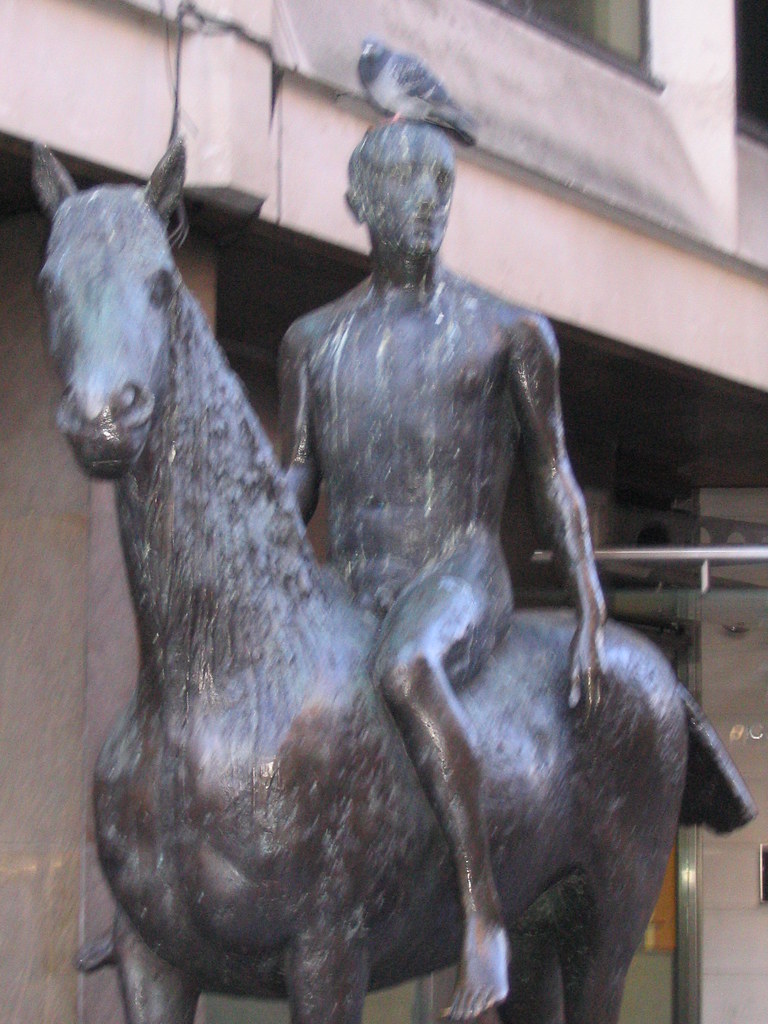
One for PigeonhedOutside Caffè Nerd on Dover Street, just off Piccadilly, is a small equestrian statue, usually with a pigeon on its head. I sat by it a few times before I realised it was an Elisabeth Frink, and I confess that I don’t recall why I began to pay attention to her. There was a small show at Woking I took myself off to a couple of years ago and materials at the Beaux Arts Gallery, London.

In my mental map, British twentieth-century scuplture was dominated by three names — Henry Moore, Barbara Hepworth and Eduardo Paolozzi — before we get into the Caros and the Gormleys and the more conceptual sculptors. Moore and Hepworth seem to occupy a curious middle ground between neoromanticism and modernism — shapes somewhere between the abstract and the bodily, sensual, demanding to be caressed. Paolozzi is plainly of the machine age — the aesthetics of collage and the cyborg, Lego bricks and circuit boards in bronze.
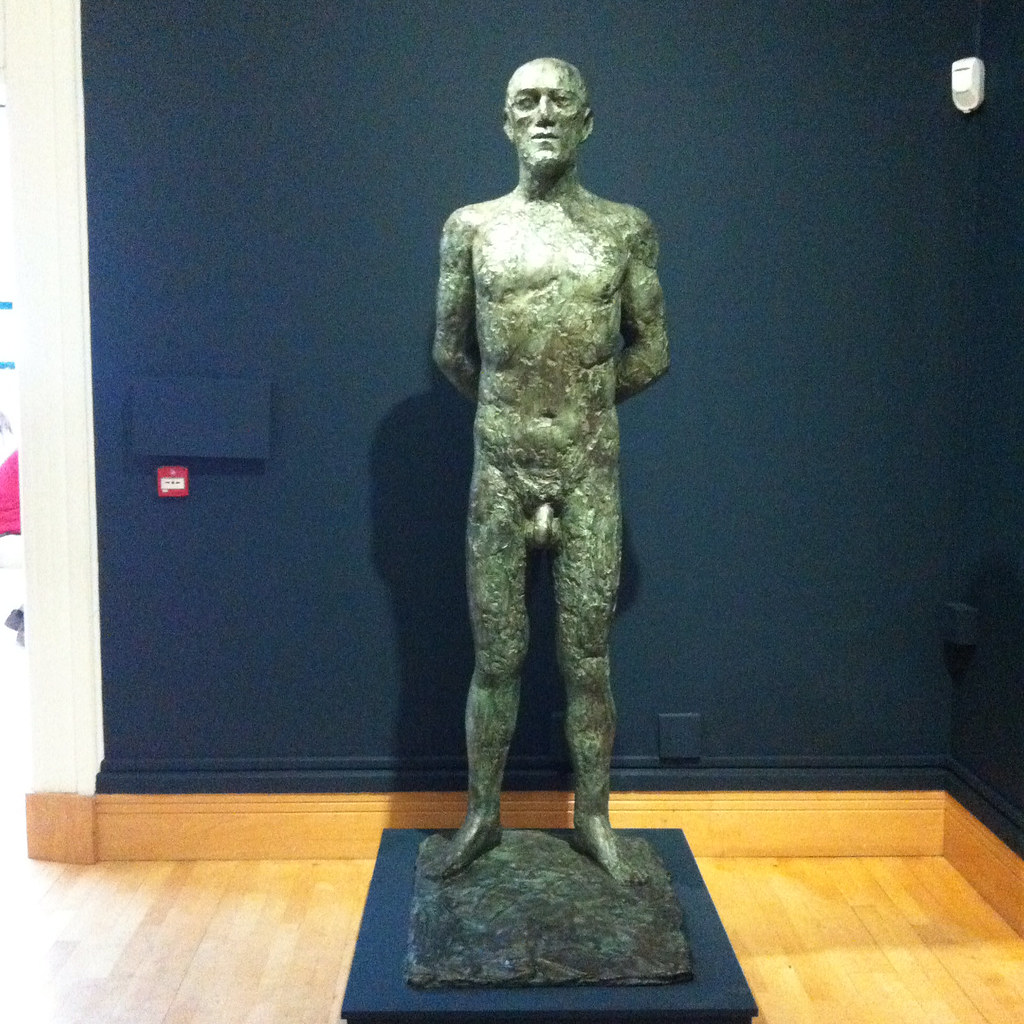
Standing ManWhilst all three are producers of solid work, Moore and Hepworth are more abstract and Paolozzi is more surreal than Frink. Frink’s sculpture has an extraordinary physicality to it. Her statues are of walking, running, jumping, flying and falling men — yeah, pretty well all men — and clearly there is tension between such movement and the fitness of bronze or concrete. Even the standing men seem to loom, arms behind their back, cock and balls hanging, solid presences, somewhere between threatening and sexualised.
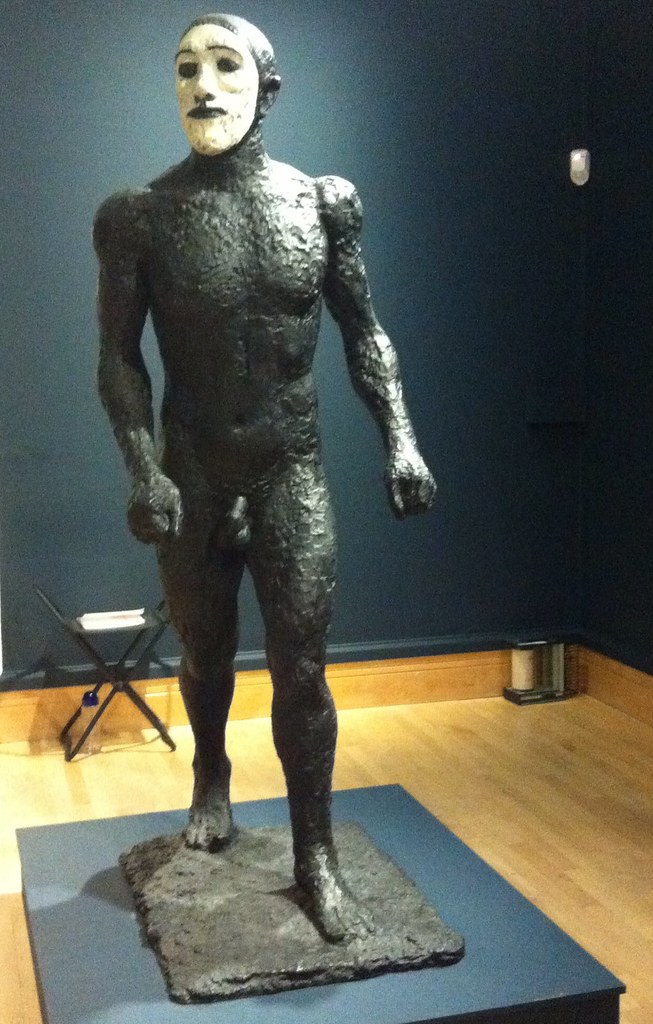
Riace IIIImagine: some of these were commissioned for the headquarters of W. H. Smiths. Remember that when you try to get your free chocolate bar with a copy of The Mail on Sunday. The Walking Man became one of the Riace, named for the bronze statues found in the sea in 1972, and is in white face, one of Frink’s odd experiments in coloured bronze. Apparently her statue of a dog was coloured; the Desert Quarter (1985) bronze is white. Are these angels or demons?
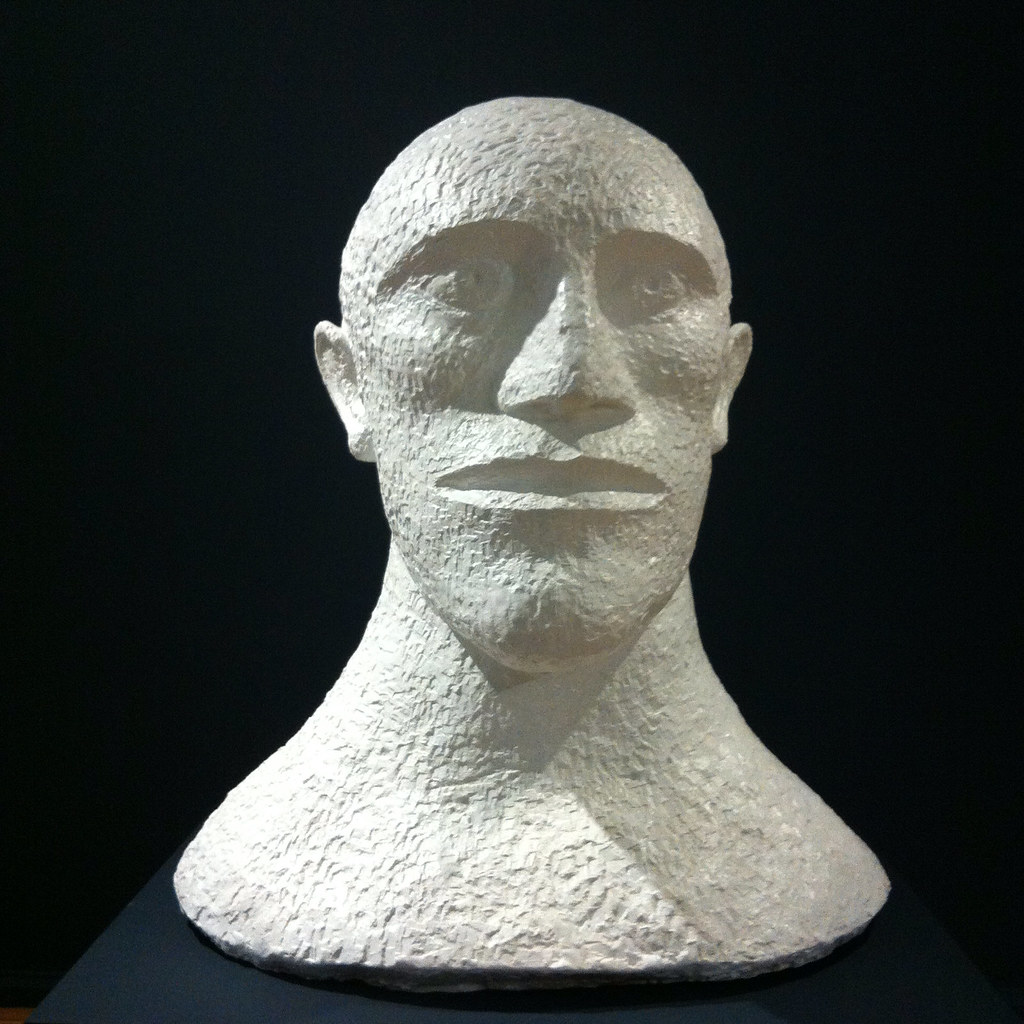
Desert Quarter
She’s presented here in a curiously dialectic way; on the one had she was a child during the Second World War although she knew of the horrors of Belsen and the atomic bombs, the anxieties of the Cold War; on the other hand her public commissions are associated with the Utopianism of the Garden City and New Town movement in the post-war rebuilding. Sculpture was meant to inspire people — whether outside civic buildings or shopping centres, or in the new Coventry and Liverpool Metro Cathedrals.

Her Christ, in a gouache, is muscular, the emphasis on the physicals over the divine. There are pictures here of the crucified Christ, the body emphasised over the cross. There is a Mary and a nun, and a study for Judas, which is also known as the warrior. Her military men — the flying men, the air men — always already seem traumatised, the sculptural equivalent of post-traumatic stress syndrome. And that makes me wonder about her Judas; he betrayed with a kiss, he was paid his thirty pieces of silver, he bought the field and hung himself. Was Judas a warrior — did he fight with his demons and lose?
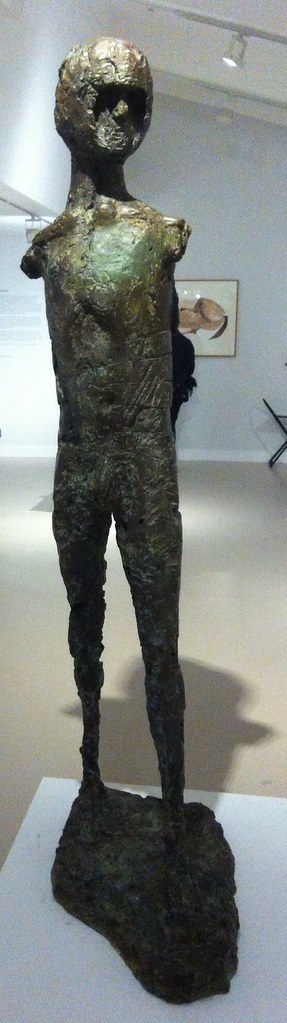
BirdmanThere is her Birdman, apparently commissioned for a school but thought destroyed (like her first commission, but a damaged version was found this year), a tall, gangly man, with stubs on his back, decommissioned wings perhaps, a fallen angel among men. There is her Running Man (1978), not, apparently, an athlete, but rather a fugitive from some unspecified conflict. Her Flying Men (1982) are hang gliders but seem about to cast themselves into space — inspired by one Léo Valentin (1919-56) who made his own birdlike wings in a vain attempt to fly. Is he also her Falling Man (1961)?
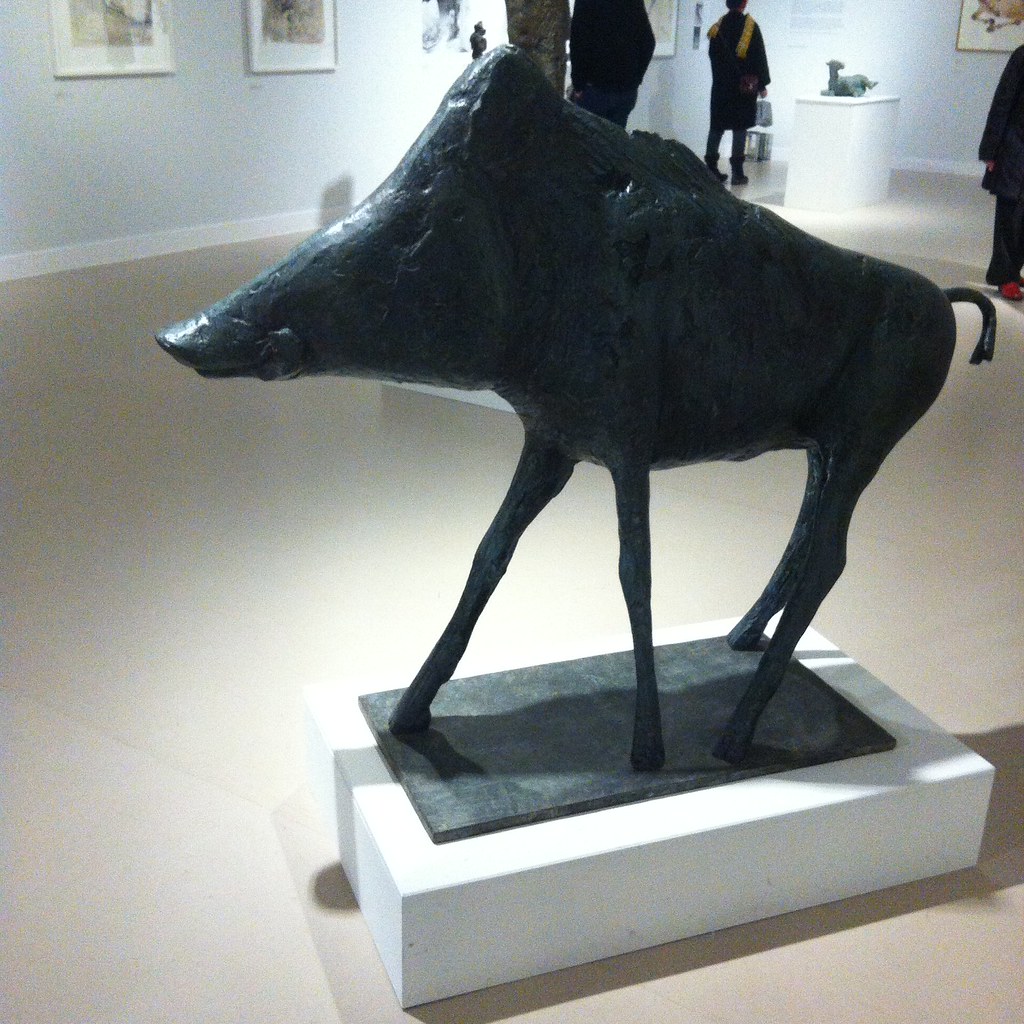
BoarThere are animals — lots of horses, sometimes with riders, a boar for Harlow, warthogs and dogs. Dogs whose heads you want to pat but mustn’t. There are birds, but of ill omen, her Harbinger Bird III (1961) and Warrior Bird (1953), corvids, menacing; on the other hand her eagles, often designed for pulpits and linked to the Kennedy assassination (there is also an uneasy sculpture, The Assassins, but all of them are uneasy).

And of course, there is the baboon, commissioned for London Zoo, but it’s a different version here. And there’s a water colour, apparently inspired by an Australian trip although that makes little sense, of an encounter between a man and a baboon. Apparently the baboon is unimpressed by the man.
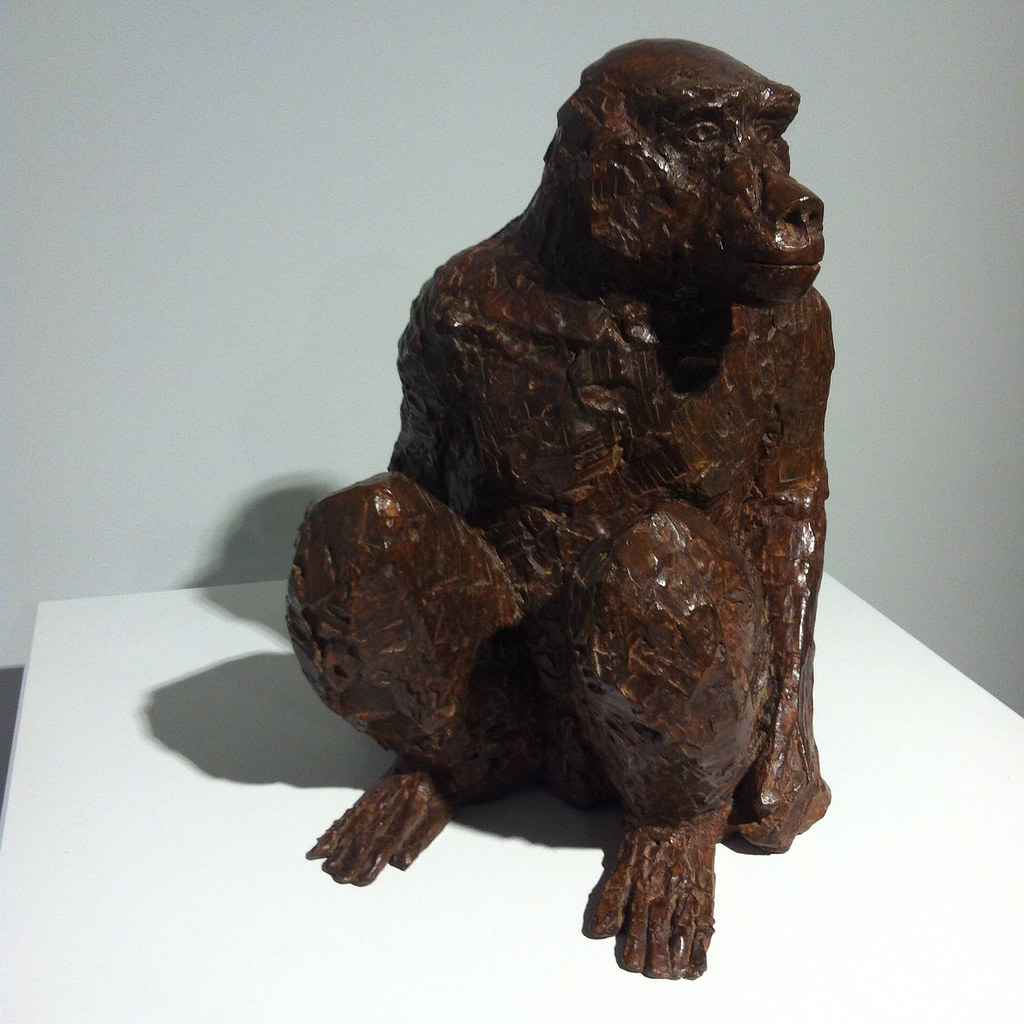
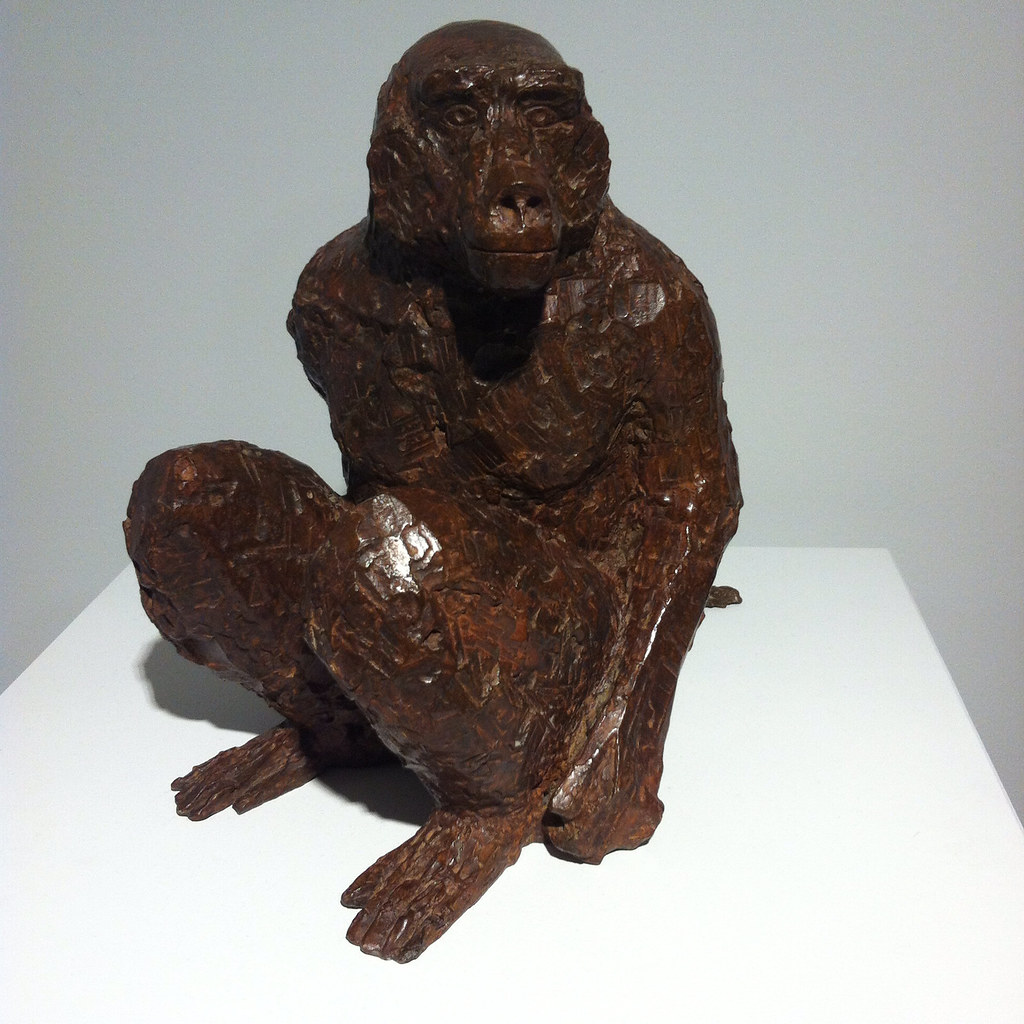
BaboonBaboon

So her subject is man rather than woman. She may have done mother and child pairs like Hepworth and Moore, but none are here on display, and she was clearly a mother. The few female statues here are caped or cowled. Is there an avoidance of female objectification? Is her aim to objectify men? There were warrior women she could have portrayed, traumatised refugees. But clearly that was not for her.

Bridget Courbevoie

Bridget Riley: Learning from Seurat (Courtauld Art Gallery, 17 September 2015–17 January 2016)

I tried to find the bridge (Bridge at Courbevoie (1886-87)) on Google maps but failed — the river Seine, the bridge, a distant factory, trees, fisher men, walkers. Georges Seurat’s brand of Post-Impressionism, pointillism, made up from coloured dots, half way between colour printing and cathode ray tubes. In another place, Roy Lichtenstein was to enlarge dots and make pop art of comics.

Copying is original.

Deliberately, if annoyingly, the copy and original hang either side of the doorway, challenging you to find a viewpoint from which they can be compared. You carry the memory of one to the other.
photo (2)

Bridget Riley may have seen the painting at the Courtauld – I presume it was at the Warburg Institute, Woburn Square in 1959, having recently moved from Portman Square? — but instead it struck her in R.H. Wilenski’s book on Seurat and she then decoded to paint her own version. It’s bigger, of course, but then the book may not have been clear how big the original was. I think she knew, really, so decided to make the dots larger, and so the intensity of the original is pushed even further from photorealism. The sky is curiously yellow, matching the colour in the water and the grass. He creates light from colour and that seems to be what fascinated Riley.

If the colours become abstract, then so do the shapes — triangles, poles, lozenges, anticipating Riley’s move from stripes into something more… foliated. The Lagoon paintings, for example.

sketch

And then, on an opposite wall, Pink Landscape (1960), the shimmer of summer heat in Sienna represented by dots of red and green and pink and orange and blue, and a child’s farmhouse of white walls and a red roof. The shapes of the fields form lozenges.

Wilenski writes of Bridge that “The little man in the bowler hat has missed his train back to Paris and will be scolded by his wife; the child will be late for tea and spanked, maybe, by its mother.”

Heigho.

But we would lose the narrative in Riley as the pinstripes become stripes.

Here we’re offered variants on stripes — Late Morning I (1967) with green and red and white and blue stripes insisting on length and direction, the vertical, Vapour (1970) with white, brown, purple, green stripes overlapping, question the plane and Ecclesia (1985), thicker stripes, taking on volume.

But Tremor (1962) draws the eye — black and white triables that also form curves and ribbons and you swear the painting rotates in front of you.

A painting approximates reality through strokes, dots, stripes and the pointillist returns it to dots. Riley’s insight was to occupy the geometry, to chase the relation of shape, in canvases that move both optically and emotionally, to create luminence.

Bibliography

  • Bridget Riley: Learning from Seurat (London: The Courtauld Gallery/Ridinghouse, 2015)
  • Wilenski, R. H., Seurat (London: Faber & Faber, 1949)

Mirthless in Brooklyn

Vampire in Brooklyn (Wes Craven, 1995)

It’s a bad sign when, even a week or so after watching, you are unclear whether you are watching a horror film or a comedy.

There was a time when Eddie Murphy was box office gold — actually he’s waxed and waned several times — and this film comes at a point where he’s tied into doing films for Paramount (for example Beverley Hills Cop (Martin Brest, 1984) and sequels, Coming To America (John Landis, 1988), Harlem Nights (Eddie Murphy, 1988), Boomerang (Reginald Hudlin, 1992)), but wants a break from doing comedy. Craven, meanwhile, had long harboured desires to move on from horror.

It is a match made in…

Well, somewhere damp.

The opening seems promising enough with a ship adrift and heading into a Brooklyn harbour in the fog — a nod back to Dracula somewhere along the line. But Murphy in weird wig and thick accent as vampire Maximillian from somewhere in the Caribbean is insufficiently horrific or comedic, displaying the same kind of tension that Jim Carrey sometimes does when playing straight. Maximillian is in search of a woman to continue the species, in the form of NYPD cop Rita Veder (Angela Bassett). Maximillian, meanwhile, has to pass as a preacher and an Italian criminal, allowing him space for the comic business that has largely been displaced onto his hapless, petty criminal assistant and valet, Julius Jones (Kadeem Hardison). These are some of the longest scenes in the movie.

Let’s note the theme of the untrustworthy family — Veder’s mother, some kind of paranormal anthropologist, is dead, and it almost seems as if Maximillian is her father, or a father figure, which leads us to incest. There are a couple of dream sequences, as she wakes from a nightmare, and Maximillian turns a squalid apartment into a mansion.

Meanwhile, we have a strong female lead — albeit with the slightly lovelorn Detective Justice (Allen Payne) to help her out — and indeed an African American lead (compare Poindexter “Fool” Williams (Brandon Adams) in The People Under the Stairs (1991)). In fact, Italians aside, there are very few white actors in the film — Joanne Cassidy has a cameo as Captain Dewey, as does Jerry Hall as a woman mugged in the park in a moment that ought to have political bite, but… We should note Zakes Mokae from The Serpent and the Rainbow (1988) as Dr Zeko, but have a creepy sense of the Haitian equivalent of Orientalism about both roles. Craven is trying.

But the film is trying — Murphy will go onto better things, and Craven was to put his tongue better in his cheek in the Scream franchise.

Old Red Eyes is Back

Red Eye (Wes Craven, 2005)

So the original plan was to watch a film that wasn’t work-related – Midnight in Paris (Woody Allen, 2011) – but that started skipping and so I went back to the Wes Craven pile I’ve been working through and should have written up but haven’t. Of course, this is a late entry in the oeuvre and I need to check out whether this or Cursed (2005) came out first. These were his penultimate non-Scream franchise movies.

I’m interested in these as works of an auteur and so the point is I suppose that this is thriller rather than horror, although it has hints of the home invasion horror that Craven began with in The Last House on the Left (1972). Craven was arguably the director who introduced the supernatural into the slasher, but he didn’t need it here or in many of his early films. Unusually, too, there is no playing around with reality and fantasy, although comic relief receptionist Cynthia (Jayma Mays) is wandering through a nightmare shift.

So we have Lisa Reisert (Rachel McAdams), a nervous flier on her way home to Miami from her grandmother’s funeral, making phone calls to an over protective dad, the great Brian marked-for-death Cox; you know it can’t end well. She strikes up a brief relationship with blue-eyed Jackson Rippner (Cillian Murphy) – indeed the film could have been called blue eyes – who turns out to be part of a plot to kill deputy Homeland Security guy Charles Keefe (Jack Scalia). She must move him into a suite where he can be assassinated or her father gets it. Most of the film is in the claustrophobic confines of the plane.

So, relatively common for Craven, we have a female lead – although at first you wonder whether she couldn’t fight back a little more. The decks seem stacked against her, but that’s the way the plot works. She comes good in the end, although (spoiler) she is denied the pay off.

There is a political subtext – the evils of the Homeland security – but oddly the film comes down on the side of them and the villains are mostly unseen and ill-defined off screen machinators. Should we see it as a critique of the TSA that the characters are so able to move on and off of aeroplanes, even on a domestic flight? The earlier Craven would have had a bit sharper teeth, but this is Amblin after all.

The families are less ambivalent than usual – the Keefe family seem adorable and whilst Lisa’s parents are split up, daddy seems nice if overprotective. Again, earlier films have critiqued the family, and in the avenging family there is a question of whether eye for eye justice is justified.

The climax, despite a largely unnecessary return to the hotel, is at the family home, mid remodelled, and somewhere along the line there is the sense of the uncanny as the familiar and he forgotten. The place of refuge and safety turns into a trap – Lisa moves from locking out into locking in. The police, obviously, can’t help as usual, and justice has to be personal. Her weapons are improvised – whilst villains have guns and knives, she has chairs and fire extinguishers and hockey sticks but an inexplicable failure to kick anyone in the balls. And, as I say, patriarchy reasserts itself.

I’m glad I’ve ticked this off the list, but it’s a by the numbers slick thriller with some nice touches.

How to Suppress #94

Back in the day I wrote a chapter on postmodernism and science fiction for The Cambridge Companion to Science Fiction. Space, as always, was tight, and as I recall, my focus was on the three key thinkers who characterise postmodern theory — for better or worse Jean Baudrillard, Fredric Jameson and Jean-François Lyotard. I certainly knew about Meaghan Morris’s The Pirate’s Fiancée: Feminism, Reading, Postmodernism (1988) and Donna Haraway’s “A Manifesto for Cyborgs” (1985) but it looks like neither get a mention. It might have been I assume one or other would be in a chapter on gender or feminism, but that’s no excuse.

More problematic — and I’m not going to go and check — is that all my fictional examples were by male authors.

The editors did not notice, but someone did:

Butler fails to mention even one science fiction text author by a woman or even one female literary theorist. How to suppress women’s writing? Butler’s article supplies an egregious answer. (Barr 153)

Yes, bang to rights.

Continue reading →

Wild Untutored Phoenixes… Phoenices… er…

At the start of Philip Pullman’s great His Dark Materials, Lyra is a wild child, a seeming orphan, playing in the grounds and on the roofs of an Oxford college, who needs to be chased away from the fruit trees. A sensitive reader might remember Eve from the Garden of Eden, at least in her unfallen state, and the connection is made explicit for us by The Amber Spyglass (2000):”The girl, then, is in the position of Eve, the wife of Adam, the mother of us all and the cause of all sin” (71). Having obtained the alethiometer, a sort of divining instrument, she is able to comprehend and use it, without any training.

As I wrote in “The Republic of Heaven: The Betrayal of Philip Pullman’s His Dark Materials Trilogy”, Pullman allows Lyra to retreat from a character able to communicate with everyone and who has agency, to a much more subservient character. In fact, as soon as she meets Will Parry, she is very much more girly and cooks him breakfast, albeit badly, and then spends much of the final volume in a coma. At some point, she falls, in a sequence I think we have to read as sexual (but involves marzipan) and loses that innocence. By the end of the novel, she is destined to have a formal education of the kind she had scorned at the outset of Northern Lights and may at best hope for a bluestocking existence. She has to be taught to use the alethiometer.

Of course, this innocence/experience thing is drawing on William Blake (his Songs of Innocence and Experience, which feature a sleeping Lyca) and Heinrich von Kleist’s parable of “On the Marionette Theatre” (1810). Let me quote myself:

This story describes a brief encounter between the narrator and a dancer, Herr C., in the town of M. in 1801. The two see a performance of string puppets and Herr C. claims the marionettes have a grace that dancers could learn from. The puppets, being artificial, “would never be affected” because they are not self-conscious. Self-consciousness for humans is “inevitable because we have eaten of the tree of knowledge. And Paradise is bolted, with the cherub behind us; we must journey around the world and determine if perhaps at the end somewhere there is an opening to be discovered again.” The narrator responds with a story of a graceful young man who pulled a thorn out of his foot; seeing himself in a mirror, the young man recognised his likeness to a similarly-posed statue. Afterwards he became self-conscious and narcissistic. Herr C. then tells a further story, about how he fenced with a Russian family and then fought a tethered bear. Try as he might, Herr C. was unable to defeat the bear. The human’s self-conscious actions were unable to defeat the animal’s unconscious actions. Herr C. concludes that humanity’s grace can be eventually regained: “grace returns after knowledge has gone through the world of the infinite, in that it appears to best advantage in that human bodily structure that has no consciousness at all — or has infinite consciousness — that is, in the mechanical puppet, or in the God.” Grace can be regained by eating for a second time from the Tree of Knowledge.

Great things can be done unconsciously – or, rather, without consciousness – by those in a state of grace.

When I wrote both chapters, I’d clearly forgotten France Gray’s concept of the “Wild Untutored Phoenix”.* Gray discusses the various ways in which we deny that women are funny or have a sense of humour – they are too prudish or gossip too much or… It’s a variant on How to Suppress Women’s Writing. Gray suggests “When women are visible making people laugh, deny the existence of a conscious creative process” (8). It’s just an accident, it’s just chance.

But it was of the Wild Untutored Phoenix I thought when thinking about Rey in Star Wars: The Force Awakens. Obviously we all have our theories about who one of her parents is, but what is clear is that she can use the force without the, admittedly limited, training that Luke had, a training which when returned to is cut short. Do we read this as a real talent and skill, or do we end up with some essentialised wild girl, running around, having to be chased away from the fruit trees? At what point will discipline chop off her agency.

Pleasing although Finn is as a character, could he be the Will to her Lyra? Will she modify her needs in favour of his and will she – like Han, who was not a Jedi – be put into a sleep? Will she keep her agency? We have the example of Leia to look back to – canny and strong in the first (fourth) movie, slave in the third (sixth) (although she has a few weapons left to her). Can a woman be allowed to stay strong and her talents not get undermined?

We’ll see.


Note


* As far as I can see, this is a reference to an article on D. H. Lawrence by F. R. Leavis in Scrutiny. This is an odd – Lawrence would say queer, no doubt – linkage that I need to think through more.

Bibliography

  • Butler, Andrew M. “Bearly Conscious? Deconstructing Pullman’s Postmodern Marionettes”, Philip Pullman. Edited by Catherine Butler and Tommy Halsdorf, London: Palgrave Macmillan, 2014: 96-112.
  • Butler, Andrew M. “The Republic of Heaven: The Betrayal of Philip Pullman’s His Dark Materials Trilogy.” Children’s Fantasy Fiction: Debates for the Twenty First Century. Edited by Nickianne Moody and Clare Horrocks. Liverpool: ARPF/Liverpool JMU, 2005: 285-298.
  • Gray, Frances. Women and Laughter. London: Macmillan, 1994.

Conference 2016 Messengers from the Stars – Episode IV

Science Fiction and Fantasy International Conference

Faculty of Letters, University of Lisbon

http://messengersfromthestars.letras.ulisboa.pt/

CALL FOR PAPERS

Science Fiction and Fantasy objects are a permanent part of today’s cultural industry.  From the margins to mainstream culture, their ubiquity demands critical debate beyond the preconception of pop culture made for mass entertainment. The University of Lisbon Centre for English Studies (ULICES) invites you to take part in the 4th International Conference Messengers From the Stars: On Science Fiction and Fantasy to be held at the School for Arts and Humanities, University of Lisbon, November 16-18, 2016. We welcome papers of about 20 minutes (maximum) and also joint proposals for thematic panels consisting of 3 or 4 participants. Postgraduate and undergraduate students are also welcomed to participate.

Topics may include but are not limited to the following:

  • Artificial Intelligence
  • Comic Books/Graphic Novels
  • Fan Fiction/Fandom
  • Fantasy and Children’s Literature
  • Fantasy and Science Fiction on Screen (Cinema, TV, Web, etc.)
  • Fantasy and the Gothic
  • Imagination and Fantasy
  • Journey
  • Music and Science Fiction
  • Place and Non-place
  • Science and Fiction
  • Utopias/Dystopias
  • Videogames

Confirmed keynote speakers:

Andrew M Butler – School of Media, Art and Design (Canterbury, UK)

Katherine Fowkes – High Point University (NC, USA)

Deadlines:

Individual papers, as well as thematic panel proposals, should have 250 words maximum and be sent to mensageirosdasestrelas@gmail.com along with a short biographical note (100 words maximum) by May 31, 2016.

Notification of acceptance will be sent by June 30, 2016.

Working Languages: Portuguese and English

Registration:

Early bird registration:  July 1st – September 15th

70 € / Students: 30 €

Late bird registration: September 16th –October 31st

80 € / Students: 40 €

Note:

  1. Only after proof of payment is registration effectively considered.
  2. Participants are responsible for their own travelling arrangements and accommodation.
  3. Undergraduate and post-graduate students must send proof of student status with their registration.


Others Include Magritte and Brel

TINTIN: Hergé’s Masterpiece/The Mysteries of Marlinspike Hall (Terrace Rooms, Somerset House, 12 November 2015-31 January 2016)

photoToward the end of this exhibition is a photograph of Hergé and Andy Warhol.

One of them is an artist. The other one worked in reproductions.

Ah, but which is which?

I remember the large format Tintin books from my junior school, back in the day before graphic novels were a thing — but I don’t recall reading any. I must have done. Nothing stuck. There were cartoons, too, right? HERGÉ’S ADVENTUUUUUUUUUUUURES OF TINTIN. Oddly enough, I did read the book on Tintin by Tom McCarthy.

A few years ago, my local Waterstone’s — one of them, the one which produces authors — had a boxset of all twenty-four volumes in a medium format in a slip case at a daft price, but one which was clearly cheaper than buying twenty-four individual titles. All or nothing. And then, several months before the film, they reduced it considerably. So I bought it with the intention of reading them before so the film. I didn’t read them. I didn’t see the film.

And so when there was news of an exhibition at Somerset House, I thought that was an excuse, but I’ve still only read about five. I’ll go back now and work through. Tintin appears to be a journalist, although I’ve yet to see him file a story. There seems to be a pattern of receiving a telegram or travelling to another country and running into men with guns, and an encounter with the local police who throw him in prison thanks to the villains misleading them. Captain Haddock may turn up and the identical (non?)twins Thompson and Thomson and chaos ensues before Tintin unveils the criminals. Snowy, his dog, does the full Timmy’s-down-the-mineshaft business, but nobody listens to him.

photo (1)Hergé was born Georges Remi in Etterbeek, Belgium in 1907, so he would have been seven when the Germans invaded and devastated the country. He went to a Catholic school and excelled, although not apparently in art. More significantly, he joined the scouts, and started drawing a strip, Totor for a scouting magazine. The moral code, the respect for authority and the doing a good deed every day — along, perhaps, with Catholicism — feeds into Tintin. Hergé had found work with a Catholic newspaper, Le Vingtième Siècle, and was invited to draw a weekly strip for its children’s supplement, Le Petit Vingtième from 1929.

The new technologies of the age — electricity, cars, gramophones, telephones and cinema all contribute to the strips, with Hergé apparently taking inspiration from early cinema as much as earlier comics. Among the latter we must presumably include Benjamin Rabier’s Tintin Lutin. Hergé aspires to realism; he did a lot of research on the Destination Moon (1950/1953) and Explorers on the Moon (1952-3/1954), getting the rocketry as right as was possible then. (The former predates George Pál’s film as far as I can see, assuming Objectif Lune appeared in the serialisation.) On the other hand, the action twisting action, Tintin’s survival and the constant defeat of criminals stretches credulity. Hergé has very basic ligne clair (clear line) which is nonetheless efficient.

The initial strips — Tintin in the Land of the Soviets (1929-30/1930, Tintin in the Congo (1930-31/1931) and Tintin in America (1931-32/1932) — have a crude, conservative, xenophobic, not to say racist feel, and it’s worth remembering that Belgium was a colonial power in Africa. (See, say, Heart of Darkness.) However, on becoming friends with Zhang Chongren in 1934, he started doing more research into the background locations of his adventures, beginning with The Blue Lotus (1935-36/1936). The exhibition calls him Chang — minus his personal name — and calls him Hergé’s “spiritual guide”, which brought me up short. As I read on, I am going to have to be aware of the degree to which Hergé avoids xenophobia.

Meanwhile, the Nazis rose to power and invaded and occupied Belgium, closing Le Vingtième Siècle; Tintin continued in the Nazi-controlled Le Soir and I’ve vague memories of where Hergé was politically. McCarthy must have discussed this in his book. This is presumably at the same time as Paul de Man’s work for the same paper? There is clearly the risk of an appearance of collaboration on Hergé’s part. After the closure of Le Soir, he established his own magazine with Raymond Leblanc, a resistance fighter.

The exhibition mostly consisted of black and white panels from the original stories, mostly minus the dialogue. These were described as facsimiles — but I wasn’t clear whether this meant modern copies of the archive or these had been made in the production process. There were also small photographs — some I suspect photocopies, not all clearly labelled. And then in each room there is either a vitrine containing a three dimensional recreation of a frame from the strips or a model — Marlinspike Hall or Tintin’s flat. On the side wall were further reproductions, as well as on the windows and in fireplaces. Information boards included scans.

As scanning and printing technology has improved, I’ve noticed more and more use of facsimiles in exhibitions. Does it matter that they are copies? Am I fetishising the original with its aura of labour — Hergé’s steps in putting a strip together? Tintin was mass produced — in newspapers, in collections — and so the hand of the artist is lost in what we’ve seen. Should it be brought back? In an interview, Hergé said that not only did he have fun, he was paid to do it. And that photo of a meeting with Warhol — he of the Campbell Soup and Brillo Pads and silkscreens and chat shows as art — is telling.

I don’t think there were any examples on show, but apparently Hergé embraced abstract art in later life. In 1976 he bought a Calder mobile — coincidentally there is a show of that artist’s work at Tate Modern. There’s much more to be said about Hergé, I suspect; I seduced myself into buying the book, so no doubt I will say more.

Shit Academics Say

Having finished all three lectures for Monday by close of play Thursday, I can take the weekend off.

Well, I have a meeting on Saturday, which doesn’t count.

 I can take the weekend off.

There are the portfolios that need marking, and I can get a few done on the train. But apart from that  I can take the weekend off.

And I’m going to see a comedian Sunday night, which might feed into research. But that doesn’t count.

And I’m so close to the library, I might as well look for the other book I wanted yesterday.  I can take the weekend off apart from that.

And I want to read the book I did take out.

But apart from that, I can take the weekend off.

Making the Green One Red

Teaching across several modules brings about odd juxtapositions. And that is especially so of Laughing Matters and Horror.

This week, I was lecturing on the Comedy of Remarriage, using Stanley Cavell’s (problematic) Pursuits of Happiness, where (drawing on Northrop Frye) he discusses the green space that characters go to in romantic comedies to work through the chaotic phase of desires. Obviously this goes back at least as far as A Midsummers Night’s Dream and the forests around Athens, but it comes right up Eternal Sunshine of the Spotless Mind and Montauk Beach. Cavell notes that in three or four of the comedies of remarriage he discusses the space is called Connecticut (“this locale is called Connecticut. Strictly speaking, in The Lady Eve the place is called ‘Conneckticut,’ and it is all but cited as a mythical location, since nobody is quite sure how you get there, or anyway how a lady gets there.” I’m assuming it was a location where people thought they could get quicky marriages just outside of New York.

Meanwhile, with a certain amount of trepidation, on the Horror module I showed The Last House on the Left as a video nasty, a film that was only passed uncut in the UK as recently as 2008. I suspect the three students that showed up found it tame… Robin Wood argues “The reason people find the violence in Last House so disturbing is not that there is so much of it, nor even that it is so relentlessly close and immediate in presentation. It is these three positions – the position of victim, the position of violator, the position of righteous  avenger – and the interconnections among them that Last House on the Left dramatizes.” Martin Barker suggests “The film puts us on the side of a sense of the characters’ failure. There is no hope in their world. There is no one in the film who can be our point of view”. To me one aspect of horror is what it makes “nice” people do (compare the end of Let the Right One In) and the estranging impact of the sound track.

The basic narrative is one about two (sexualised, drinking) teenagers who go to the city for a concert and are kidnapped by the quasi-family of criminaks they’ve attempted to score drugs off. The two are sexually assaulted and raped, with one killed and the other left for dead. And then, in a twist of fate that bekongs in Dickens or a fairy tale, the criminal’s end up with one of the teen’s parents and revenge is taken.

The parents live in Connecticut.

I’m not saying that The Last House on the Left is a romantic comedy but…

Just as Craven’s film disturbs with its comic relief, so there is a dark side to the romantic comedy. I suspect — it’s been a while since I studied the period — that some attention has been paid to the sexual politics of the seductions of Hermia and Helena in A Midsummer Night’s Dream, not to mention Titania. Someone, I think Laraine Porter but it might be Frances Grey, notes the gender imbalances of Bakhtin’s carnivalesque, where women are more likely to be exposed to sexual violence in a period of sexual licentiousness and suspended rules. No must not be deconstructed.

But it brings me back again to a sense of how comedy can be subversive and conservative, horror can be subversive and conservative and comedy and horror are a flea’s bite apart.