Gunnar Staalesen, Wolves in the Dark (Ingen er så trygg i fare (2014), translated by Don Bartlett, (2017))

No one is as safe in danger
as God’s small flock of children,
the bird is not hidden behind the leaves,
the star is high above the dust.
Gunnar Staalesen, Wolves in the Dark (Ingen er så trygg i fare (2014), translated by Don Bartlett, (2017))
No one is as safe in danger
as God’s small flock of children,
the bird is not hidden behind the leaves,
the star is high above the dust.
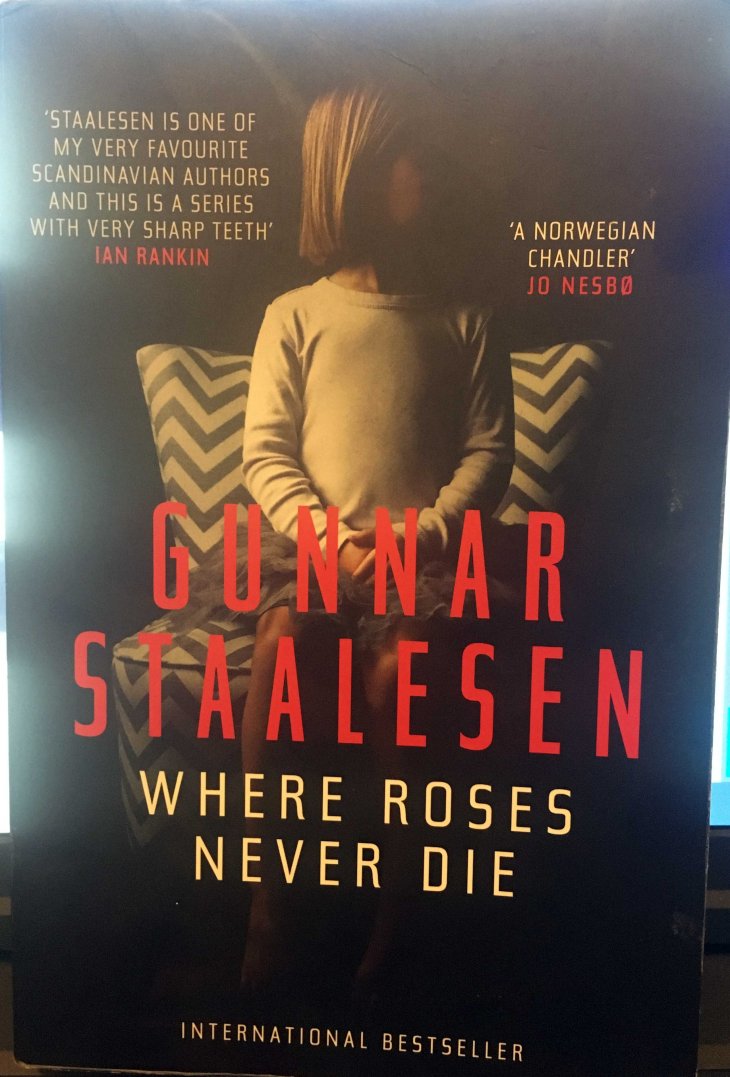
Gunnar Staalesen, Where Roses Never Die (Der hvor roser aldri dør (2012), translated by Don Bartlett (2015))
So, perhaps for the first time, there’s a spoiler here for those who haven’t read the books in sequence (and I’d already done so by reading the backcover…). Hidden after the picture…
Gunnar Staalesen, Cold Hearts (Kalde hjerter (2008), translated by Don Bartlett (2013))
 So here I could see the end coming.
We have two interweaved plots: the Bergen criminal underworld and the Bergen charitable middle class. Varg Veum, private eye, outcast, pariah, persona non grata, is able to code switch between the levels, perhaps more acceptable to the sex workers than the professional classes or the police. Continue reading →
Gunnar Staalesen, The Consorts of Death (Dødens Drabanter (2006), translated by Don Bartlett (2009))
High above the mountains, the moon had appeared, the earth’s pale consort, distant and alone in its eternal orbit around the chaos and turmoil below. It struck me that the moon wasn’t alone after all. There were many of us adrift and circling around the same chaos, the same turmoil, without being able to intervene or do anything about it. We were all consorts of death.
There are two things to notice about this entry in the Varg Veum series – first, it is the debut of Don Bartlett as translator; two, it is not set more or less contemporaneously with publication. Continue reading →
Gunnar Staalesen, The Writing on the Wall (Skriften på Veggen (1995), translated by Hal Sutcliffe (2004))
“the voracious violence of the wolf, who can also turn protective, paternal, and maternal”
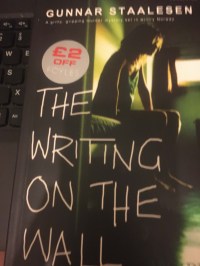 So, the best part of a decade has passed – Varg’s son is at university in Oslo and his wife’s new husband has died, although these seem like minuscule details, touched in passing. The friendly policeman is not mentioned, another seems to have died (I don’t recall the name) and a grumpy cop, Dankert Muus, is a week or so from retirement.
Here we have three cases that you know will intersect:
Continue reading →
Gunnar Staalesen, At Night All Wolves Are Grey (I Mørket er Alle Ulver Grå (1983), translated by David McDuff, 1985)
“One always forgets a wolf along the way”
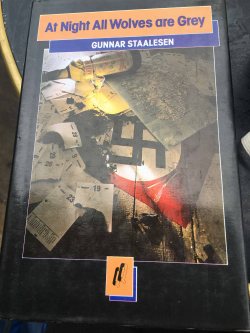 Sometimes there’s an itch, and obviously whilst I have books, I really ought to be reading about Bergen’s most famous private eye. Even if he has a wandering eye. And digging around t’Interwebs, I found all but one of the translated titles on a single non-BigSouthAmericanRiver. Mind you, I went back there for Consorts of Death.
And when the pile arrived, I discovered two things. Continue reading →
Agnes Ravatn, The Bird Tribunal (Fugletribunalet, 2013, translated by Rosie Hedger, 2016)
 It’s a little unfair, but this kind of (usually) female gothic is haunted – Daphne Du Maurier’s Rebecca springs to mind, as does (to a lesser extent) Charlotte Brontë’s Jane Eyre, as well as Hitchcock’s Rebecca and The Birds. Oh, and Bluebeard.
This wasn’t the first book I’d bought in a real shop since the lockdown, but it was my first expotition out of the postcodes and a visit to the Oxford Street Bookshop. It leapt out at me from the crime and thriller section, and it was only after I left the shop that it was a Book at Bedtime serial, which I’d only caught sections of. And for some reason had thought of Frankenstein.
Gunnar Staalesen, Yours Until Death (Din, Til Døden, 1979, translated by Margaret Amassian, 1993)
 Some crime novels don’t age well.
Too long ago for liking, I bought a boxset of all the Morse novels dirt cheap from a charity shop, and began reading them in order. I’d not seen more than one of the TV versions – ironically, when staying in Oxford with a friend who was busy working – and so all I knew was beer, crosswords, Jaguar, solving the crime having accused everyone else and dubious geography. I read about three, starting with the first, and paused when I decided I didn’t like the way Morse looked down the blouses of his interviewees.
Continue reading →
Jørn Lier Horst, The Cabin (2018, Det Innerste Rommet, translated by Anne Bruce, 2019)
 So, it has to be said, the original book is called something closer to The Innermost Room, rather than The Cabin, but the cabin seems to be the must-have accessory of your upper middle class Norwegian. The title, I would argue, has a certain amount of ambiguity as to [spoilers!] which room it is.
But maybe it’s Norwegianer.
Continue reading →
Jørn Lier Horst, The Katharina Code (2017, Katharina-koden, translated by Anne Bruce, 2018)
 So here we have a definite shift – the earlier Wisting novels came from small press Sandstone, but this book marks a move for Lier Horst to Penguin and the embracing of cliché du jour “figure walking away from us into snowy forest” book cover. The scene could be snowy, but the novel is set in October and not late enough that a fishing trip at a cabin isn’t practical. I note that Jørn Lier Horst’s name is smaller than the novel’s title, so he isn’t yet being sold on that.
 Subject to Change