I’m in the Mood for Painting

Transferences: Sidney Nolan in Britain (Pallant House, 18 February—4 June 2017)

Sometimes you hold contradictory thoughts in your head to your own detriment — I’d known that Sidney Nolan was one of the most significant Australian painters, but I hadn’t realised he was so good.

Let’s phrase that a bit differently — whilst I had seen Nolan paintings (I’m presuming) in Melbourne and at the RAA Australia exhibition, I hadn’t been hugely struck by his work. I seem to recall there’s a painting in the Tate walkthrough of British art, and I just remember the colour brown.

The Pallant House Gallery, in collaboration with the Sidney Nolan Trust, have put together an exhibition to mark his centenary, drawing on the property of the trust and paintings in the Tate collection (I suspect rarely shown), paintings from Leicester Art Gallery, Walker Gallery and so on. It is an impressive collection.

Like (most?) Australian painters, he is drawn to landscapes, and there are several incredible moonscapes of the centre of Australia — mountains and craters and deserts, often as glimpsed from an aeroplane. These were too big to do on site, and I wonder if there are notebooks of sketches not shown here? They are suitable huge, but you notice that he seems more likely to paint the vertical or in a square than in landscape format, presumably to fit in all the layers of horizon and height and depth, rather than a wide, empty sweep. Inland Australia, I guess, is one of those rare exceptions.

Occasionally, he also painted on glass, almost like a contour map, using Ripolin, a kind of enamel paint (making him a precursor to George Shaw). Alongside the Australian desert is the Antarctic one — as dead as Australia interiors seem but freezing rather than hot. There are also paintings such as Carcase in Swamp, a title that is seemingly half right, a product of a commission of a newspaper or magazine to record seemingly the worst drought in Northern Queensland, where corpses were strewn across landscapes or somehow caught up trees. No magazine would touch them, but it was clearly stored in his image bank (to reappear in theatre designs decades later).

Sidney Nolan had been sought out by Kenneth Clark of Civilisation when the latter visited Australia, and this led to Nolan moving to Britain in 1951, away from his increasingly complicated love life in Heide outside Melbourne, although I suspect it became no less complex as a result. It needs therefore to be borne in mind that many of Nolan’s landscapes were painted in retrospect from a very different location. Indeed, he had a studio without windows to avoid distraction.

We get to see glimpses of three of his series of paintings — Ned Kelly, Burke and Willis and Mrs Fraser and Bracewell. I guess the Ned Kelly series is the most well-known — the Irish-descended bushranger convicted for stealing horses who went on the run after the attempted murder of a policeman. He fled to the Bush as an outlaw, being involved in the death of further policemen and a number of hold-ups. The final showdown was at Glenrowan, where the gang wore the homemade metal suits and were shot dead — Kelly survived, to be put on trial and executed in 1880 aged 25. Apparently Nolan’s grandfather was one of the police officers at Glenrowan — and Nolan painted this shootout at least once.

Typically Kelly is reduced to the square, spade-like mask, with a slot for the eyes, sometimes just showing the eyes. The mask stands on a spindly neck on an abstracted body, sometimes on a horse, often wielding a weapon. In other paintings, the mask becomes painted in blocks of colour, a moment of Mondrian or Miro. His Australian symbol could also be twisted to other uses — Kelly Spring 1956 gives him a blue background, a tree with blossom and is presumably a nod to events in Hungary.

And then there’s large, vertical, landscape painting, Ned Kelly and Policeman, with the landscape rather over shadowing the three policemen at the bottom of the image and Kelly on a horse. The label seems to be suggesting that Kelly is facing them down, but to me it looks like he is riding away. Of course, the mask looks the same from either side. There is also the painting of the death mask of Kelly, another mask but this time of his “real” face, based on the post-execution cast. (Do I recall Francis Bacon had a death mask of William Blake? Did I make that up? There are apparently others links too.) Death of a Poet has the bright blue background and strange plants twirling around much of the picture space, especially on the left. Apparently this is also a nod to Arthur Rimbaud, French poet and gun runner, although I’m not entirely clear how.

The second myth he draws on is of Burke and Wills, leaders of a 1860–61 expedition to cross Australia from Melbourne to the Gulf of Carpentaria in the north, which failed on its return to Cooper’s Creek where Burke and Wills died. On the one hand, this was a heroic journey — humanity vs. the landscape — on the other hand this was stupidity, given their lack of knowledge of bushcraft. Burke seems to stand out though — there is The Explorer Burke on a Camel (1966), where a naked Burke almost seems to be merging with the camel, a huge empty landscape behind him.

And then there’s Camel and Figure (1966).

Again, the landscape is striking, overwhelming, the camel stretched out toward a ?naked? Burke, almost subservient to him. Apparently nudity is the sign of someone who has given up and is about to die in a desert. Of course, he’s naked in both the paintings.

Finally, Mrs Eliza Anne Fraser was shipwrecked off the coast of Queensland in 1836 and claimed to be captured by Aboriginal people. She was rescued by convicts John Graham and (in legend) David Bracewell. In the legend, Bracewell asked for a pardon for escorting her to safety, but was betrayed. Novelist Colin MacInnes suggests we read the legend as an allegory for the relationship between the British empire and convict Australia; they’ve also been read in relation to Nolan’s relationship to Sunday Reed, with whom he’d had an affair. There are three paintings here — Convict in a Billabong (1960), a picture dominated by the browns of the vertical reeds and the light green of the trees, with Bracewell picked out in horizontal white and brown lines that parallel the stripes of the billabong. Meanwhile, Woman and Billabong (1957), a mix of browns, yellows and ochre, Mrs Fraser viewed from behind, in the billabong, to the left a weird figure somewhere between a finger and a phallus, presumably Bracewell? This surprisingly idyllic scene contrasts with the equally brown In the Cave (1957), where there is an almost randomly brown field, presumably the cave, with Bracewell in rather darker brown stripes; Mrs Fraser is drawn as a sexualised figure in supposedly aboriginal style, with a blue, red and yellow stripe as waist. The authentically “primitive” Australian here being envisioned seems at odds with the British empire metaphor.

One painting that seems to be outside the usual series and themes of his work is Peter Grimes’s Apprentice (1977) — a drowned figure in purple inspired by Benjamin Britton’s opera. Nolan and Britten knew each other, presumably through Nolan’s work in opera design, and Britten had died the year before. The drowned boy, with ginger hair, is in purple, with what appears to be a fish hook design on his jumper, which only seems appropriate. He is surrounded by fish, which almost seem like musical notes and are about to chew on him. It is a rather strange Ophelia-theme, peaceful yet fearful, an accidental (and tragic) rather than deliberate death.

And then, finally, I’ll turn to a late self-portrait, Myself (1988), depicting an old man with round glasses, somewhere between John Lennon and infinity, and scrawled over the top a frame like Ned Kelly’s mask — cementing an ongoing identification between Nolan and the convict, whether Kelly or Bracewell (I’m less clear he wants to be Willis). But perhaps he is transported to Britain rather to to Australia, the downunder upended. Scrawled is not quite the word — it is a portrait in spray paints, a long from graffiti but haunted by semilegal street art and apparently typical of his late work. The colours are incredible. (Apparent IKON have an exhibition of the portraits coming up.)

And here’s something that appears to only being discovered slowly — alongside the spray paints, Nolan had used Ripolin, an enamel paint, polyvinyl acetate and other industrial paints. Does this reflect his background in commercial painting — he used what he knew? Might we assume — cultural cringe alert — this was what he had available and so used? Various American pop artists were to use synthetic paints — but Nolan seems to predate them. Not for the first time, we should pay more attention to artists on the fringe of the standard narratives. What becomes very visible are the horizontal or vertical lines of the painting, almost scratched onto the surface.

I also note that most — perhaps all? — of the Tate paintings were donations from Baron McAlpine of West Green, scion of the construction company, property developer in Western Australia, art collector and, er, Tory supporter. I have to confess that he had rather interesting taste in art.

Sussex Mods

Sussex Modernism: Retreat and Rebellion (Two Temple Place, 28 January-23 April 2017)

As an incomer to Kent, I’ve always had a guilty preference for Sussex. We lay claim to Turner (hence the Anthea Turner Gallery), Hamish Fulton walks down the road and H.G. Wells and Joseph Conrad were locals, but after Tommy Cooper, Mary Tourtel and Peter Firmin there’s a sense that you run out of culture. (Tracey, I forgot Tracey.)

Continue reading →

Revolutionary Red

Revolution: Russian Art 1917-1932 (Royal Academy of Arts, 11 February-17 April 2017)

There were revolutions in Russian art before the turbulent events of 1917. There were artists who painted shape and colour, constructivists, people like Lyubov Popova, who rejected figurative art, and there was Malevich, with his variations on the black square. Revolutionary thinking requires revolutionary representation — except that there’s a line of left wing thinkers who prefer the photographic and the realistic. There’s an argument that realist art — especially in the written form — evolved to document commodities (see the patron and his stuff); soviet socialist realism ended up in a similar place. And the avant garde adapted or died. Or both.

The Royal Academy has brought together a large number of Russian paintings from 1917 to the mid-1930s, tracing some of the routes that artists took over almost two decades, from the October Revolution to the early days of Stalin’s purges. It’s too rich a brew to do full justice to, and I only wish I had my O Level notes on the revolution to hand. There were lots of photos — of workers, of artists, of politicians — and some of them seemed to echo the work of Stieglitz and Strand from about the same time. I’m guessing there’s crossover between the two.

The first room dealt with the image of Vladimir Lenin, the great leader the Germans let through to try and shift the balance on their Eastern Front. The Bolsheviks overthrew the provisional government of the February Revolution, nationalised various companies and redistributed land. A massive personality cult clearly developed around cult — suppressing opposition. Isaak Brodsky’s Vladimir Lenin and a Demonstration has the leader in a dark coat, arm stretched out to his right on a sheet of paper, with a crowd behind him, presumably revolting. Behind him is a red sheet, not quite a curtain, too furled to be a flag, red for communism or perhaps red for blood. The same artist’s Lenin in Smolny (1930) is even more realist, depicting Lenin writing in a chair which is covered with a sheet, placed on bare wooden floor boards. The Central Committee of the Soviets was initially located in the Smolny Institute for Young Noble Ladies in Petrograd and this is where a life-size Lenin (dead by 1930, of course) is hard at work he could almost be Thomas Hardy. Kliment Redko’s Insurrection (1925) is an extraordinary image — a rectangular canvas of much darkness, with Lenin in the centre in front of a burning fire, surrounded by soldiers in a diamond shape, with fighting coming from the corners. The painting was hidden until 1980 — Lenin’s icon status forbidden. Georgy Rublev’s Portrait of Joseph Stalin (1930) has the dictator sat in a white, possibly wicker chair, for all the world a Habitat seat, and in a white suit. He is reading a newspaper, I assume Pravda. The background is an orange red, and almost invisible on this is a dog. I’m really not sure how to read this — unsurprisingly the painting was not exhibited whilst Stalin lived.

There was more experimental stuff alongside this realism. Natan Altman’s Russian Labour (1921) is abstract, sculpture as much as painting consisting of paper, enamel and charcoal on mahogany. Several of Popova’s Space-Force Construction (1921) show her stripes and curves of colour. Pavel Filonov’s Formula occurs in several versions, almost superimposed surreal images within images colours, almost like Richard Gadd in their obsessive detail. More experimentation can be found in Ivan Klyun’s Objective Painting According to the Principle of Light-Colour 1921. Then there’s Konstantin Yuon’s extraordinary New Planet (1921): red and yellow planets and moons on a landscape, a group of figures reaching up to a red planet. It is revolution as science fiction.

Of course, Malevich with his black square is one off the most challenging figures — this is a later copy I believe, but we’ve not long seen versions at Tate Modern and The Whitechapel Art Gallery. Malevich is represented from the Fifteen Years of Artists of the Russian Soviet Republic exhibition, held 1932-33 in what was then Leningrad – a Black Square, Red Square, coloured figures like crash test dummies, small white models, archons, architectural maquettes… remarkably all but one of the paintings survived. In 1932 this was apparently marginalised, but here it is clearly a highlight.

But the avant garde is countered by revolutionary realism and counter revolutionary realism. There are the paintings of peasants and supervisors and the electrification of the Soviet Union — the great shift from feudal society to an attempt at modenrnity, unsurprisingly doomed to failure. And one that led to thousands starving (which was hardly new). Konstantin Rozhdestvensky’s Family in a Field (1932) with spectrum strips of colour blue to red for the fields and horizon and sky, with an impressionist worker with sickle in the foreground. Suprematism meets realism. In a section of Eternal Russia, the art shows nostalgia for the old days and a wish to preserve the old ways, the old religion. We have birch trees by a lake — and I suspect the tree often presents the idea of national identity (see John Dahl and Caspar David Friedrich). Then there’s Marc Chagall’s celebration of his wife, Promenade (1917-18), a flying purple woman levitating above a green self portrait. There’s an almost Cubist green landscape and a pink church.

If you didn’t have a flying wife, then maybe you could avail yourself of one of Vladimir Tatlin’s worker’s flying bicycles — part glider, part dragonfly, likely as successful as Icarus’ feathers and wax, and tempting to see it as a metaphor for the Russian revolution’s utopian project. The Academy suspends a replica in its octagonal room, where I last saw Rothkos, and I was transfixed by the shadows and its slow rotation.

And then a room devoted to Kuzma Petrov-Vodkin, whose Beside Lenin’s Coffin was in the first room. He’s lying in a red orange casket, green plants either side, mourners in the background. It is at his trademark raised angle, looking down forty five degrees. Petrov-Vodkin was inspired by Renaissance art he saw in Italy, notably Giotto and Fra Angelico. His Petrograd Madonna (1918 in Petrograd) balances a blue background and pink foreground, with the peasant in a green dress and a head scarf, clearly and definitely not being Mary. The icon tradition lives on.

His landscape Midday. Summer (1917) shows a fecundity the five year plans were grasping for with apples, a farmer, cattle, and in the middle of the landscape, the funeral of the artist’s father. This breaks chronology, of course.

We end with Stalin’s utopia — images of sports, marches, displays, collages and footage of the destruction of a cathedral, alongside a model of a planned replacement. And a photo of Joseph Stalin. Meanwhile, a booth has names and pictures of the shot, the executed, the exiled and the imprisoned. It is sobering.

This is no straight forward celebration of Soviet art and propaganda. You need a tin ear to hear that. Throughout the exhibition we read of the fate of many figures in the arts — disappeared, starved, sidelined. Life under the tzars had not been great — their overthrow hardly improved much. And as for perestroika…. well, we are where we are.

Americon Gothicon

I suspect I first saw American Gothic after seeing the cover of the British paperback of Philip K. Dick’s The Man Whose Teeth Were All Exactly Alike and then watching (or rewatching) The Rocky Horror Picture Show, which has a copy on the wall in one scene and I think has two characters dress up as the people in the painting. It was only then that I discovered who Grant Wood was (although I forget how) and the myriad parodies his masterpiece has inspired.
I don’t suppose I ever thought that it was on display somewhere, or that I would see it, but I once heard that it would be the centrepiece of an American painting in the 1930s exhibition at the Royal Academy of Arts I knew it would by my chance to see it in the flesh. Although, it was with some trepidation – would it stand up to the hype?

So we have two people, a young going on middle-aged woman on the left, an older man on the right, a white board house behind them and a red building over his left shoulder. It’s not clear whether they are wife and husband or daughter and father, but he is in front, holding a three-pronged pitchfork. Their clothing echoes each other and the setting: her dress or apron seems to the blinds in the church-like window behind them, her collar and neck broach answers the button on his collar less shirt and his glasses. The curve of her neckline echoes the curve of his dungarees and the pitchfork. Meanwhile, the vertical tines parallel the lines on his shirt, the dungaree seams and the boards and pillars of the house and red building. The vertical leads to a lightning conductor, not quite above the tine and, what is presumably a spire in the distance.

He looks deadly serious, has a high prominent forehead and John Lennon specs, and grasps the tool of his work firmly, even as he may be wearing his Sunday best jacket, possibly his only jacket. If we take the picture to be contemporary with its painting, 1930, there is perhaps an old fashionedness about it, although I assume we still heft hay about. He’s not quite looking at us, he’s perhaps looking at the artist, or over his shoulder.

She isn’t looking at us or the artist – her head is turned, her eyes elsewhere as perhaps she wants to be? Her blonde hair is tied back, severe, and yet a lock has escaped, dangling down.

And behind her, the stoop, with cactus — mother-in-law’s tongue, a three-pronged echo of the pitchfork and a begonia. Cacti are prickly, not exactly welcoming, but are hardy and survive in the heat. There’s a window behind that, with green blinds, looking a bit battered.

The house frames the two heads – her eyes just above the guttering of the roof, his lips in line, the roof meeting the wall of the upper storey in line with his ear lobes.

Of course, what you never see in reproductions of the painting, is the frame. It’s a rather thick, grey wood, unvarnished, pitted with holes like it has wood worm. (I don’t know what that looks like, to be honest, but it’s how I’d imagine that.) It’s practical and not at all showy – the broach, the jacket, the plants, they’re showy.

There’s an echo of Northern Renaissance paintings – something like the Arnofini portrair but reversed and the couple here are closer together. There’s a cold, undead, touch to the skin. The enigma of their exact looks makes me think of this as the American Mona Lisa.

And so anyhow, it turns out that she is Wood’s sister, Nan Wood Graham, and he is their dentist, Dr. Byron McKeeby, and they are envisaged as daughter and father. The apron was mail order, I think from Sears. The house is the Dibble House, in Eldon, Iowa, apparently built in the Carpenter Gothic style in 1881-82.

And yes, the painting is remarkable in real life too – worth the price of the ticket alone.

Flaming Nora

Flaming June: The Making of a Masterpiece (Leighton House, 4 November 2016-2 April 2017)

Limping through the undertubes a couple of months back, I was struck by a poster of a painting of what I took at first to be a marigold, but turned out to be a young woman in a dress. FINAL WEEKS it proclaimed, but I’m not convinced that it gave a closing date. I think I’d gathered it was at Leighton House, a venue in Kensington that was on my radar to visit.

And then I forgot.

A friend went to see it, it was his favourite painting. I paid attention. I plotted. I planned to visit it on a Tuesday, my research day.

Leighton House. Closed Tuesdays.

Good job I checked.

So I postponed an idea of Eastbourne, and decided to combine this with a trip to the RAA and Russian and American art, and navigated via a Caffe Nerd and attempting to remember what the Design Museum on High Street Ken looked like when it was the Commonwealth Institute. It wasn’t yet June, but was about the first sunny day in a while even if I sat outside in the shadows at Nerd. And eventually getting there, and one of those slightly weird negotiations of what are the rules for this exhibition?

In my limited mental picture, he was part of the Pre-Raphs, of which I’m not exactly a fan despite their supposed radicalism (which now looks like a box of fudge waiting to happen). I vaguely remember his paintings coming back to the Tate after an absence (to where?), but I couldn’t picture any. No good, eh? He clearly got lorded, and I vaguely assumed he was an ascendant of someone who taught me.

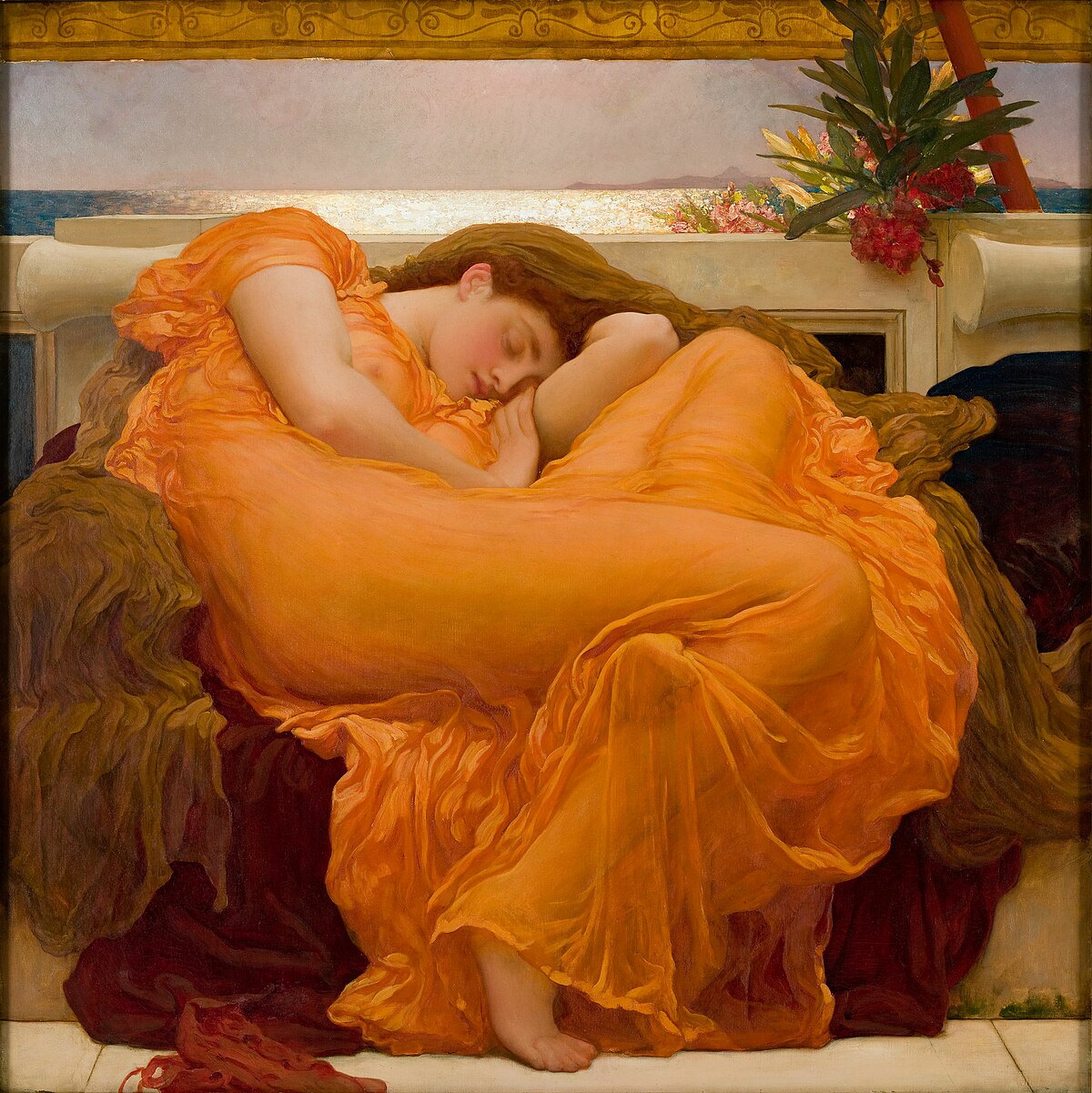
Anyway, the woman in orange, although popular fiction would call her The Girl in the Flaming Dress, one of five paintings Leighton prepared for the Royal Academy summer exhibition, as he was in the final months of his life. I think one of them has gone missing, as has the one he substituted for one he didn’t like at the last minute.

And apparently it was amazing we have this.

It didn’t sell at the show and was bought by The Graphic to be turned into a print to give away in Christmas 1895. After being shown in their office window, it was loaned to the Ashmolean and dropped out of sight — I’m not the only one to be unimpressed by Victorian confectionary. It turned up in Battersea, boxed in over a chimney, and was nearly bought by a young Andrew Lloyd Webber (make your own snide comments). A Puerto Rican industrialist, Luis A. Ferré, partly in town to buy art for his gallery, saw it in The Maas Gallery, London in 1963 and paid £2,000 for it. Since then, it has been at the Museo de Arte de Ponce, aside from rare loans to other galleries

So we have a woman in an orange dress, curled up almost in a circle, an oleander plant to her top right, a shining sea behind her, and draping cloth around her. It is undeniably attractive, with a striking horizontal line of her leg parallel to the golden frame, the ledge and sea, with a zig zag of her lower legs and arms, an almost circular composition. If you look carefully — and of course you do, since you’ll most likely not be heading off to Puerto Rico in the foreseeable future — there is a hint of nipple, of the skin tone under the diaphanous orange draperies.

Is that a word?

Of course, my gaydar had been triggered earlier by a small male nude on the staircase and a frankly camp Arab Hall of dark green tiles brought in from some grand tour or other. He never married, but there are rumours of affairs with a female model and a close relationship with a male friend. We just don’t know, it seems. Anything else is gossip.

Shrugs.

Next to it is a much smaller painting, a practice perhaps for Flaming, with tiny island in the sea, lost from the final version, and a slightly different top to the picture.

To its left, are the remaining paintings from 1895. ‘Twixt Hope and Fear is an elegantly dressed woman, sat on a chair so she looks over her shoulder at us. The vertical to diagonal arm dominates the composition — as does the double take I had about whether there was an iPhone in her right hand and she was taking a selfie.

Methinks not.

The Maid with the Golden Hair — see, that’s a proper title, but girl would be moderner — has a young girl reading a book, caught in a private moment. They reckon it’s Lena Dene, younger sister of his main model, Dorothy (he’s a friend of… nevermind), but I’d rather know what she is reading.

Verticals are accented in Lachrymae — a woman stood, supporting her head and arm on a fluted pillar bearing an urn, presumably a funerarararary one. The sun glints through the cypress tree behind her — a tree which is a symbol of (guess what?) mourning. At her foot is a wreath.

The final picture is Candida, a head and shoulders portrait, replaced by a (lost) painting Listener (although there’s a colour reproduction of it). So, five (or six) lone women, three of them possibly the same model and a Miss Lloyd.

Then you realise you’ve done this in the wrong order.

Hidden in his bedroom, with a spartan-looking single bed and letters that tempting to touch, and a fur rug that isn’t, is the print from The Graphic, a little worse for wear.

Back in the Silk Room are various preparatory drawings — black and white chalk on paper as he attempted to get the posture of the woman right and, Lo and behold!, a photogavure of his Summer Moon (c. 1872), two women asleep, one of them not unpostured like Flaming Nora, their arms curved in parallel, a circular opening behind them. Another photogravure, The Garden of the Hesperides (1893?), three women asleep under a tree (and now in the Lever collection, so I guess I’ve seen it in Port Sunlight. And then there’s Summer Slumber (1894), also seen in photogravure and notable for the flaming June relief in the wall this slumberer is slumbering on. This strikes me that Flaming June must be a little earlier than suggested. I’m not clear where the actual painting is.

And there are also preparatory pictures for some of the other paintings; in the studio are other paintings of oleanders and a photo of some carvings, although it requires a bit of detective work to work out what you should be looking at. It also took me a while to realise I need to go anti clockwise round the Silk Room and how the painting of an Algiers Courtyard fitted in.

But then I was back to Flaming, to soak her in again.

I can’t say I am converted to Leighton, and I suspect the works normally here are not his best, but it was intriguing to see this rarity.

Great Scotch!

Edward Krasiński (Tate Liverpool, 21 October 2016–5 March 2017)

I confess I walked through Edward Krasiński rather quickly on my first visit — I’d been delayed by a shop having moved and thus a late check-in at my hotel, followed by further delay as I tried to access my work email. And I wanted, at least, a look over the stunning Blake-Emin combo to see if it was what I feared.

Spoilers!

I was there to see Yves Klein, even if somewhere in my head it was Yves Tanguy. And I had just over an hour instead of the best part of ninety minutes. The next day, albeit again running late, I spent the best part of an hour in there.

But something had brought me up short — what looked like a broken ladder and then dangling black squares and a blue line.

Blue is beautiful.

Blue is best.

Did Tate Liverpool really schedule by the colour blue?

Krasiński’s early works are apparently Dadaist and surreal, but I assume that these are not on display. He seems to have been a late starter, with the works here dating from about 1960 when he was about forty. There are various small assemblages, too complex to be tagged Readymades (I feel the hand of Duchamp and Beuys on his shoulder), which are hanging on the walls. The materials include wood, metal, plastic, felt, acrylic and I get the sense that in part he is playing with the triangle set up between object, space and beholder. My understanding is that these would have been shown in darkness, a kind of labyrinth of art, but here the dark browns offset the whiteness of the walls and the bright light of this space. Later he would take photographs of some of his works on location, undercutting privileged vantage points (although a photo does fix one).

There’s also a large photo, Untitled (1996) of man in suit holding a hose coming off a roll — the end of the column column protrudes, next to a small piece of rope, and a bit of blue tape that I didn’t notice on my first go round. A relic of an earlier exhibition or deliberated short?

The second area has various solids hanging from wires (although I did wonder if these didn’t need to be less visible. Composition in Space 4 (1965) has a vertical suspension of black discs, each with a red to white colour red disc of decreasing size in each centre. There were also a numbers of broken spears, with the same dark brown, red, white colour gradation, suspended more or less horizontally, one looking like a broken rope ladder. And then there were a series of balls, not quite a Newton’s Cradle — and I wonder if Cedric Christie came across these works. There’s a capturing of time and space, a freezing of movement.

The third space — although I was quite clear of the trajectory, and I suspect Krasiński would lead us — had various small assemblages on white plinths, interventions, consisting of cords, cylinders, slopes and bits of wood. There’s a black cylinder, apparently filled with blue stuff, dribbling over the edge. J-4 (1968) is a tube going through a cylinder, cable in tube on curved white ribbon, from which the numbers 234567890 emerge. Where is number one?

But the breakthrough seems to have come with the Tokyo Biennale, when his sculptures were delayed in transit. He was going to send them a telex — the word BLUE five thousand times and this would be on display, on a coil of paper. To mark time, he arranged for a strip of blue Scotch Tape to be placed around the room: “After that there was nothing more I could do; it was so radical there was no turning back”

BLUE SCOTCH – WIDTH 20MM
LENGTH UNKNOWN
I STICK IT HORIZONTALLY
AT A HEIGHT OF 130 CM EVERYWHERE
AND ONTO EVERYTHING
WITH IT I ENCOMPASS EVERYTHING AND REACH
EVERYWHERE.
IT MAY OR MAY NOT BE ART,
BUT IT DEFINITELY IS
BLUE SCOTCH – WIDTH 20MM
LENGTH UNKNOWN.

We get sculptures of white and blue — a white rectangle, blue at the bottom, a blue cable dangling; two white books, one labelled A (and the other B?), a blue cable emerging, a blue surface between the books; a gutted white phone, dark blue wire tangled; the A/B opposite pages of an open white book with a blue tube emerging…

“I have lost the end” he says, in a photo of him trying to untangle some string or rope or cable.

The next room is of interventions — black and white axonometric drawings, unmasking the reality of the flat and the three dimensional, a kind of demented IKEA catalogue, with his now trademark blue stripe following the walls, weaving past a toilet chain and water pipe, giving illusions of depth.

the blue stripe is the intervention by the artist who is an on-looker/witness of the events taking place. It is an observer of changing phenomena that contain time. All that exists is time. Even inanimate objects are not extemporal: they are mutable”

… this leads us into the next space, which includes a false corridor, and a photographic and artistic replication of his apartment and gallery.

The artist Henryk Stażewski had invited him to live in his apartment and eventually left it to Krasiński. Art would be made there — or in his bedroom — and then shown in the apartment as gallery, with photographs of the space sometimes being shown in other galleries. The blue line continues across further axonometric drawings, and some white three dimensional objects, line with black. Photos of Krasiński’s acquaintances and other artists hang on cubes, striped blue, apparently making visual puns (although I didn’t get the joke). There is a token example of Henryk Stażewski’s work, black lines on a white background, like needles

And then there are sculptures of large, bent paperclips.

We’ve all been there.

The final intervention is a series of square mirrors, with black reverses, hung from the ceiling disrupting the space. They are utterly hypnotising.

img_0755

Krasiński’s art has a deceptively simple idea underlying it, but it was so seductive. On the one hand, a kind of minimalism, on the other complexity. It might be site specific — in that the meaning of the site it is found in is changed by the work. But the work could be everywhere.

There is a photo of Krasiński conducting the sea, a moment worthy of Klein, a musical Cnut. But he has such a strange power — a strip of blue Scotch Tape, 20mm,* at a height of 130cm, length unknown or unnecessary can turn anywhere into art.

* or 19mm. Imagine if Scotch Tape were to go bust. The end of art.

Blue is Beautiful, Blue is Best

Yves Klein (Tate Liverpool, 21 October 2016-5 March 2017)

In the photos of Yves Klein I sort began to do a double-take for Buster Keaton. He has a sort of deadpan look, aided by the wearing of a smart suit or a waistcoat and shirt, which is at odds with the performance of his art — he’s somewhere between a clown and a ringmaster.

Continue reading →

“Cheese” Seems to Be the Hardest Word

The Radical Eye: Modernist Photography From The Sir Elton John Collection (Tate Modern, 10 November 2016–21 May 2017)

So Elton John got sober in 1990 and sold much of what he owned – but an art dealer friend showed him some black and white photographs and he became hooked enough to buy a dozen on the spot. Since then he has amassed something like 8,000 of them, which grace the walls of his Atlanta apartment in Academy style frame-by-frame, check-by-check. About 150 of them are on display, in John’s frames, in the new exhibition space at t’Tate t’Modern.

It is an extraordinary collection of modernist images, from the big names and the less well known, from the 1920s to the 1950s. Inevitably, it needs stamina – and the sudden bursts of colour on two walls is a relief from black and white, no matter how beautiful black and white is. As these are photographs as art, colour is mostly banished from the practice until the 1970s anyway. But when the photos can be as small as a cigarette card and no larger than A4, a certain amount of (sorry) focus is required.

Broadly speaking, the images split into three categories: the portrait; the document; and the estrangement. To my eye, the last is the most interesting, the first the least, but the categories overlap.

A lot of the portraits are of artists, authors or musicians, as artist photographs document their own circle. There are muses, teachers and pupils – so we have Man Ray, Edward Weston, Tina Modotti, Alfred Stieglitz as subject or object. Alfred Stieglitz’s portrait of Georgia O’Keefe is unusual as her face takes up the left side of the print, with wood, perhaps fencing, forming the right half; usually he chops her up into body parts. We have a row of artists and composers, André Breton and Ivor Stravinsky among others, where we are invited to perceive the artistic impulse at work in the face staring back at us.

Projection, much?

Along one wall, almost appropriately, are Irving Penn’s images of celebrities jammed into the corner of a wall apparently structured for the purpose. Noel Coward looks especially tall and wiry, although the caption, “Noel Coward was a playwright, director, composer and noted wit”, whilst not wrong, seems a little… off. Spencer Tracy did indeed win two Oscars, but that seems a little clipped too. Meanwhile, Carl Van Vechten depicts Leo Coleman as Toby in The Medium 18 May 1946, but doesn’t explain Leo Coleman was a black dancer in the Katherine Dunham troupe who appeared in an opera, The Medium, premiered at Columbia University ten days earlier. Dora Maar appears, but it’s assumed that you know she’s one of Picasso’s muses as well as a photographer and painter.

There is a room devoted to documentary, with some of the greats – Ansel Adams, Ilse Bing, Walker Evans, Dorothea Lange, Helen Levitt and so on, the great projects of the WPA in the 1930s and images of cities. Of course, there are all kinds of ironies and paradoxes – not least the millionaire rock musician and philanthropist owning and empathising with an image of poverty such as Lange’s Migrant Mother (1936). We have the art of poverty rather than the poverty of art, but we are projecting the story on the image. Part of the documentation is possible due to new smaller format cameras or faster films; some of the pictures are snatched street photographs, taken without their object’s knowledge, others would have been carefully set up. The distinction is not clear here; you’ll need to go elsewhere (the catalogue?) for technical details. I appreciated a picture by Robert Frank of Paris, I suspect the only living photographer from the exhibition.

Finally, the estranging, the avant garde, the experimental. Lazló Moholy-Nagy’s View From the Berlin Radio Tower (1928) is a good starting point, as objects blur into abstraction when viewed from on high – as does the Boy On Bicycle From Brooklyn Bridge by Ralph Steiner. There are several radio towers and aerials here, some as vantage points, others a view from below, as choice of bird or worm’s eye view collides with modernity. In distinction from distance, there is the close-up of objects (eggs, cups, plants) or tight cropping, to make us question what we are seeing. The photo as still life become abstract. Paul Strand – a protégé of sorts of Stieglitz and underrepresented here – combines both with the play of shadows of the commuter against the columns of Wall Street. And then there are the distortions in the photographing or developing stages, the double exposures, the scratches and damaged. I knew Herbert Bayer’s Humanly Impossible (Self Portrait) (1932) with the missing underarm chunk, but I hadn’t connected him to Lonely Metropolitan (1932), the eyes on hands in front of montaged buildings, which I half recognised. There is Man Ray’s Glass Tears, the titular drops like beads across a tightly cropped face, I think a mannequin’s? (It’s telling I can’t tell – take that, uncanny valley. Apparently he made it just after he split up from Lee Miller; I don’t think there were any of her photos on display here but it’s a depressing though that she would be so replaced.) And of course, there’s the Rayographs, one of several versions of the technique of camera-less pictures where objects are placed on light sensitive paper.

There is much here to enjoy and appreciate, if you can have the patience to slow down and admire. John evidently has taste, or has been well-curated (odd labelling aside). Ideally, I think, you’d go in and see half a dozen pictures and then go and stare at a bright coloured painting to recalibrate. But the thought of whatever selection there is of eight thousand pictures on his walls – where inevitably they must become invisible, feels me with a sense of unease.

On a Certain Tendency in British Art 1920-1950

In using the myth, in manipulating a continuous parallel between contemporaneity and antiquity, Mr. Joyce is pursuing a method which others must pursue after him. They will not be imitators, any more than the scientist who uses the discoveries of an Einstein in pursuing his own, independent, further investigations. It is simply a way of controlling, of ordering, of giving a shape and a significance to the immense panorama of futility and anarchy which is contemporary history. […] Instead of narrative method, we may now use the mythical method. It is, I seriously believe, a step toward making the modern world possible for art”

The Mythic Method: Classicism in British Art 1920-1950 (Pallant House, 28 October 2016-19 February 2017)

Occasionally I feel as if I should have done some homework before seeing an exhibition.

I will have read, I’m sure, “”ULYSSES, ORDER, AND MYTH” by T.S. Eliot back in the day, 1988 or 1989, and so would have once been aware of the tension between Classicism and Romanticism, and Modernism’s fight against the Victorians. Ulysses appears to the unwary reader a chaotic work, but if anything it is over structured, with bodily organs and literary styles and of course the narrative of the Odyssey. We have a dialectic tension between bringing an archetypal tale up to date and raising a wandering Jew and a wandering poet to the level of classical heroes.

The Pallant, a gallery of which I thoroughly approve down to hours of train timetable research to get there, has a thesis here of British art adopting what Eliot calls the mythical method in the aftermath of the First World War. The attempt is to present the contemporary, the up to date, through a classical lens. Perhaps it is a clutching at order in the ruins of the British Empire. We had had all the isms — Futurism, Vorticism, Cubism — and then a move from the abstract back into the representational. Compare, say, the early work of David Bomberg (who is missing from here) to his post war work.

It is a good story.

Take John Armstrong’s GPO Pheidippides, one of a series of posters advertising the GPO using historical narratives, here the runner who brought news of a battle to Sparta. The athlete is central, between images of male soldiers and waiting women. The image is meant to be of a Greek urn, but there is no attempt at perspective here. Telecommunications with the kudos of myth.


Or Meredith Frampton’s curious Still Life (1932), a hyperreal, photorealistic and yet surreal account of a broken urn on a plinth, alongside masonry and a sculpted head, sawn and shattered trees, flowers, barley and a tape measure. It is a Ozymandian, fallen world, highly suggestive of … hmmm.

And we have more evidently classical subjects — the Vanessa Bell and Duncan Wood Toilet of Venus (a pudgy Venus among the orange and yellow and pink), William Roberts’s The Judgement of Paris (1933) (where the trousered Paris guards his golden apple from a dog) and Roberts’s Parson’s Pleasure (a classical image of donnish nudity on the banks of the Cherwell, with dog paw like trees — and a nod to Le Déjeuner sur l’herbe).

The second room has one of my favourite painters — Edward Burra, with Arcadia, a satire perhaps of the Bright Young Things of the Waugh generation, some in fancy dress, some in berets, over the top male nude statues,cross dressers, and even the staircases in the ornamental garden setting seem voluptuous (Pallant is all too coy, alas). And a little dog steals the show. The other stand out pieces here are again John Armstrongs, as if they wanted a show on him but couldn’t get enough, Psyche Crossing the Styx (1927); Psyche is here a figure from Munch, the rowers fleshy skeletons and the setting seems like it in an interior bodily space. In the Wings (1930) mixes a bust and body parts in a Angus Calder like set of mobiles and wire frames.

The third room offers portraits, by both Proctors, by Frampton again, and more strikingly Gerald Leslie Brockhurst. Here we have Wallis, Duchess of Windsor, described as a contemporary Mona Lisa but with a less enigmatic grin. The flawless depiction, three quarter length, was evidently a piece of propaganda, hard to see now without the unease of eighty years of further royal history and what we think we know about Windsor sympathies. The painting must just predate the Second World War as it is 1939. Meanwhile there is an air about the other portraits of Magritte — indeed many of the paintings on show seem to be edging towards the suburban surreal.

The penultimate room is dominated by photos and a second Burra. The photographs are almost all by Madame Yevonde, working name of Yevonde Cumbers Middleton, with subjects somewhere between art and fashion, in stunning colours. She takes a series of wives of famous men — and each of them is labelled Mrs Famous Man — and dresses them as a classical goddess or figure. Mrs Bryan Guinness, for example, is better known as Diana Mitford, who was to marry Oswald Mosley at Goebbels’s house with Hitler in attendance. At around the same time, Leni Riefenstahl was using classical imagery to dangerous effect; it should be noted that the bleached ruins of Armstrong’s Pro Patria (1938) are anti-fascist in tone.

The Burra is Santa Maria in Aracolei balances several storeys of a building and windows — one with green curtains and a face — with a strange, Daliesque statue with a oddly human hand and a shirt of … feathers? Between the two halves is a staircase, which seems to have a real world equivalent although apparent Burra hadn’t visited the site. Like Burra’s other paintings it is a water colour, in this case on four sheets of paper. It nicely echoes Edith Rimmington’s double portrait of Athena, Sisters of Anarchy in which one of two statues of Athena is turning into an owl. I’d just come across the name at Sussex Modernism, where Rimmington is presented as a photographer.

I don’t seem to have made many notes in the final room — I think there was something by David Jones, a name to which I will return — but the stand out piece was Frank Runacres’s Untitled (Ruins) (1939) where works of art, sculpture, wheels, frames and other rubble seem precariously piled over a woman, her head on hand. The bombing of Spain had already happened, but this seems to be looking ahead to the blitz. And in a corner, two small pieces by Henry Moore, one a reclining figure in bronze, but with atypical drapery.

And so we have an interesting narrative, although that one Jones and a single Eric Gill piece point to a counter narrative that could also be told: artists of the period also drew on Biblical narratives, although I would admit the mythic points more to the work of Ravilious, Wadsworth, Nash and other English Romantic Surrealists. Don’t forget Christopher Wood, however, nor Stanley Spencer, probably superior to any of the works on display here.

And if you go back to the PreRaphaelites you can see an equivocation between the mythic and Biblical, but with much more denial of the contemporary in complex ways.

And so, the method is, methinks, a tendency, among other tendencies, but no less interesting for that.

Halfterm Hockney Hideously Heaving

Hockney puts the queue in queer.

David Hockney (Tate Britain, 9 February-29 May 2017)

Several years ago, I travelled back to Nottingham for the opening of Nottingham Contemporary for an exhibition of Hockney’s early work; when I arrived on the Friday the queue was around the block. I never saw the RAA iPod exhibition as all the tickets sold out. I did see the prints at Dulwich Picture Gallery — and that was heaving. The portraits at the RAA were crowded, but I think I booked in advance.

So it was hardly surprising see that there were substantial queues for the Tate Britain exhibition — it had only just opened and it was half term. But if you want to go, book first. Use the cloak room. It’ll get hot in the exhibition.

It is sobering and instructive to realise that aside from a few pictures in the first and second rooms, you could have an entirely different retrospective of Hockney’s sixty years of work: there are the Rake’s Progress pictures; illustrations to Grimm; his prints; the bigger picture of the Yorkshire trees; the chair portraits recently shown at the RAA…

This is not to say that Hockney is a repetitive artist, indeed he is the opposite, constantly reinventing himself, but perhaps as a consequence he seems a difficult artist to pin down.

Which Hockney is on display?

I confess I found the crowd overwhelming — you see the art watchers not the work — and I went around rather quickly. I was a little surprised as to the size of the exhibition — the special exhibition space on the ground floor is normally four large rooms, much smaller than the spaces at Modern. But here we have a dozen rooms, I presume expanded into the final part of the walk through of British art. I will have to go back — maybe in members’ hours.

The first room is a little odd in its mix of periods, and you do wonder whether chronology is to be abandoned. Certainly interpretation is not there for you — each room is named, but the labels for each work are limited to names and dates. When we reach portraits, there is no biography, when we see the famous painting with the misnamed cat, Mr and Mrs Clark and Percy, you’re not going to find the real name, although some details are in the gallery guide.

The second room sees him on the edge of pop art — with canvas often visible around the paint, as if the paintings are unfinished, There are almost cartoonish figures, graffiti, obscenities, gay themes. We Two Boys Together Clinging is an obvious example, a nod to Whitman; was this the painting in Nottingham which was connected to Hockney’s obsession with the headline “TWO BOYS CLING TO CLIFF ALL NIGHT”, next to the royal insignia painting CR (for Cliff Richard)? We get the first signs of the obsession with America, which will turn into studies of swimming pools and sunbathers and boys lying on beds. Sometimes he is leaning in the direction of the abstract, sometimes a mix of the photographic (but curiously flat) and sometimes there’s a nod or two to Seurat and pointillism.

And then to photography itself, with pictures assembled from Polaroids and then 35mm, multiple viewpoints of the same topic, with a nod to Picasso perhaps.

This feeds back into paintings made on several canvases, landscapes that don’t quite connect, whether Yorkshire or way out west. Eventually this would lead to the Yorkshire trees that filled one wall at an RAA summer exhibition — but shown here only in preparatory paintings. Years later he would drive a landrover along a country road in each of the four seasons, constructing the landscape from several screens. On the one hand there are black and white charcoal drawings, on the other highly coloured landscapes that owe something to Vincent Van Gogh. It is as if he overdoses on colour and then revivifies himself with monochrome shapes and vice versa.

And in conclusion the iPad pictures, animated constructions, but from first sight not as interesting in completion as in execution. Somewhere we break from painting as time fixed on a plane from a single point of view to a reality constructed from multiple perspectives that foregrounds the time factor. Somewhere this ties back to his use of photocopiers and faxes and multiple layered prints (sometimes involving layer Perspex), none of which is on show here. His painting of space or the elimination of space.

And so, somehow, for all his apparent radicalism, Hockney like Alan Bennett has become a national treasure, packing us in. Somehow I need to penetrate his apparent shallowness — the depth of depthlessness. But it will take at least one more visit.