Larry Kramer, The Normal Heart (1985) (Olivier Theatre, National Theatre, directed by Dominic Cooke)
[I wrote a different version of my thoughts here]
In 2017, the National Theatre revived the two-part, seven and a half hour long Angels in America by Tony Kushner, I think in the Olivier, an account of the early years of AIDS and combination treatments. The following year, the Young Vic mounted a premiere of Matthew Lopez, The Inheritance, a two-part, seven-hour play about a group of gay men across a number of years. Both are sprawling plays and – it has to be confessed – go on a bit. Russell T. Davies’s It’s a Sin (2021) told an equivalent British story, between 1981 and 1991, over five c. 45-minute episodes.
The onlie begetters of these plays are William M. Hoffman’s As If (1985) – which has been filmed – and Larry Kramer’s The Normal Heart (1985). Kramer, a screenwriter and novelist, started Gay Men’s Health Crisis to warn gay New Yorkers that there was some kind of disease, probably spread by sex, that was killing increasing numbers of people and to offer support to those who were dying. Stopping having sex was not a message gay men wanted to hear and almost no one in authority wanted to help. Kramer changed the names of the people involved and dramatized his campaign.
I saw a production at Nottingham Playhouse in 1987 and I know it had a huge impact on me at the time. We’d had the don’t die of ignorance campaign, so by then AIDS had gained its name and HIV was being used as the name of the retrovirus; it would have been the era of Section 28 (or Clause 27, 28, 29…), forbidding the promotion of homosexuality. There might even have been some debate about whether it was suitable play for school children to see. I can’t remember who played the protagonist, Ned Kramer, but he’d been in other plays at the playhouse, and I largely remember the set of his apartment – and I suspect a New York skyline. I remember a lot of talk. Do I remember Keith Jarrett’s Koln concert being played between scenes?
I also remember a revival of Saturday Night Sunday Morning and overhearing an audience comment during the traumatic illegal abortion scene: “We had a bath like that.” Emotional engagement was trumped by nostalgia.
And it would have been easy for the National to go a well-made play route, fetishizing the fashion and furnishing of a rich, secular Jewish gay man, and show the chintz alluded to in the dialogue. The Olivier is a notoriously largely space to fill – which Angels used spectacle to occupy, along with sets rotating rising and lowering.
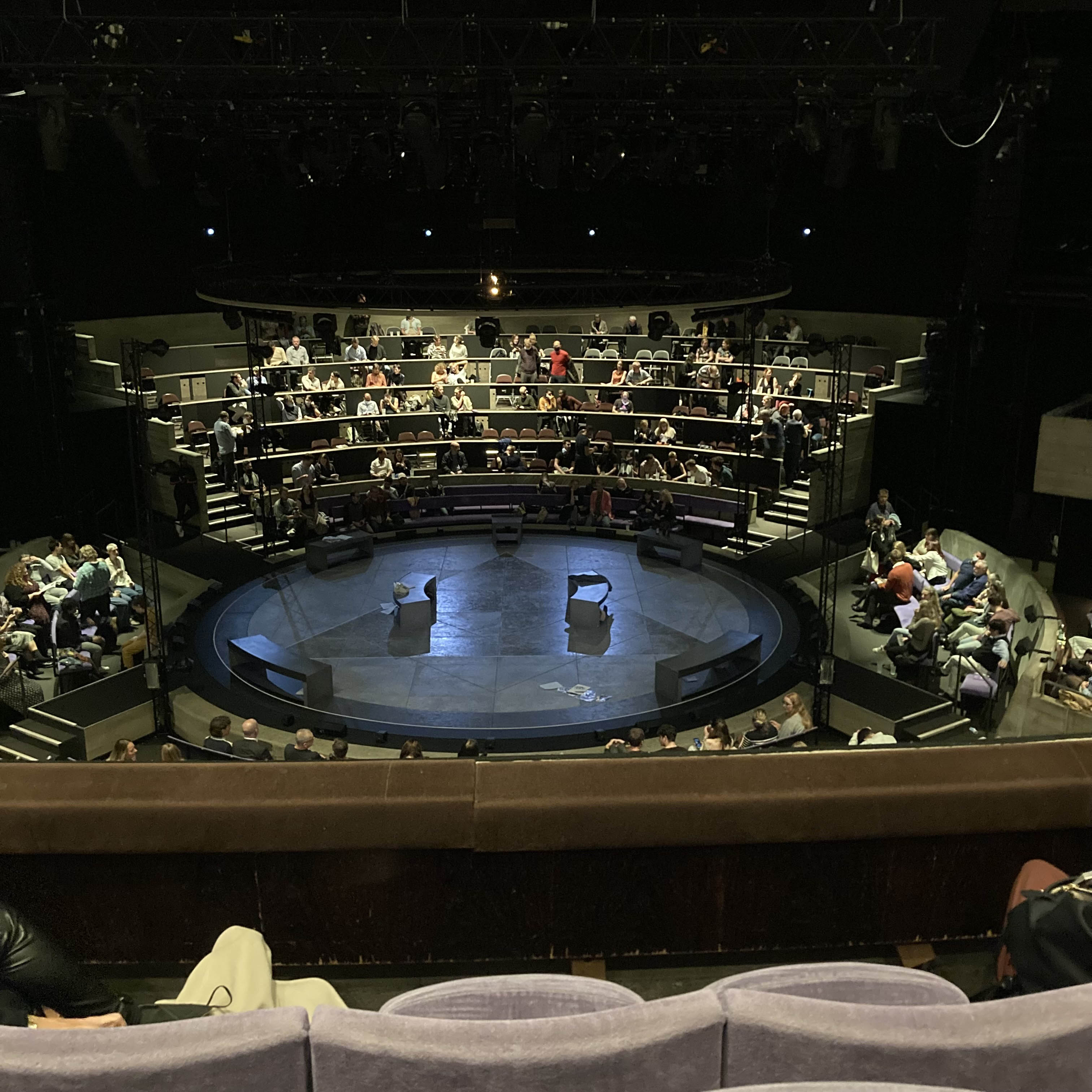 Fortunately, they avoided this: staging it a bit in the round (I wish I’d gone for a stage seat), a mainly circular space with a number of curved benches and a handful of telephones. I clocked the triangle shape on the circle before the start, and by the end of the play it had formed a pink triangle. As the play opens, a fire is lit, and this burns above the action for the rest of the play. Characters walk or are wheeled on through the audiences, sometimes announcing the date and location. Very Brechtian. Dropped props slowly fill the space, but never leaving it overcrowded.
So, this leaves the voice. It is a very speechy, preachy play. At its heart is Weeks’s (Ben Daniels)/Kramer’s message to stop having sex, the only reasonable response in the days before safer sex and combination therapies reduced the risks and prolonged lives. But this is little more than a decade after Stonewall and this felt like a demand to stop being gay. The lack of legal support meant it was safer for many people to stay in the closet – in many places even hotel rooms would be illegal to rent – and sex could be found in bathhouses, backrooms and public toilets. Kramer does allow characters to question Weeks’s views and he is eventually removed from GMHC (in real life I think Kramer resigned), but within the context of the play he is right. It is a third of the length of Angels, is less artistically ambitious, but you to be prepared to go along with the speechifying.
The only woman in play, Dr Emma Brookner (Liz Carr), a wheelchair user, is driver Weeks to action and fighting for medical funds. She had treated more AIDS patients than anyone else in the world. Whilst she has some fine acidic dialogue, she again is prone to the monologue. Perhaps the events were too raw, the message to urgent, to turn this into something more naturalistic.
And yet, there is real emotion in the play. We are made to feel horror and grief at young men dying before their time – although for the first half of the play this is more told than shown. Inevitably, HIV comes home, and it is devastating. But there are plenty of laughs, some at the expense of gay men, some at homophobia, some at specific characters. This earns the play its inevitable darkness.
When I first saw the play, there was no cure, no vaccine, little treatment. At some point around then, Ian McKellan came out on a Radio 3 arts programme (I can’t remember why I was listening – I think because I liked theatre, I think I had read his book on acting). This revival was planned as a mark of respect on Kramer’s death in 2020.
COVID scuppered that.
We have diagnosis techniques and mitigating medication. There is still no vaccine. Worldwide reaction to COVID has been patchy, but mostly swifter and more wide ranging than it was to HIV. Money has been thrown at the issue and it seems successfully. As in the early days of HIV there have been the conspiracy theories and the fake news, but the probable vector was identified much more quickly. In the meantime, HIV has spread through Africa and has infected women as well as men. It is great that this play has been revived – the reaction to It’s a Sin indicates that some generations have forgotten and other have never learned. But there are other stories to tell – not least the non-white and less middle-class experience of the epidemic.
 Subject to Change