Showing his True Colours

J.M.W. Turner: Adventures in Colour (Turner Contemporary, 8 October 2016-8 January 2017)

Joseph Mallord William Turner has to be the hardest working artist in British history. Pretty well every provincial art gallery I’ve been to has one of his works, usually of a local view. This island is obviously well gifted with landscapes, the genre which he made his own. Even the Carbuncle in Lisbon has a couple on display. In his early career, I presume he used coaches, but steam boats and then trains presumably helped his meandering — especially after the end of the Napoleonic Wars. He got to Italy, France, Belgium, the Netherlands, Poland, Czech, Slovenia, Austria and so on.

And yet I confess to a little resistance to him — I suspect there’s a little too much TurnerTM, Heritage painting, and I even went through a phase of liking the earlier, more classical styles. And I have a memory of visiting the Clore Gallery at the Tate — as you have to if you want your Blake fix — where a chunk of Turner’s unsold paintings he left to the nation are on display. Someone came in, took photos of every single panting, and left after four minutes. Very odd.

He was, of course, controversial in his day, his tastes and methods questioned, so I need to reevaluate him and his work. The Turner Contemporary has offered a couple of chances to do so — it always aims to have one of his works on show, it did a big Turner and the Elements show and now has J.M.W. Turner: Adventures in Colour as another opportunity.

The Tate posted an image of Turner’s The Fighting Temeraire on Facebook, and I noted it was a shame that this image of a sailing ship being towed by a steamboat out of a sunset to be broken up would be better if the coast were on the correct side. Someone responded that this was to do with composition and did I know the story of how Turner, on varnishing day at the Royal Academy of Arts, struck a red blob of paint on his canvas, next to Constable’s, and then worked it into a buoy.

Well, yes, actually, I do, if there’s one story that everyone knows about Turner, it’s the one where Turner, on varnishing day at the Royal Academy of Arts, struck a red blob of paint on his canvas, next to Constable’s, and then worked it into a buoy.

The coast is still in the wrong side. And anyway, sailing out of a sunset is hardly elegiac.

But clearly, the man had a way with colour, and the joy of the book on Turner and the Elements was its discussion of the technology of colours and Turner’s acquaintance with scientists of the day. The two cultures were not so divided back then. I think he was the first artists in Britain to use cobalt paints and I wish there’d been a bit more on this back then. I suspect, in what is a show that is frankly too big, the narrative got a little lost.

The first paintings you pick up as you enter are views of Norham Castle and Lincoln Cathedral. These follow the rules of landscape painting which I learned from Astrup’s breaking of them: you accentuate earthy brown in the foreground and exaggerate the blue in the background. This adds to the sense of perspective and scale — ideally you stick a human figure or an animal in the frame to give an identificatory viewpoint or a yardstick for size. Dolbadarn Castle (1800), silhouetted by the evening son, features bandits, adding a narrative (apparently about a Welsh family). Failing that, a spot of white or a splash of red will draw the viewers’ attention. His Fishermen upon a Lee-Shore (1792) has a limited pallete of browns and greens, made mobile by flecks of white and a red jacket.

In his training at the Royal Academy he was exposed to Claude Lorrain, Salvator Rosa, Nicolas Poussin, Titian and Canaletto, painters who tended to classical or Biblical narratives with landscape background. In the period of striving for realism I think you can see this — in his volcanos, fireworks and burning Houses of Parliament you can see Rosa. At much the same time, Joseph Wright was doing more interesting things with the light and John Martin finding a more monumental scale, but that’s more my taste.

Troubled by the sludginess of the browns and greens, Turner from 1805 started preparing his canvases with white paint or pigments, which gives a greater luminosity to everything that goes on top — I wonder if this was to be a Postimpressionist technique, as L. S. Lowry was to use it on advice of an French artist. Of course, sometimes the whiteness began to overwhelm the painting — the more famous canvases of clouds and seascapes, the mistiness of Frosty Morning (1813), the almost monochrome Venice with the Salute (1844) looking like spilt milk. On the other hand, he uses a European blue-coloured paper to stand in for sky or water in some drawings and a rich vermilion in Vermilion Towers (1838).

We learn along the way that he uses a mix of linseed oil and resin, megilp, as a means of enriching his standard paints and he started engaging with debates about the nature of colour. As Professor of Perspective — great job title — at the Royal Academy, he lectured on colour, colour wheels and chromatography, and whilst we have his handwritten notes on show, his writing is not legible. A transcript would have been useful — I should of course Google to see if they have been published. More annoying is the mention of refutation of Isaac Newton’s work on colour by Johann Wolfgang von Goethe, in which Turner sided with Newton, who described the splitting of light into the spectrum via the prism and discussed colour as reflected light. Goethe, on the other hand…

Well, I’m not sure what his theory is. I m not even clear, from further reading, that it is a theory. In part, in seems to depend on the prism being a special case and the refraction being more complicated than Newton allows, as well as the colour of shadows. Scratches head. Goethe’s Theories of Colour was translated by Charles Lake Eastlake in 1840, apparently a friend of Turner. Again the two cultures was unformed.

This comes to a head in Turner’s Late square canvases, with the colour taking on the curves of the circle — although I seem to recall the same circles in the work of John Martin. Two examples, I think Shade and Darkness — the evening of the Deluge (1843) and Light and Colour (Goethe’s Theory), The Morning after the Deluge — Moses writing the Book of Genesis (1843) — seem to be explorations of Goethe’s thoughts on colour and emotion, but I’m not clear how this follows through.

These paintings might be pointing back nearly forty years to his picture The Deluge (1805), in itself a response to Poussin’s painting Winter (The Deluge) (1660-64), which features a boat within a cove or a cave pool by the sea. Turner seems to have seen this in 1802 and commented “The colour of this picture impresses the subject more than the incidents which are by no means fortunate either as to place, position or colour, as they are separate spots untouched by the dark colour that pervades the whole.” Turner is setting out to correct the deficiencies he goes into note, and adds a black sailor, although this might be a much later addition. The gallery notes Turner’s investment in 1805 in a cattle farm in Jamaica, connecting him to the slave trade. However, Turner was to become abolitionist in later years.

But the story of Turner and colour is distracted by the various views of Margate that Turner produced over the years — and it is undeniably interesting to see the obscure fishing village that became a watering hole transformed over the decades, and to note how much the town has declined since. Whilst the revamped (and distinctly post-Turner) Dreamland seems to limp along from financial crisis to financial crisis, the Turner Contemporary seems to flourish. The temptation to offer local views is understandable and is one thing that will draw people in.

Just as Mitchell and Kenyon clearly filmed locals to whom they then screened the films in the 1900s and for decades the walky photographers took photos of tourists to sell to tourists, so Turner clearly had an eye on what would sell to locals — or might interest those on tour. The corner devoted to engravings and mezzotints shows how Turner could further monetise his work — with some extraordinary work — even as his perfectionism cut against this success. As a painter of working class origin, he would see no shame in pleasing as many markets as he could, even as his experiments clearly pushed at the boundaries.

More than a Load of Pollocks

Abstract Expressionism (Royal Academy of Arts, September 2016—2 January 2017)

There’s a story that in the late 1940s, the CIA funded Abstract Expressionism. It was an exercise of soft power, from the people who funnelled money into the animated Animal Farm and exploding cigars. The Soviets were busy with their Socialist Realism, whilst the Americans were channelling the chap with the lily pads with bigger brushes. The AES paint big, really big, and it takes a lot to transport all those canvases around the world. In one version the Tate wasn’t able to afford a huge exhibition and an benefactor gave the money. The story is the money came from the CIA.

If Abstract Expressionism didn’t bring down the Berlin Wall, then at least it came up with pretty cool murals.

It’s the sort of thing that can leave you cold, but if you surrender to it it’s pretty amazing.

Just like capitalism.

The cavernous spaces of the Royal Academy seem appropriate, although they’ve never quite got the walk through right. These are huge, abstract paintings, determinedly non-representation, yet in theory expressing an inner emotion. Of course, we don’t always know what that emotion is, but you can always supply your own.

The first room was a kind of overture, showing paintings from many of the big names prior to the glory days. Some of these are portraits, few of them are great, but you can see the roots in Barnett Newman’s green stripes on dark red. There’s a curious Mark Rothko, Gethsemane (1944), presumably alluding to the night of Christ’s betrayal, and sort of cruciform, but it might be an eagle with an American football. And a weird cloud flag.

Clyfford’s Still’s PH-726 (1936) has wobbly male and female bodies inscribed within a block — a two dimensional version of what Moore and Epstein were carving at about the same time. A new name to me, I confess, but one I will return to later.

And so the various stars come out — and the rooms which focused on one or two artists were stronger than those which offered dubious thematic arrangements. That being said, I don’t get on with Arshile Gorky, having bounced off his Tate Modern show a few years ago. A numbers of them look like oddly painted figures in a room — say Diary of a Seducer (1947) — and I see I’ve made the note to myself, “bad photoshop”.

Jackson Pollock, on the other hand, is truly sublime. I never quite wrote up all my notes from Liverpool, but the late, black pour, works feel like the figurative abstracted. Like Rorschach tests, you can find the sail boat if you squint right. He gives in to the chaos of the drip, somewhere between randomness, automatic painting and the unconscious at work. There’s a huge mural, designed for Peggy Guggenheim’s New York apartment, with “a prancing, bestial presence” which maybe you wouldn’t want to live with. You don’t get a lot of help from the titles — even Summertime (1948) isn’t that helpful, with its wide, short overlapping of colours and drizzles. The trajectories of flies on a summer’s evening? There’s his Blue Poles (1952), with its striking, vertical totems, daring you to distinguish figure from ground. There are other colours, of course, (black grey white) but it’s striking how often he returns to red, blue and yellow, as if he’s unravelled a Piet Mondrian.

[and there, tucked on one wall, is Lee Krasner, not quite the token woman — though it does have to be said that AE is a very blokey genre with its SIZE DOES MATTER statements in oil — who takes four years to come to terms with Pollock’s stupid death in a car crash, who only then can “wrestle” with his ghost to produce The Eye is the First Circle (1960), which inevitably has to be read as homage and imitation rather than the work of an artist in her own right. Later, we’ll come across Helen Frankenthaler, whose exhibition I missed at the Turner, with Europa (1957) although I saw no bull.]

Mark Rothko is glorious, as always, and the room of his work at Tate Modern can reduce me to tears. As always the paintings seem to ride the walls, rather than be hung on the them, the layers, the laminates of colour lumess and dammit that is a word. You are surrounded by them in an octagonalroom, dwarfed, and I was annoyed to see people taking selfies against them — not because of any objection to such narcissism, but because my instinct is to disappear into these canvas rather than superimpose myself upon them. There are exquisite vertigo.

I don’t think I’ve come across Clyfford Still’s work before, but I’ve put his museum in Denver on my long term to do list (when the US is more sensible about the TSA…). These are vast canvases, representing vast landscapes, abstracted into colours. My favourite was PH247 (1951), also known as Big Blue, a luminous canvas of many blues, interrupted by dark brown and orangish vertical strokes. This, too, is a room to get lost in.

Less successful is Willem de Kooning’s work, here dominated by his paintings of women, of which he wrote “I wanted them to be funny … so I made them satiric and monstrous, like sibyls”. Gee, thanks. These are women as landscapes, rather than in, to my eyes deeply misogynistic. His other landscapes, notably Dark Pond (1948), which I misread as and viewed as Duck Pond, are better, but I don’t feel inclined to follow him up.

The shared rooms were on the whole less successful, with less of a chance to get to know the range of the artists’ work. A few women sneak in here — Joan Mitchell, Helen Frankenthaler, Janet Sobel — and I suspect the only Black artist, Norman Lewis. I wanted to know much more about his work. A room of drawings, books, prints and photographs got a little unruly, as the labels and pictures were not always as clear as they might be in the crowds. The final room gives space to Joan Mitchell’s four huge canvases of Salut Tom, echoing Postimpressionism as much as Abstract Expressionism, and represents late work of some of the big names — although of course Pollock was long since dead.

One final room to draw attention to is the one of Barnett Newman and Ad Rheinhardt, who interrupt swathes of colour with zipped colours or focal zones. Rheinhardt retreated into the Malevich black square for fourteen years — 60″ x 60″ canvases painted all back. The spartan austerity is striking. But Newman was the revelation, and I wonder if he was the inspiration for the Abstract Expressionist Rabo Karabekian’s The Temptation of Saint Anthony in Kurt Vonnegut’s Breakfast of Champions (1973). Eve (1950) is a mostly red canvas with a dark red stripe on the right hand side and its twin Adam (1951-52) is brown with three red stripes of different widths. I have know idea if they connect, but he somehow feeds into Bridget Riley‘s stripes. Newman writes “only those who understand the meta can understand the metaphysical and his paintings are as much their paint as anything else — the rich blues and reds.

Of course, these artists went through a whole range of political experiences from Pearl Harbor to Watergate, and I guess they mark the point when the art world shifts from Paris to New York, with Rauschenberg and Warhol waiting in the wings (and O’Keeffe‘s rather different abstracts predate, postdate and overlap with their heyday). They are, of course, always on the edge of being the emperor’s new clothes, just paint on canvas, randomness. But in the vast spaces of the Royal Academy most of the work transcends that caveat.

Bish Bash Bosch

And so somewhere along the line I heard that a once in a lifetime exhibition of the work of Hieronymus Bosch was being shown in his home town of Den Bosch. Somewhat nervously, I decided that I wanted to go, although I nearly left it too late to book a slot. I booked a hotel in Amsterdam, a city I’d wanted to visit for years, and could have got to from Hull, had I spare time and spare cash and the same time.

So I went, and did the Rijksmuseum and the Van Gogh and took the train down to Den Bosch for what was a crowded but fantastic exhibition. I paid for it the next day, as my knee decided to pack up.

Ouchie.

Continue reading →

If You Go Back to the Woods Today

My Back to the Woods (National Gallery, 11 May-30 October 2016)

George Shaw is that rare beast, a painter who has been nominated for the Turner Prize. I was enough lucky to see the exhibition at the BALTIC, Gateshead, and to my mind it was the best work.

It couldn’t possibly win.

I don’t mean that in a modern art is crap way. I like contemporary art. I just haven’t found myself agreeing with the winners that often. Continue reading →

Beyond the Lady Gardens

Georgia O’Keeffe (Tate Modern 6 July-30 October 2016)

“you hung all your own associations with my flowers on my flowers and you write about my flowers as I think and see what you think and see of the flowers and I don’t”

“Miss O’Keeffe’s drawings … were of intense interest from a psycho-analytical point of view” Camera Work MDCCCCXII

Joanna Russ’s How to Suppress Women’s Writing is a blistering anatomy of the ways in which critics dismiss female authors. I suspect the same is true in the way we treat female artists. So many of them are just plain ignored, not part of the history, whereas others get related to more famous (artist) husbands. The recent Barbara Hepworth exhibition at Tate Britain is a case in point — the juxtaposition of her work with Ben Nicholson’s (much as I like him), risks privileging the influence in one way.

The muse is female. Continue reading →

Kit Out

Christopher Wood, Sophisticated Primitive (Pallant House, 2 July–2 October 2016)

There is a shadow over the art of Christopher Wood:

Aged twenty-nine, having just had tea with his mother, he threw himself under a train at Salisbury and was killed.

Continue reading →

Painting Exposed

Painting with Light (11 May-24 September 2016, Tate Britain)

I am bringing two pieces of baggage to this show.

Firstly a sense that a few London galleries seem to be finding excuses to show the ever popular Preraphs — compare the National Gallery Painters’ Paintings and the V&A’s Botticelli. And also the talk by Karen Shepherdson on Tony Ray-Jones and Martin Parr puts a debate about photography as art and commerce onto my mind. And having just seen William Eggleston at The National Portrait Gallery, my mind was on art.
Continue reading →

Norwegian Marigold

Painting Norway: Nikolai Astrup (Dulwich Picture Gallery, 5 February-15 May 2016)

It’s perhaps odd to think of landscape as political. It shouldn’t seem odd – humanity has shaped the planet with earthworks and agriculture and transportation across the centuries, and the ideological boundaries of course define it. Landscape painting goes further in its selection and depiction of topic, to write a nationality in oil or watercolours.

We’re pretty pisspoor when it comes to Norwegian artists – we only really know Edvard Munch and we mostly know him through misreading The Scream. Add to that Johan Dahl and Peder Balke (to whom I will come back in future blog entries), and I fear the list is exhausted. Munch isn’t really known for his landscapes as such, more his figures in them, but his backgrounds are clearly psychological in nature.

There’s a Dahl painting of a tree in one of the Bergen galleries, which represents Norway. This is presumably an echo, conscious or otherwise, of one of Caspar David Friedrich’s paintings of a tree, which represents Germany. Sylvan metonymy is the way forward – and no doubt a head scratching or two would recall an English oak to mind.

 Der Einsame Baum

Astrup (1880-1928) is an artist whose dates straddle the establishment of an independent Norway, and who is considered to be part of a generation of painters who were creating the country in paint – Norway had become ceded to Sweden from Denmark in 1814 and began fighting for independence, but it was not until 1905 that this finally came about. (I think there’s a set of artists, composers and writers in the 1840s and 1850s who were also working on this project, including Dahl.) Until the Dulwich Picture Gallery show Astrup had not been shown in the UK – and he was unknown to Andrew Graham-Dixon’s somewhat, uh, erratic, documentary on Norwegian art. The majority of canvases on show were landscapes – although sometimes there are groups of people, usually his family, whether siblings or wife and children, but also peasants planting or harvesting.

The most relevant image here is seen best in A Morning in March (c. 1920), a twisted trunk with two branches reaching upwards and splitting, with narrower twigs radiating out. On closer inspection, the tree becomes personifiable, animorphic, as a stretching figure – yawning? Screaming? – with those branches as hands. In woodcuts, some earlier, the figure looks more masculine, in others seems to be breasted.

Astrup was the son of a Lutheran minister and thus grew up both in a religious household and a damp one – the parsonage was not the healthiest of places. He seems to have spent many weeks in bed, presumably staring out of the windows, thus seeing the view in a variety of lights. Rather like Munch, although I suspect for different reasons, Astrup keeps returning to the same images – the same lake, the same mountain – but with different coloration. In painting different colours, he is painting different moods, which attach to spring, summer, autumn and winter.

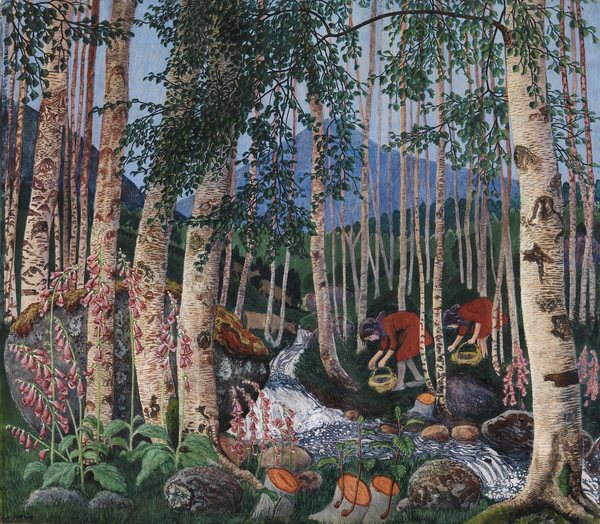
Alongside oils and water colours are wood block prints, carefully carved up from a number of different pieces of wood, ready to be applied with different colours of paint. (Remember, if you think this a primitive technique, that this was Escher’s preferred media.) Each time a block is applied, he has to wait for the paper to dry again – and the paper was liable to shrink and the block expand. A complex image like Foxgloves – which exists in numerous versions – might require twenty dryings before it was complete and a single bodge could ruin the image. Sometimes he would expand a print by adding oil paint ting, sometimes he would add it to an oil painting.

Whilst this was creating a national Norwegian visual language, he was inspired by the Japanese woodcuts he saw in Paris in 1902 and in London in 1908 – most clearly in the design known as Bird on a Stone, with a dipper on a stone on the edge of a fjord, a skinny tree in the foreground and mountains in the distance. The Japanese used water-based pigments, but like him pressed the paper against the block rather than vice versa.

This layout was to lead to a set of images of tree, fjord and mountainside, made concrete in the woodcut cover design for Stein Bugge’s Vår oh Vilje (1916), Spring and Desire, where a closer inspection of the mountains in the background reveal a naked woman lying on her back – a recumbent ice queen. This segues into Spring Night and Willow and A Morning in March, in which the ice queen forms an opposition to the (male) tree troll.

The same double take is necessary in his painting and prints of Grain Poles, where the wheat echoes the image of the troll – the catalogue helpfully points us to Theodor Kittelsen’s Troll Wondering How Old He Is (1911) and Grain Poles in Moonlight (1900), as well as pointing to a house as skull (Ålhus Church) and flames as dragons (Preparations for the Midsummer Eve Bonfire (1908)).

Such haunted landscapes would have been at odds with his father’s Lutheranism – indeed the paganism or Norse mythology underlying the Midsummer Eve Bonfires that he was to repeatedly paint reflect a tension with a disapproving parent. He had to stand at a distance – away from its ungodliness and eroticism. But it has its roots in a mythology than underpins Norwegian identity. At the same time, a painting such as Autumn Dusk in the Garden (1902) has a warm light coming from the parsonage and he seems to have been upset by its fall into disrepair and demolition.

The confluence of identity and landscape comes most clearly in his landscapes with marsh marigolds. These would include A Clear Night in June and A June Night and Marsh Marigolds. The vanishing of the flowers represents the passing of an earlier world and a nostalgia for it, as well as concrete evidence of agricultural development.

A number of Astrup’s paintings show the planting of crops or their harvesting, and in his later years he established a smallholding that was garden, house, studio and source of food. He experimented with traditional native plants and cross breeding. He worked on trees to turn them into trolls.

At the heart of his work, then, seems to be the need to record a passing way of life in an industrialised age that then faced the horrors of the First World War. His paintings fix a past that generate a sense of a Norwegianness that had only just achieved constitutional identity and may yet disappear in a globalised world. The authentic Norwegian appears to be art, customs and costumes associated with the rural farmers and peasants, presumably on the grounds that they remained untouched by Swedish and Danish influence, with Norway isolated from the rest of Europe, in part because of a distrust of centralisation. More than this, I am not yet qualified to pin down – I evidentally need to do some reading.

*
[I note “Traditionally Norway has had neither a strong landed gentry nor a solid urban bourgeoisie, and the vast majority of Norwegians were farmers or fishermen right up to the beginning of the 20th century.” (Thomas Hylland Eriksen) but “Furthermore, he [Øyvind Østerud] shows how important aspects of our national identity were defined by the urban bourgeoisie in the last century: ‘It was the urbane ruling class that defined the culture of the mountain peasantry – in an idealized form – as quintessentially Norwegian.'”]

Bibliography

  • Frances Carey, Ian Dejardin and MaryAnne Stevens Painting Norway: Nikolai Astrup 1880-1928 (London: Scala Arts, 2016)

While Someone Else is Sleeping

Bruegel in Black and White: Three Grisailles Reunited (Courtauld Gallery, 4 February–8 May 2016)

I knew Pieter Bruegel the Elder from that W.H. Auden poem, about Icarus and life going on, and I went away and looked at reproductions of his extraordinary canvases back in the day to see what W.H. was on about. Most years I turn to Bruegel’s Battle of Carnival and Lent to illustrate Bakhtin’s ideas of carnival – or at least, the historical sweep.

The Courtauld Gallery has given us a unique chance – one of the works cannot leave the gallery – to look at his three authenticated grisailles for the first time.

No, I had no idea what they were either.

A grisaille is a painting more or less in black and white, although shades of grey seem possible. Sometimes, I gather, in brown. These can be used to extraordinary effect – the depiction of night and darkness, perhaps, or a three dimensional impact on a plane. One of the locations of such works is on the closed flaps of altarpieces in Dutch churches – and so a religious subject is often presupposed and Hieronymus Bosch had already produced some of these. What Bruegel seems to have done is to lay down an area of white on wood – compare L.S. Lowry’s use of white paint to prime his canvases – a drawing added in charcoal or red chalk, a thin black wash added to most of the canvas and then Bruegel painted on top of that, presumably mostly in greys. The grisailles seem to have been painted in a hurry, with alterations whilst the paint dried.

Until the mid-twentieth century, two examples were known: The Death of the Virgin and Three Soldiers, with a third, A Woman Taken in Adultery coming up for auction in 1952 and eventually being bequeathed to the Samuel Courtauld Trust collection. Two of these clearly have religious themes, and the existence both of prints of these and of a Resurrection suggests that there is at least one more yet to be found.

catThe Death of the Virgin is dated c. 1562-5 and is a nocturnal, almost chiaroscuro, depiction of the dying moments of the Virgin Mary surrounded by worshippers, partly lit by a candle in her hands, but also luminescent. Everyone is in (then) contemporary dress, of course – it is an extra-Biblical interpolation. Life goes on, too, of course, a cluttered table and chair are at the end of the bed, someone is asleep in the corner and, best of all, a cat is in the prime position by the fire. These details show up better in the 1574 print version by Philips Galle, where the light levels are considerably higher and some of the awkward perspectives of a chair are rectified. On the other hand, that chair perhaps nods to Van Gogh to come. One the other hand, that underplays the religious significance of the light of Mary set against the candles and the fire.

A Woman Taken in Adultery is taken from the He-that-is-without-sin bit of John (8.1-11) – although why Christ is writing this rather than saying it out loud eludes me. Christ is leaning over on the left hand side of the picture, scratching in the dust in Dutch, his head just overlapping the woman, and the Pharisees are on the right of the picture, stones to the ready on the paving. Note Christ is either on a lower step or (I can’t quite tell from the perspective) there is a gap between his paving and the Pharisees’. There is a crowd in the background – some passing by, others gawping. The fact that Christ is writing with his right hand suggests this was an original work rather than a preparation for prints.

Pieter’s son Jan sent the grisaille to patron Cardinal Federico Borromeo in Milan, but the latter felt this was too generous, had a copy made in about 1825, and sent it back. Pieter Perret made a print in 1579 – again this is much light, with a foreground text – and Jan had painted a copy roughly 1597, which brings us slightly closer to the foreground foursome and isolated the crowd more distinctly. None of these have the vitally of Bruegel’s original. Pieter’s son, Pieter Bruegel the Younger, also copied the painting, apparently several times, with a colour one on display here. The realism and the individuation of the figures is at the expense of the spiritual dimension – it feels less religious.

The Three Soldiers (1568) seem not to be a religious subject – there is a drummer and a fifer and in the background a soldier with a flag. The best guess is that these are Landsknechte, mercenaries, which could have fought for Spain or the Holy Roman Empire. My dim and distant history A Level reminds me of the ongoing wars in Europe – the Netherlands, Spain, Italy, the Holy Roman Empire – and the forces of Catholicism, various flavours of Protestantism and the counter-reformation. It is perhaps a plea for religious tolerance? At one point, the grisaille was owned by the future Charles I, although it briefly left the royal collections during the Commonwealth, it seems to have passed from William III to a private secretary, William van Huls.

Two more grisailles round out the exhibition — The Visit to the Far (c. 1600), attributed to Jan Brueghel the Elder, and Frans Pourbus the Elder’s The Last Supper (c. 1570). The former had been thought to be by Pieter, but is reckoned to be inferior – a series of figures in a farmhouse, with a nurse and baby in the foreground. It may be a copy of a lost Bruegel painting, it may be a pastiche. Again the absence of a religious subject must be noted – but of course non-religious examples may have been lost.