:/

Doctor Who: “Smile”

Nu Who has built a few episodes around people being prevented from doing or being forced to do certain things — I’m thinking especially of “Blink”, but if I had a better memory of the last ten years I could think of more examples. Here it is again then: smile, though your heart is aching
Smile even though it’s breaking
When there are clouds in the sky, you’ll get by
If you smile through your fear and sorrow
Smile and maybe tomorrow
You’ll see the sun come shining through for you.

Smile, it’ll never happen. Imagine having to smile or you’ll die.

Actually, I have a feeling Ray Bradbury already did, a story where someone was arrested for not smiling — I used to know titles, and I know it wasn’t “The Smile”.

So the Doctor seems to have taken Bill under his wing — he was grooming her, educationally speaking at least — and she’s still asking the questions that were the clever and probably unconscious subtext of the original creators of the series. Why a police box? How much did it cost? Why did you take it? How do you fly it? The Doctor as helpline, answering all calls. Bill is owed a trip, so she asks to see the future to see if humanity is happy (dramatic irony). After the gadding about shenanigans of “The Pilot” we get a single destination.

Of course, Margot is contractually obliged to knock knock and tell us about the Vault and the Doctor’s duty to guard it. The Doctor, never knowingly underhubrised, reckons he can pop out to ten thousand years from now and be back before Margot’s finished smoking the kippers.

Yeah, right.

But in what the Doctor here calls “negotiation” with the TARDIS as opposed to steering, we know that navigation is as accurate or off-kilter as the plot demands.

So we are transported to the future human colony and we see characters running through wheat fields.

Naughty.

Colonist May does not have long for the colony world, as her reaction to hearing that Everyone is Dead is to cry and leads her to be flayed by the killer locust robots called Vardies.

I am half convinced this is Polari.

But only half.

So the Doctor and Bill walk into this death trap, with Bill entranced by robots who speak emoji. The Doctor has a lovely cake and eat it line about a future “utopia of vacuous teens”, and they have their first Vardy experience. Actually, I do like the look of this utopia future — CGI and a leisure centre I assume — and the central gimmick is neatly done, even if you half expect someone to be quoting the Three Laws of Robotics. The emojibots enforce happiness. An outbreak of grief would doom the colony. After the Doctor and Bill discover a rather literal skeleton crew, the Doctor realises the answer is to blow the colony buiding up.

The second act becomes about the attempt to do so and the exploration of the colony ship Erehwon — a nice joke let down by the misspelling of Samuel-no-relation-Butler’s novel. Complications ensue, which is the arrival of a killer emojibot and the awakening of the colonists. The Doctor can’t blow up the ship because it will kill the colonists, but if he doesn’t blow it up the ship will kill the colonists.

The Doctor has been making allusions throughout to the Magic Haddock, which is a variation on W.W. Jacobs’s “The Monkey’s Paw” story about three wishes, with the third wish wiping out the previous two. He also mentions a reset button — a rather knowing thing in what we know is the last season of the programme in its current form. Moffat has hit reset buttons before. A few years ago, the narrative used to be resolved by simply rewriting DNA on the fly, here the waving of the sonic screwdriver is the universal panacea.

And it was going so well.

I think Frank Cottrell-Boyce gets away with it, because the banter between Bill and the Doctor is fun, and we should keep an eye on her movie knowledge. I could have done without them both saying the episode’s punchline.

But, like a Spielberg movie, it doesn’t stop there, at the right point — like the early Hartnell episodes we are tipped into the next episode, with an elephant on the Thames. So take note — the Doctor was wrong about blowing something up and he was wrong about being home again home again jiggidy-jig. But then, I guess, it’s never too late for him to get home on time.

But at some point hubris is going to be clobbered.

Please Sir, Can I Have Some Moore?

Albert Moore: Of Beauty and Aesthetics (York Art Gallery, 7 April-1 October 2017)

This exhibition comes with a thesis. I have to confess I wasn’t convinced.

York-born artist Albert Joseph Moore (1841-1893), son of painter William Moore (d. 1851) and brother to several artists, was part of the Aesthetic movement with Burne-Jones, Leighton, Watts and Whistler. The exhibition claims that his privileging of colour and mood over subject in search of beauty and art for art’s sake was a precursor to British abstract art. Digging around, I found a review of Moore and Burne-Jones from 1881: “Mr. Albert Moore paints neither incidents nor subjects nor allegories: he limits himself very much to the realisation of perfectly balanced for and exquisitely ordered colour.”
Continue reading →

Carry on Constable

Constable and Brighton: Something Out of Nothing (Brighton Museum & Art Gallery, 8 April-8 October 2017)

Two artists muscle to the front of early nineteenth century British art: Turner and Constable. Turner, because of Summer exhibition, yadda yadda, varnishing day, yadda yadda, red paint, yadda yadda, it’s a boat and Constable, because between some prints in the living room and six table mats, he was probably the only artist to make it into my childhood home. I can’t help but feel that William Blake and John Martin are better and more interesting than both, but I suspect time has made them more seem conservative than they deserve. There was a huge retrospective of Constable’s big paintings at the V&A a couple of years ago (I suspect I have notes somewhere), but he doesn’t get me excited.

Continue reading →

The Spoils

Victor Pasmore: Towards a New Reality (Pallant House, 11 March-11 June 2017)

I can claim no great knowledge of art aside from what I’ve looked at and then thought about, and maybe then read about. Victor Pasmore was filed in a mental box of British abstract, with if I recall a couple of paintings at Brighton that have caught my eye a couple of times.

It was odd to go into the first room of this Pallant House retrospective and think, French. There was an air of Paris in the domestic interiors and the drinkers in cafés and objects on tables. That almost-out-of-focus feel. It reminded me of a room in one of the Bergen galleries that I nearly skipped when I had this feeling, only to realise it was very early and thus atypical Edvard Munch.

Mother and Florence (1928) can be the typical one, the faces impossible to pick out, the focus on the sewing machine. It turns out he was influenced by French Postimpressionism, the Paul Cezanne and Claude Monet and Pierre Bonnard. Having worked in admin for the London County Council, he studied part time at the Central School of Art and then he went onto be a founder with William Coldstream and Claude Rogers of the Euston Road School, who focused on objective observation and naturalism in art — this was to win him accolades from Kenneth Clark of Civilisation.

It’s all a little dull.

He was a conscientious objector to the Second World War, although he was refused this status at first and served a prison sentence. Living in Hammersmith and Chiswick, he began painting landscapes that tended more to the abstract and resisted being picturesque.

There’s certainly the influence of Whistler — although they are not as impressive as his Thames pictures — and the abstract tendency of Turner.

But apparently he saw his own turn to the abstract as a new beginning rather than a continuation of a tendency, and there was was some Ben Nicholson in the mix. The greyed out landscapes with coloured shapes gave way to coloured shapes on a neutral field and titles which were revised to remove references to seasons, times or locations.

I’m presuming I first saw Triangular Motif in Pink and Yellow (1949) the best part of thirty years ago at the Ferens, and it and the other collages are the works that I prefer. But I have to say I can see the influence of Piet Mondrian and Ben Nicholson, and I prefer the originals.

Perhaps echoing Nicholson’s reliefs, he moves into three dimensions, mounting slats of materials on black backed glass or squares of wood, sometimes off centred. By then he was teaching at Newcastle and got a job for Richard Hamilton, and I do wonder if he was responsible for Kurt Schwitters’s extraordinary Merzbarn Wall going to Newcastle. I like the spirals and mazes and contour map shapes, but I wasn’t blown away. Sometimes I could see how the spirals turned a painting into a response to Van Gogh, but I think he’d refute such a reading.

The Pallant has a great record of shows of artists I’ve always wanted to see or artists I hadn’t realised I should see, but this time it didn’t press my buttons.

I’m in the Mood for Painting

Transferences: Sidney Nolan in Britain (Pallant House, 18 February—4 June 2017)

Sometimes you hold contradictory thoughts in your head to your own detriment — I’d known that Sidney Nolan was one of the most significant Australian painters, but I hadn’t realised he was so good.

Let’s phrase that a bit differently — whilst I had seen Nolan paintings (I’m presuming) in Melbourne and at the RAA Australia exhibition, I hadn’t been hugely struck by his work. I seem to recall there’s a painting in the Tate walkthrough of British art, and I just remember the colour brown.

The Pallant House Gallery, in collaboration with the Sidney Nolan Trust, have put together an exhibition to mark his centenary, drawing on the property of the trust and paintings in the Tate collection (I suspect rarely shown), paintings from Leicester Art Gallery, Walker Gallery and so on. It is an impressive collection.

Like (most?) Australian painters, he is drawn to landscapes, and there are several incredible moonscapes of the centre of Australia — mountains and craters and deserts, often as glimpsed from an aeroplane. These were too big to do on site, and I wonder if there are notebooks of sketches not shown here? They are suitable huge, but you notice that he seems more likely to paint the vertical or in a square than in landscape format, presumably to fit in all the layers of horizon and height and depth, rather than a wide, empty sweep. Inland Australia, I guess, is one of those rare exceptions.

Occasionally, he also painted on glass, almost like a contour map, using Ripolin, a kind of enamel paint (making him a precursor to George Shaw). Alongside the Australian desert is the Antarctic one — as dead as Australia interiors seem but freezing rather than hot. There are also paintings such as Carcase in Swamp, a title that is seemingly half right, a product of a commission of a newspaper or magazine to record seemingly the worst drought in Northern Queensland, where corpses were strewn across landscapes or somehow caught up trees. No magazine would touch them, but it was clearly stored in his image bank (to reappear in theatre designs decades later).

Sidney Nolan had been sought out by Kenneth Clark of Civilisation when the latter visited Australia, and this led to Nolan moving to Britain in 1951, away from his increasingly complicated love life in Heide outside Melbourne, although I suspect it became no less complex as a result. It needs therefore to be borne in mind that many of Nolan’s landscapes were painted in retrospect from a very different location. Indeed, he had a studio without windows to avoid distraction.

We get to see glimpses of three of his series of paintings — Ned Kelly, Burke and Willis and Mrs Fraser and Bracewell. I guess the Ned Kelly series is the most well-known — the Irish-descended bushranger convicted for stealing horses who went on the run after the attempted murder of a policeman. He fled to the Bush as an outlaw, being involved in the death of further policemen and a number of hold-ups. The final showdown was at Glenrowan, where the gang wore the homemade metal suits and were shot dead — Kelly survived, to be put on trial and executed in 1880 aged 25. Apparently Nolan’s grandfather was one of the police officers at Glenrowan — and Nolan painted this shootout at least once.

Typically Kelly is reduced to the square, spade-like mask, with a slot for the eyes, sometimes just showing the eyes. The mask stands on a spindly neck on an abstracted body, sometimes on a horse, often wielding a weapon. In other paintings, the mask becomes painted in blocks of colour, a moment of Mondrian or Miro. His Australian symbol could also be twisted to other uses — Kelly Spring 1956 gives him a blue background, a tree with blossom and is presumably a nod to events in Hungary.

And then there’s large, vertical, landscape painting, Ned Kelly and Policeman, with the landscape rather over shadowing the three policemen at the bottom of the image and Kelly on a horse. The label seems to be suggesting that Kelly is facing them down, but to me it looks like he is riding away. Of course, the mask looks the same from either side. There is also the painting of the death mask of Kelly, another mask but this time of his “real” face, based on the post-execution cast. (Do I recall Francis Bacon had a death mask of William Blake? Did I make that up? There are apparently others links too.) Death of a Poet has the bright blue background and strange plants twirling around much of the picture space, especially on the left. Apparently this is also a nod to Arthur Rimbaud, French poet and gun runner, although I’m not entirely clear how.

The second myth he draws on is of Burke and Wills, leaders of a 1860–61 expedition to cross Australia from Melbourne to the Gulf of Carpentaria in the north, which failed on its return to Cooper’s Creek where Burke and Wills died. On the one hand, this was a heroic journey — humanity vs. the landscape — on the other hand this was stupidity, given their lack of knowledge of bushcraft. Burke seems to stand out though — there is The Explorer Burke on a Camel (1966), where a naked Burke almost seems to be merging with the camel, a huge empty landscape behind him.

And then there’s Camel and Figure (1966).

Again, the landscape is striking, overwhelming, the camel stretched out toward a ?naked? Burke, almost subservient to him. Apparently nudity is the sign of someone who has given up and is about to die in a desert. Of course, he’s naked in both the paintings.

Finally, Mrs Eliza Anne Fraser was shipwrecked off the coast of Queensland in 1836 and claimed to be captured by Aboriginal people. She was rescued by convicts John Graham and (in legend) David Bracewell. In the legend, Bracewell asked for a pardon for escorting her to safety, but was betrayed. Novelist Colin MacInnes suggests we read the legend as an allegory for the relationship between the British empire and convict Australia; they’ve also been read in relation to Nolan’s relationship to Sunday Reed, with whom he’d had an affair. There are three paintings here — Convict in a Billabong (1960), a picture dominated by the browns of the vertical reeds and the light green of the trees, with Bracewell picked out in horizontal white and brown lines that parallel the stripes of the billabong. Meanwhile, Woman and Billabong (1957), a mix of browns, yellows and ochre, Mrs Fraser viewed from behind, in the billabong, to the left a weird figure somewhere between a finger and a phallus, presumably Bracewell? This surprisingly idyllic scene contrasts with the equally brown In the Cave (1957), where there is an almost randomly brown field, presumably the cave, with Bracewell in rather darker brown stripes; Mrs Fraser is drawn as a sexualised figure in supposedly aboriginal style, with a blue, red and yellow stripe as waist. The authentically “primitive” Australian here being envisioned seems at odds with the British empire metaphor.

One painting that seems to be outside the usual series and themes of his work is Peter Grimes’s Apprentice (1977) — a drowned figure in purple inspired by Benjamin Britton’s opera. Nolan and Britten knew each other, presumably through Nolan’s work in opera design, and Britten had died the year before. The drowned boy, with ginger hair, is in purple, with what appears to be a fish hook design on his jumper, which only seems appropriate. He is surrounded by fish, which almost seem like musical notes and are about to chew on him. It is a rather strange Ophelia-theme, peaceful yet fearful, an accidental (and tragic) rather than deliberate death.

And then, finally, I’ll turn to a late self-portrait, Myself (1988), depicting an old man with round glasses, somewhere between John Lennon and infinity, and scrawled over the top a frame like Ned Kelly’s mask — cementing an ongoing identification between Nolan and the convict, whether Kelly or Bracewell (I’m less clear he wants to be Willis). But perhaps he is transported to Britain rather to to Australia, the downunder upended. Scrawled is not quite the word — it is a portrait in spray paints, a long from graffiti but haunted by semilegal street art and apparently typical of his late work. The colours are incredible. (Apparent IKON have an exhibition of the portraits coming up.)

And here’s something that appears to only being discovered slowly — alongside the spray paints, Nolan had used Ripolin, an enamel paint, polyvinyl acetate and other industrial paints. Does this reflect his background in commercial painting — he used what he knew? Might we assume — cultural cringe alert — this was what he had available and so used? Various American pop artists were to use synthetic paints — but Nolan seems to predate them. Not for the first time, we should pay more attention to artists on the fringe of the standard narratives. What becomes very visible are the horizontal or vertical lines of the painting, almost scratched onto the surface.

I also note that most — perhaps all? — of the Tate paintings were donations from Baron McAlpine of West Green, scion of the construction company, property developer in Western Australia, art collector and, er, Tory supporter. I have to confess that he had rather interesting taste in art.

Sussex Mods

Sussex Modernism: Retreat and Rebellion (Two Temple Place, 28 January-23 April 2017)

As an incomer to Kent, I’ve always had a guilty preference for Sussex. We lay claim to Turner (hence the Anthea Turner Gallery), Hamish Fulton walks down the road and H.G. Wells and Joseph Conrad were locals, but after Tommy Cooper, Mary Tourtel and Peter Firmin there’s a sense that you run out of culture. (Tracey, I forgot Tracey.)

Continue reading →

Waiting for Hamlet

Rosencrantz and Guildenstern are Dead (directed by David Leveaux, Old Vic, cinema relay)

This is a haunted play and I suspect only partly deliberately. I saw the Mark Arden-Stephen Frost-Lionel Blair version at Nottingham Playhouse thirty years ago, which was I now realise a twentieth anniversary of its profession debut at the Old Vic in 1967 after a 1966 Edinburgh Fringe run. It is a play that weaves in and out of Hamlet in an ingenious way — the backstage to the main plot as it were. And every time I see Hamlet, I feel that it is a play full of quotations… even leaving aside any debt to Thomas Kyd’s The Spanish Tragedy and an ur-Hamlet.

But it is also Samuel Beckett — the two tramps who are passing time, Waiting for Godot, visited by Lucky and Pozzo, philosophising. And playing games. In Beckett’s play there is a reaching for a deeper meaning, at least on the part of the audience, but without the sense of quite what that is. Not only that, but once we see the barrels on board ship, I am transported back to Happy Days (1961), with characters in barrels.

It might be a young man’s play, with effortless riffing on probability (a coin landing heads ninety times), chaos theory (a hint at the butterfly effect) and other scientific ideas, but there’s also thinking about death, what real death is, whether it can be represented rather than known, the nature of memory. Seeing it again, possibly fifteen years after I saw Stoppard’s intriguing film version with Tim Roth and Gary Oldman, twenty years or more after having last read it, I am struck by the cleverness of the structure, the thematic unities between the first and second half (although I think this production moves the interval — certainly Stoppard has done rewrites). The coin toss game leads to the which-hand-is-it-in giving Rosencrantz (or is it Guildenstern?) the chance to give back some of the money he won from Guildenstern (or was it Rosencrantz?) at the start of the play. And the looking in barrels for people is somewhere between find the lady and Schrödinger’s cat.

So here we have Daniel Radcliffe as Rosencrantz — the box office gold, although it may be depressing that Stoppard needs a star as draw. Radcliffe wants to show his acting chops — even as he disguises them under an actorly beard. He’s done Equus, another classic, another play where it is hard to place the author’s own point of view. It would be easy to be uncharitable, and here I certainly had the sense he was the weak link. Arden and Frost were a double act, I could almost imagine Steve Punt and Hugh Dennis playing the roles (there’s even a physical resemblance) and I think there’s an instinctive camaraderie that is needed to get the timing pitch perfect. Perhaps it was the distraction of the cameras, but in the first act at least he seemed not quite on cue. It doesn’t help that he is in the dimmer role — his vacant, smiling, rabbit in the headlights seemed a little one note. In the second act he hit his stride — there is more action to set against, and there was a louder audience reaction, even an awww.

His costar, Josh McGuire, is undoubtedly stronger, but table tennis needs two great players. I’ve looked him up, and I don’t remember him from the things he’s in that I have seen. He’s more obvious comic, also a little camp, and at times seems to be acting as the director (of the play of “life”?) in a way I don’t recall from earlier viewings.

In the short film tour of the Old Vic that preceded the play, he is the lead compared to Radcliffe, whom both Chris and I noted was never looking at the camera. Is this the celeb who has learned not to make eye contact? Real shyness as himself? Would the play work if the casting were to be reversed? Radcliffe, the star, as Rosencrantz is the supporting part to a minor role.

I suspect there was a severe rake to the stage, because the other actors towered over them at times. Chris was reminded of The Lord of the Rings and there was a visual affinity to Frodo and Sam — with Radcliffe as Sam. That leaves the idea of Ian McKellen as the Player, here played by David Haig.

Haig is best known as sitcom actor and the Richard Curtis “comedies”, but I have seen him in Chichester’s play version of Yes, Prime Minister as Jim Hacker against Henry Goodman’s Sir Humphrey, foregrounding his insecurities and pettiness against the oily superiority. There is little insecurity here, though, even as the Player craves the audience. He is the cockney actor manager, tough, full of the gift of the gab, and oddly sexually ambivalent — here I think Stoppard has added a few more sexual touches to a play first professionally performed in the year that homosexuality was partially decriminalised. Alfred (Matthew Durkan) as the boy act forced to cross dress rather steals his scenes.

The cast of the main play of Hamlet feel a little slight, and I was slightly confused by the choice of a black actor (Wil Johnson) as Claudius, uncle and now father to a very pale Hamlet (Luke Mullins). Colour blind casting? I guess he and Hamlet sr could be half brothers or… I don’t know, it seemed an odd distraction. Did Theo Ogundipe double as Horatio (son of the white Polonius) and Fortinbrass? Or am I foolish to look for realism in this play?

But, yes, the play took wing towards the end and the relationship between the leads finally fell into place. The creative director of the Old Vic tells he always chooses plays which are politically meaningful, and it is in that second act that we get the lines about not placing faith in England:

Rosencrantz: I don’t believe in it anyway.
Guildenstern: What?
Rosencrantz: England.
Guildenstern: Just a conspiracy of cartographers, then?

The words of the almost thirty-year-old Stoppard, né Tomáš Straussler, clearly in love with the language and clearly not afraid to take on the masters of the English theatre.

Revolutionary Red

Revolution: Russian Art 1917-1932 (Royal Academy of Arts, 11 February-17 April 2017)

There were revolutions in Russian art before the turbulent events of 1917. There were artists who painted shape and colour, constructivists, people like Lyubov Popova, who rejected figurative art, and there was Malevich, with his variations on the black square. Revolutionary thinking requires revolutionary representation — except that there’s a line of left wing thinkers who prefer the photographic and the realistic. There’s an argument that realist art — especially in the written form — evolved to document commodities (see the patron and his stuff); soviet socialist realism ended up in a similar place. And the avant garde adapted or died. Or both.

The Royal Academy has brought together a large number of Russian paintings from 1917 to the mid-1930s, tracing some of the routes that artists took over almost two decades, from the October Revolution to the early days of Stalin’s purges. It’s too rich a brew to do full justice to, and I only wish I had my O Level notes on the revolution to hand. There were lots of photos — of workers, of artists, of politicians — and some of them seemed to echo the work of Stieglitz and Strand from about the same time. I’m guessing there’s crossover between the two.

The first room dealt with the image of Vladimir Lenin, the great leader the Germans let through to try and shift the balance on their Eastern Front. The Bolsheviks overthrew the provisional government of the February Revolution, nationalised various companies and redistributed land. A massive personality cult clearly developed around cult — suppressing opposition. Isaak Brodsky’s Vladimir Lenin and a Demonstration has the leader in a dark coat, arm stretched out to his right on a sheet of paper, with a crowd behind him, presumably revolting. Behind him is a red sheet, not quite a curtain, too furled to be a flag, red for communism or perhaps red for blood. The same artist’s Lenin in Smolny (1930) is even more realist, depicting Lenin writing in a chair which is covered with a sheet, placed on bare wooden floor boards. The Central Committee of the Soviets was initially located in the Smolny Institute for Young Noble Ladies in Petrograd and this is where a life-size Lenin (dead by 1930, of course) is hard at work he could almost be Thomas Hardy. Kliment Redko’s Insurrection (1925) is an extraordinary image — a rectangular canvas of much darkness, with Lenin in the centre in front of a burning fire, surrounded by soldiers in a diamond shape, with fighting coming from the corners. The painting was hidden until 1980 — Lenin’s icon status forbidden. Georgy Rublev’s Portrait of Joseph Stalin (1930) has the dictator sat in a white, possibly wicker chair, for all the world a Habitat seat, and in a white suit. He is reading a newspaper, I assume Pravda. The background is an orange red, and almost invisible on this is a dog. I’m really not sure how to read this — unsurprisingly the painting was not exhibited whilst Stalin lived.

There was more experimental stuff alongside this realism. Natan Altman’s Russian Labour (1921) is abstract, sculpture as much as painting consisting of paper, enamel and charcoal on mahogany. Several of Popova’s Space-Force Construction (1921) show her stripes and curves of colour. Pavel Filonov’s Formula occurs in several versions, almost superimposed surreal images within images colours, almost like Richard Gadd in their obsessive detail. More experimentation can be found in Ivan Klyun’s Objective Painting According to the Principle of Light-Colour 1921. Then there’s Konstantin Yuon’s extraordinary New Planet (1921): red and yellow planets and moons on a landscape, a group of figures reaching up to a red planet. It is revolution as science fiction.

Of course, Malevich with his black square is one off the most challenging figures — this is a later copy I believe, but we’ve not long seen versions at Tate Modern and The Whitechapel Art Gallery. Malevich is represented from the Fifteen Years of Artists of the Russian Soviet Republic exhibition, held 1932-33 in what was then Leningrad – a Black Square, Red Square, coloured figures like crash test dummies, small white models, archons, architectural maquettes… remarkably all but one of the paintings survived. In 1932 this was apparently marginalised, but here it is clearly a highlight.

But the avant garde is countered by revolutionary realism and counter revolutionary realism. There are the paintings of peasants and supervisors and the electrification of the Soviet Union — the great shift from feudal society to an attempt at modenrnity, unsurprisingly doomed to failure. And one that led to thousands starving (which was hardly new). Konstantin Rozhdestvensky’s Family in a Field (1932) with spectrum strips of colour blue to red for the fields and horizon and sky, with an impressionist worker with sickle in the foreground. Suprematism meets realism. In a section of Eternal Russia, the art shows nostalgia for the old days and a wish to preserve the old ways, the old religion. We have birch trees by a lake — and I suspect the tree often presents the idea of national identity (see John Dahl and Caspar David Friedrich). Then there’s Marc Chagall’s celebration of his wife, Promenade (1917-18), a flying purple woman levitating above a green self portrait. There’s an almost Cubist green landscape and a pink church.

If you didn’t have a flying wife, then maybe you could avail yourself of one of Vladimir Tatlin’s worker’s flying bicycles — part glider, part dragonfly, likely as successful as Icarus’ feathers and wax, and tempting to see it as a metaphor for the Russian revolution’s utopian project. The Academy suspends a replica in its octagonal room, where I last saw Rothkos, and I was transfixed by the shadows and its slow rotation.

And then a room devoted to Kuzma Petrov-Vodkin, whose Beside Lenin’s Coffin was in the first room. He’s lying in a red orange casket, green plants either side, mourners in the background. It is at his trademark raised angle, looking down forty five degrees. Petrov-Vodkin was inspired by Renaissance art he saw in Italy, notably Giotto and Fra Angelico. His Petrograd Madonna (1918 in Petrograd) balances a blue background and pink foreground, with the peasant in a green dress and a head scarf, clearly and definitely not being Mary. The icon tradition lives on.

His landscape Midday. Summer (1917) shows a fecundity the five year plans were grasping for with apples, a farmer, cattle, and in the middle of the landscape, the funeral of the artist’s father. This breaks chronology, of course.

We end with Stalin’s utopia — images of sports, marches, displays, collages and footage of the destruction of a cathedral, alongside a model of a planned replacement. And a photo of Joseph Stalin. Meanwhile, a booth has names and pictures of the shot, the executed, the exiled and the imprisoned. It is sobering.

This is no straight forward celebration of Soviet art and propaganda. You need a tin ear to hear that. Throughout the exhibition we read of the fate of many figures in the arts — disappeared, starved, sidelined. Life under the tzars had not been great — their overthrow hardly improved much. And as for perestroika…. well, we are where we are.

But Not As We Know It

Life (Daniel Espinosa, 2017)

A year, maybe two years, ago there was viral footage of an octopus sliding around the deck of a ship and eventually escaping through a teeny weeny hole. Cute.

That wasn’t the only moment of déjà vu that I had watching this sf-horror hybrid — most obviously its DNA is infused with Ridley Didley’s Alien, with an alien inadvertantly being brought back on board a spaceship and killing the crew one by one until we’re left with the final girl. On a purely CGI level, you might well be able to make the case that the effects have improved in forty years and I do confess that the tension is satisfactorarily cranked up in the final third, but we will forget about this film before the next Star Wars release.

What was I writing about?

There is also no denying that there is an impressive single continuous take at the opening as we are introduced to a pleasingly international crew on the International Space Station, moving in and out of space and connecting corridors and so forth in a seeming cry of fuck you, Gravity, I can do this too. But this is presumably relatively easy in the motion capture and digital era — imagine what Hitchcock could do with Rope now.

So there’s a probe which has a soil sample (sans potatoes) from Mars that is going to be analysed on the ISS what with quaranteen and all, only it’s approaching too fast and is likely to collide with the ship or the astronaut playing catch. For the sake of the plot, the probe is snagged and, for the sake of no nausea, continuity editing is reestablished.

Ship’s biologist Hugh Derry (Ariyon Bakare) locates a cute little monocell critter, apparently dormant, so he plays around with the atmosphere in the lab vitrine and gives it some ECT and it yawns and says hello daddy. Before you can say that’s not a bleeding obvious subtext, school children have decided that the alien will be christened Alien McAlienface — sorry, no, Calvin. I mean, it’s not as if the crew is going to be divided into the damned and the elect, is it? I may have hallucinated a character saying “I have a bad feeling about this”, but Calvin is pissed at the electronic probing and fights back and escapes. It can squeeze through the tiniest spaces.

And so, eventually, we get a body count and the kind of random disaster plotting that has been played with most recently in The Martian and Passengers — being knocked out of stable orbit, using up too much fuel, losing radio contact with Earth… And having carefully established that each cell can do the same thing as all the other cells, it rapidly becomes apparent that there is more than one Calvin. And fewer crew.

There are further attempts at the Deep and Meaningful — one character is reading The Interpretation of Dreams (“Can you say, ‘Monster from the Id’*”) and a copy of Margaret Wise Brown and Clement Hurd’s Goodnight Moon is produced as a present for an astronaut who has just become a father (and that presumably has significance if you’ve read it).l

But the film cannot really recover from the sense that the characters are so shallow and lack sufficient back story to really make you care. There are some pretty deaths, and you do kind of root for the characters, but not with any enthusiasm. And even the almost obligatory genre ending can’t really redeem it.

* Anachronistic joke, obviously, as Interpretation is 1899, 1900, and The Ego and the Id (1923).

Flaming Nora

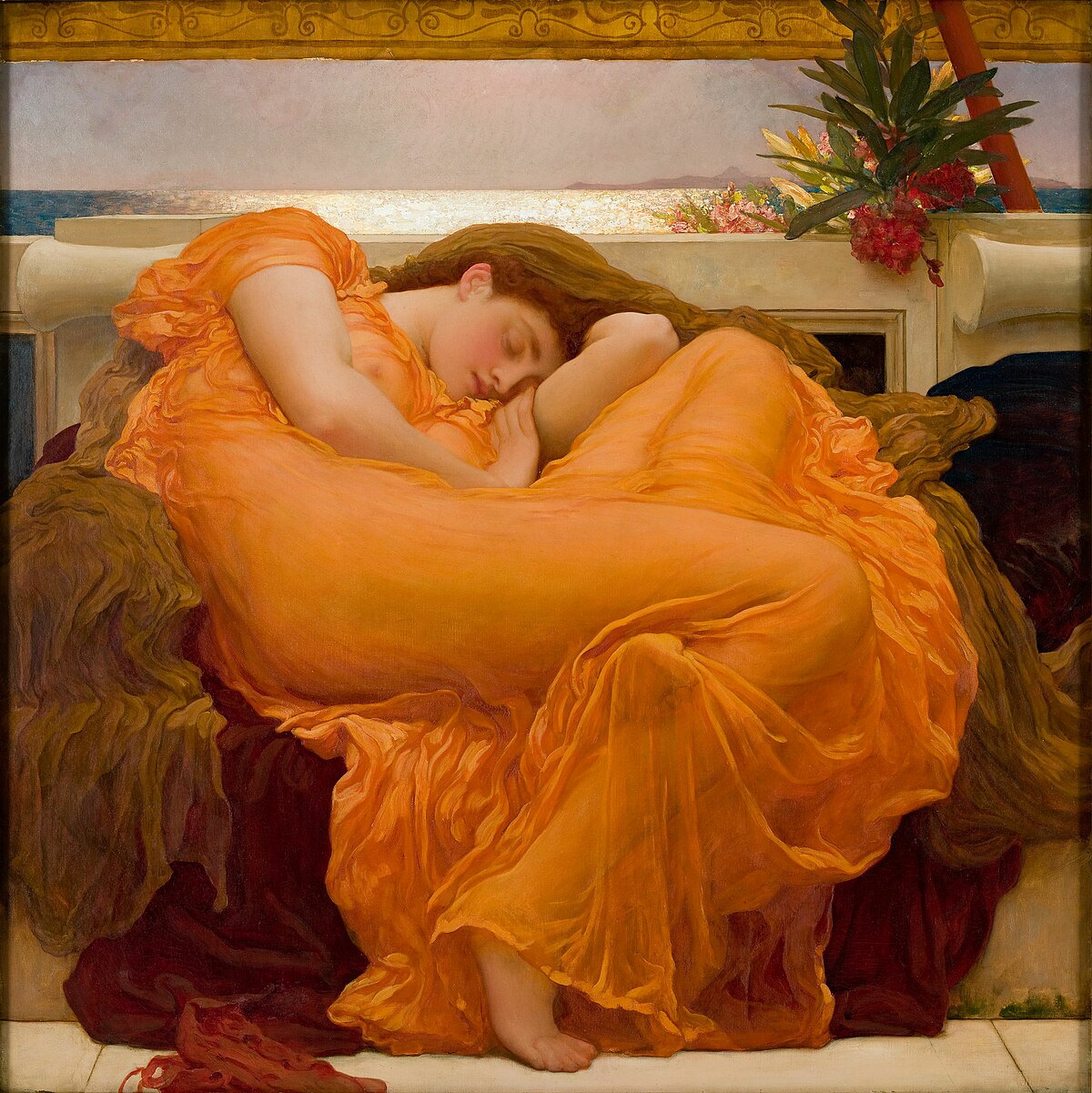
Flaming June: The Making of a Masterpiece (Leighton House, 4 November 2016-2 April 2017)

Limping through the undertubes a couple of months back, I was struck by a poster of a painting of what I took at first to be a marigold, but turned out to be a young woman in a dress. FINAL WEEKS it proclaimed, but I’m not convinced that it gave a closing date. I think I’d gathered it was at Leighton House, a venue in Kensington that was on my radar to visit.

And then I forgot.

A friend went to see it, it was his favourite painting. I paid attention. I plotted. I planned to visit it on a Tuesday, my research day.

Leighton House. Closed Tuesdays.

Good job I checked.

So I postponed an idea of Eastbourne, and decided to combine this with a trip to the RAA and Russian and American art, and navigated via a Caffe Nerd and attempting to remember what the Design Museum on High Street Ken looked like when it was the Commonwealth Institute. It wasn’t yet June, but was about the first sunny day in a while even if I sat outside in the shadows at Nerd. And eventually getting there, and one of those slightly weird negotiations of what are the rules for this exhibition?

In my limited mental picture, he was part of the Pre-Raphs, of which I’m not exactly a fan despite their supposed radicalism (which now looks like a box of fudge waiting to happen). I vaguely remember his paintings coming back to the Tate after an absence (to where?), but I couldn’t picture any. No good, eh? He clearly got lorded, and I vaguely assumed he was an ascendant of someone who taught me.

Anyway, the woman in orange, although popular fiction would call her The Girl in the Flaming Dress, one of five paintings Leighton prepared for the Royal Academy summer exhibition, as he was in the final months of his life. I think one of them has gone missing, as has the one he substituted for one he didn’t like at the last minute.

And apparently it was amazing we have this.

It didn’t sell at the show and was bought by The Graphic to be turned into a print to give away in Christmas 1895. After being shown in their office window, it was loaned to the Ashmolean and dropped out of sight — I’m not the only one to be unimpressed by Victorian confectionary. It turned up in Battersea, boxed in over a chimney, and was nearly bought by a young Andrew Lloyd Webber (make your own snide comments). A Puerto Rican industrialist, Luis A. Ferré, partly in town to buy art for his gallery, saw it in The Maas Gallery, London in 1963 and paid £2,000 for it. Since then, it has been at the Museo de Arte de Ponce, aside from rare loans to other galleries

So we have a woman in an orange dress, curled up almost in a circle, an oleander plant to her top right, a shining sea behind her, and draping cloth around her. It is undeniably attractive, with a striking horizontal line of her leg parallel to the golden frame, the ledge and sea, with a zig zag of her lower legs and arms, an almost circular composition. If you look carefully — and of course you do, since you’ll most likely not be heading off to Puerto Rico in the foreseeable future — there is a hint of nipple, of the skin tone under the diaphanous orange draperies.

Is that a word?

Of course, my gaydar had been triggered earlier by a small male nude on the staircase and a frankly camp Arab Hall of dark green tiles brought in from some grand tour or other. He never married, but there are rumours of affairs with a female model and a close relationship with a male friend. We just don’t know, it seems. Anything else is gossip.

Shrugs.

Next to it is a much smaller painting, a practice perhaps for Flaming, with tiny island in the sea, lost from the final version, and a slightly different top to the picture.

To its left, are the remaining paintings from 1895. ‘Twixt Hope and Fear is an elegantly dressed woman, sat on a chair so she looks over her shoulder at us. The vertical to diagonal arm dominates the composition — as does the double take I had about whether there was an iPhone in her right hand and she was taking a selfie.

Methinks not.

The Maid with the Golden Hair — see, that’s a proper title, but girl would be moderner — has a young girl reading a book, caught in a private moment. They reckon it’s Lena Dene, younger sister of his main model, Dorothy (he’s a friend of… nevermind), but I’d rather know what she is reading.

Verticals are accented in Lachrymae — a woman stood, supporting her head and arm on a fluted pillar bearing an urn, presumably a funerarararary one. The sun glints through the cypress tree behind her — a tree which is a symbol of (guess what?) mourning. At her foot is a wreath.

The final picture is Candida, a head and shoulders portrait, replaced by a (lost) painting Listener (although there’s a colour reproduction of it). So, five (or six) lone women, three of them possibly the same model and a Miss Lloyd.

Then you realise you’ve done this in the wrong order.

Hidden in his bedroom, with a spartan-looking single bed and letters that tempting to touch, and a fur rug that isn’t, is the print from The Graphic, a little worse for wear.

Back in the Silk Room are various preparatory drawings — black and white chalk on paper as he attempted to get the posture of the woman right and, Lo and behold!, a photogavure of his Summer Moon (c. 1872), two women asleep, one of them not unpostured like Flaming Nora, their arms curved in parallel, a circular opening behind them. Another photogravure, The Garden of the Hesperides (1893?), three women asleep under a tree (and now in the Lever collection, so I guess I’ve seen it in Port Sunlight. And then there’s Summer Slumber (1894), also seen in photogravure and notable for the flaming June relief in the wall this slumberer is slumbering on. This strikes me that Flaming June must be a little earlier than suggested. I’m not clear where the actual painting is.

And there are also preparatory pictures for some of the other paintings; in the studio are other paintings of oleanders and a photo of some carvings, although it requires a bit of detective work to work out what you should be looking at. It also took me a while to realise I need to go anti clockwise round the Silk Room and how the painting of an Algiers Courtyard fitted in.

But then I was back to Flaming, to soak her in again.

I can’t say I am converted to Leighton, and I suspect the works normally here are not his best, but it was intriguing to see this rarity.